Topics for discussion in english
Topics for discussion in english
English Speech Topics for Students

Writing a exciting and thoughtful speech requires one to select a good topic, research it thoroughly and formation of individual opinions to express on the same. School students are usually asked to speak on a contemporary topic in order to help them become good public speakers as well as learn the art of expressing oneself in front of an audience. While many speech competitions often allot topics beforehand, you might also have heard of extempore where topics are given on the spot for speech. This blog brings you a list of common English speech topics as well as some helpful tips and tricks that can assist you in expressing your thoughts and opinions in an effective manner in front of an audience.


This Blog Includes:
List of Best English Speech Topics
Speeches are all about one’s own thoughts. It should not be copied from somewhere. It is all about what the speaker thinks of any given topic. Take a look at the following list of English Speech Topics on different contemporary issues as well as concepts.
1-minute Speech Topics
2-Minute Speech Topics
Easy Speech Topics in English
Exploring English Speech Topics? You must also take a look at Extempore Topics!
English Speech Topics on Environment
English Speech Topics on Social Issues
English Speech Topics on Important Days & Events
English Speech Topics on Greatest Leaders in India & Around the World
To know what to mention in such speech topics, explore the Great Personalities in the World !
English Speech Topics on Proverbs
Explore these proverbs & their meanings through this blog on Difficult Phrases !
English Speech Topics on Education
Check Out: Synonyms List
Miscellaneous Speech Topics
Types of Speech Topics
While exploring persuasive English speech topics, you must make sure that they are stimulating, engaging, concise and clear. There are three main types of Persuasive Speech topics which are:
1. Factual Persuasive Speech: These topics include facts, figures and statistics to thoroughly analyse the given topic and assess whether it’s true or false.
2. Policy Persuasive Speech: Discussing policies, laws and reforms, these speech topics critically examine the advantages and disadvantages of the given policy or law and suggest the improvements that can be made.
3. Value Persuasive Speech: Mainly focusing on social or political issues, these speech topics present the critique and argument of whether certain actions are morally right or not.
Useful Tips for Delivering a Great Speech
While speaking on a particular topic, there are certain things which you must keep in mind to make your speech expressive and effective. Before providing you with a comprehensive list of English speech topics, let’s take a look at the some useful topics that help you in acing any topic you are speaking on.


While preparing for English Speech topics, you must also check out IELTS Speaking Topics!
Thus, we hope that this list helps you in preparing for different English speech topics. Gearing up for IELTS? Sign up for an online demo session with our experts at Leverage Edu and we will assist you in preparing for its different sections as well as improving your reading, listening, speaking and writing skills to ensure that you ace the exam with flying colours!
15 Different English Speaking Topics For Intermediate Students (+Free PDF)
Justlearn
For every ESL student, speaking with native English speakers is like a dream come true. To get to a decent conversational level to be able to talk to native speakers, you have many things to learn and many words and phrases to remember.
And while we are talking about words and phrases, have you been thinking about some English-speaking topics?
There are plenty of entertaining topics you can chit-chat about. The following topics are suitable for intermediate students, so keep reading and see which ones you find most entertaining or which ones are your favorites.
15 Different English Speaking Topics For ESL Intermediate Students
You don’t know what to talk about with native English speakers?
Don’t worry because, in the following lines, you can find 15 different discussion topics ideal for English intermediate students.
Travel
Everyone likes to travel. Visiting other places, learning about other cultures, and meeting new people is always fun. Besides, it is one more experience and opportunity to practice the language.
What country would you like to visit?
Which country you would never visit again?
Which country did you visit more than once?
What do you like to visit in a foreign country?
Do you like traveling in summer or winter?
Food And Cooking
Food is also one of the favorites topics because everyone likes talking about food and delicious dishes.
It is mainly one of the topics suitable for beginners because of the related vocabulary, but you can expand and ask for more details for a more advanced level.
What is your favorite food? And why?
Which country, according to your opinion, has the best dishes?
What is the worst thing you’ve ever tasted?
Do you like to cook?
What do you like to cook?
How often do you cook?
What are the advantages or disadvantages of cooking?
Where do you get ingredients for cooking?
What do you think about organic food?
Do you eat only organic food?
Hobbies
Hobbies are something we enjoy doing in our spare time, so, naturally, everyone loves talking about their hobbies.
Do you have any hobbies?
How often do you do your hobbies?
How did you start these hobbies?
What do you think about (not) having hobbies?
What hobbies did you used to have and which ones you would like to do?
Work is a very important part of our lives. Most of us have jobs and work, so we always have to say something about that. Talking about work is one of the topics that can get people together.
Here are some suggestions when talking about work.
What work do you do?
Do you like your job?
Is your job demanding?
What is your opinion about work in general?
What is your dream job and why?
Environment
Topics about the environment are always inspiring and can lead to many other, even different, topics.
So, it is good to talk about the environment, as long as the conversation remains polite and without arguing.
What are serious environmental problems?
How can people help the environment?
What is your opinion about climate change?
What do you think about pollution?
What should the government do to help the environment?
Television And Social Networks
Talking about television and social networks is entertaining and it gathers people together.
There are plenty of things you can chit-chat about television and media and here are some of them.
What is your opinion about television?
Do you watch television?
How often do you watch television?
Which tv programs do you watch?
Is watching television good for kids and if not, why?
Why are social networks so popular?
What do you think about social networks?
Do you use social networks?
Do people use social networks for bad purposes?
Which social networks do you use?
Sports
Don’t think that only men like talking about sports. You would be surprised to hear that many women actually like talking about this topic. Therefore, don’t divide people by gender. If you like talking about sports, ask your speaker about the opinion, no matter if it is a woman.
Do you like sports?
What is your favorite sport?
Do you watch sports?
Did you play any sport while you were in school?
Do you play sports now?
How often do you play sports?
Animals And Pets
These living beings that are part of our lives and our best friends are the topic everyone would gladly talk about. That’s why in the following lines, you can find some questions about animals and pets.
Do you like animals?
Do you have any pets?
Which is better to have as a pet, a dog or a cat?
What is your favorite animal?
What do you think about using animals for various types of testing?


What do you think about killing animals for food?
Are people responsible for the extinction of some of the animals?
Do you help animal shelters in your town?
What is your opinion about the zoos and animals there?
Do animals suffer in zoos?
Making Plans And Goals
Making plans and goals has always been one of the favorite topics people like to discuss. Why then it wouldn’t be one of the English-speaking topics you can talk about with native English speakers?
What are your plans for…?
What are your plans for learning English?
What are your goals in life in general?
How do you plan to reach your goals?
How do you feel when you reach your goals?
Dream a Little Dream
Dreaming and dreams have been fascinating topics both for scientists and psychologists and ordinary people.
Dreams can inspire you and help you with your consciousness.
Some of the fun questions about dreams can include the following questions.
Do you dream often?
What kind of dreams do you usually dream?
Which dreams do you still remember?
Do you think about dreams a lot the following day?
What do you think dreams and dreaming mean?
For Shopaholics
Some people love shopping so much that they can’t live either one day they don’t buy something. Others, on the other side, don’t like shopping and when they have to go buying things it’s like a punishment.
All in all, this topic is always interesting to discuss, so here are some questions that might help you start the conversation.
Do you like shopping? If don’t, why?
What do you mainly shop for?
What is your favorite shopping store?
How often do you go shopping?
Do you like going shopping alone or with friends?
Do you do online shopping?
What do you think about online shopping?
What are (dis)advantages of online shopping?
What do you think people will do the shopping for in the future?
Life Experiences
Age doesn’t guarantee you the knowledge, but it may guarantee you experience. Besides, it is always entertaining to talk about your life experiences and hear the experiences of others.
What is the greatest experience you’ve had?
What is the worst experience you’ve ever had?
What is the best idea you’ve ever had?
Do you learn from your own experiences?
On what achievement you are the proudest of?
Life in General
Talking about life, in general, is a great way to practice words and phrases you don’t use every day.
Since everyone has different views on life, here are some questions you may use while talking about life.
What is the meaning of our lives?
Do you think that there is an afterlife?
What do you think about your life?
What are you grateful for?
Is there some secret to a happy life?
Money, Money, Money
Money is essential in today’s world. Without it, we simply can’t live; we can’t buy food, pay the rent and have the food over our heads. As much as it may seem difficult to sometimes talk about money, besides being one more thing you can talk about, talking about money helps you expand your vocabulary and learn money-related terms.
What do you think is money the most important thing in our lives?
Do you manage to save some money?
How do you organize your money?
If you win a lot of money in the lottery, what would you do with it?
Are there some tips and tricks to save money and spend less?
Books And Reading
With so many amazing books, this topic is always the right one to discuss with others.
This is an especially favorite topic about book lovers. They could talk about books for days.
Here are some of the questions about reading and books in general.
Do you like reading? If not, why?
What type of books do you usually read?
Do you have a favorite book?
Do you have a favorite writer?
Have you read something currently?
What was the last book you’ve read?
What do you think of e-books?
Do you read books online?
What are (dis)advantages of reading books online?
Do you usually buy or borrow books?
Final Thoughts
These are some of the topics you can discuss with native speakers. In case you don’t know any native English speakers, English tutors can help you. Besides being professional tutors, these people are native speakers, which is right for what you need.
Moreover, if you want to have these topics in one place, we have for you a PDF file you can download completely for free and use as a reminder when you start a conversation.
These topics can also inspire you to continue talking about other things or expand the existing topics.
After all, talking about entertaining and pleasant things is what matters. As long as you enjoy the conversation as well as your speaker, and practice the language, the topic is ideal.
Let’s Talk Shop! 28 Business English Topics to Ignite Conversation
Teaching business English is more or less the same as teaching standard English—with a few twists and tweaks.
Usually you’ll start with students who speak at a pretty advanced level and tend to want to gear their English towards business themes rather than general topics like planning their vacation, asking for directions or shopping for shoes.
These students also tend to need English specifically for work-related purposes so they’d like to get their speaking skills refined, especially with regard to talking business.
But what to talk about? The business section of the newspaper? Their company’s financial state? The economy?
Well, sure, but that’s so broad, and where do you even start? This is where I come in to help you with my magical list of 28 business English conversation topics to start off the class with a bang.
As the teaching training you’ve had has taught you, it’s best to start the class with a warm-up, or something that can get some speaking started, and these topics will do just that. They’re also great for sparking more in-depth conversations and debates.
Along with the topics, I’ve included some example questions you could ask relating to each subject. The topics are quite broad, so feel free to adjust according to your class’s skill, rhythm and pace.
After the discussion, you could seamlessly jump into textbook material, creating a harmonious rhythm in your business English class!
Download: This blog post is available as a convenient and portable PDF that you can take anywhere. Click here to get a copy. (Download)
28 Conversation Topics for Business English Students
1. Businesses
Talking about other businesses is, essentially, talking business. Other businesses could be friends, foes, inspirations or anything else. A simple topic, yet such a deep one. Some questions you could ask are:
2. Negotiations
No verb goes with the word “business” better than “negotiation.” Some could say negotiations are business. It’s a good topic that has students speaking about any and all kinds of negotiations. You could ask questions such as:
3. Job Interviews
Unless your students got a job hookup from a friend or a family member, chances are they have something to say about job interviews. They are the “first dates” of the business world and this topic gets some good chatter going. A few great questions are:
It can be very helpful to show your students actual videos of interviews to give them a better idea of what to expect. For example, you can use FluentU to show them the job interview scene from “The Pursuit of Happyness,” starring Will Smith, and help them pick out some key interview vocabulary:
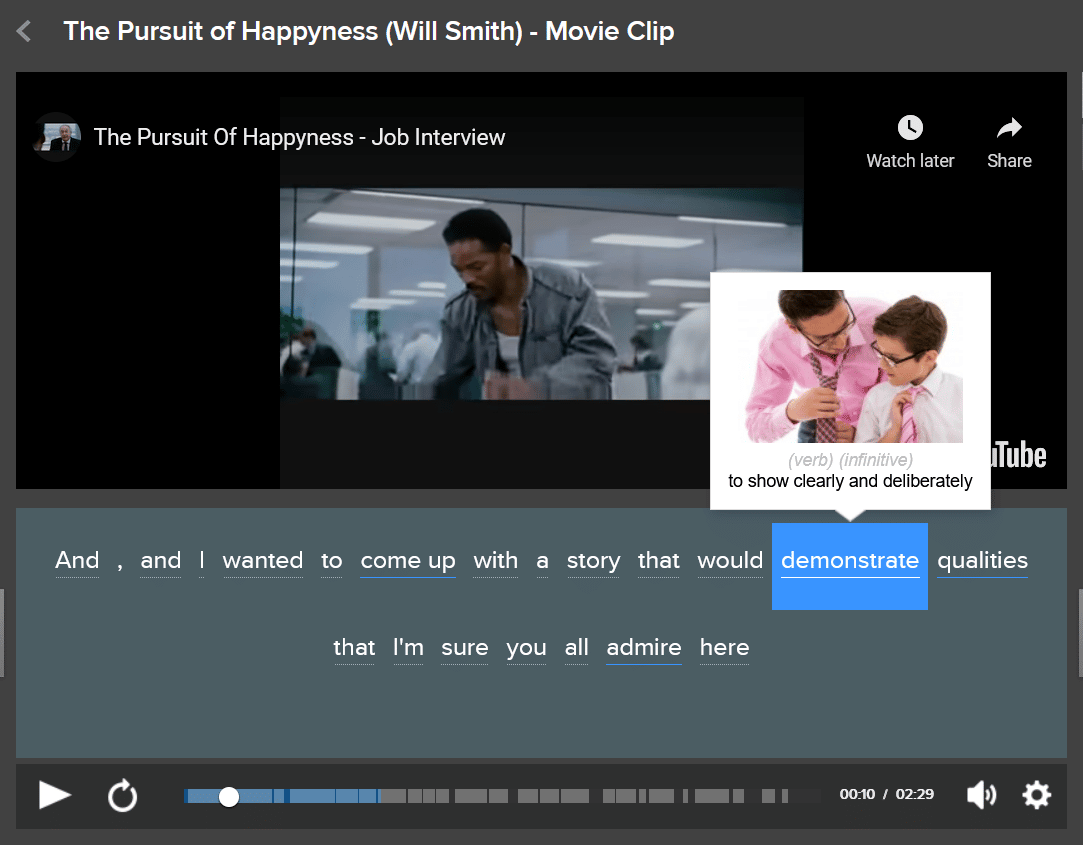
You can hover over any word to show a quick definition or click on it for a more in-depth breakdown of any word or expression in the subtitles. There are hundreds of other authentic English videos that you can harness for their contextual teaching elements, from movie clips like the one above to news segments, commercials and inspirational talks.
4. Working Abroad
Some students, especially if they need English for work, may have had some experience working in another country or even have some colleagues who are working abroad. This topic is good since working abroad becomes more and more relevant in this day and age. A few good questions include:
5. Crisis
An inevitable topic in the world of business, students do enjoy sharing views on crises. They can share their thoughts, questions and opinions about responding to all kinds of crises. Unless a particular crisis is hitting their country terribly hard, where some may feel sensitive about the topic, it’s an excellent topic to speak about. You could bring up questions like:
6. Leaders
Leaders are the coaches of business. They provide guidance and wisdom to many. Your students may feel inspired by some notable leaders, or they may look up to leaders in their respective countries, companies or industries. They may even dream of becoming leaders themselves. Get students talking about what kinds of people are best equipped to lead businesses. Some questions to ask are:
7. Business Presentations
In this day and age, presentations are everywhere thanks to modern technology. There’s a good chance that not only do your students have something to say about them, but they may have to give some at their job. Questions you could give them are:
8. Meetings
Unless your students work an hourly position, they more than likely have meetings and talking about meetings is a nice topic since it’s so relatable. Great questions include:
9. Termination
This is the “getting dumped” experience of the workforce, but it’s something that’s a part of business. If students want to speak better business English, navigate tough interview questions and plan their careers, then it would behoove them to practice talking about getting terminated. A few good questions could be:
10. Managers
Slightly different (or vastly, depending on your work) than leaders, managers are something that everybody has something to say about. Love them or hate them, they’re an essential subject to discuss in business. Perhaps some of your students are managers themselves. You could ask:
11. Small Business
Small businesses are the cornerstone of growing enterprises and thanks to e-commerce they are on the rise. A few questions to ask the class could be:
12. Work Appraisals
Any decent company gives their employees a sort of appraisal every so often, so it’s a good topic to discuss since appraisals are made to improve the quality of the employee’s work. You could ask things like:
13. Retirement
Even though retirement is the end of the road for business and a long way down the road for some students, it’s a good topic to discuss since it affects everybody eventually. Great questions could be:
14. Work Experience
Everybody talks about his or her work experience and it helps them with who they are in their career today. Some great questions are:
15. Overtime
Overtime is as enjoyable as it is avoidable. Unfortunately, it’s inevitable but most students will have a thing or two to chime in with about overtime. Good questions could be:
16. Business Trips
Business trips, whether they be domestic or international, are more and more common these days and are a good topic to discuss. After all, most likely your students that go on business trips need to speak English! You could ask:
17. Competition
If your students want to speak business English well, then they’ll need to talk about competition. The competition is everywhere and is a great topic to really scope out how your students feel about business in general. Great questions could be:
18. Risk Management
Most students should be familiar with risk and hopefully more familiar with how to manage it so it’s a fine topic to incite some quality discussion. Great questions are:
19. Investing
Investing is an important topic that many business English students know a fair deal about, depending on their business. It’s a relatable topic that could be of special interest to some students. You could ask questions like:
20. Colleagues
Everybody has something to say about colleagues and talking about them can help get students talking about more personal things, which can really help them exit their comfort zones. A few good questions could be:
21. Hard Times
Unfortunately, hard times are quite prevalent these days. But talking about them is good for business since it could expand your students’ knowledge of current events. You could ask questions like:
22. Raises
Everybody loves raises, but talking about them (especially with a superior) is a different story. Amongst classmates though, talking about raises can bring up some interesting chatter. Questions like these are good:
23. Sales
Some may say that business is sales and they just might be right. Sales are to business as education is to knowledge. Talking about sales is an important skill in business English, especially if some students need to sell in English. A few great discussion questions are:
24. Customers
But alas, there can’t be sales—or business for that matter!—without customers. Since everyone has been a customer on more than a few occasions in their lives, it’s a great topic for students! Questions like these work well:
25. Customer Service
Customer service is also another aspect of business that both salespeople and customers know a thing or two about. It’s a fantastic topic that can bring some enlightening discussion. You can ask questions like:
26. Marketing
Marketing is an essential field in the world of business and many students enjoy talking about the diverse subject. You could ask questions such as:
27. Consulting
Many companies, big and small, have experience with consultants and it’s an important topic in the world of business improvement. Some great questions could be:
28. Rules & Regulations
Rules and regulations are literally everywhere in the business world and they could present some useful and interesting information. You could give the students questions like:
So there you have it, a vast list of various topics that are great for business English students.
Although it’s preferable (and likely) that your students already have jobs to answer these questions but since these topics are so relatable and general, it shouldn’t be a problem to start off the classes with some simple questions on such topics.
You could even choose the topics in accordance to the current business news and mix the questions up a bit. The best piece of advice is to make it relatable, relevant and remarkable this way the students have something to say and never lose interest.
So, let’s talk business!
Download: This blog post is available as a convenient and portable PDF that you can take anywhere. Click here to get a copy. (Download)
Controversial Topics for Speeches and Debates
Updated 21 Apr 2022
Writing argumentative research papers, participating in class discussions, taking part in college debates – all these seemingly different activities have one common thing: students should choose controversial topics for each of them. The ability to protect one’s point of view, as well as evaluate the pro and against arguments in a controversial situation, is a viable asset every student should gain while studying.
What is Controversy?
A simple explanation would sum things up by bringing up an issue or a theory that would lead to public disagreement. A good example would relate to religious wars, ethical conflicts, politics, or certain preferences where a person would have a different opinion. As a rule, dealing with the most controversial topics, you have to be careful as these will touch upon sensitive issues. While you may talk about religion or past conflicts that have taken place, always show due respect and make sure that you provide some evidence issued by both sides.
The most important is to choose your controversial topics carefully by focusing on something that you know well. Ask yourself controversial questions and see how these can be approached by starting a debate. Start by telling about what you think about an issue, quote other people, talk about the dangers or those ethical (moral) aspects that make you choose X over Y. You should explain why you are researching some controversial issue by focusing on both sides. For example, when you study politics, make sure to provide some background information about personalities that you analyse.
When you are dealing with a conflict, controversial opinions are important for finding a compromise. It should be one of your purposes as you write a controversial essay. As always, it’s essential to choose your topic correctly by narrowing things down as much as you can. For example, when you are dealing with gun control issues or medical marijuana, you should think about the field of your studies by approaching things professionally. If you have a personal point in what you explore, it’s better to avoid the topic as you may feel unbiased as you enter the discussion. Choose something that you can explore without a personal relationship and things will become easier.
Therefore, we’ve prepared a long topics list for you to train your skills while participating in interesting and entertaining activities.
Choosing Best Topics
There are several important aspects students should consider while choosing their controversial topics for discussion. Here are several questions we suggest you answer before deciding on your topic:
What is your purpose? – Your topic choice may differ depending on the particular purpose. For instance, if you plan to participate in a tournament in your high school or college debate club, it may be more sound to choose topics that are controversial, relevant, even funny. Participants, as well as the audience, would appreciate such choices, as they suggest interesting, entertaining pastimes. In argumentative paper writing though, students might choose really complex topics that require considerable research, especially if they have much time for pre-writing research.
Who is your audience? – Another aspect that requires clarification and consideration is an audience. Topics for high school students will definitely differ from topics for the advanced academic community. Similarly, the audience may influence particular motions. For instance, college students will discuss vaccination topic in a significantly different manner than university students studying medicine. Depending on your audience, you may choose to research different aspects of your chosen controversial topics.
Are you personally interested in this topic? – Avoid picking topics that don’t appeal to you. It is always better to participate in discussions and write papers that entertain you or provide insights you consider valuable. Under such circumstances, you are more likely to hold and share your own thoughts along with beliefs.
Can you find credible sources? – Either participating in a discussion or writing an argumentative research paper, students should look for strong evidence. Discussions based solely on personal opinions are often either tenuous or too narrow in scope. Source credibility matters a lot as credible sources present information based on research and empirical studies. By citing credible sources, students demonstrate their preparedness along with awareness about various aspects their chosen topic has.
There is a great variety of topics one may choose from. Therefore, students should narrow the scope of possible discussions by clarifying their purpose, audience, personal interests, and credible sources. By doing so, they will ensure the relevance of discussed information, turning discussions into entertaining activities that are interesting for participants along with the audience.
Need more writing assistance?
Order you first paper and join EduBirdie club to receive discounts and updates.
Controversial Discussion Topics And How To Teach Them


How to Teach Controversial Topics
Introducing the Topic
Before giving students any materials supporting one side or the other about a controversial topic, it’s important to set some ground rules. Debates on controversial topics can get quite heated so students need to be reminded that in order for a discussion to run smoothly, there should be no name-calling or insults directed at each other, students need to respect the other person’s point of view even if they don’t agree with it, and they need to allow people to express their points of view without interruption.
The next step is to introduce the topic and ask your class what they already know about it. This is only the first of many opportunities for discussion in your class. If you are teaching adults, you may be surprised at the experience your students may already have with a given issue. Also, letting students volunteer information may give you a heads up that they could have deep personal connections to the topic or it might be out of their frame of reference.
Present Both Sides of the Issue
Facilitate Discussion
After presenting both sides of the issue and making sure students understand the controversy, give small groups of students an opportunity to discuss the arguments each side presents. To add an extra level of learning and practice, students can fill in a debate planner like this one to help them organize their thoughts, key vocabulary, and stances.
They will be sure to offer their own opinions, perhaps vehemently, and you should not pressure them with discussion as an entire class. As students talk about the issue, they will be able to help each other further understand the arguments posed by each side. Just be sure that all groups are allowing free expression from everyone. You may have to step in if one or two students are being bullied by opposing opinions. You want all your students to feel free to speak and express themselves even if their opinion is the minority. Remember, you are the facilitator.

Express Your Own Opinion
After introducing both sides of the issue and allowing students to discuss their opinions, now is your opportunity to express your own opinion on the subject. Waiting until this point to uncover your own viewpoint gives your students the freedom to express themselves honestly without fear of repercussion. Students can be intimidated to support a point of view in conflict with their teacher’s. If you wait until students have already had the opportunity to discuss their opinions, you remove the intimidation that comes with disagreeing with the teacher.
Present a Case Study
It’s one thing to have a theoretical discussion about a controversial topic, but when you add in the element of real-life through a case study, it adds a whole new dimension to the discussion experience. In your lesson planning, try to find a case study that will help foster discussion. A good case study will not have a clear-cut or straightforward course to a conclusion and reinforce that life is not black and white.
Not only will struggling with the situation encourage discussion, it will provide a more lifelike and realistic use for language. Life itself is not cut and dry, and if your students will be using language in real-world situations, they will have to express themselves in difficult circumstances. Encourage your students to take risks and express their opinions.
Facilitate (More) Discussion
Now that students have heard both sides of the issue, discussed the topic with their peers, learned where you stand on the issue and looked at a real-life case study, it is time to discuss the issue again. Go back to the discussion questions you provided at the beginning of the unit and allow students to express any changes in their opinions or share things that they have learned. The goal in teaching a controversial subject is not to sway students to one opinion or the other, but they may change the way they feel after further discussion. They may also strengthen the beliefs they had at the beginning of the unit, but hopefully, they can express themselves more clearly and give strong support for their beliefs.
When handled correctly, controversial topics can be a gold mine of conversation in the ESL classroom.
Though it is sometimes necessary to create discussion with supplied curriculum topics, using controversial issues in the classroom allows a natural and emotional pathway to conversation. If you are sensitive to your students’ opinions and aware of their feelings, tough-to-tackle-topics just might provide the best lessons all year.
Example controversial topics:
Have you ever taught any controversial topics? What topic was it and how did it go? We’d love to hear your thoughts in the comments below!
100 ESL Debate Topics That Will Get Your Students Fired Up
A vault of modern-day topics guaranteed to spice up your lesson

Are you looking for ways to liven up the discussion in your ESL classroom without having to resort to old-fashioned debate topics?
If so, you’re in luck!
In this post, I’ve curated 100 controversial ESL debates that are guaranteed to get your students going.
How to use these ESL Debate topics
In order to get the best out of these topics, there are a few things you should consider before presenting them to your class.
English level
If you think debating in your native language is tough, try doing it in a foreign language. These debates have been specifically chosen for English language learners who are at least intermediate level to advanced. If you’re looking for something to challenge your lower intermediate students, and want to give this a go, try coming up with a vocabulary list of words that would be helpful for your students to know in order to participate in the debate. Lacking vocabulary is the biggest sticking point when it comes to participation, or lack thereof, in ESL debates.
Subject
While making this list, I tried to think about topics that most students around the world have heard about and can offer his or her opinion on. However, this will not be the case for every topic. For your convenience, I have linked out to articles that discuss the issue, should you wish to introduce it to your students before they debate.
Structure
I have structured each of these questions to yield a yes/no answer. However, to make your debates more engaging, I’d suggest coming up with more detailed sides of the debate. Doing this will also help your students come up with more elaborate answers.
For example, if you have the question “Should terminally ill patients have a right to end their life?” you might want to pose two sides of the argument to your class. So one argument would be “Doctors should have the right to assist terminally ill patients in their death.” The other side of the argument would be “People should die naturally, without interference or help.”
Top Group Discussion Topics with answers for all Streams
Group Discussion Topics for Various Streams
Group Discussion is actually the debate on opinions and exchange of ideas. This process is conducted to select candidates for admission in management colleges, especially for MBA. Normally, group discussions involve a small group of applicants. Each group has a different topic to discuss. Before we share GD topics for various disciplines, let’s check out some of the group discussion tips to avoid major hurdles in selection process of any business school.

Group Discussion Tips

Be sure to take stand during the discussion. You don’t have to conclude with a negative or positive outcome. Instead you have to summarize the discussion. You have to be neutral to get an edge over the others. Candidates have time limit to discuss the topic. Each participant needs to give their personal views about the topic. The discussion will be judged by the panel. Once the time is up, the judges will select the best candidate from the group. The same process will be followed in other groups.
Group Discussion Topics for Freshers
These days, companies usually conduct group discussions in order to filter candidates according to their interpersonal and communication skills. Here are the latest group discussion topics for freshers.
Practical Education vs. Theoretical Education – Which One is Better?
There are different ways to acquire knowledge about certain things. On one side, there is theoretical knowledge, on the other side is implementing the theory in practical. Both theoretical and practical educations are important as both of these make you excellent on anything you do.
Theoretical Knowledge teaches you the why behind something. You can understand why a specific technique works when other fails. It builds the context, gives a wider insight and helps you make strategy. Theory helps you set a plan for your future. It teaches you with the experience of others. It leads to in-depth insight of a concept by understanding the why.
On the other side, practical education helps you learn certain techniques to create the tools of your business. It is much closer to your daily activities. There are certain things in life you can learn only through experience. Practical knowledge is gained through real life situations. It leads to deeper knowledge of concept with the personal experience.
Both practical and theoretical educations are important and you cannot survive in your career unless you show results. You need practical knowledge to do that. Learning to solve a particular problem just teaches solving the same problem in real life. But practice makes you perfect and takes you so far.
Which type of Family System is better – Joint Family or Nuclear Family?
Family is considered to be the important part of our life. Joint family and nuclear family are two different types of family systems in India. Joint family usually consists of parents, their children, spouses of these children and their offspring. On the other side, a nuclear family has only parents and children. Both nuclear family and joint family have their pros and cons. Joint family system is prevalent in India as it is known for cultural diversity.
Due to the prevalence of urbanization, people prefer to live in nuclear family over joint ones. It is because nuclear families feel much better than joint ones. They provide calm and peaceful environment to the members. A person may get peaceful environment after coming from work.
Is women safety in India a big concern?
According to the National Crime Records Bureau, across 4037 cases were recorded of crime against women in 2000 in Chennai. In subsequent years, the city had seen some decline in crime rate, i.e. by 838 in 2013. But it’s just opposite in Delhi, the capital of India. In 2000, the crime against women was just 17.6 out of 100,000 females (i.e. only 2122 incidents). But in 2013, it was recorded 151.13 out of 100,000 females (around 11449 cases).
Group Discussion Topics for Interviews
In Group Discussions, the panel of judges will test your knowledge about a particular subject, your perspective in a logical way, and your enthusiasm in understanding others’ opinion on the same topic. It is about how you express yourself with grace in this situation. Before going any further, be sure to consider these group discussion tips for interviews –
The Topics
Topics for GD interviews are complex. So, you have to keep your eyes and ears open to know what’s going on around you. You are not supposed to be an expert in any topic. Instead, you should have at least some kind of awareness. Increase your General Knowledge by reading magazines, watching news and being updated with current affairs. Discuss these topics with family and friends. Create your own group to discuss these topics.
What If You Know Nothing about the Concerned Topic?
If you have preparations, don’t panic!
First of all, listen to everyone very carefully for the first couple of minutes. Analyze the information and form your personal opinion. It is not important your opinion should be correct every time. But it should be logical and well formulated that can show how you think to the panel. Don’t just reinforce or sum up with other’s opinion. Instead, add value to your discussion.
Group Discussion Topics
What to Know about FDI in Retail?
FDI refers to Foreign Direct Investment in which a foreign company invests in another country where it is not doing any business. Usually, FDI is done by companies to expand their profits and business. These days, FDI is booming in retail sector. A lot of companies are heading to India to open their retail chains and doing business with companies of host country.
Should Voters in India Have NOTA Choice?
So, the general elections are coming and people are willing to vote for their desired candidate. But there are some who are not willing to vote. It’s not because they are not interested in casting votes, but they cannot vote because they don’t want to vote any of the candidates on the election. This way, the government has introduced “None of the Above” or NOTA option. Every citizen has a right to express their opinion. Gone are the days when people had to vote anyone as there is no choice. With the arrival of NOTA option, people can reject candidates. It is probably the beginning of fair politics.
Now the people can show that they disagree with the person standing in the elections. Hence, the parties have to replace their representatives. It’s better not to select anyone instead of choosing the one who is less harmful to the country. It promotes transparency to the system.
Are MNC’s superior to Indian companies?
There are a lot of confusions among general public in India about whether to join Indian company or a multinational company. Indian companies are expanding their reach and global outlook by establishing their centers across the US, Japan, China, Czech Republic, Malaysia and other countries. Within few years to come, we will see MNCs of both Indian and foreign origin. In different things, MNC’s win the race against Indian companies, such as salaries, infrastructure, etc.
Group Discussion Topics For Engineers
Group Discussion is a very complex part of selection process. Engineering students and candidates have to face a lot of issues in Group Discussion process. Group discussion has been the important aspect for selection process over the years. Here are the common group discussion topics for Engineers during the selection process.
Is India A Soft Nation?
On a positive note, India is a soft and peace-loving country which is very much important to the citizens. India is a land of diversity where people of all religions live peacefully. Over the centuries, India has never attacked any country. It is not an extremist country which promotes only a single caste, religion or creed. Irrespective of caste, every person has equal rights and freedom to do their duties. Both socially and economically backward classes get subsidiaries from the government regarding medical, education, food etc.
Are Indian films corrupting the minds of Indian youth?
These days, movies leave a great impression on the minds of people. The effect of Indian cinema can easily be seen on youth. Its effect can be witnessed not only in elders of urban and rural areas, but also on children. It is wrong to say that all Indian films are disturbing and corrupting youth. Films are made in different genres like thriller, patriotism, action, robbery, comedy etc. Youth imitates everything in films and it reflects in their driving skills, the way how they talk and their dressing sense.
Benefits of Co-education
Co-education has a lot of benefits. First off, it reduces extra burden on government to provide education with more schools. Next up, it develops healthy relationship between both boys and girls with free exchange of ideas. When girls see boys in their class, they don’t do silly things as they understand that boys are not different from them. Free exchange of ideas between both sexes makes them good companions and friends. They get a chance to learn together, study together and to understand each other better.
Group Discussion Topics for MBA
Group Discussions are conducted to test specific group skills which cannot be assessed in personal interview, such as ability to lead, to reason, to inspire, listening and social skills, out-of-the-box thinking, flexibility, ability to work as team player, ability to handle situations, attitude and body language. For a successful professional, these skills are very important. Due to the significant rush for MBA admissions in top B schools, institutes conduct Group Discussion as elimination round. During the peak time, institutes have to test thousands of candidates registered for MBA program. With Group Discussions, institute can analyze around 15 candidates within 10 minutes.
Group Discussions have been the important part of selection process for admission in lots of business schools. So, it is vital to assess your strengths in all such areas and work on improving your weaknesses. To crack GD process, you have to stay up-to-date with what’s happening across the world. Be aware of current happenings and affairs that affect our lives. Your ability to play and lead is assessed in group discussions. Make reading magazines and English newspapers a habit, watch documentaries and news on TV to get wider insight on certain issues.
The topics for group discussion can be from different issues, such as business news, current events, sports, politics, social, or anything general. Here are some of the common GD topics for MBA students –
Why MBA?
MBA is actually a general management program which is not a specialization, even though you take some electives on second year. It equips you with all the basic tricks and tools of the trade to do the job well. You don’t have to understand each account handled by your marketing team. Instead, you have to assess the sales graph and find out what’s going right and what’s going wrong. You have to check sales report and find out what’s doing well and what’s not. When you get an attrition rate from HR team, you have to make sense with it and find out if it is correct or not. If not, you have to find out how to fix it.
MBA also gives you opportunity to build network and credentials. An MBA from IIM doesn’t need to prove himself as much as someone from a local college. In a country like India, where jobs are based on academic qualifications, it can open doors of opportunities to impress interviewers and get the resume shortlisted.
Is pursuing MBA a blind rat race?
Rat race is actually, self-defeating, endless and pointless approach. It’s like rats from the lab racing on the maze to fetch the piece of cheese. Now the students seem to race and get ahead financially. Parents of sound skilled students force them to take MBA courses. Especially when the student is not interested, pursuing MBA degree from a local institute doesn’t make sense.
People spend years to attempt and prepare for CAT exams. Even worse, most of them don’t have eligibility to enroll at their desired institute because of poor academic background. MBA colleges are mushrooming these days and the value of degree is dropping. So, the rate race of MBA is not more than a few youngsters competing with each other to pursue the course in institutes they actually don’t need at first place.
Is MBA Important to be a Successful Businessman?
Sometimes, there is no connection between success and education. But great ideas lead to success as they can help you stand out of the crowd. Management education is the discipline which teaches students to become great managers and business leaders. Is it important to have MBA background to be a successful businessman? Pursuing MBA is not a person’s choice always. It is always wise to have an additional qualification. MBA degree can be proved useful in your career at some time. It carries lots of significance and value. A lot of aspiring businessmen pursue MBA as a strong option to set career.
Group Discussion Topics for Navy
During the Service Selection Board (SSB) Interview process which runs for 5 days, 9 GTO tests are conduct to assess the performance of candidates as a team player and as an individual. Group discussion is one of the important parts of these nine tasks. Unlike screening, candidates shouldn’t come out with a common conclusion. In group discussion, candidates have to take part actively and comment something related to the topic. Here are some of the common GD topics for Navy students –
How Indo-Pak Relations Can Be Improved?
Over the past 70 years, Pakistan and India have been failed to resolve their conflicts and to form a good relationship as a neighboring country. It could have benefitted both countries and people in both sides of border. Governments have started a lot of peace processes but most were either abandoned or stillborn in their youth. In order to improve relations between both countries, it is very important to address the problem of terrorism jointly.
The government should resolve the water issues with the methods by the Indus Basin Treaty. It is important to pursue confidence-building measures to alleviate the lack of trust. It is important to facilitate the trade and economic co-operation to form mutuality of interest. Both India and Pakistan should understand the legitimate interests of each other in Afghanistan and pursue without getting into conflict with one another.
What are the Causes of Unemployment in India?
Caste system is the main cause of unemployment in the country. The employment is limited for specific castes. Work is offered to reserved candidates instead of deserved ones. This factor really gives rise to unemployment. Slow economic growth of the country is another major reason. Economy of India is underdeveloped and economic growth is too slow. It fails to provide employment opportunities.
Increase in population also gives rise to unemployment in the country. A huge part of population relies on agriculture which gives seasoned occupation. It provides employment only for few months.
Why value of Indian Rupee Falling against US Dollar?
Global economic slowdown is known to be the major factor that contributes to the fall of both Indian currency and stock markets. The devaluation of China’s Yuan is also affecting the sentiments across the world. For the third time in a year, the international growth forecasts have been slashed and China has been seeing slow growth of economy. The US is also the largest importer of crude oil. The prices of crude oil fell and US has been saving more money to buy crude oil. Hence, the value of US dollar is improved and it led to fall of Indian rupee and various other currencies.
How to Prepare for Group Discussion for Navy Interviews?
Group Discussion Topics for Adults
A sensible discussion is intended to come out at a solution which signifies balance. You have to define your understanding of issue from several perspectives. At the end, the conclusion should describe the filtration of recommendations and relevant issues for changes/policies which can be created in the existing system.
1. Should we allow incurably diseased persons to live or not?
Life has been gifted by god to us. Only he has right to take it. We don’t have right to interfere in his things. Everyone has a right to live on this world as long as he doesn’t want us to die. Just because someone is suffering from a disease which cannot be cured, he must not be put to death.
On the other side, an incurable disease causes constant stress to the family. The needs of diseased person are endless irrespective of having best possible care, attention and treatment for him. He always remains disgruntled and dissatisfied. It affects the comfort and peace of mind of family.
Any kind of legislation cannot define the gray areas. It is important to ensure that people deciding to end the life is in the best interest of society and patient.
2. Which is best – Love Marriage or Arranged Marriage?
Since two people fall in love at first sight, not because of due deliberation, it is believed that love marriage is not that simple and they usually result in divorce or quarrels with elders and hard time in relationships. On the other side, arranged marriages rely on strong foundations. The partner is decided by more experienced people. Our parents are more mature, experienced and rational and they know how to deal with these matters. They can always choose the best life partner for you. Young people don’t give a second thought to the compatibility and suitability of their love. They are controlled by passion and they lack proper judgment.
All in all, whether it is love or arranged marriage, what is important is love. No matter it develops after or before marriage.
3. Is Science a Boon or Curse?
Science has always been a boon to mankind. Since the appearance of first man on earth, he has potential to harness the power of nature to improve humans and lead a better life. Civilization and science go hand in hand. A civilized nation achieves scientific progress. Science has improved the lifespan as it has given new medicines to combat diseases and infections. ECG, radiological progress, MRI, CT Scan etc. help us diagnose and detect severe infections.
Automation and industrialization made production less strenuous and possible on a mass scale and science has been proved as a boon. However, it is true that it is also responsible for unemployment on large scale. Immigration of rural workers in industrial centers has affected joint family system in the cities. But we can still benefit from science through sustainable development.
Group Discussion Topics for College and University Students
Is China a Threat to IT industry in India?
China is undoubtedly a powerful nation that has expanded their IT powers to give competition to other nations. India is a developing nation. So, China is supposed to be the threat to India’s IT growth. China has skilled manpower and provides everything at cheaper rates. So, a lot of highly skilled software professionals prefer other countries. It is the major drawback for India. In research and development in IT industry, China government spends millions.
These days, India is developing rapidly, outperforming China in IT sector. China is behind India because of language barrier. Software across the world is accepted in English and India has larger number of English speaking professionals than that in China. So, China cannot be a threat to India’s IT industry because India is far better than China in developing software.
Is IT Industrial growth a boon or growing pressure to Indian cities?
IT has undoubtedly changed millions of lives by changing the economy of the country. Is IT really changing lives or making it worse?
These days, people are migrating to IT hubs in India like Bangalore. But technological growth has caused exhaustion of resources. IT cities cannot meet the infrastructural needs of increasing population. People migrating from rural areas to metro cities put villages and agriculture on back foot and making it worse to feed the needs of ever-growing population. Environment and transport pollution are leading problems.
On the other side IT booming has improved food production and led to substantial growth for personal fulfillment. Technology has enhanced the living status of several Indians because of large demand for IT pros. IT people has improved Indian economy to a huge extent. IT industry is increasing job opportunities for ever-growing population. In short, IT boon has both pros and cons. People are migrating to IT cities and IT boom becomes the blessing in disguise. But there is a hope for some kind of technological breakthrough to help Indians survive in hard times.
Should Live-in Relationships be encouraged?
Live-in relationship is considered to be the ideal option to know your partner when they live with one another without marriage. Partners can understand the likes and dislikes of each other by spending time without having any social obligation. Couples can easily separate without any harm or guilt if they feel that their relationship is not compatible. It can help reduce divorce rates. It develops the feeling of maturity between the partners.
On the other side, social stigma in society is the biggest drawback because this kind of relationship has not been accepted by Indian society yet. Due to lack of social responsibility, a partner can freely change his or her partners. It is not so open in India and it may lead to the feeling of discomfort to people around you. It often goes against family. Even if the family accepts live-in, couple may lose interested in one another.
It is a mutual agreement between both partners and they agree to live with one another without marriage. They live as a couple to know whether they are compatible. They separate if they find that their relationship is not compatible. Commitment is the important part of any relationship. Partners should understand one another very well. Whether marriage or live-in, it is important to ensure that it doesn’t cause any domestic violence.
Speaking Activities for Language Clubs

Apart from teaching regular classes, we also conduct language clubs from time to time in order to boost the confidence of the learners to use the target language in more real life, ad-hoc situations. Moreover, if classes target a specific group of people enrolled in the course, language clubs give us the opportunity to work with a wider and more varied audience.
Things to Consider
When getting ready for a language club, a couple of things should be taken into account.
To me, planning a language club is much harder than a regular session, as here the chances are high that you will be working with people you have not worked before. Hence, you don’t know the most effective ways of engaging with this audience.
Language Club Ideas
Some activities that I normally use during language clubs are as follows;
1. Debate and/or Discussion
People love talking about their experiences and opinions. This is a great way to get them speak using the target foreign language.
Before the class, choose the topics you want the students to debate about. Some ideas can be;
The last club I conducted was based on topic 3.
Once the students are done with the discussion, elicit some ideas open class.
Alternatively, you can split the students into 2 groups and assign roles; Group 1-agrees with the statement, Group 2 disagrees. Time the students for 2 minutes to generate ideas on the topic and choose a person who will represent it. Once the speakers from both groups are ready, ask them to face each other, time them for 3-5 minutes and let them debate on the topic. When the time is up, invite open class ideas around the statement.
2. Speed Networking
This is another fun activity that the students enjoy doing. Before the class prepare some questions. For example;
To save time and paper, you can post these questions on PPT. I normally have 5-10 slides with 2-3 questions on each depending on the number of the group.
During the session, ask half of the student to stand with their back to the board. Those who are looking at the board can see the first slide with the questions and need to interview the person standing in front of them. Encourage the students to give as many details a possible and ask follow up questions. Allocate 2-3 minutes for this.
When the time is up, ask the students to swap places and proceed with the next slide and so on.
Alternatively, to have the students work with more than one person, deliver all the questions to each student and ask them to go and stand next to the person they want to talk to first. When the pairs are formed, time them for 3 minutes and ask them to interview each other with the questions. When the time is up, ask students to find a new partner and carry on with the task.
When the students have had a chance to interview at least 3 people, stop the activity and ask for open class feedback on some findings about each other.
This activity is also a very nice ice breaker and students learn about each other quite a lot.
3. Movie Club
Everyone loves watching movies, so why not use it to boost foreign language competency as well?
Before the session, send out the trailer of the film you are going to watch. It prepares the students to the club and they are already in the mood when they arrive.
It’s better to choose not so famous movies or new releases, otherwise, the chances are most people will have seen it. However, if finding a new one is hard, you can simply choose an old favourite and highlight the language learning process more.
Merely watching the movie is not enough for a language club though. It should have an educational purpose as well. To do so, prepare some key words and phrases that might interfere with understanding and pre-teach them before starting the movie. You can either prepare a matching activity, personalized examples, realia or any other way from our previous article on Vocabulary presentation here.
Along with it, prepare some T/F or WH questions that the students will need to comment on during or after watching the movie.
It is also a good idea to ask the students to write a review of the movie in the end to summarize the session and practice some writing skills as well.
4. Book Club
This probably is an old favourite. In contrast to the previous ones, this club can be more long term.
Choose a book or a series of short stories you want the target audience to read and set deadlines to meet and discuss several chapters.
To make the audience more engaged, you can assign the students to prepare the discussion questions themselves. So, you will have a different student running each session.
This works well with teenage learners better and can be used to motivate the students to take more responsibility for their home reading tasks.
5. Texts
This is another reading activity but a short term one.
This activity is full of talking and boosts fluency and creativity very nicely.
6. Game club
A bit more fun and interactive audience? Try the game clubs!
There are some favourite games that can be played to combine joy and learning. Those are;
Mafia — here are the instructions to the game. Students enjoy this game. It is very useful if you want to cover the language of arguments, expressing opinions, etc.
Alias — a very popular one, available on Apple Store and Play Market. Can be played with B1 and higher level of learners as the words are sometimes quite challenging. This is also a very nice opportunity to learn new words and phrases.
Alibi — this one is personally my favourite.
Last night between 6pm and 9pm a bank was robbed. Nobody knows exactly when it was done but it was certainly taken between 6pm and 9pm. Two people were seen outside the shop last night and have been taken in for questioning by the police. At present, they are the prime suspects and unfortunately they are in this very room! However, only one of them is guilty.
This develops critical thinking skills and is very fun especially when conducted with teenage learners.
Tag: conversations topics for teenagers
Where do you Stand? Entertainment & Culture
This is another edition of my “Where do you Stand?” conversation series. Students debate different topics related to entertainment and culture but must rate the opinion on a scale from 1-6 before they begin the discussion.
The PowerPoint contains examples of language of opinion, agreement and disagreement designed with C1 students in mind. If you are teaching lower level students, you could just use the student handout. You can download a B2 phrase sheet here.
Here are the topics students discuss:
The book is always better than the film.
There are too many sequels and spin-off films these days. There aren’t many original stories.
The original version of a song is always the best.
Celebrities shouldn’t complain about being in the public eye. It’s part of the jobNetflix will kill the cinema.
You shouldn’t watch films on your phone. It ruins the experience.
Watching a film at the cinema is always better than at home.
Violent films and videogames should be banned.
Music, art and drama should be compulsory subjects at school.
Social media companies should be responsible for the content that users post on their platforms.
Children shouldn’t play with “violent” toys like guns and weapons.
Something is always lost when a text is translated.
Physical books will disappear one day.
Governments should be allowed to censor some elements of the media including books and films.
The benefits of social media platforms outweigh the negative aspects.
Sports involving animals (hunting, horse riding, bullfighting, etc.) are an important part of my culture and must be protected.
Watching too much television makes you stupid.
Discussion: Where do you Stand? Animal Rights
This is a discussion topic for B2+ students on the topic of animal rights. Download the student handout and PowerPoint below:
The PowerPoint contains advanced language for expressing opinion, personalising the topic, agreeing and disagreeing. It was made with C1/C2 students in mind. If you’re teaching lower levels, the student handout may be more suitable, although I recommend supplementing it with a phrase sheet, perhaps try my FCE Speaking Phrases post.
Put students into small groups (3/4) or conduct the activity as an open class discussion. Before engaging in discussion on the topics, students must decide individually to what extent they agree or disagree with the given statement by circling one of the numbers from 1-6. The idea is that students will be more likely to take a stand and defend their point of view and less able to go along with the crowd if they’ve assigned their opinion a numerical value.
You could also introduce the phrase “to play devil’s advocate” and encourage students do it during the discussion. Another idea could be to assign a specific student from each group as the devil’s advocate for each topic, thus forcing them to come up with counter arguments to what their classmates are saying.
Here are the discussion topics:
Crime and Punishment: Conversation Topic

Follow me on twitter @ RobbioDobbio
This is a conversation topic for adults and teenagers on the subject of crime and punishment. Students discuss how safe they feel in their city, discuss the attraction of crime films and decide the correct punishment for some heinous (and not so heinous) crimes. Download everything below:
Handout
Discussion
Brainstorm Crimes and punishments
https://www.englishclub.com/english-for-work/police-crime.htm
Glamourising Crime
Show pictures of crime films/books.
The punishment fits the crime
Students debate what punishments are appropriate for the crimes in the powerpoint.
Discussion: What’s the solution?

Follow me on twitter @ RobbioDobbio
This is a lesson plan made up of a powerpoint with different problems that need solutions to use as a jumping off point for a discussion, as a ten minute filler or a debate topic. Download the powerpoint below:
My Emoji Weekend

Follow me on twitter @ RobbioDobbio
I can’t remember where I got this idea from, I think it was Lindsay Clandfield at the Barcelona IH Conference two weeks ago. This is a quick lesson plan designed for use with teenagers of almost any level. Download the lesson plan below:
Preparation
Write what you did at the weekend, but, write it in emojis. Like this:

Take a photo of the emojis and either print them out or project them in some way.
Class Procedure
Show students the emojis and tell them that they represent your weekend. In pairs students have to recreate your weekend as a text, this is a good opportunity for them to practice past simple and also language of sequencing: After that/afterwards, later, in the afternoon, firstly, secondly, finally etc.
Give students about 5 mins to prepare their text, monitoring and boarding any vocabulary. Students then read out their version of your weekend. The pair whose version is closest to the real version is the winner. You can also award points for imagination. Below is the text version of my weekend.
My Weekend
On Saturday morning I had a lie-in because I was very tired. I woke up at around 11 and had a cooked breakfast. Then I watched a football match on TV. After that I went to the city centre to go clothes shopping, I bought a new shirt and some trousers. Then I stopped in a kebab shop for lunch. When I got home I watched an action film on my laptop and went to bed early.
On Sunday I had to get up early, I got up at 7am. I ate two bananas for breakfast and then I ran the Barcelona half-marathon. I finished the race and won a medal. Afterwards I went to a bar with some friends to celebrate. I drank some beers and ate a hamburger. When I got home I had a shower, played some videogames and went to bed, I was exhausted!
Pair-work
Now give students 2 minutes to draw their weekend in emojis. If you want you could have students send their emoji weekend to each other via a messenger app, this may not be advisable with some groups. They should know most of the emojis but if they don’t use the pictures below:
Students then have to guess what their partner did by looking at their emojis. They then tell each other if they were wrong or right and explain the real version.
What’s the best/worst thing about…?
Follow me on twitter @ RobbioDobbio
This is a conversation activity designed to get teenagers and adults talking and practice the phrases:
The best/worst thing about… is…
Download the powerpoint below, project it and have students discuss their ideas in groups then share them in open class, board any emergent language and exploit any opportunities for debate and exponents of agreeing, disagreeing and expressing opinion.
Speaking Topic: Could you…?

Follow me on twitter @ RobbioDobbio
This is a speaking topic designed for teenagers that could also be used with adults. It consists of hypothetical questions with “could you…?” for example: “could you live without your mobile?”
Put students in small groups (3/4) or you could make it an open class discussion. Download the powerpoint below.
Conversation topic: Who’s in the wrong?

Follow me on twitter @ RobbioDobbio
This is a conversation lesson plan for intermediate (B1) upwards around the topic of blame. Download the powerpoint below:
Warmer
SS discuss in pairs:
Language of blaming:
SS complete the sentences with the following words:
Show the first slide from the powerpoint and have students discuss who is to blame in small groups. Ss then report back in open class. You might want to assign roles from the different situations to different students to make it a bit more exciting.
Conversation topic: The best way to…

Follow me on twitter @ RobbioDobbio
This is a straightforward conversation topic lesson plan which can be used with both teens and adults and many levels (high A2+). Students discuss the best thing to do in different situations.
You will need the “best way to…” powerpoint:
Put the following structures on the board:
The best/worst thing to do is…
Agreeing and disagreeing:
Project the powerpoint onto the board and go through the slides. Play devil’s advocate and ensure that students debate each topic thoroughly.
Debates
You could split the class into teams and debate one of the topics. Give each team an opinion, for example “the best way to break up with someone is by text”, and they have to defend that opinion even if they don’t agree with it.
Homework
Have students choose one of the topics raised and write an essay on it; exploring the different ways suggested and reaching a conclusion as to which is the best.
259 Interesting Speech Topics [Examples + Outlines]

Jim Peterson has over 20 years experience on speech writing. He wrote over 300 free speech topic ideas and how-to guides for any kind of public speaking and speech writing assignments at My Speech Class.
 Interesting speech topics guide, including seven ways to find, and refine and precise some good subjects in the speechwriter’s process.
The most asked question I get almost every day from students is this:
What makes a topic interesting?
Well, the answer is simple. You have to like it yourself, the subject has to be appropriate to the rules of the assignment, to the audience and the setting of the meeting:
In this article:
How To Find An Interesting Topic
1 – Look in magazines, journals, and newspapers for events.
Can We Write Your Speech?
Get your audience blown away with help from a professional speechwriter.
Free proofreading and copy-editing included.
Current or historical, that does not matter at this point, both are okay – and recent engaging and exciting facts, and perhaps valuable information that attracts the attention.
Articles about subjects that interests you and that are comfortable for you to talk about are good indications.
2 – Jot down any possible idea that comes up for interesting speech topics. I always draft a short list for myself of candidate issues if I am contracted for a public speaking engagement.
And then I skip the ones that are too difficult and too complex to prepare and master in 8 to 10 minutes time.
3 – Review some online books on the subject for more detailed current information about your topic. Or go to a library and ask for books and reference articles about your subject.
Without exception, all librarians I know will help you sorting out the speechwriter subject with their advice and recommendations. For example you choose for an alluring pleasure physical activity or farming and countryside topic.
Try to understand how the author has covered it. What’s his structure? What points, information or arguments are the strongest? What examples and illustrations has she or he used?
4 – Peerless reliable statistics and new discoveries can help writing and refining.
Look for controversies, rare and strange opinions. What do you think of it? What do you want your audience to think of it?
5 – Think about related engaging interpretive hints to talk about. When you view your rough list, try to find new points, different angles of view or just turn your thoughts upside down. Look at the special aspects that surprise the listeners.
>>> For example try these 2 more detailed summary outlines with main points and subpoints. Use my sample structure to add or otherwise wipe steps and stages you do not need.
>>> In addition to these patterns, you find more ideas for outlined main points in my Minute Section (in the navigation menu bar right on your left of this portal page). Or move straight to sixty plus lineups for speechwriters.
That can be very enlighting for enhancing public discernment. They also can see, feel, or even taste and smell what you try to explain or demonstrate in a couple of minutes.
6 – Look for supporting and also for opposing opinions, plus interesting speech topics statements. Add visual aids where you want to emphasize or to give some prominence to an unimaginable point in your interesting topic idea.
7 – Watch news shows, history documentaries and debating programs – for example, the morning shows and the evening news. They are especially helpful for developing a rough list of wheedling brainstorms.
Interesting Speech Topic Examples
Best Interesting Speech Topics
Don’t have time to read our full list of 200+ topic ideas? Here is our list of 10 interesting speech topics.
Interesting Persuasive Speech Topics
Here is our list of top interesting persuasive speech topics.
Interesting Informative Speech Topics
Here is our list of top interesting informative speech topics.
Topics with Outline
Need a topic for your speech about an interesting persuasion statement?
Here are some of the best speech ideas and two easy informative subjects you can alter into a firm convincing claim.
Need other attracting ideas?
Check the navbar on the left and you will find thousands of special hints and tips for your public presentation 🙂
1. Whistleblower Protection Is Not Effective
Another topic for your speech on business could be on fair trade:
2. Is Fair Trade Really Fair?
And what do you think of this explosive persuasive topic for your speech?
3. Nuclear Power Is Dangerous Stuff
And now two informative suggestions for a topic for your speech. But you easily transform them into some of the best speech ideas for persuasion speeches:
4. Checklist Before Taking A New Job
5. The Advantages Of Working In The Night
You can think about the disadvantages too … Approach this subject from different sides and you double your opportunities!
SAT / ACT Prep Online Guides and Tips
The Best Controversial Topics for Debates and Essays


Controversial topics are a good choice for an essay or debate because they immediately draw in the reader or listener. The adage that “controversy sells” is so rooted in society that even the rapper Chamillionaire named his second album after it! Controversial issues are also a good topic because it’s easier to write a strong thesis and find sources to back up your argument. After all, when something is controversial, everybody wants to have their say over it.
However, it’s also important that you address controversial issues with sensitivity and care. Because controversial topics tend to raise emotions, you must walk a thin line between opinion and fact in order to build trust between you and your reader/listener.
In this article, we’re going to give you the best controversial topics you can use for essays and debates—and we’ll explain the controversies for you, too! We’ll also discuss when to use controversial topics, the pros and cons of choosing a controversial issue, and tips for making sure you’re treating a controversial topic with sensitivity and respect.
That’s a lot to cover, so let’s get started!

Controversial topics are issues that can really get people up in arms. (Yes, it’s a dad joke. No, we’re not sorry.)
What Are Controversial Topics?
If you’ve flipped on a television lately, you’ve probably seen people on the news arguing different sides of an issue. (Occasionally, these arguments can get pretty emotional!) When you see this happening, there’s a good chance that the people you’re watching are discussing a controversial topic.
Controversial debate topics include subjects that create strong differences of opinion. They are issues that can affect politics, society as a whole, individuals on a personal level, the environment, or any other area of life that people feel strongly about. Additionally, controversial issues often have no clear answer because people’s feelings and personal beliefs are often strongly involved.

3 Pros and 3 Cons of Using Controversial Topics in Essays or Debates
It might be tempting to pick any old controversial topic and run with it. Not so fast! While controversial topics definitely give you a lot to talk about in an essay or debate, there are some definite drawbacks to dealing with hot-button issues.
Here are the pros and cons you should consider before deciding to use a controversial topic in your work.
Pro #1: It’s Usually Easy to Find Sources
Everyone wants to have their say on controversial topics, which is great when you need sources to include in your paper! A quick library or Google search will turn up tons of information. It can make that part of writing (or preparing for a debate) much easier.
Con #1: It Can Be Hard to Find Good Sources
When you Google a controversial source, the results can be overwhelming. While you’re probably going to have tons of hits, they’ll be from a wide range of sources like social media, personal blogs, podcasts, and message boards (like Reddit and Quora). Just because something appears high in a Google result doesn’t make it a good source that you can site in a paper or speech.
Good sources are ones that are written by credentialed authors (they are experts in their field) and include reliable, cited evidence. A good place to find good sources are scholarly databases, like JSTOR and ProQuest, since the articles on these databases have been vetted by other experts before they are published. Reputable news outlets can also be good resources, too.
Pro #2: It’s Easier to Talk About Things That Interest You
If you care about a topic you probably already know a little bit about it. This is especially true for many controversial issues. After all, they tend to be controversial because many people have opinions on them! If you pick a controversial issue that’s near and dear to your heart, you’ll find that you have a lot to say about it.
Con #2: It’s Hard to Keep Your Emotions In Check
If it is a topic you care about a lot, you probably already have strong opinions formed. But in order to build trust with your reader/listener and to be accurate, you need to use neutral language so that your reader/listener can draw their own conclusions based on your work. While it’s tempting to call people out or get heated, those are both pitfalls you should avoid.
Pro #3: Controversial Issues Capture Attention
Tackling a subject like mass incarceration, the death penalty, or abortion is a good way to get your audience to sit up and take notice. People want to hear your opinion to see how it does—or doesn’t—match their own.
Con #3: You Open Yourself Up to Criticism
On the flip side, if your argument doesn’t align with their beliefs, the people reading or listening to your argument may criticize your opinion or belief because it is not the same as theirs. You’ll have to spend extra time making sure you’ve created a strong argument since people have often spent more time thinking about a controversial topic and are better able to challenge your position.

How to Pick Good Controversial Topics for Teens
When picking what topic to write about, it’s important that you pick a good strong topic that is relevant and that has an amount of easy to find good sources. When deciding on a topic, try to keep these tips in mind!
Tip #1: Choose a Topic That Interests You
It’s easier to work on a subject you enjoy. Don’t use a topic you find boring or have no interest in. Write about a topic you are passionate about, since your own interest will shine through in your writing or speech. Also, when you pick a topic you like, the assignment can actually be fun. Imagine that!
Tip #2: Be Passionate. But Not Too Passionate
Stay away from topics where you might be too passionate about one side since it can be tough to distance yourself enough to see both sides of the argument. You’ll want to know what good arguments the other side has so that you can defend your position against them. If you’re too passionate about a subject, you might miss key details that help you defend your position. Every side has good points—that’s why there’s an argument in the first place!
Tip #3: Make Sure There’s Hard Evidence
Pick a topic where there’s evidence, not just a “he said, she said” kind of thing. Avoid arguments that don’t have any facts or figures backing them up or they are entirely opinion based. Examples of topics that are controversial but lack compelling evidence include government conspiracies or theories that have been proven false, like the Earth being flat or that pineapple belongs on pizza (it doesn’t).

Tip #4: Know Your Audience
If you are writing about controversial debate topics, ask yourself who it is you are trying to persuade. Is it your teacher? A certain segment of the population? If you know who your audience is, you can better tailor your argument to hit on the points they care about.
For example, say you’re writing an essay about how teacher’s unions are unnecessary. If your audience is your teacher—who’s probably in a union!—you’re going to have to work harder to prove your point since they’re more likely to be in favor of unions. (You’ll also need to make sure you’re being fair and respectful to avoid offending your teacher. We’ll talk more about how to do that in a minute.)
In the example above, knowing your audience can (and should) change the way you write your argument in order to make it as persuasive and convincing as possible.
Tip #5: Narrow Down Your Topic
Make sure your topic is broad enough that you have plenty of information sources to choose from but narrow enough that you aren’t overwhelmed by the amount of information. An easy way to narrow a broad topic is to limit it to a time period or geographical location. For instance, let’s say that you want to write an argumentative essay about climate change. Climate change covers a lot of ground, so you could narrow it down to only writing about climate change in the last 15 years. You could narrow it down even more by writing about how climate change has affected a small geographical location, like California or your own city, in the last 15 years.

Gun control is a perennially controversial topic in the United States.
The Best Controversial Topics of 2019
Here are some of the most controversial topics discussed this year. Many of these issues are evergreen topics, which means you’ll be able to find plenty of information for them!
Politics
These are topics related to current political subjects both in the US and abroad.
Is Brexit a good or bad idea?
In 2016, the United Kingdom voted to settle the question of whether or not they should leave the European Union. Proponents of Brexit argue that leaving the EU would save money for the nation as they would no longer need to pay a membership fee to the EU. Opponents argue that the UK will lose money due to new trade restrictions.
Did Russia interfere with the 2016 Presidential Election?
After Donald Trump won the 2016 Presidential Election, there were several investigative reports published that suggested that Russia used targeted Facebook ads to encourage people to vote for Trump, and Russia may have been the ones who hacked the Democratic National Convention. Trump supporters have been quick to rebuff this claim, arguing that the election results reflect the will of the American population. However, those who are anti-Trump argue that Trump did not legitimately win the election and that the results were due to Russian interference. They cite the fact that Hilary Clinton had a larger popular vote than Trump to support this.
Should there be stricter gun control?
The United States has experienced more than 200 mass shootings in 2019, and each new incident brings up controversial questions about gun control. Those in favor of gun control argue that more gun laws would reduce gun deaths. Those against gun control argue that the Second Amendment protects their right to own guns and any legislation for stricter gun control would be unconstitutional.
Should America allow illegal immigrants to become American citizens?
As more and more immigrants arrive at America’s borders, the debate over immigration becomes even more heated. On the pro side, people argue that illegal immigrants help the economy by paying taxes and that most immigrants came here as asylum seekers, which is legal. Opponents argue that these immigrants have crossed the border illegally and that a large portion of these immigrants are violent criminals and should be sent back to protect American citizens.
Should the death penalty still be allowed?
Many states have done away with the death penalty, yet some states still support it. Many have questioned if the death penalty is a moral, ethical, and effective way to deal with crime. On the pro side, the argument is that the death penalty acts as a deterrent to crime and can help bring closure to families affected by heinous criminal activity. On the con side, the argument is that it violates the 8th amendment and that sometimes innocent people have been put to death.
Should abortion be allowed?
Recently, several states have enacted new legislation limiting access to abortion. The pro-choice/pro-abortion side argues that women should be allowed to control their bodies without any interference from the government or religious authority. The pro-life/anti-abortion side argues that abortion is murder and inflicts pain and suffering on the unborn fetus. They are also opposed to Roe vs. Wade, a court decision that made abortion legal in the United States.
Should doctor-assisted suicide be allowed?
In January of 2019, Hawaii will join six other states in enacting Death with Dignity laws for patients with terminal illnesses. However, unlike in countries like Belgium, Luxembourg, Canada, and the Netherlands, doctor-assisted euthanasia is still illegal according to US federal laws. Many believe it should also be legal on the federal level. Those for doctor-assisted suicide argue that allowing those with chronic pain or terminal illnesses to end their lives is a compassionate act that relieves their suffering. Those opposed argue that it violates the Hippocratic Oath to “do no harm,” and allowing euthanasia is a slippery slope that will lead to doctors deciding who is worthy of life and who is not.
Should the government legalize recreational marijuana?
As of 2018, there are 11 states that have legalized recreational marijuana: Alaska (2014), California (2016), Colorado (2012), DC (2014), Maine (2016), Massachusetts (2016), Michigan (2018), Nevada (2016), Oregon (2014), Vermont (2018), and Washington (2012). Legal marijuana proponents argue that the War on Drugs was a failed initiative that unfairly affected minority communities,and that marijuana isn’t any worse for you than drinking alcohol. Those against legal marijuana argue that the drug is addictive and leads to a higher percentage of school dropouts, car accidents, and crime.
Science
These are topics based on current controversies happening in the scientific field.
Are humans causing global warming?
As the polar ice caps continue to melt, people question whether or not human activity is responsible for raising the temperature of the Earth. Proponents of this idea argue that due to human-generated waste and carbon dioxide, we are responsible for this rise in temperature. Opponents argue that the earth has gone through many warming and cooling cycles and that human activity is not to blame.
Are GMOs good or bad?
In recent years there has been an increase in the number of controversial questions raised by GMO, or genetically modified, crops. Those in favor of GMOs, which stands for genetically modified organisms, argue that without genetically modified crops and animals, there would be food shortages; they also argue that GMOs have been around for millennia. Those opposed to GMOs argue that GMOs could be the cause of the rise of cancers and that the pesticides needed to grow GMO crops contribute to pesticide-resistant pests.
Will work done on artificial intelligence eventually lead to our demise?
Artificial intelligence (AI) is becoming more sophisticated, which raises questions about the ethics and eventual outcome of creating artificial intelligence. Proponents believe artificial intelligence will keep us safer and solve many of the world’s problems; but opponents believe that developing AI might not be ethical, they ask whether or not robots programmed with AI count as conscious beings and should be given rights, or if AI will eventually lead to humanity’s downfall.
Should we allow gene editing on human beings?
2017 saw exciting advances in the science of gene editing with the arrival of CRISPR-Cas9 gene editing method. However, it’s also raised some controversial debate topics regarding the ethics of allowing gene editing. Gene editing proponents argue that gene editing will allow us to cure genetic diseases and prolong life. But opponents argue that the technology will create more social inequity because only the rich will be able to afford it. They also argue that editing the genes of human embryos is tantamount to playing God.
Are self driving cars really safe?
In 2018, a car accidentally ran over and killed a pedestrian as she was crossing the street in Tempe, AZ. Despite this, driverless car manufacturers like Tesla and transportation companies like Uber argue that driverless technology is ultimately safer than human piloted transportation. This is due to the fact that driverless cars would feature many sensors and safety features whereas human drivers have a tendency to get distracted or sleepy while driving, and some may be driving under the influence of drugs or alcohol. There are many pro and con arguments about the controversial issues related to driverless technology, which makes this a great controversial topic for essays and debates!
Should anti-vaxxers be forced to vaccinate their kids?
Recently a measles outbreak has spread throughout Europe. According to the World Health Organization, there have been at least 40 measles-related deaths associated with the outbreak. Many blame anti-vaxxers, or parents who believe vaccines cause autism and other illnesses, for the spread of this disease. Those who are pro-vaccine argue that vaccines save lives and by not vaccinating their children, anti-vaxxers are putting others at risk. Anti-vaxxers argue that vaccines can cause serious side effects like autism, seizures, or Guillain-Barre Syndrome. They also argue that getting vaccinated is a personal choice that should be respected by the government.
Do we really need a General Data Protection Regulation (GDPR)?
In April of 2016, the European Union enacted the General Data Protection Regulation, which is designed to protect EU citizens’ personal data. Proponents for the GDPR argue that it will prevent the number of wide-scale data breaches and hacking that occurs on a day to day basis. Opponents argue that the GDPR doesn’t do enough to protect data and that it will negatively impact the economy because of the fines that will be enforced if a company fails to comply with GDPR guidelines.
Should we grow our meat in a lab?
Recent advances in technology have allowed scientists to experiment with lab-grown, edible meat that doesn’t require animal slaughter. Supporters of lab grown meat claim it is better for the environment and does away with the moral issues surrounding animal husbandry, including animal abuse and inhumane farming practices. Opponents claim lab grown meat may have adverse health effects on people who eat lab-grown meat, especially since the technology is so new. Opponents also argue that lab-grown meat could end the farming industry and put thousands of people out of work.

Uber is great when you need a lift. but does it treat its employees fairly?
Society & Culture
These are current topics that involve our day to day lives.
Should transgendered people be allowed to use the bathroom of their choice?
Is it still okay to use UBER?
In 2017, UBER was rocked by claims of sexual harassment, sexual discrimination, and false advertising. The hashtag #DeleteUber went viral in January 2017, and many users and drivers boycotted the company. This situation raises two controversial questions. First, what rights do contract workers have in this new, emerging gig economy? And second, is UBER the victim of cancel culture, or do customers have an ethical obligation to boycott companies with shady practices?
Cultural appropriation or cultural appreciation? What’s the difference?
Katy Perry has been criticized for her 2017 music video «This Is How We Do” because the singer wore cornrows in her hair. Many have claimed the appearance of a Caucasian woman with a traditionally black hairstyle is cultural appropriation. These opponents argue that because people of color have been discriminated against for wearing traditionally black hairstyles, white women who sport the same hair styles profit from it. However, some argue that without cultural appropriation, many elements of minority cultures have become popularized, like rap music and R&B.
Should we give men accused of sexual misconduct a second chance?
In 2017, comedian Louis CK was accused of sexually harassing his female colleagues. Since these accusations went public, Louis CK has tried to rehabilitate his image, and he has since publicly apologized. But this raises the question of whether we should give men accused of sexual misconduct a second chance if they seem to have learned their lesson.
Is social media ruining society?
According to a 2018 survey, approximately 70% of Americans use at least one social media site including Facebook, Instagram, or Twitter. Those in favor of social media argue that it promotes a sense of community and helps create social interactions. But social media detractors argue that sites like Facebook or Reddit waste time, trigger mental illnesses, and encourage dangerous bullying.
Should people get fired for what they say on social media?
Recently, James Gunn, the director of Guardians of the Galaxy, was fired by Disney because there were several tweets on his Twitter feed they believed were offensive. He is not the only one, either: Roseanne was fired by Netflix after she made an offensive tweet towards politician Valerie Jarrett. This has raised some controversial questions, like whether someone be held professionally accountable for what they say on social media. Proponents for social media accountability argue that what someone posts on social media is a reflection of who they are as a person. Opponents argue that posting on social media is protected by free speech and that the context of the posting should matter.
Is the #MeToo movement helping or hurting women?
The #MeToo movement began in 2017 with a series of articles that accused Harvey Weinstein of rape and sexual assault. These articles led to Weinstein’s ostracization from Hollywood and eventually led to criminal investigations into his behavior. The #MeToo movement has brought down several powerful men with accusations of sexual misconduct. But some argue the movement has set the feminist movement back by discouraging companies from hiring women due to their fear of lawsuits.
Is Gen Z worse than previous generations?
Someone is always complaining that the generation after them is worse than their generation. As members of Gen Z mature and reach adulthood, they face many criticisms from the preceding generations. For example, detractors have accused Gen Z of being lazy and introverted. However, others think Gen Z might be the generation that saves the world.

Arts & Entertainment
These are topics that are currently affecting sports, tv, Hollywood, literature, music, and art.
Should movies and television shows be forced to hire more diverse casts?
Hollywood has come under fire for “whitewashing” or the act of casting a white actor when the role should have gone to a person of color. An example of this is when Rupert Sanders, director of Ghost in the Shell, cast Scarlett Johansson as the Asian protagonist Major. Opponents of this practice argue that “whitewashing” takes jobs away from deserving POC actors. However, others argue that art should be free of any restrictions or boundaries.
Should the show 13 Reasons Why have removed its controversial scenes?
In 2017, Netflix released an original show based on the young adult novel 13 Reasons Why, which focuses on the suicide of 17-year-old Hannah Baker. Parents and educators opposed the release of this show due to the fact that it involved several controversial topics for teens such as suicide and rape. But those that support the show have argued that it provided a way to start conversations with teens about these tough topics. Ultimately, Netflix went back and edited out the controversial scenes. This topic gives you the opportunity to talk about whether mature content like suicide and rape is appropriate in shows aimed toward teenagers. You can also discuss whether Netflix’s removal of the offending scenes is the right decision or not.
Should male and female actors make the same amount of money?
In 2018, Hollywood came under fire after the internet learned that Michelle Williams was paid substantially less for her role in “All The Money In The World” than her male co-star, Mark Wahlberg. Some argue that as the bigger star, Whalberg deserved to be compensated at a higher rate. Others argue that Williams did the same amount of work as Wahlberg and should receive the same amount of pay. This issue plugs into the larger social issue of pay discrepancies based on race and gender.
Should athletes be allowed to kneel during the national anthem?
People have started to boycott Nike for their commercial featuring Colin Kaepernick. Kaepernick is a San Francisco 49ers quarterback who has received a lot of press for being the first athlete to kneel during the national anthem in protest the treatment of African Americans and minorities in the United States. President Trump has publicly stated that any athlete who kneels during the national anthem is being disrespectful and should be fired. Yet others defend kneeling during the anthem, regarding it as an expression of free speech that’s protected under the First Amendment.

The 5 Best Tips for Treating Controversial Topics With Sensitivity and Respect
In order to write a good argument and convince your reader/listener to agree with you, you will need to treat your controversial issue with sensitivity and respect. This helps the reader/listener to trust you.
But that can be really hard when you feel passionately about your topic and your opinions! Here are the best tips for making sure you stick to the facts, not the feelings.
Tip #1: Avoid Charged Language
An author is accused of using loaded language when they substitute words with positive or negative connotations instead of using more neutral language. Some examples of this are using the word “superior” instead of better, calling the opposition “stupid,” or using biased terminology (“infanticide” vs. “abortion”). While emotional appeals are a great tool to persuade people to your point of view, when they’re used in the wrong way, they come across as overly aggressive and biased.
Tip #2: Avoid Logical Fallacies
A logical fallacy is an error in your argument’s logic because it presents the topic’s information in a deceptive way. Below are some common logical fallacies to watch out for.
Straw Man Fallacy: this is when you ignore your opponent’s real argument and instead argue that your opponent believes something easily ridiculed or proved false.
Slippery Slope: this is when you argue that something seemingly benign will lead to an unlikely extreme.
Generalizations: generalizations are statements about an idea that do not have any facts to support them. They tend to play into stereotypes and often rely on exaggerations or over the top statements.
For more information on logical fallacies and how to avoid them, check out this resource.
Tip #3: Do Not Attack Your Opponent Personally
This is called an ad hominem fallacy, and is often referred to as “mud-slinging” or “bashing.” When you do this, it implies that the only way you can counter your opponents viewpoints is through personal attacks. (Also, it’s just not cool.) Instead, stick to using facts and figures to show why their argument is wrong.
Tip #4: Avoid Hyperbole, Stereotypes, and Clichés
These are common issues that crop up in argumentative writing that ultimately weaken your position.
Hyperbole happens when you exaggerate. When you use hyperbole, you risk misrepresenting the issue at hand—which is an argument killer. For example, take this statement: “If we don’t stop climate change now, we’ll all be dead in 10 years.” While climate change is definitely a huge risk to humanity, saying everyone on Earth will die in a decade if we don’t fix is a significant exaggeration. It would be better to say something like, “If we don’t start to solve climate change now, we’re risking the livelihoods and safety of future generations.” This is a more moderate statement that you can back up with facts, like scientists’ belief that climate change will put coastal cities underwater.
Stereotypes are oversimplified, misinformed, or prejudiced assumptions held about other people or things. For example, a common stereotype is that all women love pink. (Spoiler alert: they don’t.) While stereotypes like this seem harmless, most are not. For example, a stereotype like the idea that all immigrants are criminals is extremely harmful. Stereotypes are not only false, they make you seem biased and ill-informed.
Finally, clichés are overused or commonplace phrases, themes, or expressions. These are often phrases that have been said so much that they’ve lost all real meaning. For example, the idea that people can “pull themselves up by their bootstraps” is a textbook example of a cliché. Instead, it’s better to explain the idea behind the cliché in more detail. In this case, it would be better to say that people—no matter their station in life—can create opportunities for themselves through hard work.
Tip #5: Don’t Beat a Dead Horse
Remember that your job is to present them with the facts in an open and honest way. If you have done a good job, your reader or listener will come away with the same opinion as you, or at least more informed. It’s okay to state your opinion in your paper as long as you use other sources to back your opinion up and are fair to the other side. (Also resist the urge to restate your opinion every other sentence—it’s monotonous and doesn’t do much to win your reader over!)
5 Resources for Finding More Controversial Debate Topics
If you’re not inspired by the topics we’ve already mentioned, don’t worry. There are many other controversial topics out there! Here are some other places you can look to find a topic that’s perfect for your essay or debate.
#1: ProCon.Org
You probably noticed that we’ve included links in this article that take you to ProCon.org. That’s because this website is a treasure trove of controversial issues! The website has lists of ideas that they break down into general pro/con lists, and each topic links you research starters.
#2: National & Local News
Much of the modern news cycle is devoted to discussing hot-button topics of our time. If you’re looking for topics related to current events, news sources like The New York Times and The Washington Post will help! Also, don’t discount your local news resources, either. They’ll give you valuable information about what’s going on in your community and how larger, national issues are impacting where you live.
#3: They Say / I Say: The Moves That Matter in Academic Writing (Fourth Edition) by Cathy Birkenstein & Gerald Graff
Writing argumentative papers where you have to pick (and defend) your perspective is a skill you’ll use throughout high school, college, and beyond. They Say/I Say walks you through everything you need to know to write an argument. Even better: the book uses controversial issues as a way to teach writing, so you’ll get expert instruction on how to use them to write an amazing paper.
#4: Documentaries
Documentaries provide more in-depth perspectives on topics—both historical and contemporary—that have shaped the world. A great documentary can give you a thorough overview of an issue, and often they dig into different perspectives around an event, idea, or historical moment. The PBS series, Frontline, is a good place to start, but don’t be afraid to look at critically acclaimed films (like The Times of Harvey Milk or How to Survive a Plague) for inspiration as well.
#5: The Learning Network
The Learning Network, a blog run by The New York Times, is a great resource for students and teachers. They have lots of great resources, and their article on 200 prompts for argumentative writing is amazing for anyone looking for essay or debate topics. The article split into categories by topic and links to articles that can help explain each issue. It’s a great place to find a topic that interests you.

What’s Next?
Controversial topics are just the tip of the iceberg when it comes to things you can research and write about for class. Check out our list of 113 amazing research paper topics to put you on the path to an A+ paper grade! (If you’re looking for speech topics or argumentative essay topics, we’ve got you covered, too.)
Researching a controversial topic is just the first step in the argumentative process. You also have to be able to persuade your reader or listener to believe in your point of view. Here are 3 killer tips to help you write an amazing argumentative essay.
Learning how to read critically, come up with an argument, and communicate it is one of the fundamental skills you’ll need to tackle the writing portions of the SAT and ACT. To make sure you’re prepared, check out our step-by-step guide to the essay portion of the SAT (and the ACT).
These recommendations are based solely on our knowledge and experience. If you purchase an item through one of our links, PrepScholar may receive a commission.
Have friends who also need help with test prep? Share this article!
How to make every topic interesting for teenagers?

Although teenagers are fantastic students to work with, they are so picky. It is quite common that teachers struggle to motivate them to work with some topics. There are lots of topics they don’t want to discuss. How to engage them in the lesson on environment, education, family?
In this article you will find some ideas how to make lessons interesting for bored teenagers.
Topic 1 — Sport
Inject humour into the topics. Show the video of the cheese rolling contest in 2018.
Discuss with students what unusual sports they know. Ask them to change the rules of common sports to make them bizarre. For example, chess boxing or underwater hockey.
Topic 2 — Food
Topic 3 — Family
Why should students discuss some families from the coursebook who they even don’t know? Choose pictures of THEIR favourite celebrities or other famous people from Instagram.
For example, these photos can help you discuss the topic of relationships in the family.

Discuss what kind of relationships Shawn Mendes has with his mother and sister, have debates what quarrels they usually have about (first, brainstorm what teenagers and parents usually argue about, student even will not notice that this vocabulary list is from their “boring” coursebook), ask to investigate Instagram and, finally, reveal the truth:
Topic 4 — Daily routines


Topic 5 — Art
When students hear the word “art” the majority of them tend to think about classical music, ballet, paintings of landscapes and so on. But what about modern art, advertisement (Yes! that is also art), contemporary songs in the lesson? Things are developing rapidly in this area. Stay tuned.
Trigger your students with the quiz “Is it Art or not?” where students need to find the difference between modern art and paintings by toddlers.
Art is supposed to have a message, street art is not an exception. Show pictures of graffiti in the street and let students find the meanings behind the picture.
 Street art by Banksy
If you want your students to describe pictures, play the boardgame “ Dixit ” (you can use “Dixit” itself or even choose pictures from the Internet). The rules of the games are the following:
One player is the storyteller for the turn and looks at the images on the 6 cards in her/his hand. From one of these, she/he makes up a sentence and says it out loud (without showing the card to the other players). Each other player selects the card in their hands which best matches the sentence and gives the selected card to the storyteller, without showing it to the others.

Which topics are boring for your students? What do you do to make your teenagers interested in them?
SAT / ACT Prep Online Guides and Tips
55 Great Debate Topics for Any Project


A debate is a formal discussion about a topic where two sides present opposing viewpoints. Debates follow a specific structure: each side is given time to speak either for or against the topic at hand.
Many students study debate in high school to improve their speaking skills. As a debater, you learn how to clearly structure and present an argument. The skills you develop as a debater will help you on everything from a college admissions interview to a job presentation.
Selecting debate topics is one of the most important parts of debating. In this article, we’ll explain how to select a good debate topic and give suggestions for debate topics you can use.
How to Select Good Debate Topics
A good debate topic is one that lets the participants and the audience learn about both sides of an issue. Consider the following factors when selecting a debate topic:
Interest: Are you interested in the topic? Would the topic be interesting to your fellow classmates, as well as to the audience listening to the debate? Selecting a topic that you’re interested in makes the preparation part of the debate more exciting, as well as the debate more lively.
Argument Potential: You want to choose a debate topic that has solid argument potential. If one side is clearly right, or if there isn’t a lot of available information, you’ll have a hard time crafting a solid debate.
Availability of Data: Data points make an argument more robust. You’ll want to select a topic with lots of empirical data that you can pull from to bolster your argument.
Now that we know how to select a debate topic, let’s look at a list of good debate topics.
Debate Topics Master List
If you’re searching for your next debate topic, here are some suggestions.
Social and Political Issues Debate Topics
Education Debate Topics

Health Debate Topics
Technology Debate Topics
How to Prepare for a Debate
Once you’ve selected your debate topic, the next step is to prepare for your debate. Follow these steps as you get ready to take the podium.
Read Your Evidence
The most important step to building your debate confidence is to familiarize yourself with the evidence available. You’ll want to select reputable sources and use empirical data effectively.
The more well read on your topic you are, the better you’ll be able to defend your position and anticipate the other side’s arguments.
Anticipate the Other Side’s Arguments
As part of your debate, you’ll need to rebut the other side’s arguments. It’s important to prepare ahead of time to guess what they’ll be talking about. You’ll bolster your own side’s argument if you’re able to effectively dismantle what the other side is saying.
Plan to Fill Your Speech Time
Each speaker at a debate is limited to a certain amount of time. You should plan to use every second of the time that you’re allotted. Make sure you practice your talking points so that you know you’re within the time frame. If you’re short, add in more evidence.
Practice to Build Confidence
It can be scary to take the stage for a debate! Practicing ahead of time will help you build confidence. Remember to speak slowly and clearly. Even if your argument is great, it won’t matter if no one can understand it.
Final Thoughts
Debate is a great way to hone your public speaking skills and get practice crafting and defending an argument. Use these debate topics if you’re searching for a focus for your next debate.
What’s Next?
Looking for ways to keep the debate going in non-academic life? Then you’ll love our list of 101 «this or that» questions to argue over with your friends.
Thinking about how you can use your argumentative skills in a future career? Read up on the five steps to becoming a lawyer to see if that’s a path you want to pursue.
It can be hard to schedule time to study for an AP test on top of your extracurriculars and normal classwork. Check out this article on when you need to start studying for your AP tests to make sure you’re staying on track.
Need more help with this topic? Check out Tutorbase!
Our vetted tutor database includes a range of experienced educators who can help you polish an essay for English or explain how derivatives work for Calculus. You can use dozens of filters and search criteria to find the perfect person for your needs.

Have friends who also need help with test prep? Share this article!
Hayley Milliman is a former teacher turned writer who blogs about education, history, and technology. When she was a teacher, Hayley’s students regularly scored in the 99th percentile thanks to her passion for making topics digestible and accessible. In addition to her work for PrepScholar, Hayley is the author of Museum Hack’s Guide to History’s Fiercest Females.
Student and Parent Forum
Our new student and parent forum, at ExpertHub.PrepScholar.com, allow you to interact with your peers and the PrepScholar staff. See how other students and parents are navigating high school, college, and the college admissions process. Ask questions; get answers.

Ask a Question Below
Have any questions about this article or other topics? Ask below and we’ll reply!
205 Controversial Topics for your Essay, Speech, or Debate

Amanda Green was born in a small town in the west of Scotland, where everyone knows everyone. I joined the Toastmasters 15 years ago, and I served in nearly every office in the club since then. I love helping others gain confidence and skills they can apply in every day life.

Do you think social media platforms should censor politicians? No matter how important you feel this issue is relative to other issues of the day, you’re likely to have an opinion one way or the other. Why? Because it’s a controversial matter, and it immediately pushes some buttons in our brains.
What makes issues like this so engaging?
Controversial topics have two features that almost instantly grab people’s attention. On one side, they are both simple and familiar, and so are understandable without any effort. On the other side, they touch on sensitive matters that society as a whole has not yet come to terms with. This makes them tickle our inherent desire for closure. We want to make up our minds once and for all!
So if you’re looking for such a topic for your essay, speech, or debate, you’ve come to the right place!
We’ve compiled a list of hundreds of controversial issues organized by subject matter (You can visit our page on how to write a persuasive controversial essay if you want to improve your base skills). Whether you’re trying to come up with a topic for your science, psychology, history class – or nearly any other topic! – you’re sure to find an issue below that will keep your audience engaged, and even stir up some discussion.
In this article:
What Are the Pros and Cons of Controversial Topics
As mentioned earlier, picking a controversial topic almost guarantees that you’ll command your audience’s attention. But such issues have downsides too. We go over the advantages and disadvantages of hot-button issues to help you make the right choice for your essay, speech, or debate.
Can We Write Your Speech?
Get your audience blown away with help from a professional speechwriter.
Free proofreading and copy-editing included.
Interesting Controversial Topics by Field
Below, we’ve compiled a catalog of fascinating controversial topics by field. Keep in mind that many of these spill over from one category to another, so there is some overlap. Is climate change a political or scientific issue? There’s a controversial question for you!
Political Debate Topics
Controversy is where politics are born. There’s usually some point of disagreement about any matter related to public affairs – that’s why a politician’s main job is to debate and come to an agreement (ideally) on how to handle these issues. Or, as political scientist Harold Lasswell put it succinctly, politics is, “Who gets what, when, how.”
So political issues are controversial by definition. We’ve worked hard to provide you with the longest, most comprehensive list you’ll find anywhere, and any of these topics may be instantly captivating.
Controversial Criminal Justice Topics
Is justice being served? Few things get under people’s skin as much as perceived injustices. We are more or less programmed to seek fairness both for ourselves and for others. That’s why, similar to political topics, criminal justice issues are naturally engaging.
Appropriate punishment is salient now especially in the US after years of debates and protests related to the killings of minorities like George Floyd, Michael Brown, and Tamir Rice. More recently, the storming of the US Capitol, the role the President’s words had in inciting the perpetrators, and how liable they are when following their President’s words, are also hot-button issues. It’s hard to go wrong with a criminal justice topic.
Controversial Religious Topics
Religion is a sensitive issue everywhere. Since it often concerns people’s innermost beliefs and principles, it’s not difficult to capture your audience’s attention with a religious topic. But beware that it’s also very easy to offend someone if you’re not careful.
Take religious freedom, for example – a concept interpreted in very different ways by different people. When in 2012 a Christian baker in Colorado refused to bake a wedding cake for a gay couple, was he exercising his religious freedom or discriminating against LGBTQ people?
Controversial Topics for Teens
The teenage years are a transition period between childhood and adulthood, which causes a natural struggle between treating teens as children or adults. Can we hold teenagers accountable for crimes they committed? Or should their parents be responsible? Issues like this make a lively debate inevitable.
Are you looking for more controversial topics for teens? Check out our other article where you can find 170+ controversial debate topics for teens, as well as the dos and don’ts when debating controversial topics.
Controversial Science Topics
Science has a very specific way of addressing controversies – by looking at evidence. When scientists disagree on something, they have to back their views with data and logical arguments. But scientific questions are often taken outside the realm of the experts and turn into social, political, or economic issues.
That’s why it’s important to be familiar with the concept of false equivalence – a fallacy in which a flawed or misleading argument is presented as equivalent to a sound and logical one. For instance, scientists have shown that the preponderance of evidence points to the reality of climate change. Media outlets and some politicians, however, sometimes present the issue as not settled. No matter whether climate change is real or not, saying that a politician’s opinion is as valid as a scientist’s – when we’re talking about that scientist’s field – is a false equivalence. Issues like that are bound to create a heated (pun intended) debate.
Controversial Sports Topics
Professional sports hold a lot of potential to create controversy. Hardly a week goes by without some major sports issue making the news. Whether it’s deflated footballs, kneeling during the anthem, or equal pay for male and female athletes, sports topics usually carry an emotional charge as most people have a strong opinion one way or the other.
Controversial Food Topics
Sharing a meal with others unites us, but our opinions on food often divide us. Why is one part of the world starving, while another struggles with obesity? Is famine a result of a shortage or a distribution problem? Questions about food are important for humanity, which makes them compelling topics for discussion.
Controversial Nutrition Topics
Nutrition is one of the most controversial scientific fields – dietary guidelines seem to be changing by the day. Is it OK to eat more than two eggs a day? Are carbs more unhealthy than fats? Issues like that are notoriously hard to resolve as even a carefully designed scientific study struggles to untangle the many factors that go into human health.
Controversial Animal Topics
Bring up the practice of eating dog meat in some countries to a dog lover, and you’ll more than likely evoke a very strong reaction. But how is it different from eating other social and intelligent mammals, such as pigs? There are many unresolved animal issues that can make for a captivating paper or presentation.
Controversial Topics in Psychology
Many argue that psychology as a science is still in its infancy. There’s no consensus on a lot of the big questions related to people’s minds. Is there even a way to know what’s happening inside someone else’s head besides our own? A behaviorist would insist there isn’t.
Controversial Relationship Topics
Being in a romantic relationship involves constantly negotiating and renegotiating issues ranging from the most mundane to the most profound. On top of that, most adults are or have been part of a couple, making this a relatable and attention-grabbing subject.
Controversial Medical Topics
Health is arguably the most important thing for a person. So it’s no surprise that we take issues related to health and medicine very seriously. Is there any point in prolonging a dying patient’s pain through life support? Questions like this are hard to give a definitive answer to, making them potent discussion topics.
Controversial Topics in Nursing
If nurses are essential workers, why do they get paid so little? To get to the bottom of this, we need to go beyond the nursing profession and take a hard look at society as a whole. Besides, just like doctors, nurses face ethical dilemmas in their work every day, which creates a lot of room for debate.
Controversial Topics in Biology
Biology deals with nothing less than life itself! And what’s a more fascinating question than the origin of life? Although we seem to be far from deciphering this mystery, there are many other issues that both scientists and laypeople have good reason to debate.
Music Controversial Topics
If you’re a classical music lover, you’ll very likely scoff at the assertion that rock ‘n’ roll is the best musical genre. But who’s to say? Maybe someone will argue that there are objective measures of the quality of music. As with any issue that’s close to many people’s hearts, music can be an excellent topic for discussion.
Controversial Art Topics
Do you think Banksy will go down in history as one of the great artists, or do you see his works as cheap stunts? Either way, you’ll probably agree that art has changed almost beyond recognition since the time of Rembrandt. Whether that’s a good or bad thing is just one topic worth exploring.
Controversial History Topics
Hardly anyone would disagree that we should learn from history to avoid making the same mistake twice. But what exactly are history’s lessons is up for debate, and so make for great discussion topics.
Funny Controversial Topics
Are cats better pets than dogs? Does pineapple belong on a pizza? These are the kind of age-old debates we look into in our Funny Controversial Topics page.
10 Conversation Topics for Adults Learning English

Adult English students typically have very different needs, interests, and experiences compared to younger learners. As a result, adults usually want to talk about very different topics. So if you’re practicing your English speaking skills for the IELTS, you’re probably in need of some conversation topics to practice with. Watch this video to get an idea of where to start, then keep reading to get our conversation topics for adults learning English!
Engaging English Conversation Topics for Adults Learning English
For each of the following topics, we will include an overview, as well as a few questions to get you started:
Staying Healthy
As we get older, we must all face the reality of our aging bodies. When you were young, you probably weren’t very concerned about diet, exercise, cholesterol, or annual check-ups. However, changing health is now a daily reality. As a result, this is a topic that most adults will find relevant.
Here are a few good questions for your next discussion on health:
Parenting
Even if you don’t have children (and don’t plan to have any in the future), you probably have an opinion about parenting. Parenting styles can vary greatly between different families, and this is a great opportunity to discuss issues related to having and raising children.
Any of the following questions will help get you started:

Change
Change is a natural part of life. While some people embrace change, other people fear it. Though this is a very general topic, it can be applied to many different aspects of adult life, from relationships to education.
Here are a few sample questions on change:
Cultural Differences
When you meet someone from a different country, cultural differences are almost bound to come up. This is because many people enjoy talking about the unique aspects of their home country. While you should always be careful and show respect for other cultures, you shouldn’t be afraid to ask questions and learn more about different places.
Here are some useful conversation starters:
Work
Whether you’ve only been in the workforce for a short time or you’re nearing retirement, you’ve probably got a few interesting stories to tell. For better or worse, work takes up the vast majority of your adult life. As part of this topic, you can delve into related topics like getting promotions, career aspirations, and work culture.
The following questions are just the tip of the iceberg:
Budgeting
Even if you have a very high-income job, you probably need to budget your money to one degree or another. With bills, taxes, and day-to-day expenses, budgeting is a necessary consequence of being an adult. While it’s considered impolite to ask personal questions about income, this doesn’t mean you can’t discuss certain habits or behaviors related to money.
Here are some good ways to talk about budgeting:
Sports
Sports like soccer, baseball, and basketball are some of the most popular hobbies and pastimes in the world. However, not every adult is a huge sports fanatic. Nonetheless, most people have had some experience playing or watching sports, even if they are not passionate about the subject.
So, here are a few questions to help you talk about sports in English:
Technology
Ever-changing technology is an aspect of the modern world that affects everyone. From AI replacing human workers to medical inventions saving millions of lives, the possibilities with technology are practically limitless. This also makes technology a fun and interesting topic of conversation for adult English students.
Here are a few sample questions on technology:
Stress
While stress is not fun to experience, it can be a very interesting topic of conversation. Discussing stress is also a great way to address issues that cause it, so your conversation can be highly therapeutic. Stress is something that every adult experiences, which also makes it a great topic for your next English conversation.
Here are a few stress-related questions:
Crime and Punishment
Crime is something that almost everyone has an opinion about. Your views on crime and punishment are likely influenced by where you were born, your upbringing, and your political views, among other things.
Crime can also be a great segue into related issues like class differences and the role of government in society. Be prepared though, as you might encounter some strong opinions on these topics!
Here are a few relevant questions:
We hope you found these conversation topics for adults learning English useful. Now you have plenty to talk about in your next English conversation!

Most Popular Resources
[crp limit=”4″ post_thumb_op=”after”]
Author

Matthew Jones is a freelance writer with a B.A. in Film and Philosophy from the University of Georgia. It was during his time in school that he published his first written work. After serving as a casting director in the Atlanta film industry for two years, Matthew acquired TEFL certification and began teaching English abroad. In 2017, Matthew started writing for dozens of different brands across various industries. During this time, Matthew also built an online following through his film blog. If you’d like to learn more about Matthew, you can connect with him on Twitter, LinkedIn, or his personal website!
No comments yet.
Magoosh blog comment policy: To create the best experience for our readers, we will only approve comments that are relevant to the article, general enough to be helpful to other students, concise, and well-written! 😄 Due to the high volume of comments across all of our blogs, we cannot promise that all comments will receive responses from our instructors.
We highly encourage students to help each other out and respond to other students’ comments if you can!
If you are a Premium Magoosh student and would like more personalized service from our instructors, you can use the Help tab on the Magoosh dashboard. Thanks!
English Speaking Practice: 20 Conversation Topics
These conversations topics and questions will help any learner practice and master speaking English. Age or level of English doesn’t matter, what matters is practice, practice, practice.
So here you go, find a speaking partner, choose a topic and have fun!
Starting a conversation
1. Current situation
How are you doing?
How’s the family?
How was your weekend?
2. Job / Work
How long have you worked there?
How are your coworkers?
What’s the best / worst thing about being a (their job)?
3. News
What do you think about (current news story)?
Did you hear about (news story)?
How much do you follow the news?
What do you think doesn’t get enough news coverage?
What gets too much attention in the news?
How do you get your news?

4. Sports
Do you like (sport you like)?
What teams do you follow?
What was the last game you went to?
What do you think about (popular player / team that is doing well)?
Do you play any sports?
Who do you think will win the (major sports event)?
5. Not too distant future
What are your plans for the weekend?
Where are you planning to go for your next vacation?
Do you have anything exciting going on this week?
Getting to know someone
1. Free time
What do you do in your free time?
How much free time do you have?
What do you wish you had more time for?
2. Music
What kind of music are you into?
What music did you like when you were younger?
What’s your favorite band / singer?
Have you been to any concerts recently?
What’s your favorite album?
3. Movies
What type of movies do you like?
What’s your favorite movie?
Who’s your favorite actor / actress / director?
What’s the last movie you saw?
4. Food
What’s your favorite food / ethnic food / restaurant / thing to cook / seasonal food?
Do you like cooking?
How do you usually find good restaurants?
What weird foods have you tried?
5. Books
Do you like reading books?
What types of books do you like?
What’s the last book you read?
What’s your favorite book?
What book is overrated?
Are there any books you would really recommend I read?
6. TV
What shows do you watch?
What do you think about (popular TV show)?
Have you seen (TV show you like)?
What are some shows that ended that you were really into?
What show do I really need to check out?
7. Travel
Where have you been on vacation?
What did you like / dislike about (place they traveled)?
Where do you wish you could go?
What place do I really need to see?
What’s your favorite place you’ve been?
8. Hobbies
Do you have any hobbies?
How long have you been doing them?
How did you get started?
What common misconceptions do people have about your hobby?
What hobbies did you have when you were younger?
9. Learning / Studies
What kinds of things do you pick up easily?
What subjects were hardest for you in school?
What kinds of things are you interested in learning more about?
Talking about personal stuff
1. Where they grew up
What was your hometown like?
Did you enjoy where you grew up?
How much did where you grew up shape you?
What were some of the best and worst things about where you grew up?
2. Things they were into
What games did you play as a child?
What kind of hobbies did you have when you were growing up?
What cartoons or shows did you watch when you were a kid?
What fads or interests were you really into when you were younger?
3. Friends
Do you stay in touch with your old childhood friends?
What do you usually do when you hang out with your friends?
Do you prefer having a lot of friends or just a few close ones?
How long have you known your best friend?
How did you and your best friend meet?
4. Accomplishments
What accomplishment are you most proud of?
What awards or trophies have you won?
What is the next big thing you want to accomplish?
5. The distant future
What do you think life will be like in 10 / 25 / 50 / 100 years?
Do you think humanity is headed in a good direction?
What discovery could be made that would completely change the course of humanity?
400+ Language Exchange Topics (organized by language level & theme)
by Marissa Blaszko · February 8, 2021
Once you’ve figured out how to do a language exchange, language exchange topics are going to be incredibly important.
Because your once-a-week Skype or Zoom call with the same person is going to get incredibly boring incredibly fast if all you do is talk about what you did last week, how work is going, and languages.
One of the best language exchange tips I’ve ever received is to use a menu of conversation exchange topics. But since I do 2-5 language exchanges every week…. I quickly ran out of a lot of smaller (and unorganized) language exchange topics lists online.
So here is the ultimate language exchange topics list ever put together! Hope you enjoy!
How to use these language exchange topics (START HERE)
Before jumping in, make sure you check out this handy graphic for how to make the most out of this list!
(Also, a huge thanks to my own language exchange partner Ingrid! She was the one who first introduced me to language exchange topics and then helped me create this one. Her creative language blog can be found at SecondHalfTravels.com.)
BEFORE YOU START
AS YOU WORK THROUGH THE LANGUAGE EXCHANGE TOPICS
And here are some more tips for building great language exchanges:
This page of language exchange topics is the best to start with! But once you finish it (or if you want to work with a tutor on top of your exchanges), here are some other conversation menues we’ve made!


Language Exchange Topics
Life Story
 Life Story
These conversation topics are the most basic, but great for getting to know a new language exchange partner!
A1-A2 Exchange Topics
B1-B2 Exchange Topics
C1-C2 Exchange Topics
Communication & The Mail
A1-A2 Exchange Topics
B1-B2 Exchange Topics
C1-C2 Exchange Topics
Daily Schedule
 Daily Schedule
This topic might feel a bit small-talk, but the real reasoning for including it was to give beginner language students some interesting ways to use the vocabulary and grammar they’re learning, and force advanced students to brush up on some lesser-used daily routine vocabulary.
A1-A2 Exchange Topics
B1-B2 Exchange Topics
C1-C2 Exchange Topics
Family
 Family
While “family” doesn’t always make it on the list of taboo topics to talk about, make sure the other person is interested in these before deciding to spend an entire exchange chat on it. (Adoptees, children who immigrated, and many other people might find certain questions painful, although I tried to be cognisant about that while writing these.)
A1-A2 Exchange Topics
B1-B2 Exchange Topics
C1-C2 Exchange Topics
Jobs
 Jobs
JobsOur weird relationships with jobs and work span cultures. This is a great one for practicing storytelling and polishing your ability to ask good follow-up questions!
A1-A2 Language Exchange Topics
B1-B2 Language Exchange Topics
C1-C2 Language Exchange Topics
Education
 Education
The education questions here are a mix of personal and political, and could certainly be split up between two or more language exchanges. So again–ask great follow up questions and really enjoy this one!
A1-A2 Exchange Topics
B1-B2 Exchange Topics
C1-C2 Exchange Topics
Language Exchange Topics about… Languages!
 Language Exchange Topics about… Languages!
Everyone’s favorite topic! These questions were a ton of fun to write, but if you have any other ideas leave them in the comments below so I can take a look and hopefully expand this section.
A1-A2 Exchange Topics
B1-B2 Exchange Topics
C1-C2 Exchange Topics
Home Life
 Home Life
Our relationships with the people we live with and where we live are not only unique culture-to-culture but person-to-person. This is great for practicing or revisiting beginner vocab, especially if you go into a lot of detail about specific objects and how they’re used.
A1-A2 Exchange Topics
B1-B2 Exchange Topics
C1-C2 Exchange Topics
Events & Parties
A1-A2 Language Exchange Questions
B1-B2 Language Exchange Questions
C1-C2 Language Exchange Questions
Politeness
 Politeness
This section was absolutely inspired by all of the faux pas and groseros that have tripped me up before with friends from other countries. Again–if you have any other ideas for what else could go in this section, please leave the questions in the comments for consideration to be added!
A1-A2 Language Exchange Topics
B1-B2 Language Exchange Topics
C1-C2 Language Exchange Topics
History
A1-A2 Conversation Ideas
B1-B2 Conversation Ideas
C1-C2 Conversation Ideas
Friends and Dating
 Friends and Dating
Who do we know outside of our families? And how important are those people to us?
A1-A2 Exchange Topics
B1-B2 Exchange Topics
C1-C2 Exchange Topics
Food
 Food
FoodFood vocabulary is often taught at lower language levels. But do you know how to name herbs, explain cooking instructions, or critique a dish? Hopefully you can get really expansive with these questions and your answers!
A1-A2 Language Exchange Questions
B1-B2 Language Exchange Questions
C1-C2 Language Exchange Questions

Language exchange topics about religion and politics
Religion and Politics
I tried to make these questions less about the individual and more about society as a whole. But if either you or your partner isn’t excited about these, you can skip this section of topics.
A1-A2 Exchange Topics
B1-B2 Exchange Topics
C1-C2 Exchange Topics
Holidays
 Holidays
Time for some nostalgia! Have fun explaining these to someone who’s maybe never heard of them before.
A1-A2 Exchange Topics
B1-B2 Exchange Topics
C1-C2 Exchange Topics
Myths and Paranormal
 Myths and Paranormal
Dig into some really culturally-relevant vocabulary and C-level grammar. Because of the difficult vocabulary, none of these questions are good for A-level students–but if you’re excited to talk about this hopefully you can use it as inspiration to improve the language you’re learning!
B1-B2 Exchange Topics
C1-C2 Exchange Topics
Pastimes and Hobbies
 Pastimes and Hobbies
With the workday getting longer and longer, do people still have hobbies?
A1-A2 Language Exchange Questions
B1-B2 Language Exchange Questions
C1-C2 Language Exchange Questions
Sports and the Outdoors
For this language exchange topic, please be sensitive to different physical abilities your partner may have. We’ve included questions for language learners who use wheel chairs, have had tramatic injuries, or who have any disability–but it’s best not to assume that everyone can do things as easily as you can!
A1-A2 Language Exchange Topics
B1-B2 Language Exchange Topics
C1-C2 Language Exchange Topics
Health and Healthcare
 Health and Healthcare
Not only is health personal, but it’s also political. Remember not to ask questions that are too direct about someone else’s health unless they volunteer that information.
A1-A2 Language Exchange Topics
B1-B2 Language Exchange Topics
C1-C2 Language Exchange Topics
Climate, Geography, and Urban Life
 Climate, Geography, and Urban Life
Language learning often focuses on cultures. But what about that places we live? What do they look like, and how do we survive them?
A1-A2 Exchange Topics
B1-B2 Exchange Topics
C1-C2 Exchange Topics
Travel and Tourism
 Travel and Tourism
My goal with these questions was to make them as inclusive as possible. Remember to not assume your language partner’s passport has the same accessibility as yours, or that they’ve traveled as widely as you have.
A1-A2 Exchange Topics
B1-B2 Exchange Topics
C1-C2 Exchange Topics
Fashion and Style
 Fashion and Style
This category of language exchange topics isn’t just for fashionistas! Plenty of nostalgia, politics, and culturally-interesting questions for anyone to enjoy.
A1-A2 Conversation Exchange Topics
B1-B2 Conversation Exchange Topics
C1-C2 Conversation Exchange Topics
Art and Music
 Art and Music
Do you use music in your language learning routine? Do you know the history of the language you’re studying? You don’t have to be a professional artist to enjoy these questions!
A1-A2 Language Exchange Topics
B1-B2 Language Exchange Topics
C1-C2 Language Exchange Topics
Books and Literature
 Books and Literature
This is another great list of topics to help you give and receive awesome recommendations, as well as deepen your understanding of other cultures.
A1-A2 Exchange Topics
B1-B2 Exchange Topics
C1-C2 Exchange Topics
Movies and Shows
 Movies and Shows
This is probably going to be the most beloved part of this list. Remember: don’t spoil a new show for your partner if they haven’t seen it!
A1-A2 Conversation Exchange Topics
B1-B2 Conversation Exchange Topics
C1-C2 Conversation Exchange Topics
Plants and Animals
 Plants and Animals
Language learners tend to love people, but what about all of the other species we coexist with?
A1-A2 Exchange Topics
B1-B2 Exchange Topics
C1-C2 Exchange Topics
The Internet
 The Internet
Since you’re reading this online, you almost certainly have some opinions about cyberspace…
A1-A2 Language Exchange Topics
B1-B2 Language Exchange Topics
C1-C2 Language Exchange Topics
Technology
Since you’re reading this online, you almost certainly have some opinions about cyberspace…
A1-A2 Language Exchange Topics
B1-B2 Language Exchange Topics
C1-C2 Language Exchange Topics
Spaces and Physics
Language exchange topics about science are almost always reserved for B2+ level students. We added some for the A-level students, but don’t get frustrated if these end up too hard! They’re meant to be a challenge.
A1-A2 Exchange Themes
B1-B2 Exchange Themes
C1-C2 Exchange Themes
Self-care and Growth
 Self-care and Growth
To close off this list, let’s look to our future with some optimism.
A1-A2 Exchange Topics
B1-B2 Exchange Topics
C1-C2 Exchange Topics

Bonus: how to do a language exchange tips
Honestly, this list is going to change how you do language exchanges. But on top of using this menu, here are the biggest lessons I’ve taken away after two years of awesome (and terrible) language exchanges.
Do you have any questions or language exchange topics you think should go on this list? Let me know in the comments so I can consider adding them and making this list truly inexhaustible!
75 Group Discussion Topics
Jim Peterson has over 20 years experience on speech writing. He wrote over 300 free speech topic ideas and how-to guides for any kind of public speaking and speech writing assignments at My Speech Class.
Group discussion topics, ideas and themes – small and large groups. Please see below a list of over 40 public speaking topics for discussions and analyses in debates between people. They can be used in communication class for persuasive speaking assignments or education articles.
Group discussion topic types are:

In this article:
Group Discussion Topic Ideas
Factual
Factual group discussion topics are – as the word says – about facts. This is a sample list of speech topics on current issues and facts:
Can We Write Your Speech?
Get your audience blown away with help from a professional speechwriter.
Free proofreading and copy-editing included.
Controversial
A controversial speech topic is one with many controversies, read: the pros and the cons. Keep in mind that all current group discussion topics are notmy opinion, but just a sample list of speech topics!
Abstract
More abstract discussion topics for a group are things that cannot be touched, not be easily defined or formulated. Just think in a creative manner and start a vivid group discussion with one of these abstract motifs to talk about:
Case Studies
The fourth type of group discussion topics are so-called case studies. You determine a problem and together with the other team members you have to find a satisfying solution.
These are small-team ideas. Just modify and alter where necessary, these are just guiding light topic ideas:
Tip: Try to make an inventory of various angles of view and opinions you find in education articles on the themes you consider to work out as group discussion topics.
Short Stories
The fifth type of group discussion topics are short stories. These short stories are good group speech topics:
What Are Some Interesting Topics to Discuss in a Group?
This article was co-authored by Lynda Jean and by wikiHow staff writer, Hannah Madden. Lynda Jean is an Image Consultant and the Owner of Lynda Jean Image Consulting. With over 15 years of experience, Lynda specializes in color and body/style analysis, wardrobe audits, personal shopping, social and professional etiquette, and personal and business branding. She works with clients to enhance their image, self-esteem, behavior, and communication to facilitate their social and career goals. Lynda holds Bachelor degrees in Sociology and Social Work, a Master’s degree in Clinical Social Work, and a Certified Image Consultant (CIC) certification. She studied Image Consulting at the International Image Institute and the International Academy of Fashion and Technology in Toronto, Canada. Lynda has taught Image Consulting courses at George Brown College in Toronto, Canada. She is the co-author of the book, “Business Success With Ease,” where she shares her knowledge about, ‘The Power of Professional Etiquette.’
There are 7 references cited in this article, which can be found at the bottom of the page.
This article has been viewed 29,562 times.
Whether you’re with friends, coworkers, or family members, keeping up a lively discussion will make your time together much more fun. Keeping a few conversation topics in your back pocket is a great way to introduce new ideas and get the group talking. Try pulling these out at the next dinner party or get-together to keep things interesting and learn more about each other.
10 English Speaking Topics For Intermediate Students

For every ESL student, speaking with native English speakers is like a dream come true. To get to a decent conversational level to be able to talk to native speakers, you have many things to learn and many words and phrases to remember.
And while we are talking about words and phrases, have you been thinking about some English-speaking topics?
There are plenty of entertaining topics you can chit-chat about. The following topics are suitable for intermediate students, so keep reading and see which ones you find most entertaining or which ones are your favorites.
15 Different English Speaking Topics For ESL Intermediate Students
You don’t know what to talk about with native English speakers?
Don’t worry because, in the following lines, you can find 15 different discussion topics ideal for English intermediate students.
Everyone likes to travel. Visiting other places, learning about other cultures, and meeting new people is always fun. Besides, it is one more experience and opportunity to practice the language.
What country would you like to visit?
Which country you would never visit again?
Which country did you visit more than once?
What do you like to visit in a foreign country?
Do you like traveling in summer or winter?
Food And Cooking
Food is also one of the favorites topics because everyone likes talking about food and delicious dishes.
It is mainly one of the topics suitable for beginners because of the related vocabulary, but you can expand and ask for more details for a more advanced level.
What is your favorite food? And why?
Which country, according to your opinion, has the best dishes?
What is the worst thing you’ve ever tasted?
Do you like to cook?
What do you like to cook?
How often do you cook?
What are the advantages or disadvantages of cooking?
Where do you get ingredients for cooking?
What do you think about organic food?
Do you eat only organic food?
Hobbies are something we enjoy doing in our spare time, so, naturally, everyone loves talking about their hobbies.
Do you have any hobbies?
How often do you do your hobbies?
How did you start these hobbies?
What do you think about (not) having hobbies?
What hobbies did you used to have and which ones you would like to do?
Work is a very important part of our lives. Most of us have jobs and work, so we always have to say something about that. Talking about work is one of the topics that can get people together.
Here are some suggestions when talking about work.
What work do you do?
Do you like your job?
Is your job demanding?
What is your opinion about work in general?
What is your dream job and why?
Topics about the environment are always inspiring and can lead to many other, even different, topics.
So, it is good to talk about the environment, as long as the conversation remains polite and without arguing.
What are serious environmental problems?
How can people help the environment?
What is your opinion about climate change?
What do you think about pollution?
What should the government do to help the environment?
Television And Social Networks
Talking about television and social networks is entertaining and it gathers people together.
There are plenty of things you can chit-chat about television and media and here are some of them.
What is your opinion about television?
Do you watch television?
How often do you watch television?
Which tv programs do you watch?
Is watching television good for kids and if not, why?
Why are social networks so popular?
What do you think about social networks?
Do you use social networks?
Do people use social networks for bad purposes?
Which social networks do you use?
Don’t think that only men like talking about sports. You would be surprised to hear that many women actually like talking about this topic. Therefore, don’t divide people by gender. If you like talking about sports, ask your speaker about the opinion, no matter if it is a woman.
Do you like sports?
What is your favorite sport?
Do you watch sports?
Did you play any sport while you were in school?
Do you play sports now?
How often do you play sports?
Animals And Pets
These living beings that are part of our lives and our best friends are the topic everyone would gladly talk about. That’s why in the following lines, you can find some questions about animals and pets.
Do you like animals?
Do you have any pets?
Which is better to have as a pet, a dog or a cat?
What is your favorite animal?
What do you think about using animals for various types of testing?
English Tutors English TutorsSee More
Spanish Tutors Spanish TutorsSee More
German Tutors German TutorsSee More
See More Tutors See More Tutor
What do you think about killing animals for food?
Are people responsible for the extinction of some of the animals?
Do you help animal shelters in your town?
What is your opinion about the zoos and animals there?
Do animals suffer in zoos?
Making Plans And Goals
Making plans and goals has always been one of the favorite topics people like to discuss. Why then it wouldn’t be one of the English-speaking topics you can talk about with native English speakers?
What are your plans for…?
What are your plans for learning English?
What are your goals in life in general?
How do you plan to reach your goals?
How do you feel when you reach your goals?
Books And Reading
With so many amazing books, this topic is always the right one to discuss with others.
This is an especially favorite topic about book lovers. They could talk about books for days.
Here are some of the questions about reading and books in general.
Do you like reading? If not, why?
What type of books do you usually read?
Do you have a favorite book?
Do you have a favorite writer?
Have you read something currently?
What was the last book you’ve read?
What do you think of e-books?
Do you read books online?
What are (dis)advantages of reading books online?
Do you usually buy or borrow books?

Free English Placement Test
Deep Conversation Topics

Looking for some deep conversation about serious topics? Look no further, we have some great conversation questions that aren’t as lighthearted as our other questions.
We’ve broken down our deep conversation questions into separate topics. You can scan the topics to see what interests you or just choose a topic at random and get started. Remember to always ask follow up questions to find out more.
TABLE OF CONTENTS
Deep Conversation Topics and questions
Some of these are quite heavy and some can be a bit of a downer, so make sure your conversation partner is up for it and it’s the right environment to discuss these questions. They’re definitely not questions you want to bust out at a party.
Personal Questions
Human Nature Questions
We have some other questions about human nature on our philosophical questions page.
Society, culture and the World
We have even more questions about society and government as well.
Life and death
Future of the human race
For more future of the human race questions check out our philosophical questions about science and technology.
Tag: conversation topics
C1/C2: Expressing Opinion – Hot Button Topics

This is a quick activity I threw together to help higher level students with expressing opinions on a range of controversial or “hot button” topics. I got the list of opinion expressions from the excellent englishclub.com, they have some great lists of functional language exponents organised by level, check them out:
Download the handout and PowerPoint below:
Procedure
Give out the handout and have students work together to try to complete the opinion expressions.
Go over their answers in open class.
Drill natural pronunciation of the expressions. Point out to students that we often emphasise or stress the part that identifies the stated opinion as our own:
As far as I’M concerned,…
You know what *I* think?
For the hot-button topics you could either brainstorm some with your students by asking:
What issues are people debating fiercely these days?
What was the last heated argument/debate you had about?
Or, you could use the ones in the PowerPoint. Show a slide and have students express their opinions in small groups.
If you have an exam preparation group, the activity would work well as a warm-up to tackling some of the collaborative tasks such as Advanced speaking parts 3&4.
C1/C2: Killer Expressions Grouped by Topic

Thanks to my colleague Natascha Wallace for this idea. Basically it’s a list of advanced expressions, grouped by topic, for C1/C2 students and sets of conversation questions on those same topics. The idea being that they can drop them into their writings or use them in the speaking exam in order to score more points. Alternatively, beyond the world of exams, they will undoubtedly be useful IRL! Download the handouts below:
Procedure:
Have students read the expressions in the first category and try to guess the meaning in pairs. Clear up any doubts in open class.
Ping-pong
Tell students they have 1 minute to try to memorise as many of the expressions in the category as they can. After 1 minute tell them to turn their papers over. Students then play “ping-pong” in pairs one person says one expression and the other must say another back and forth until one can’t remember any more expressions. After they’ve played a couple of rounds tell them to look at the expressions again and refresh their memories of the ones they struggled to remember.
Then hand out the conversation questions and have students discuss them in groups of 3. One member of the group should act as the examiner, asking the questions and also counting the number of killer expressions each person uses. Encourage students to have fun with it and use as many as they can.
Then move onto the next category, rinse and repeat.
There are a lot of categories so you may want to split it over several classes.
Where do you stand? Education

This is another edition of my “Where do you Stand?” conversation series. Students debate different topics related to education but must rate their opinion on a scale from 1-6 before they begin the discussion. Download the PowerPoint and student handout below:
If you want to use it with B2 students you could use this phrase sheet.
Credit to Owlcation for some of the debate topics:
Where do you stand? Science & Technology

This is another edition of my “Where do you Stand?” conversation series. Students debate different topics related to science and technology but must rate their opinion on a scale from 1-6 before they begin the discussion. Download the PowerPoint and student handout below:
If you want to use it with B2 students you could use this phrase sheet.
Credit to Owlcation for some of the debate topics:
Where do you Stand? Entertainment & Culture
This is another edition of my “Where do you Stand?” conversation series. Students debate different topics related to entertainment and culture but must rate the opinion on a scale from 1-6 before they begin the discussion.
The PowerPoint contains examples of language of opinion, agreement and disagreement designed with C1 students in mind. If you are teaching lower level students, you could just use the student handout. You can download a B2 phrase sheet here.
Here are the topics students discuss:
The book is always better than the film.
There are too many sequels and spin-off films these days. There aren’t many original stories.
The original version of a song is always the best.
Celebrities shouldn’t complain about being in the public eye. It’s part of the jobNetflix will kill the cinema.
You shouldn’t watch films on your phone. It ruins the experience.
Watching a film at the cinema is always better than at home.
Violent films and videogames should be banned.
Music, art and drama should be compulsory subjects at school.
Social media companies should be responsible for the content that users post on their platforms.
Children shouldn’t play with “violent” toys like guns and weapons.
Something is always lost when a text is translated.
Physical books will disappear one day.
Governments should be allowed to censor some elements of the media including books and films.
The benefits of social media platforms outweigh the negative aspects.
Sports involving animals (hunting, horse riding, bullfighting, etc.) are an important part of my culture and must be protected.
Watching too much television makes you stupid.
Conversation Topic: Kids & Parenthood

A simple conversation activity I designed as a follow-up to my previous post entitled “A Weekend Off”. It can be used with B1+ students. Students discuss various topics related to parenthood, kids and growing up. Download the handout below:
Put students in pairs or small groups and have them discuss the questions. Pause regularly to feedback in open class. The activity should generate a lot of emergent language.
Student Handout
What do you think are the biggest challenges for new parents?
How is growing up different for:
What position were you in your family?
What are some stereotypes associated with the different positions among siblings?
What are the pros and cons of being an only child?
What do children learn from having siblings?
What do you think is the perfect number of children to have?
What are the pros and cons of these stages of children’s lives?
What’s the most rewarding and most challenging aspect of each stage?
Discussion: Where do you Stand? Animal Rights
This is a discussion topic for B2+ students on the topic of animal rights. Download the student handout and PowerPoint below:
The PowerPoint contains advanced language for expressing opinion, personalising the topic, agreeing and disagreeing. It was made with C1/C2 students in mind. If you’re teaching lower levels, the student handout may be more suitable, although I recommend supplementing it with a phrase sheet, perhaps try my FCE Speaking Phrases post.
Put students into small groups (3/4) or conduct the activity as an open class discussion. Before engaging in discussion on the topics, students must decide individually to what extent they agree or disagree with the given statement by circling one of the numbers from 1-6. The idea is that students will be more likely to take a stand and defend their point of view and less able to go along with the crowd if they’ve assigned their opinion a numerical value.
You could also introduce the phrase “to play devil’s advocate” and encourage students do it during the discussion. Another idea could be to assign a specific student from each group as the devil’s advocate for each topic, thus forcing them to come up with counter arguments to what their classmates are saying.
Here are the discussion topics:
B2+ Conversation Topic: Pet Peeves & Bugbears
This is a conversation topic for B2+ students in which they discuss things that annoy them. First they study some expressions related to annoyance and anger, then put them to use in a discussion about different annoying habits. Download the student handout, key and Powerpoint below:
Warmer
Start by writing “Pet hates/peeves & Bugbears” on the board and give examples of some of your personal pet peeves using some of the expressions from the student handout.
Vocabulary Focus
Give out the handout and have students complete the expressions. Check answers in open class.
Instruct students to cover the handout, then show the first slide from the Powerpoint, students now need to remember the expressions using the words from the exercises on the handout:
STAND – I can’t stand it when…
The sentences are animated on the Powerpoint so you can reveal them one at a time.
Repeat for the expressions about anger.
Discussion
Put students in pairs or groups of three.
Go through the slides on the Powerpoint showing different annoying habits and behaviours.
For each slide encourage students to discuss their feelings about the topic and also think of a specific time in their lives when they’ve witnessed such behaviour, and how they reacted. If they can’t think of a specific time, encourage them to speculate about how they would react: “If I saw someone throwing litter out of a car window, I would lose my rag!”
Encourage students to share their opinions and experiences in open class.
Wrap up the activity by having students write a definitive list of 3 pet peeves/bugbears that they have.
For adult students or groups that you know well, you may want to teach slightly more explicit versions of the expressions:
It fucks me off
Homework
Have students listen to our episode of 2Ts in a Pod on the topic of Pet Hates:
“I could eat a horse!” – Food Conversation Topic

Super simple conversation activity based around the topic of food. Suitable for a range of levels from A2 upwards. It was written for students based in Barcelona so a couple of questions won’t make sense outside Catalonia, but you can skip/adapt those ones. Credit to my DELTA tutor Neil Forrest for the dressing a salad question and nationalfoods.org for the weird national dishes questions.
Introduce the topic of food debates using the first slide about the Devon vs Cornwall cream tea debate. Cream teas are scones topped with jam and clotted cream but there is a heated debate regarding which should be put on the scone first. Cornish heathens think that the jam should go first, followed by the cream, which is just preposterous. Righteous Devonians know that the correct order is cream first, then jam. (can you guess where I’m from?) Then ask students to discuss any food debates that exist in their country.
Download the powerpoint below:
Gender Roles: B1-B2
This is a guest post by Soleil García Brito. It is a lesson plan on the topic of gender roles. Students complete a First-Certificate-style multiple choice cloze exercise, a listening comprehension based on a clip from Friends and finally, a discussion on the topic. Download the student handout and teacher’s notes below:
Discussion Starters for Children | ESL Conversation Topics for Kids

Top 10 Discussion Starters for Kids
It’s common that native speaker English teacher have to teach “conversation classes.” This is not always easy to do with lower level students, especially kids who might be a little bit shy.
I like to start off my classes with one of these interesting discussion starters for kids. Or, you can keep a few in your back pocket for those few minutes at the end of class when you’re done your lesson.
Keep on reading for all the information and TEFL discussion topics you need to make your classes with kids even better.
The Best Discussion Starters and ESL Questions for Kids
If you want some conversation starters for children, you’re in the right place. Use a favourite discussion starter to start your classes off in style.
Favorite Things
Have students fill in the blank with, “What’s your favorite _____?” Collect the papers, choose the best two or three and have then answer the questions.
Birthday Party
What would your perfect birthday party be? Money is no object.
Favorite and Least Favorite Meals
Something your parents cook that you love.
Something your parents cook that you hate.
Can you cook anything?
What’s your favourite food?
In your Bedroom
How is your bedroom decorated? Why did you choose each thing?
Ideal Vacation
What is the best vacation you can think of?
After School
What do you do after school usually? Is this what you want to do?
Super Power
If you could have one superpower, what would it be? Why?
$100
Favorite Thing and Person
What is your favorite thing?
Who is your favorite person?
Feelings
Do you ever feel angry?
Do you ever feel lonely?
When do you feel happy?
Your House
Do you have a favourite spot in your house?
What are 3 words to describe your home?
Who do you live with at your house?
What room do you usually play in?
Family
Do you most prefer spending time with a parent (mom or dad) or sibling (brother or sister)? Or, maybe a grandparents or aunt/uncle?
What are some things you like to do together?
Does your family eat dinner together most nights?
Does someone in your family have a very important job?
Do people listen to you when you talk?
School
What have you learned at school lately?
What’s your favourite subject? Why?
Who is your favourite teacher of all-time? Why are they your favourite?
Tips or Advice
Do you have any advice for kids entering into grade ___ at your school next year?
Books and Movies
What kind of books do you like to read?
What kind of movies do you like to watch?

ESL topics and questions for kids
How do I Use these Discussion Starters for Students?
That’s a good question and we’re happy that you asked! With adults, it’s pretty easy. You can just find a conversation topic that leads into whatever grammar or vocabulary point you’re teaching that day. Set up the question, put students into pairs or small groups and let them get to it.
However, kids are often less willing to just chit-chat with a partner about something. You may have to use more structure and make it more teacher-centred.
If you have a small class, then every student could share their answer. If you have a larger class, give each group 1-2 minutes to share their answers. Then, they could pick one student from each group to share their answer with the class.
Student-Generated Discussion Starters
One thing that I like to do at the beginning of a class is to get the students to come up with discussion starters. I give the class a few examples like the ones above. Then, I ask them what sorts of things they’re interested in talking about in our classes.
Each student has to write down 1-3 questions they’d like to discuss together over the semester. Then, gather up the papers and use it to make a master list of questions for each class. As you use them, cross that one off and make sure you go get at least one from each student.
Looking for a Discussion Starter for Adults?
If you’re looking for discussion starters for adults, then you’ll need to check this out. We have 10 of them to help you get your classes started off in style.
Источники:
- http://www.justlearn.com/blog/english-speaking-topics-for-intermediate
- http://www.fluentu.com/blog/educator-english/business-english-conversation-topics/
- http://essays.edubirdie.com/blog/controversial-topics
- http://busyteacher.org/4686-33-controversial-topics-and-how-to-teach-them.html
- http://www.teachenglishabroad.co/ultimate-guide-to-engaged-ells/100-esl-debate-topics-that-will-get-your-students-fired-up
- http://theinterview.top/top-group-discussion-topics-with-answers/
- http://skyteach.ru/2020/01/18/speaking-activities-for-language-clubs/
- http://freeenglishlessonplans.com/tag/conversations-topics-for-teenagers/
- http://www.myspeechclass.com/interesting-speech-topics.html
- http://blog.prepscholar.com/controversial-topics-issues
- http://skyteach.ru/2018/11/15/how-to-make-every-topic-interesting-for-teenagers/
- http://blog.prepscholar.com/good-debate-topics
- http://www.myspeechclass.com/controversial-speech-topics.html
- http://magoosh.com/ielts/conversation-topics-for-adults-learning-english/
- http://eflideas.com/2021/08/18/english-speaking-practice-conversation-topics-questions/
- http://relearnalanguage.com/language-exchange-topics/
- http://www.myspeechclass.com/group-discussion-topics.html
- http://www.wikihow.com/What-Are-Some-Interesting-Topics-to-Discuss-in-a-Group
- http://oxfordlanguageclub.com/page/blog/10-english-speaking-topics-for-intermediate-students
- http://conversationstartersworld.com/deep-conversation-topics/
- http://freeenglishlessonplans.com/tag/conversation-topics/
- http://eslspeaking.org/top-10-discussion-starters-for-children/