Isw institute for the study of war

Isw institute for the study of war

Isw institute for the study of war

This interactive map complements the static control-of-terrain maps that ISW daily produces with high-fidelity and, where possible, street-level assessments of the war in Ukraine.

The West should pay close attention to the Chinese military’s preparations for urban combat, as these efforts will have profound effects on China’s policy toward Taiwan and elsewhere.

Isw institute for the study of war. The Evolution Of Kremlin FP 2 0. Isw institute for the study of war фото. Isw institute for the study of war-The Evolution Of Kremlin FP 2 0. картинка Isw institute for the study of war. картинка The Evolution Of Kremlin FP 2 0. This interactive map complements the static control-of-terrain maps that ISW daily produces with high-fidelity and, where possible, street-level assessments of the war in Ukraine.

In this 2019 report, Nataliya Bugayova breaks down the trajectory of Russian foreign policy after the fall of the USSR. She argues that the US mistakingly believed that a brief period of non-assertive foreign policy from the mid-1980s to mid-1990s was the new norm for Russia.

Isw institute for the study of war. Website%20Sliders%20 %20Ukraine. Isw institute for the study of war фото. Isw institute for the study of war-Website%20Sliders%20 %20Ukraine. картинка Isw institute for the study of war. картинка Website%20Sliders%20 %20Ukraine. This interactive map complements the static control-of-terrain maps that ISW daily produces with high-fidelity and, where possible, street-level assessments of the war in Ukraine.

A Russia-prosecuted war in Ukraine, Europe’s largest country by landmass and home to 44 million people, would be a generation-defining humanitarian and geopolitical disaster. ISW is closely monitoring Russia’s military posturing on Ukraine’s border.

Isw institute for the study of war. 2020%20Putin%20Offset%20Kremlin%20Geopolitical%20Adaptation%20Cover%20Photo 1. Isw institute for the study of war фото. Isw institute for the study of war-2020%20Putin%20Offset%20Kremlin%20Geopolitical%20Adaptation%20Cover%20Photo 1. картинка Isw institute for the study of war. картинка 2020%20Putin%20Offset%20Kremlin%20Geopolitical%20Adaptation%20Cover%20Photo 1. This interactive map complements the static control-of-terrain maps that ISW daily produces with high-fidelity and, where possible, street-level assessments of the war in Ukraine.

The West has had some success in countering the Kremlin since Russia’s illegal occupation of Crimea, but Russian President Vladimir Putin has found ways to offset external pressures on Russia without relinquishing his gains and goals.

Latest from ISW

Russian Offensive Campaign Assessment, August 26

Russian forces did not make any claimed or assessed territorial gains in Ukraine on August 26, 2022, for the first time since August 18, 2022. However, Russian forces still conducted limited and unsuccessful ground attacks on the Eastern Axis on August 26. The International Atomic Energy Agency (IAEA) stated that unspecified actors (but almost certainly Russian forces) reconnected part of the Zaporizhzhia Nuclear Power Plant (ZNPP) to the Ukrainian power grid on August 26. Ukrainian nuclear operating enterprise Energoatom stated that unspecified actors reconnected one of the power units to the ZNPP and are working to add capacity to the ZNPP’s operations. Russian forces remain in full control of the plant, though it is unclear why they would have reconnected the power unit.

Russian Offensive Campaign Assessment, August 25

Russian President Vladimir Putin’s August 25 decree to increase the size of the Russian military starting in January 2023 is unlikely to generate significant combat power in the near future and indicates that Putin is unlikely to order a mass mobilization soon. The decree increases the nominal end strength of the Russian Armed Forces by 137,000 military personnel, from 1,013,628 to 1,150,628, starting on January 1, 2023. The Russian military likely seeks to recover losses from its invasion of Ukraine and generate forces to sustain its operation in Ukraine. The announcement of a relatively modest (yet likely still unattainable) increased end strength target strongly suggests that Putin remains determined to avoid full mobilization. The Kremlin is unlikely to generate sufficient forces to reach an end strength of over 1,150,000 soldiers as the decree stipulates. The Russian military has not historically met its end-strength targets. It had only about 850,000 active-duty military personnel in 2022 before Russia’s full-scale invasion of Ukraine, for example, well shy of its nominal end strength target of over one million.

Russian Offensive Campaign Assessment, August 24

Russian Defense Minister Sergey Shoigu stated on August 24 that Russian forces are slowing down the overall pace of their offensive operations in Ukraine while reaffirming that Russia’s objectives in the war have not changed. At a meeting with defense ministers from member states of the Shanghai Cooperation Organization (SCO) Shoigu stated that Russian troops will be slowing down the pace of offensive operations in Ukraine in a conscious effort to minimize civilian casualties. Shoigu also reiterated that operations in Ukraine are going according to plan and that Russian forces will accomplish all their objectives, supporting ISW’s assessment that Russia’s maximalist strategic war aims in Ukraine have not changed. The Russian MoD has previously issued similar statements to account for the pace of operations in Ukraine.

Russian Offensive Campaign Assessment, August 23

Russian government sources confirmed that Russia is bringing Ukrainian children to Russia and having Russian families adopt them. Russian federal subject (region) Krasnodar Krai’s Family and Childhood Administration posted about a program under which Russian authorities transferred over 1,000 children from Mariupol to Tyumen, Irkutsk, Kemerov, and Altay Krai where Russian families have adopted them. The Administration stated that over 300 children are still waiting to “meet their new families” and that citizens who decide to adopt these children will be provided with a one-time bonus by the state. Ukraine’s Main Intelligence Directorate (GUR) additionally reported that Russian officials transferred 30 Ukrainian children from Khartsyzk, Ilovaysk, and Zuhres in occupied Donetsk Oblast to Nizhny Novgorod under the guise of having the children participate in youth educational-training programs. The forcible transfer of children of one group to another “with intent to destroy, in whole or in part, a national, ethnical, racial or religious group“ is a violation of the Convention on the Prevention and Punishment of the Crime of Genocide.

Russian Offensive Campaign Assessment, August 22

Russian occupation officials in Zaporizhia Oblast have obliquely declared the region’s independence from Ukraine by falsely identifying Ukrainian citizens entering the occupied region as temporary asylum seekers. Head of the Zaporizhia Oblast occupation administration Yevheny Balitsky signed an order that designates Ukrainian citizens arriving in occupied Zaporizhia Oblast as temporary asylum seekers based on Russian law. The order requires the registration of Ukrainian and Russian citizens based on their place of residence or place of arrival in the Russian-occupied parts of Zaporizhia Oblast and requires the distribution of temporary identification forms for all “stateless persons.” Ukrainians and Russians may register if they present proof of their temporary asylum application. This decree has various implications under both international law and domestic Russian law. International law states that a refugee is an individual from outside the country (or who is stateless) who is seeking “temporary asylum” in another country to escape persecution. Russian law defines a refugee as a person ”who is outside of his/her country of nationality or habitual residence.” Neither of these statuses properly apply to the majority of people crossing from unoccupied Ukraine into occupied Zaporizhia.

Russian Offensive Campaign Assessment, August 21

Russian forces’ momentum from territorial gains around Bakhmut and Avdiivka in late July is likely exhausted, and Russian attacks in eastern Ukraine are likely culminating although very small Russian advances will likely continue. Russian forces seized Novoluhanske and the Vuhlehirska Thermal Power Plant (TPP) southeast of Bakhmut on July 25 and 26, respectively, consolidating Russian control around difficult water features after many weeks of fighting. Russian sources celebrated these gains as a significant military victory without noting that Ukrainian military Ukrainian forces successfully broke contact and withdrew from the area. Russian forces also celebrated the capture of Ukrainian fortifications around the Butivka Coal Mine ventilation shaft southwest of Avdiivka, after Ukrainian forces withdrew from the area on July 30. Russian forces capitalized on these gains to a limited extent and have been attacking toward Bakhmut from the northeast and southeast, and around Avdiivka, but these attacks are now stalling. Russian forces have not made significant territorial gains around Bakhmut or Avdiivka since their advances through Novoluhanske, the power plant, the Butivka Coal Mine, and a few small settlements near those areas.

Источник

Research

Overwatch Podcasts

ISW’s Overwatch Podcast features discussions with experts and practitioners to explore challenges and opportunities that lie ahead for the United States.

Belarus Crisis Coverage

ISW is closely monitoring the unfolding, dynamic, and complicated events in Belarus and its consequences for US national security and the NATO alliance.

The Military Learning and Future of War Project

This series of papers explores the ways the United States and its potential adversaries are learning from ongoing geopolitical competition and military engagements.

Iraq 2021-2022: A Forecast

The United States cannot stabilize—or safely deprioritize—the Middle East without first stabilizing Iraq.

Countering Russia’s Way of War

The Institute for the Study of War and the Critical Threats Project at the American Enterprise Institute undertook a joint Planning Exercise focused on Russia’s objectives and ways of warfare under Vladimir Putin. The study identified key lessons and guidelines for future U.S. strategy.

Isw institute for the study of war. ISW%20GJK%20Center 0. Isw institute for the study of war фото. Isw institute for the study of war-ISW%20GJK%20Center 0. картинка Isw institute for the study of war. картинка ISW%20GJK%20Center 0. This interactive map complements the static control-of-terrain maps that ISW daily produces with high-fidelity and, where possible, street-level assessments of the war in Ukraine.

The General Jack Keane Center for National Security

Research Policy

The Institute for the Study of War (ISW) is a 501(c)(3) organization and produces strictly non-partisan, non-ideological, fact-based research. ISW seeks to promote an informed understanding of war and military affairs through comprehensive, independent, and accessible open-source research and analysis. ISW’s research is made available to the general public, military practitioners, policy makers, and members of the media.

ISW’s research methodology relies on both primary and secondary sources, enabling researchers to develop a comprehensive understanding of the situation on the ground. In order to analyze military and political developments in any given area, ISW’s research analysts must wholly understand the systems of enemy and friendly forces. They must also understand the population demographics, physical terrain, politics, and history of that area. This lays the analytical foundation for understanding the reasons for particular developments and fulfilling their assigned research objectives. ISW analysts also spend time in places like Iraq, Afghanistan, and elsewhere in order to gain a better understanding of the security and political situation and to evaluate the implementation of current strategies and policies. Our researchers compile data and analyze trends, producing a granular analysis of developments in areas of research, producing an accurate, high-resolution, timely, and thorough picture of the situation. ISW’s research methodology guarantees its success and commitment to improve the nation’s ability to execute military operations, achieve strategic objectives, and respond to emerging problems that may require the use of American military power.

Research Integrity Policy

The Institute for the Study of War (ISW) is a 501(c)(3) organization and produces strictly non-partisan, non-ideological, fact-based research. ISW seeks to promote an informed understanding of national security through comprehensive, independent, and accessible unclassified research and analysis. ISW’s research is made available free of charge to the general public, military practitioners, policy makers, and members of the media.

Non-partisan: ISW is strictly non-partisan. Should an ISW scholar or affiliate take a position on a policy issue, they do so speaking for themselves and not for ISW, its Board of Directors, or other scholars or employees. Should ISW staff participate on political campaigns, they must inform ISW’s leadership of their affiliation and conduct all such work outside of business hours and in their personal capacity. ISW researchers and publications do not advocate for specific legislation at any time. They will not seek to advance commercial or legislative interests of ISW funders.

Integrity: All of ISW’s research and analysis is unclassified, fully documented, and of the highest integrity. ISW staff must inform ISW leadership of any conflicts of interest, such as if they own significant stock or equity in a commercial interest closely related to their research focus. If a conflict of interest occurs, ISW will not accept funding from that interest for that staff member’s work. Likewise, ISW employees may not accept payment from lobbying or advocacy groups even in their personal capacity.

Funding: In order to sustain and grow our research programs and achieve our mission, ISW is funded entirely through the support of foundations, corporations, and private individuals. ISW does not take any US or foreign government money. Research is driven by events on the ground and based on the priorities of ISW’s leadership and analysts. Foundations may sponsor research. Business entities that do not provide gifts to ISW may occasionally commission brief studies for internal use only on topics related to ISW’s primary research areas, such as a risk-evaluation of a security environment. ISW accepts such commissions on a case by case basis, very rarely, and only when the aforementioned conditions are met.

Источник

Who We Are

The Institute for the Study of War advances an informed understanding of military affairs through reliable research, trusted analysis, and innovative education. We are committed to improving the nation’s ability to execute military operations and respond to emerging threats in order to achieve U.S. strategic objectives. ISW is a non-partisan, non-profit, public policy research organization.

Learn More

We believe ground realities must drive the formulation of strategy and policy. In pursuit of this principle, ISW conducts detailed, open-source intelligence analysis to provide the most accurate information on current conflicts and security threats. ISW researchers spend time in conflict zones conducting independent assessments and enhancing their understanding of realities on the ground. Through reports and timely events, our research educates military and civilian leaders, reporters, and the public to enhance the quality of policy debates.

Our Board Members

General Jack Keane (US Army, Retired), Chairman, Institute for the Study of War; President, GSI, LLC

Dr. Kimberly Kagan, Founder & President, Institute for the Study of War

The Honorable Kelly Craft, Former US Ambassador to UN and Canada

Dr. William Kristol, Director, Defending Democracy Together

The Honorable Joseph I. Lieberman, Senior Council, Kasowitz Benson Torres & Friedman, LLP

Kevin Mandia, Chief Executive Officer & Board Director, Mandiant

Jack D. McCarthy, Jr., Senior Managing Director & Founder, A&M Capital

Bruce Mosler, Chairman, Global Brokerage, Cushman & Wakefield, Inc.

General David H. Petraeus (US Army, Retired), Member, KKR & Chairman, KKR Global Institute

Dr. Warren Phillips, Lead Director, CACI International

Colonel William Roberti (US Army, Retired), Managing Director, Alvarez & Marsal

Our History

Learn More

Dr. Kagan published her first Iraq Report in March 2007, introducing the Washington policy community to ISW’s flagship research product. Since its formation in 2007, the ISW Iraq Project has remained the premier source for unbiased analysis on the changing political and security dynamics affecting progress in Iraq.

Building upon the success of the Iraq Project, ISW launched the Afghanistan Project in April 2009 in response to growing demand to better understand the war in Afghanistan. Research from this project has focused on insurgent groups such as the Haqqani Network, political corruption, and coalition operations. In addition, ISW has used its unique access to military commanders to launch a Best Practices in Counterinsurgency series that aims to capture the most important lessons from today’s wars in order to speed the way in which these lessons are applied the formulation of new military strategy.

In November 2011, ISW added to its Afghanistan and Iraq projects with the broader Middle East Security Project. This new research program will study the national security threats emerging from the Arabian Gulf and wider Arab World, identify ways the United States and Gulf States can check Iran’s growing influence and contain the threat posed by its nuclear ambitions, explain the shifting balance of power within the Middle East, and assess responses the United States and Arab states take to address these changes as they emerge. Leading up to this project launch, ISW began tracking the conflict in Libya in March 2011, publishing daily and weekly Libya updates and an in-depth look at the first six months of that conflict called the Libyan Revolution.

Overview

The Institute for the Study of War (ISW) is a non-partisan, non-profit, public policy research organization. ISW advances an informed understanding of military affairs through reliable research, trusted analysis, and innovative education.

We are committed to improving the nation’s ability to execute military operations and respond to emerging threats in order to achieve U.S. strategic objectives.

ISW was founded on the principle that a healthy democracy requires civilian leaders who are well versed in military affairs. The abandonment of military studies at America’s colleges and universities since the Vietnam War poses a serious challenge to civilian control of the military and to the well-being of our nation. Therefore, ISW seeks to strengthen civilian leadership and the electorate by making the important study of military operations available to the public.

We also believe that the formulation of strategy and policy must be driven by the realities of current conflicts and threats. In pursuit of this principle, ISW conducts detailed open source intelligence analysis to provide the most accurate information on current military operations. Our research educates practitioners, policy makers, members of the media, and the public to enhance the quality of policy debates. ISW conducts regular briefings with Members of Congress and the executive branch and hosts timely events for a wide-ranging and influential audience to facilitate the exchange of ideas. Military and civilian leaders have come to rely on ISW as an unbiased and invaluable resource.

Research Policy

The Institute for the Study of War (ISW) is a 501(c)(3) organization and produces strictly non-partisan, non-ideological, fact- based research. ISW seeks to promote an informed understanding of war and military affairs through comprehensive, independent, and accessible open-source research and analysis. ISW does not advocate the adoption of legislation to implement its findings.

ISW’s research is made available to the general public, practitioners, policy makers, and members of the media by any suitable means, including oral or written presentations, provided that the communications are not limited to or directed toward those interested in only one side of a particular issue. ISW respects the benefits provided by the active participation of civilian leaders in the formation and development of military affairs policy, including congressional oversight, and believes that an enhanced understanding of military affairs among civilian leaders results in significantly better policy.

«Nonpartisan analysis and research» is defined as an independent exposition of a particular subject matter. The analysis may conclude that legislation is appropriate to achieve a particular objective if it contains a sufficiently full and fair exposition of the pertinent facts to enable the public or an individual to form an independent opinion or conclusion. ISW’s research agenda is determined by the ISW President in consultation with the Research Manager. The content of ISW’s publications are determined by the research staff through their in-depth, independent, and fact-based research.

ISW’s research methodology relies on both primary and secondary sources, enabling its researchers to develop the comprehensive understanding of the situation on the ground. In order to analyze military and political developments in any given area, researchers must wholly understand the systems of enemy and friendly forces. They must also understand the population demographics, physical terrain, politics, and history of that area. This lays the analytical foundation for understanding the reasons for particular developments and fulfilling their assigned research objectives. Using both primary and secondary sources, our researchers compile data and analyze trends, producing a granular analysis of developments in areas of research, producing an accurate, high-resolution, timely, and thorough picture of the situation. ISW’s research methodology guarantees its success and commitment to improve the nation’s ability to execute military operations, achieve strategic objectives, and respond to emerging problems that may require the use of American military power.

Источник

Isw institute for the study of war

Karolina Hird, Grace Mappes, Angela Howard, George Barros, and Mason Clark

August 26, 6:45pm ET

Click here to see ISW’s interactive map of the Russian invasion of Ukraine. This map is updated daily alongside the static maps present in this report.

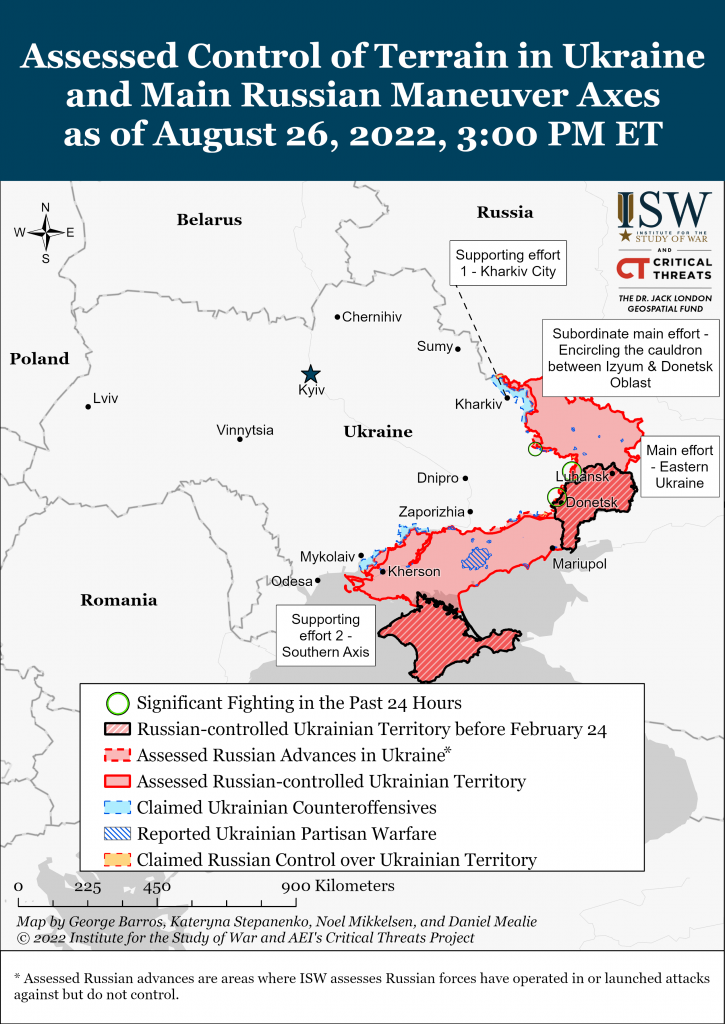
Russian forces did not make any claimed or assessed territorial gains in Ukraine on August 26, 2022, for the first time since August 18, 2022. [1] However, Russian forces still conducted limited and unsuccessful ground attacks on the Eastern Axis on August 26.

The International Atomic Energy Agency (IAEA) stated that unspecified actors (but almost certainly Russian forces) reconnected part of the Zaporizhzhia Nuclear Power Plant (ZNPP) to the Ukrainian power grid on August 26. [2] Ukrainian nuclear operating enterprise Energoatom stated that unspecified actors reconnected one of the power units to the ZNPP and are working to add capacity to the ZNPP’s operations.[3] Russian forces remain in full control of the plant, though it is unclear why they would have reconnected the power unit.

Russian occupation authorities remain unlikely to successfully conduct sham referenda to annex Ukrainian territory into the Russian Federation by early September, despite reports of advancing preparations for referenda. Spokesperson for Ukraine’s Main Intelligence Directorate (GUR) Vadym Skibitsky stated on August 26 that Russian authorities have completed administrative preparations for referenda and created election headquarters, drawn up voter lists, and created election commissions, which Skibitsky stated indicates that the preparatory process for referenda is “almost complete.”[4] Russian-backed occupation authorities in Zaporizhia Oblast announced that they have already audited polling stations, analyzed voter lists, and selected candidates for work in voter precincts and territorial election commissions.[5]

However, Russian occupation authorities are unlikely to be able to carry out referenda as they intend (with cooperation from local collaborators) by the purported September 11 deadline due to continued frictions within occupation administrations and ongoing partisan attacks. The Ukrainian advisor to the head of Kherson Oblast, Serhiy Khlan, stated on August 26 that the Kherson occupation administration is struggling to find people to head administrative units in charge of referendum preparations, likely due to a lack of willing locals and low levels of trust in Ukrainian collaborators.[6] Khlan notably stated that Russian President Vladimir Putin may have ordered occupation administrators to avoid importing Russian administrators to fill these roles in order to make the referendum process appear like a grassroots initiative with local support.[7] Ukrainian sources have previously reported that Ukrainian resistance and increasing partisan attacks are inhibiting preparations for the referendum.[8] While Russian authorities could hypothetically forcibly annex Ukrainian territories on an arbitrary date, they are unlikely to do so without holding staged referenda. All observed indicators suggest that Russian authorities seek to create a veneer of local support and participation before conducting the referenda to frame them as widely supported initiatives but face ongoing setbacks that will delay any annexation effort.
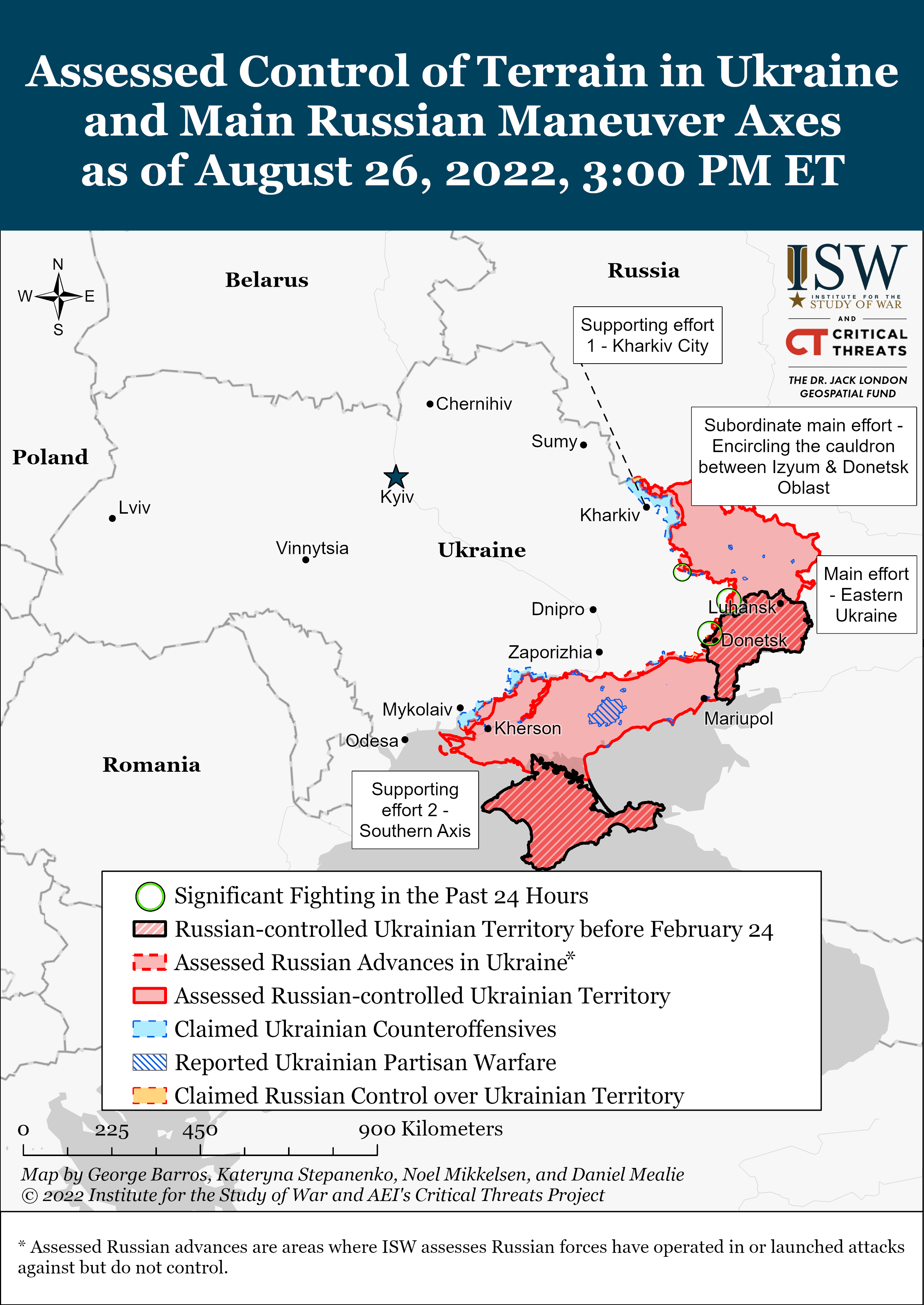
Isw institute for the study of war. DraftUkraineCOTAugust26%2C2022. Isw institute for the study of war фото. Isw institute for the study of war-DraftUkraineCOTAugust26%2C2022. картинка Isw institute for the study of war. картинка DraftUkraineCOTAugust26%2C2022. This interactive map complements the static control-of-terrain maps that ISW daily produces with high-fidelity and, where possible, street-level assessments of the war in Ukraine.

We do not report in detail on Russian war crimes because those activities are well-covered in Western media and do not directly affect the military operations we are assessing and forecasting. We will continue to evaluate and report on the effects of these criminal activities on the Ukrainian military and population and specifically on combat in Ukrainian urban areas. We utterly condemn these Russian violations of the laws of armed conflict, Geneva Conventions, and humanity even though we do not describe them in these reports.

Main Effort—Eastern Ukraine

Subordinate Main Effort—Southern Kharkiv, Donetsk, Luhansk Oblasts (Russian objective: Encircle Ukrainian forces in Eastern Ukraine and capture the entirety of Donetsk and Luhansk oblasts, the claimed territory of Russia’s proxies in Donbas)

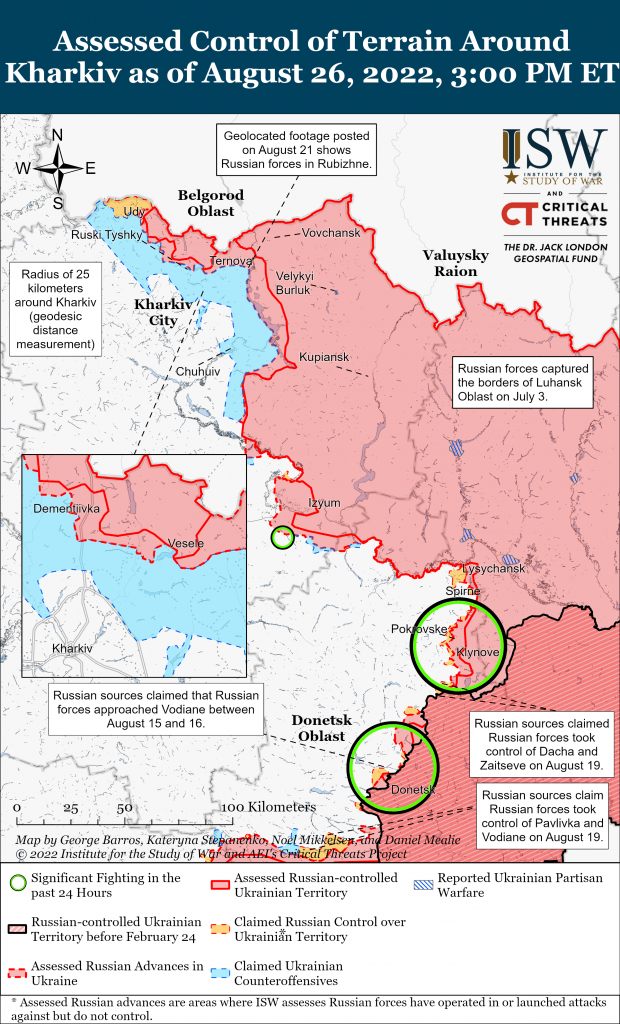
Russian forces conducted a limited ground attack southwest of Izyum on August 26. The Ukrainian General Staff reported that Russian troops attacked toward Karnaukhivka, 25km southwest of Izyum.[9] ISW has previously reported that limited Russian ground attacks southwest of Izyum are likely spoiling attacks to disrupt Ukrainian forces, rather than attacks intended to take territory along an axis of advance.[10] Russian forces continued artillery strikes along the Izyum-Slovyansk line near the Kharkiv-Donetsk Oblast border and additionally shelled a technical college in Slovyansk.[11]

Russian forces did not conduct any confirmed ground attacks toward Siversk on August 26 and fired on Siversk and surrounding settlements.[12]

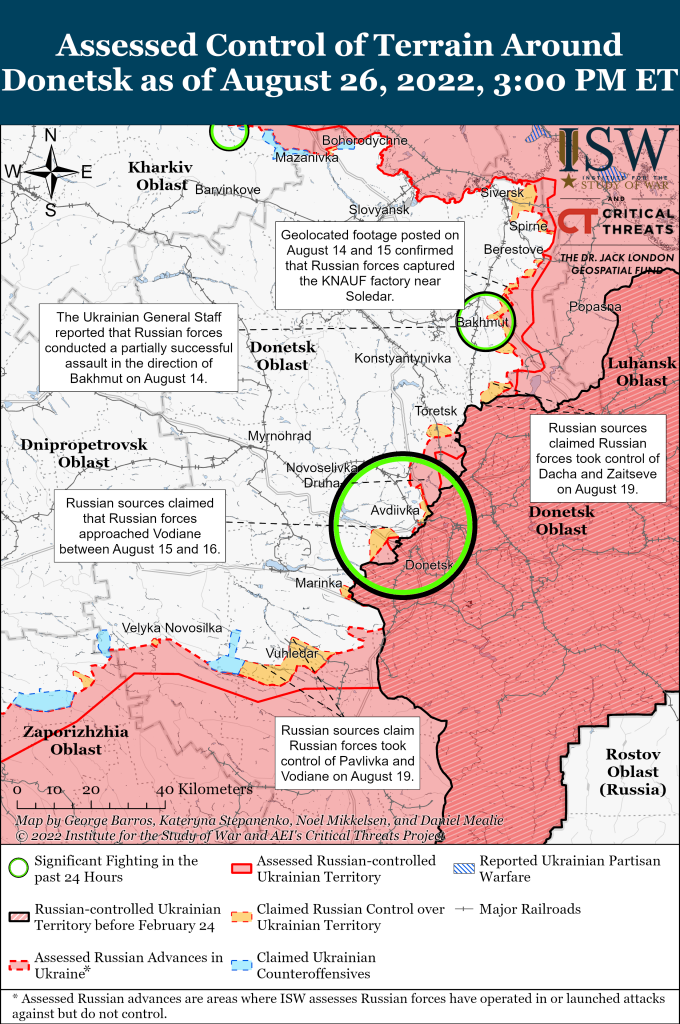
Russian forces continued ground attacks northeast and south of Bakhmut on August 26. The Ukrainian General Staff stated that Russian troops attacked near Soledar and Bakhmutske, both within 10km northeast of Bakhmut.[13] Russian sources claimed that Russian and proxy troops, along with Wagner Group mercenaries, are fighting in Soledar and along the eastern approaches to Bakhmut.[14] The Ukrainian General Staff also reported that Russian troops attempted to advance from Kodema, about 13km southeast of Bakhmut.[15]

Russian forces conducted a limited ground attack on the northwestern outskirts of Donetsk City on August 26. The Ukrainian General Staff stated that Russian troops attempted to improve their tactical position and advance toward Nevelske, less than 10km from the northwestern outskirts of Donetsk City and directly adjacent to Russian-occupied Pisky.[16] Russian forces also continued artillery strikes against Ukrainian positions along the Avdiivka-Donetsk City frontline.[17]

Russian forces did not conduct any confirmed ground attacks southwest of Donetsk City on August 26. Russian sources indicated that Russian and proxy troops are continuing to prioritize offensive operations in the Vuhledar area, about 35km southwest of Donetsk City.[18] The Ukrainian General Staff reported that Russian forces conducted air and artillery strikes southwest of Donetsk City toward the Zaporizhia-Donetsk Oblast border.[19]

Supporting Effort #1—Kharkiv City (Russian objective: Defend ground lines of communication (GLOCs) to Izyum and prevent Ukrainian forces from reaching the Russian border)

Russian forces did not conduct any confirmed ground attacks in northeastern Kharkiv Oblast on August 26. Ukrainian and Russian sources reported that Russian troops continued offensive operations to contest positions north of Kharkiv City and conducted air and artillery strikes along the line of contact.[20]

Supporting Effort #2—Southern Axis (Russian objective: Defend Kherson and Zaporizhia Oblasts against Ukrainian counterattacks)

Russian forces did not conduct any confirmed ground assaults in Zaporizhia Oblast on August 26. The Ukrainian General Staff reported that Russian forces conducted airstrikes against Hulyaipole and Olhivske, roughly 20km northeast of Hulyaipole.[21] Russian forces continued heavy shelling along the line of contact, including near Hulyaipole and Huliaipilske on the T0814 highway and Orikhiv and Mala Tokmachka on the T0815 highway.[22]

Russian sources claimed that Ukrainian forces continued to shell the Zaporizhzhia Nuclear Power Plant (ZNPP) on August 26. The Russian Ministry of Defense (MoD) accused Ukrainian forces of shelling the ZNPP’s oxygen-nitrogen station and an area of special building No. 1 on August 25-26.[23] Ukrainian sources separately reported that Russian forces struck Nikopol, Marhanets, and Chervonohryhorivka, all on the opposite bank of the Dnipro River from Enerhodar.[24]

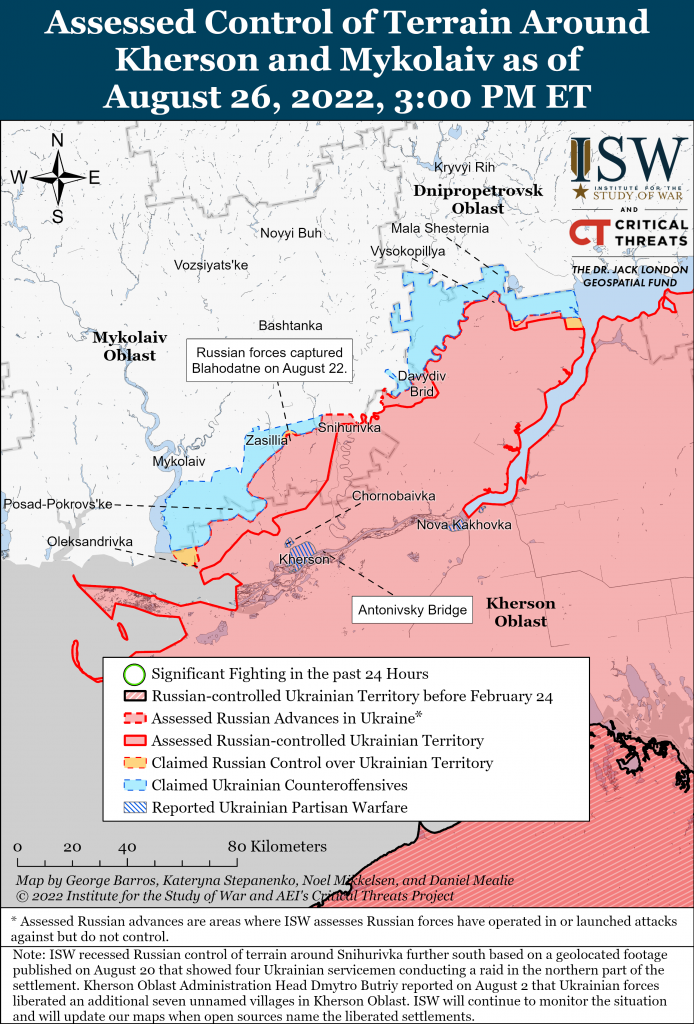
Russian forces did not conduct any confirmed ground assaults in Kherson or Mykolaiv Oblasts on August 26. The Ukrainian General Staff reported that Russian forces conducted airstrikes on unspecified infrastructure facilities near Oleksandrivka (west Kherson Oblast), Lozove (near the Ukrainian bridgehead over the Inhulets River), and Olhyne (south of Kryvyi Rih on the T2207 highway).[25] Ukraine’s Southern Operational Command Spokesperson Vladyslav Nazarov reported that Russian forces struck the Mykolaivskyi district with S-300 anti-air systems.[26] Russian forces continued shelling along the line of contact.[27]

Ukrainian forces continued to target Russian ground lines of communication (GLOCS) and military infrastructure in Kherson Oblast which support Russian operations on the right bank of the Dnipro River. Ukrainian forces again struck the Antonivsky road bridge near Kherson City on August 26, likely disrupting Russian efforts to repair the bridge.[28] Footage from August 25 shows Russian forces operating pontoon bridges adjacent to the road bridge. [29] Satellite imagery from August 23 and August 25 shows significant damage to the Antonivsky road bridge from Ukrainian strikes.[30] Ukrainian forces also struck the Darivka road bridge over the Inhulets River, and Nazarov stated that the strikes rendered the bridge inoperable.[31] Nazarov also reported that Ukrainian forces targeted Russian force concentrations, ammunition depots, and equipment stores in Kherson Oblast, including command and control elements of the Russian 98th Airborne Division in Dudchany, Kherson Oblast.[32] Ukrainian forces conducted airstrikes against Russian air defense infrastructure in Novovoskresenske, northern Kherson Oblast, and Kherson City on August 25.[33]

Russian forces continued to redeploy military equipment from Crimea to Russia, likely in response to ongoing Ukrainian strikes against Russian rear areas in Crimea. Business Insider reported on August 26 that Russian forces transferred six Su-35S fighter jets and four MiG-31BM interceptors from Crimea to mainland Russia, most likely due to the threat of Ukrainian strikes.[34] A Russian milblogger agreed with the Business Insider report and claimed that Russian forces are strengthening air defenses in Crimea to counter Ukrainian strikes as current Russian air defenses are ineffective against small Ukrainian unmanned aerial vehicles (UAVs).[35]

Mobilization and Force Generation Efforts (Russian objective: Expand combat power without conducting general mobilization)

Russian federal subjects (regions) are launching additional recruitment drives for volunteer battalions, which continue to deploy to Ukraine. Local Primorye outlet Primorskaya Gazeta reported on August 26 that Prymorskyi Krai’s 240-man-strong “Tigr” volunteer battalion (which is part of the Russian 155th Separate Naval infantry Brigade) participated in its first combat operation in an unspecified location in Ukraine.[36] ISW first reported on the ”Tigr” Battalion on July 16.[37] Russian media also reported that Bashkortostan’s “Shaimuratov” and “Dostavalov” volunteer battalions are completing their training and will deploy to Ukraine at an unspecified date in the near future.[38] Local Russian media also reported that a few dozen Russian volunteers of Tyumen Oblast’s “Tobol” and “Tayga” battalions deployed to training grounds for combat training ahead of deploying to Ukraine.[39] Russian sources also confirmed the first combat losses among Russian prisoners who recently joined the Wagner Group.[40]

Russian federal subjects continue to increase offered salaries for volunteer fighters. Nenets Autonomous Okrug Governor Yuri Bezdudny announced on August 26 that the Nenets Autonomous Okrug tripled its one-time enlistment payment from 100,000 ($1,642) rubles to 300,000 rubles ($4,928) for personnel who signed service contracts with the Russian Ministry of Defense.[41] Chuvash Republic Governor Oleg Nikolayev announced on August 26 that the Chuvash Republic will increase one-time payments to volunteer fighters of the “Atal” Battalion from 200,000 rubles ($3,285) to 300,000 rubles ($4,928).[42]

Activity in Russian-occupied Areas (Russian objective: consolidate administrative control of occupied areas; set conditions for potential annexation into the Russian Federation or some other future political arrangement of Moscow’s choosing)

Ukrainian partisans continued to target occupation authorities and disrupt Russian preparations for annexation referenda. Russian and Ukrainian sources stated on August 26 that unidentified Ukrainian partisans conducted an improvised explosive device (IED) attack against Alexander Kolesnikov, the Deputy Police Chief of occupied Berdyansk, Zaporizhia Oblast.[43] Ukrainian Mayor of Melitopol Ivan Fedorov also stated that Ukrainian partisans in Melitopol, Kherson Oblast damaged a referendum headquarters in Melitopol.[44] The targeting of collaborators by partisan groups is likely impeding Russian efforts to establish stable governing systems and pursue formal referendums in occupied territories.

Internal discord is likely also contributing to the instability of occupation regimes. The Ukrainian Resistance Center reported that Russian-appointed Mayor of Mariupol Konstantin Ivashchenko left Mariupol on August 26 following an assassination attempt on August 25.[45] Ukrainian Advisor to the Mayor of Mariupol Petro Andryushchenko stated that Russian Duma Deputy Dmytro Sablin and Russian-backed former Mariupol City Council Member Petro Ivanov ordered Ivashchenko’s assassination. Andryushchenko further reported that Donetsk People’s Republic (DNR) Head Denis Pushilin appointed DNR authorities to investigate the assassination attempt rather than turning the case over to Russian authorities, as per previous cases in Russian-occupied territories.[46] ISW cannot independently confirm Andryushchenko’s statements at this time. However, if proven true, a rift between Russian and DNR authorities would suggest Russia will face increasing difficulty coordinating governance and responses to Ukrainian threats in occupied territories.

Russian and proxy authorities continue efforts to facilitate the social integration of occupied areas using inconsistent applications of incentives and threats. Education systems remain a prime target. Parents who refuse to send their children to Russian schools in occupied territories face fines ranging from 40,000 to 150,000 rubles ($663-$2,487), the revocation of their parental rights, the confiscation of their property, and police interference, depending on their location.[47] Parents who choose to send their children to Russian schools in occupied territories may receive a one-time 10,000-ruble ($165) payment, as ISW has previously reported.[48]

The Yale School of Public Health’s Humanitarian Research Lab published a report locating at least 21 confirmed filtration facilities functioning in Donetsk Oblast alone on August 25.[49] The filtration facilities reportedly each serve one of four purposes: registration, holding, secondary interrogation, or detention of Ukrainian civilians. The Humanitarian Research Lab asserted that facility conditions include overcrowding, poor sanitation, insufficient food and water provision, denial of medical care, occasional use of electric shocks, and isolation tactics that “can constitute cruel, inhuman, and degrading treatment under international humanitarian and human rights law.”[50]

Note: ISW does not receive any classified material from any source, uses only publicly available information, and draws extensively on Russian, Ukrainian, and Western reporting and social media as well as commercially available satellite imagery and other geospatial data as the basis for these reports. References to all sources used are provided in the endnotes of each update.

Источник

Isw institute for the study of war

This interactive map complements the static control-of-terrain maps that ISW daily produces with high-fidelity and, where possible, street-level assessments of the war in Ukraine.

The West should pay close attention to the Chinese military’s preparations for urban combat, as these efforts will have profound effects on China’s policy toward Taiwan and elsewhere.

Isw institute for the study of war. The Evolution Of Kremlin FP 2 0. Isw institute for the study of war фото. Isw institute for the study of war-The Evolution Of Kremlin FP 2 0. картинка Isw institute for the study of war. картинка The Evolution Of Kremlin FP 2 0. This interactive map complements the static control-of-terrain maps that ISW daily produces with high-fidelity and, where possible, street-level assessments of the war in Ukraine.

In this 2019 report, Nataliya Bugayova breaks down the trajectory of Russian foreign policy after the fall of the USSR. She argues that the US mistakingly believed that a brief period of non-assertive foreign policy from the mid-1980s to mid-1990s was the new norm for Russia.

Isw institute for the study of war. Website%20Sliders%20 %20Ukraine. Isw institute for the study of war фото. Isw institute for the study of war-Website%20Sliders%20 %20Ukraine. картинка Isw institute for the study of war. картинка Website%20Sliders%20 %20Ukraine. This interactive map complements the static control-of-terrain maps that ISW daily produces with high-fidelity and, where possible, street-level assessments of the war in Ukraine.

A Russia-prosecuted war in Ukraine, Europe’s largest country by landmass and home to 44 million people, would be a generation-defining humanitarian and geopolitical disaster. ISW is closely monitoring Russia’s military posturing on Ukraine’s border.

Isw institute for the study of war. 2020%20Putin%20Offset%20Kremlin%20Geopolitical%20Adaptation%20Cover%20Photo 1. Isw institute for the study of war фото. Isw institute for the study of war-2020%20Putin%20Offset%20Kremlin%20Geopolitical%20Adaptation%20Cover%20Photo 1. картинка Isw institute for the study of war. картинка 2020%20Putin%20Offset%20Kremlin%20Geopolitical%20Adaptation%20Cover%20Photo 1. This interactive map complements the static control-of-terrain maps that ISW daily produces with high-fidelity and, where possible, street-level assessments of the war in Ukraine.

The West has had some success in countering the Kremlin since Russia’s illegal occupation of Crimea, but Russian President Vladimir Putin has found ways to offset external pressures on Russia without relinquishing his gains and goals.

Latest from ISW

Russian Offensive Campaign Assessment, August 26

Russian forces did not make any claimed or assessed territorial gains in Ukraine on August 26, 2022, for the first time since August 18, 2022. However, Russian forces still conducted limited and unsuccessful ground attacks on the Eastern Axis on August 26. The International Atomic Energy Agency (IAEA) stated that unspecified actors (but almost certainly Russian forces) reconnected part of the Zaporizhzhia Nuclear Power Plant (ZNPP) to the Ukrainian power grid on August 26. Ukrainian nuclear operating enterprise Energoatom stated that unspecified actors reconnected one of the power units to the ZNPP and are working to add capacity to the ZNPP’s operations. Russian forces remain in full control of the plant, though it is unclear why they would have reconnected the power unit.

Russian Offensive Campaign Assessment, August 25

Russian President Vladimir Putin’s August 25 decree to increase the size of the Russian military starting in January 2023 is unlikely to generate significant combat power in the near future and indicates that Putin is unlikely to order a mass mobilization soon. The decree increases the nominal end strength of the Russian Armed Forces by 137,000 military personnel, from 1,013,628 to 1,150,628, starting on January 1, 2023. The Russian military likely seeks to recover losses from its invasion of Ukraine and generate forces to sustain its operation in Ukraine. The announcement of a relatively modest (yet likely still unattainable) increased end strength target strongly suggests that Putin remains determined to avoid full mobilization. The Kremlin is unlikely to generate sufficient forces to reach an end strength of over 1,150,000 soldiers as the decree stipulates. The Russian military has not historically met its end-strength targets. It had only about 850,000 active-duty military personnel in 2022 before Russia’s full-scale invasion of Ukraine, for example, well shy of its nominal end strength target of over one million.

Russian Offensive Campaign Assessment, August 24

Russian Defense Minister Sergey Shoigu stated on August 24 that Russian forces are slowing down the overall pace of their offensive operations in Ukraine while reaffirming that Russia’s objectives in the war have not changed. At a meeting with defense ministers from member states of the Shanghai Cooperation Organization (SCO) Shoigu stated that Russian troops will be slowing down the pace of offensive operations in Ukraine in a conscious effort to minimize civilian casualties. Shoigu also reiterated that operations in Ukraine are going according to plan and that Russian forces will accomplish all their objectives, supporting ISW’s assessment that Russia’s maximalist strategic war aims in Ukraine have not changed. The Russian MoD has previously issued similar statements to account for the pace of operations in Ukraine.

Russian Offensive Campaign Assessment, August 23

Russian government sources confirmed that Russia is bringing Ukrainian children to Russia and having Russian families adopt them. Russian federal subject (region) Krasnodar Krai’s Family and Childhood Administration posted about a program under which Russian authorities transferred over 1,000 children from Mariupol to Tyumen, Irkutsk, Kemerov, and Altay Krai where Russian families have adopted them. The Administration stated that over 300 children are still waiting to “meet their new families” and that citizens who decide to adopt these children will be provided with a one-time bonus by the state. Ukraine’s Main Intelligence Directorate (GUR) additionally reported that Russian officials transferred 30 Ukrainian children from Khartsyzk, Ilovaysk, and Zuhres in occupied Donetsk Oblast to Nizhny Novgorod under the guise of having the children participate in youth educational-training programs. The forcible transfer of children of one group to another “with intent to destroy, in whole or in part, a national, ethnical, racial or religious group“ is a violation of the Convention on the Prevention and Punishment of the Crime of Genocide.

Russian Offensive Campaign Assessment, August 22

Russian occupation officials in Zaporizhia Oblast have obliquely declared the region’s independence from Ukraine by falsely identifying Ukrainian citizens entering the occupied region as temporary asylum seekers. Head of the Zaporizhia Oblast occupation administration Yevheny Balitsky signed an order that designates Ukrainian citizens arriving in occupied Zaporizhia Oblast as temporary asylum seekers based on Russian law. The order requires the registration of Ukrainian and Russian citizens based on their place of residence or place of arrival in the Russian-occupied parts of Zaporizhia Oblast and requires the distribution of temporary identification forms for all “stateless persons.” Ukrainians and Russians may register if they present proof of their temporary asylum application. This decree has various implications under both international law and domestic Russian law. International law states that a refugee is an individual from outside the country (or who is stateless) who is seeking “temporary asylum” in another country to escape persecution. Russian law defines a refugee as a person ”who is outside of his/her country of nationality or habitual residence.” Neither of these statuses properly apply to the majority of people crossing from unoccupied Ukraine into occupied Zaporizhia.

Russian Offensive Campaign Assessment, August 21

Russian forces’ momentum from territorial gains around Bakhmut and Avdiivka in late July is likely exhausted, and Russian attacks in eastern Ukraine are likely culminating although very small Russian advances will likely continue. Russian forces seized Novoluhanske and the Vuhlehirska Thermal Power Plant (TPP) southeast of Bakhmut on July 25 and 26, respectively, consolidating Russian control around difficult water features after many weeks of fighting. Russian sources celebrated these gains as a significant military victory without noting that Ukrainian military Ukrainian forces successfully broke contact and withdrew from the area. Russian forces also celebrated the capture of Ukrainian fortifications around the Butivka Coal Mine ventilation shaft southwest of Avdiivka, after Ukrainian forces withdrew from the area on July 30. Russian forces capitalized on these gains to a limited extent and have been attacking toward Bakhmut from the northeast and southeast, and around Avdiivka, but these attacks are now stalling. Russian forces have not made significant territorial gains around Bakhmut or Avdiivka since their advances through Novoluhanske, the power plant, the Butivka Coal Mine, and a few small settlements near those areas.

Источник

Publications

Russian Offensive Campaign Assessment, August 26

Russian forces did not make any claimed or assessed territorial gains in Ukraine on August 26, 2022, for the first time since August 18, 2022. However, Russian forces still conducted limited and unsuccessful ground attacks on the Eastern Axis on August 26. The International Atomic Energy Agency (IAEA) stated that unspecified actors (but almost certainly Russian forces) reconnected part of the Zaporizhzhia Nuclear Power Plant (ZNPP) to the Ukrainian power grid on August 26. Ukrainian nuclear operating enterprise Energoatom stated that unspecified actors reconnected one of the power units to the ZNPP and are working to add capacity to the ZNPP’s operations. Russian forces remain in full control of the plant, though it is unclear why they would have reconnected the power unit.

Russian Offensive Campaign Assessment, August 25

Russian President Vladimir Putin’s August 25 decree to increase the size of the Russian military starting in January 2023 is unlikely to generate significant combat power in the near future and indicates that Putin is unlikely to order a mass mobilization soon. The decree increases the nominal end strength of the Russian Armed Forces by 137,000 military personnel, from 1,013,628 to 1,150,628, starting on January 1, 2023. The Russian military likely seeks to recover losses from its invasion of Ukraine and generate forces to sustain its operation in Ukraine. The announcement of a relatively modest (yet likely still unattainable) increased end strength target strongly suggests that Putin remains determined to avoid full mobilization. The Kremlin is unlikely to generate sufficient forces to reach an end strength of over 1,150,000 soldiers as the decree stipulates. The Russian military has not historically met its end-strength targets. It had only about 850,000 active-duty military personnel in 2022 before Russia’s full-scale invasion of Ukraine, for example, well shy of its nominal end strength target of over one million.

Russian Offensive Campaign Assessment, August 24

Russian Defense Minister Sergey Shoigu stated on August 24 that Russian forces are slowing down the overall pace of their offensive operations in Ukraine while reaffirming that Russia’s objectives in the war have not changed. At a meeting with defense ministers from member states of the Shanghai Cooperation Organization (SCO) Shoigu stated that Russian troops will be slowing down the pace of offensive operations in Ukraine in a conscious effort to minimize civilian casualties. Shoigu also reiterated that operations in Ukraine are going according to plan and that Russian forces will accomplish all their objectives, supporting ISW’s assessment that Russia’s maximalist strategic war aims in Ukraine have not changed. The Russian MoD has previously issued similar statements to account for the pace of operations in Ukraine.

Russian Offensive Campaign Assessment, August 23

Russian government sources confirmed that Russia is bringing Ukrainian children to Russia and having Russian families adopt them. Russian federal subject (region) Krasnodar Krai’s Family and Childhood Administration posted about a program under which Russian authorities transferred over 1,000 children from Mariupol to Tyumen, Irkutsk, Kemerov, and Altay Krai where Russian families have adopted them. The Administration stated that over 300 children are still waiting to “meet their new families” and that citizens who decide to adopt these children will be provided with a one-time bonus by the state. Ukraine’s Main Intelligence Directorate (GUR) additionally reported that Russian officials transferred 30 Ukrainian children from Khartsyzk, Ilovaysk, and Zuhres in occupied Donetsk Oblast to Nizhny Novgorod under the guise of having the children participate in youth educational-training programs. The forcible transfer of children of one group to another “with intent to destroy, in whole or in part, a national, ethnical, racial or religious group“ is a violation of the Convention on the Prevention and Punishment of the Crime of Genocide.

Russian Offensive Campaign Assessment, August 22

Russian occupation officials in Zaporizhia Oblast have obliquely declared the region’s independence from Ukraine by falsely identifying Ukrainian citizens entering the occupied region as temporary asylum seekers. Head of the Zaporizhia Oblast occupation administration Yevheny Balitsky signed an order that designates Ukrainian citizens arriving in occupied Zaporizhia Oblast as temporary asylum seekers based on Russian law. The order requires the registration of Ukrainian and Russian citizens based on their place of residence or place of arrival in the Russian-occupied parts of Zaporizhia Oblast and requires the distribution of temporary identification forms for all “stateless persons.” Ukrainians and Russians may register if they present proof of their temporary asylum application. This decree has various implications under both international law and domestic Russian law. International law states that a refugee is an individual from outside the country (or who is stateless) who is seeking “temporary asylum” in another country to escape persecution. Russian law defines a refugee as a person ”who is outside of his/her country of nationality or habitual residence.” Neither of these statuses properly apply to the majority of people crossing from unoccupied Ukraine into occupied Zaporizhia.

Russian Offensive Campaign Assessment, August 21

Russian forces’ momentum from territorial gains around Bakhmut and Avdiivka in late July is likely exhausted, and Russian attacks in eastern Ukraine are likely culminating although very small Russian advances will likely continue. Russian forces seized Novoluhanske and the Vuhlehirska Thermal Power Plant (TPP) southeast of Bakhmut on July 25 and 26, respectively, consolidating Russian control around difficult water features after many weeks of fighting. Russian sources celebrated these gains as a significant military victory without noting that Ukrainian military Ukrainian forces successfully broke contact and withdrew from the area. Russian forces also celebrated the capture of Ukrainian fortifications around the Butivka Coal Mine ventilation shaft southwest of Avdiivka, after Ukrainian forces withdrew from the area on July 30. Russian forces capitalized on these gains to a limited extent and have been attacking toward Bakhmut from the northeast and southeast, and around Avdiivka, but these attacks are now stalling. Russian forces have not made significant territorial gains around Bakhmut or Avdiivka since their advances through Novoluhanske, the power plant, the Butivka Coal Mine, and a few small settlements near those areas.

Russian Offensive Campaign Assessment, August 20

Russian occupation officials in Crimea reported another drone attack on the Russian Black Sea Fleet Headquarters in Sevastopol on August 20. Russian-appointed Governor of Sevastopol Mikhail Razvozhaev claimed that Russian forces were unable to shoot down a drone, resulting in the drone hitting the roof of the Black Sea Fleet headquarters. Razvozhaev then retracted his initial statement and claimed that a fleet air defense post shot down the drone, which landed on the roof and caught fire. Social media footage showed a loud explosion and a cloud of smoke around the headquarters, and the drone likely detonated rather than being shot down. Some OSINT accounts have identified the drone as a commercially-available “Skyeye 5000mm Pro UAV.” Ukrainian officials did not claim responsibility for the attack as of the time of this publication. ISW has previously reported that Crimean occupation officials have obliquely accused Ukraine of orchestrating a drone attack on the headquarters on July 31 during Russia’s Navy Day.

Russian Offensive Campaign Assessment, August 19

Recent Ukrainian strikes on Russian military and transportation infrastructure in Crimea and Kherson Oblast are likely reducing Russian confidence in the security of Russian rear areas. Reports from August 18 about Ukrainian strikes are affecting the Russian information space despite the fact that these reports were likely overblown. Available open-source evidence indicates that Ukrainian forces did not conduct a successful kinetic attack against either the Stary Oskol Air Base in Belgorod or Belbek Air Base in Crimea on August 18. Geolocated footage shows that a fire started at a field just south of the Stary Oskol Airfield (rather than at the airfield itself), and satellite imagery shows Russian forces transporting ammunition and military equipment to a forest close to the field. An unspecified Russian Zaporizhia Oblast occupation official reiterated that Russian air defenses near the Kerch Strait Bridge activated against a Ukrainian unmanned aerial vehicle (UAV) rather than an incoming strike. There is no visual evidence of damage to either air base of as August 19. Geolocated footage shows no explosions or evidence of kinetic activity near the Belbek Air Base overnight on August 18-19, lending credence to claims that footage reportedly showing the explosion is recycled footage misattributed to the Belbek Air Base. As ISW reported on August 18, Russian sources largely reported on and disseminated these false or exaggerated reports, indicating broader Russian panic.

Russian Offensive Campaign Assessment, August 18

There were no claimed or assessed Russian territorial gains in Ukraine on August 18, 2022 for the first time since July 6, 2022. Russian and Ukrainian sources did not claim any new territorial gains on August 18. However, Russian forces still conducted limited and unsuccessful ground assaults across the eastern axis on August 18. Russian sources reported a series of unidentified and unconfirmed explosions across Crimea on the night of August 18.

Russian Offensive Campaign Assessment, August 17

Russian military leadership is likely increasingly losing confidence in the security of Crimea following recent Ukrainian strikes on Russian military objects in Crimea. Russian sources reported on August 17 that Vice Admiral Viktor Sokolov had replaced Admiral Igor Osipov as the commander of the Crimean-based Black Sea Fleet (BSF). The Russian information space, however, was evidently eager to maintain a high level of secrecy regarding Sokolov’s appointment due to the claimed threat of “terrorist danger” in Sevastopol. Recent Ukrainian strikes (associated with Ukrainian partisans and Ukrainian Armed Forces) on Russian military assets in Crimea, including the headquarters of the BSF in Sevastopol, have likely placed Russian forces on high alert and led to the restructuring of force composition, logistics, and leadership of the Russian grouping in Crimea in order to mitigate the impact of further strikes. Ukraine’s Main Military Intelligence Directorate, for example, reported that Russian forces are relocating dozens of fixed and rotary wing aircraft stationed in forward airfields in Crimea to areas deeper in the Crimean Peninsula and in mainland Russia.

Источник

Publications

Russian Offensive Campaign Assessment, August 16

Russian and Ukrainian sources reported explosions at an airfield and a critical Russian supply nexus in Crimea on August 16. Local reports and videos show a series of explosions at a Russian ammunition depot and a transformer substation in Dzhankoiskyi District and an airfield near Hvardiiske, Crimea. These explosions both caused significant damage to Russian resources and seriously disrupted Russian logistics. Russian forces have used Dzhankoi as a railway hub for transporting troops and equipment to occupied settlements in southern Zaporizhia Oblast, including Melitopol. Russian authorities temporarily suspended passenger rail service from Russia into Crimea following the attack.

Russian Offensive Campaign Assessment, August 15

Elements of the Luhansk People’s Republic (LNR) militia reportedly refused to continue fighting in Donetsk Oblast and complained about the grueling pace of offensives outside of Luhansk Oblast. The emotional significance of recent Russian targets in Donetsk Oblast resonates with audiences in the Donetsk People’s Republic (DNR), but not with LNR audiences tired of grueling offensives beyond their claimed borders. Several Ukrainian channels shared a video on August 15 of soldiers from LNR Battalion 2740 refusing to fight for the DNR. The soldiers claim that they celebrated victory on July 3, when LNR forces reached the borders of Luhansk Oblast, and that their work is done. At least one Russian milblogger has criticized the LNR servicemembers for desiring Russian support for their own ”liberation” and then refusing to fight in Donetsk Oblast. ISW cannot independently verify the origin or authenticity of this particular video. Its message reflects a larger trend of diminished LNR investment in and morale to support the Russian war in Ukraine, however. This trend is particularly dangerous to Russian forces seeking to recruit still more new soldiers from Luhansk Oblast to make up for recent losses. Further division within Russian-led forces also threatens to further impede the efficiency of the Russian war effort.

Russian Offensive Campaign Assessment, August 14

Russian and proxy troops in Ukraine are likely operating in roughly six groups of forces oriented on Kharkiv City and northeastern Kharkiv Oblast; along the Izyum-Slovyansk line; the Siversk-Lysychansk area; Bakhmut; the Avdiivka-Donetsk City area; and Southern Ukraine. The Kharkiv City and Siversk-Lysychansk groups are likely built around cores drawn from the Western and Central Military Districts respectively. The Izyum-Slovyansk axis is increasingly manned by recently formed volunteer battalions that likely have very low combat power. Wagner Group private military company (PMC) soldiers are in the lead around Bakhmut, while forces drawn from the Donetsk People’s Republic (DNR) predominate in the Avdiivka-Donetsk City area. Troops from the Southern Military District (SMD) likely formed the original core of forces in Kherson and Zaporizhzhia Oblasts but have been reinforced with troops of the Eastern Military District, Airborne Forces, and Rosgvardia. None of these groupings is homogeneous—elements of various military districts, proxy forces, volunteer units, and other formations are scattered throughout the theater. These dispositions suggest that Moscow is prioritizing the advance around Bakhmut and, possibly, toward Siversk with its Russian forces while seeking to draw on the enthusiasm of DNR forces to seize ground they have failed to take since 2014 on the Avdiivka axis. The high concentration of volunteer battalions around Izyum and Slovyansk suggests that that area is not a focus of Russian attention and may be vulnerable to Ukrainian counterattacks. The congeries of forces in and around Kherson Oblast may pose significant challenges to Russian command and control, especially if Ukrainian forces press a counteroffensive there.

Russian Offensive Campaign Assessment, August 13

Ukrainian forces are continuing efforts to disrupt Russian ground lines of communication (GLOCs) that support Russian forces on the right bank of the Dnipro River. Ukrainian forces struck the bridge on the Kakhovka Hydroelectric Power Plant (HPP) dam again on August 13, reportedly rendering the bridge unusable by heavy vehicles. Ukraine’s Southern Operational Command had previously reported on August 10 that the Kakhovka HPP dam bridge was unfit for use. The Kakhovka bridge was the only road bridge Russian forces could use following Ukrainian forces’ successful efforts to put the Antonivsky road bridge out of commission. The UK Defense Ministry has claimed that Russian forces now have no bridges usable to bring heavy equipment or supplies over the Dnipro River in Kherson Oblast and must rely mainly on the pontoon ferry they have established near the Antonivsky road bridge. ISW cannot confirm at this time whether Russian forces can use the Antonivsky rail bridge to resupply forces on the right bank of the Dnipro River.

Russian Offensive Campaign Assessment, August 12

Russian Offensive Campaign Assessment, August 11

The US State Department called on Russian forces to cease all military activity surrounding the Zaporizhzhia Nuclear Power Plant (ZNPP) and support the creation of a demilitarized zone amidst new reports of shelling at the ZNPP on August 11. The US State Department also called on Russia to return control of the plant to Ukraine. Ukrainian and Russian occupation authorities accused each other of shelling the ZNPP on August 11. Ukraine’s nuclear operating enterprise Energoatom reported that Russian shelling damaged the area of the commandant’s office, storage of radiation sources, and the nearby fire station. The fire station is approximately 5km east of the ZNPP. The Ukrainian Strategic Communications Center stated that Russian forces are deliberately staging provocations at the ZNPP and are carrying out dangerous experiments involving power lines to blame Ukrainian forces at the United Nations (UN) Security Council. Russian-appointed Zaporizhia Oblast Occupation Administration Head Yevgeniy Balitsky claimed that Ukrainian shelling damaged the ”Kakhovskaya” high-voltage power line, resulting in a fire and a large cloud of smoke seen on social media footage from the city. Russian officials have previously accused Ukraine of striking positions of crucial significance to Ukrainians – such as the falsely-claimed HIMARS strike on the Olenivka colony in occupied Donetsk Oblast. A CNN investigation concluded that “there is almost no chance that a HIMARS rocket caused the damage to the warehouse where the prisoners were being held.” Russians may be continuing a similar narrative around the ZNPP to discourage further Western support to Ukraine. ISW cannot independently verify the party responsible for the shelling of the ZNPP.

Russia and Iran Double Down on Their Strategic Partnership

Russian Offensive Campaign Assessment, August 10

Russian Offensive Campaign Assessment, August 9

The Ukrainian General Staff made no mention of Izyum in its 1800 situational report on August 9, nor did other prominent Ukrainian sources despite Western sources’ claims of an ongoing Ukrainian counteroffensive in this area. This silence represents a noteworthy departure from previous Ukrainian coverage of the Kharkiv-Donetsk axis.

Russian Offensive Campaign Assessment, August 8

Western and Ukrainian outlets circulated a report, likely false, of a Russian general allegedly threatening to destroy Europe’s largest nuclear facility, the Russian-occupied Zaporizhzhia Nuclear Power Plant (NPP), if Russia could not hold the plant. Multiple news outlets shared a screenshot from the Russian social networking site Vkontakte that claimed to cite the Russian head of the Zaporizhia occupation garrison, Major General Valery Vasilev, stating that Russia had mined the Zaporizhzhia NPP and that the plant would be “either Russian land or a scorched desert.” The screenshot appeared to be a news report posted in a Vkontakte group run by Russian outlet Lenta Novosti Zaporizhia. The outlet itself claimed that the screenshot was from a faked group and denied writing the report. The Russian Ministry of Defense condemned the report and screenshot as a “fake” and claimed that Vasilev was in Uzbekistan at the time he was purported to have made the statement to forces at Zaporizhzhia.[3] Regardless of the origin (or existence) of the original post, the reporting is unreliable. It is indirect and does not claim to cite an official statement or a statement made on any official Russian news or government website.

Источник

Publications

Russian Offensive Campaign Assessment, July 29

A kinetic event killed and wounded scores of Ukrainian POWs in Russian-occupied Olenivka, Donetsk Oblast, on July 28. Ukraine and Russia are blaming each other for the attack and available visual evidence appears to support the Ukrainian claim more than the Russian, but ISW cannot independently assess the nature of the attack or the party responsible for it at this time. The Russian Defense Ministry asserted that Ukrainian forces deliberately struck the Olenivka pre-trial detention center holding Ukrainian POWs including Azov Regiment servicemen using Western-provided HIMARS, killing at least 40 and wounding 75 POWs. Kremlin-sponsored news outlet “RIA Novosti” published videos of the detention center, which showed fire damage but not the sort of damage that a HIMARS strike would likely have caused. RIA Novosti also released footage of HIMARS missile fragments but provided no evidence that the fragments were recovered at Olenivka. Luhansk People’s Republic (LNR) Ambassador to Russia Leonid Miroshnik claimed that Ukrainian forces struck the pre-detention center to eliminate the evidence of Ukrainian surrenders and prevent POWs from speaking out against the Ukrainian government. The Ukrainian General Staff said that Russian forces conducted the attack as a false flag operation to cover up Russian war crimes, disrupt the supply of Western weapons, discredit Ukrainian forces, and stoke social tensions within Ukrainian society.[6] The Ukrainian General Staff stated that a deliberate explosion occurred near the newly-constructed penal colony, to which Russian forces had transferred Ukrainian POWs a few days earlier. The Ukrainian General Staff also noted that Ukrainian analysis of the damage to the building, intercepted phone conversations between Russian servicemen, the lack of reported shelling in Olenivka, and the absence of casualties among Russian personnel serving at the penal colony all point to a Russian deliberate “terrorist act” as the cause of the incident.[7] The Ukrainian Main Military Intelligence Directorate (GUR) accused Wagner Group head Yevgeny Prigozhin of ordering the “terrorist act” without consulting with the Russian Defense Ministry, to conceal the embezzlement of funds allocated for the maintenance of Ukrainian POWs before an official inspection on September 1.The Ukrainian Office of the General Prosecutor reported that the explosion killed at least 40 and wounded 130 Ukrainian POWs. ISW is unable to assess the nature of the event or the party responsible for it with any confidence at this time. We will update our assessment as more information becomes available.

Taliban Supreme Leader Uses Gathering of Religious Leaders to Consolidate Power

Taliban Supreme Leader Hibatullah Akhundzada leveraged a recent gathering of Taliban-aligned religious leaders to consolidate power and advance efforts to implement a hardline governance program. Akhundzada is taking on a more proactive role as the Taliban navigates internal tensions and faces continued attacks from the Islamic State’s Khorasan Province (IS-KP).

Russian Offensive Campaign Assessment, July 28

The Russian grouping in Donetsk Oblast is likely seeking to capitalize on recent marginal gains southeast of Bakhmut by continuing to attempt to advance in that area. Russian forces may be de-emphasizing attempts to take Siversk in order to concentrate on Bakhmut, but it is too soon to tell. Russian forces continued efforts to advance northward on Bakhmut from recently gained positions around Novoluhanske and the Vuhlehirska Power Plant while pursuing southwestward advances along the T1302 highway from recently captured positions in Berestove. By contrast, Russian forces have been struggling to make concrete gains around Siversk and have not made any confirmed advances toward the city since the capture of the Luhansk Oblast Administrative border in early July. Russian command is likely, therefore, seeking to maintain momentum around Bakhmut, potentially at the expense of continued pressure on Siversk. Russian forces remain unlikely to take Bakhmut itself, despite recent incremental advances in its direction.

Russian Offensive Campaign Assessment, July 27

Russian forces appear able to sustain only two significant offensive operations in Ukraine at this time, one attempting to seize Siversk and the other advancing on Bakhmut. These operations have focused on advances in the Siversk, Donetsk Oblast, direction from Verkhnokamianka and Bilohorivka and in the Bakhmut direction from the areas of Novoluhanske and the Vuhlehirska Thermal Power Plant since the end of the operational pause on July 16. Russian forces have committed enough resources to conduct near-daily ground assaults and to seize territory on these two axes but have been unable to sustain a similar offensive operational tempo or to make similar territorial gains elsewhere in Ukraine. The Russian offensive, therefore, remains likely to culminate before seizing any other major urban areas in Ukraine.

Russian Offensive Campaign Assessment, July 26

Russian-backed proxy leadership continues to enunciate deadlines for the capture of additional Ukrainian territory, likely to support ongoing preparations for referenda on the annexation of these territories to the Russian Federation. Donetsk People’s Republic (DNR) Deputy Minister of Information Daniil Bezsonov stated on July 25 that the DNR expects to capture the entirety of Donetsk Oblast by the end of August. Various Russian and Western sources have previously reported that Russia intends to hold referenda in occupied areas by the first half of September, likely sometime around September 11, which is the unified voting day in the Russian Federation. Proxy leadership and Russian-backed occupation authorities are likely pushing for deadlines for military objectives to support condition setting for expedited annexation objectives, although Russian forces remain unlikely to occupy significant additional territory in Ukraine before the early autumn annexation timeline.

Russian Offensive Campaign Assessment, July 25

Russian forces made marginal territorial gains south of Bakhmut on July 25 but are largely suffering from the same fundamental limitations that previously prevented them from rapidly gaining substantial ground during offensive operations in Luhansk Oblast. Geolocated social media footage from July 25 shows that troops of the Wagner Group Private Military Company (PMC) have advanced into Novoluhanske and Russian and Ukrainian sources noted that Russian forces are taking control of the territory of the Vuhledar Power Plant on the northern edge of Novoluhanske, likely as a result of a controlled Ukrainian withdrawal from the area.

Russian Offensive Campaign Assessment, July 24

Ukrainian officials are increasingly acknowledging Ukrainian counteroffensive operations in Kherson Oblast. Kherson Oblast Administration Advisor Serhiy Khlan stated on July 24 that Ukrainian forces are undertaking unspecified counteroffensive actions in Kherson Oblast. Ukrainian President Volodymyr Zelensky said on July 23 that Ukrainian forces are advancing “step by step” in Kherson Oblast. His statement does not make clear whether he is referring to small, ongoing Ukrainian advances in Kherson Oblast or a broader counteroffensive. Ukraine’s Southern Operational Command reported on July 24 that Ukrainian forces are firing on Russian transport facilities in Kherson Oblast to impede maneuverability and logistics support. This activity is consistent with support to an active counteroffensive or conditions-setting for an upcoming counteroffensive. Khlan also said that Ukrainian strikes on Russian-controlled bridges around Kherson City only aim to prevent Russian forces from moving equipment into the city without stopping food and other essential supplies from entering the city.

Russian Offensive Campaign Assessment, July 23

Ukrainian forces are likely preparing to launch or have launched a counteroffensive in Kherson Oblast as of July 23, but open-source visibility on the progress and tempo of the counteroffensive will likely be limited and lag behind events. Ukrainian Kherson Oblast Administration Adviser Serhiy Khlan stated on July 23 that Ukrainian forces have seized unspecified settlements in Kherson Oblast but called on Ukrainian civilians to remain silent on the progress of the counteroffensive until Ukrainian authorities release official statements. Foreign Policy National Security Reporter Jack Detsch reported on July 22 that an unspecified senior US defense official stated that Ukrainian forces have recaptured unspecified “portions of Russian-occupied villages” in Kherson over the past week of July 15-22, indicating that Ukrainian forces have made some unspecified territorial advances along frontlines. The area between the front line and Kherson City is rural and primarily composed of small settlements that are less likely to report on force movements and engagements, allowing control-of-terrain in this area to change without evidence appearing in open-source reporting. Russian authorities additionally have no incentive to report on Ukrainian territorial gains. The informational dynamics that allow ISW to report on Russian offensive operations with relatively little lag are thus inverted in this situation. ISW will report on the progress of any Ukrainian counteroffensives to the best of its ability within these constraints.

Russian Offensive Campaign Assessment, July 22

Russian Offensive Campaign Assessment, July 21

Russian forces conducted a few limited and highly localized ground attacks on July 21. The current Russian operational tempo is not markedly different from what it was during the officially declared operational pause between July 7 and July 16. Russian forces continued to conduct minor attacks throughout that period to the northwest of Slovyansk and around the Siversk and Bakhmut areas without capturing any decisive ground. Since July 16, Russian troops have continued local attacks to the east of Siversk as well as east and south of Bakhmut; they have not made any major territorial gains in these areas as of July 21. The Russian grouping northwest of Slovyansk has in fact conducted fewer ground attacks along the Kharkiv-Donetsk Oblast border than it did during the official operational pause. The lack of successful ground attacks beyond the Slovyansk, Siversk, and Bakhmut areas is consistent with ISW’s assessment that the Russian offensive is likely to culminate without capturing Slovyansk or Bakhmut.

Источник

Isw institute for the study of war

The United States cannot stabilize—or safely deprioritize—the Middle East without first stabilizing Iraq.

Iraq is Fragile, Not Hopeless: How Iraq’s Fragility Undermines Regional Stability

The stabilization of the Iraqi state remains strategically important to the United States and worthy of a concerted US policy effort.

Iraq Control of Terrain Map: February 9, 2016

Iraqi Security Forces (ISF) and Sunni Arab tribal ­fighters backed by Coalition air support recaptured central Ramadi on January 9, the completion of a six-month operation. Iraqi Security Forces entered the city center on December 22.

The Pitfalls of Relying on Kurdish Forces to Counter ISIS

American over-reliance on Kurdish forces as the primary ground partner in the fight against the Islamic State of Iraq and al-Sham (ISIS) threatens the long-term success of the anti-ISIS campaign.

Ramadi Control Map: December 28, 2015

The Iraqi Security Forces (ISF) reportedly recaptured the government complex in central Ramadi on December 28 after clearing ISIS-held areas south of the complex on December 26 and 27.

Media Contact

For media inquires please contact:
202-293-5550 x205
press@understandingwar.org

Stay Updated

Isw institute for the study of war. signup. Isw institute for the study of war фото. Isw institute for the study of war-signup. картинка Isw institute for the study of war. картинка signup. This interactive map complements the static control-of-terrain maps that ISW daily produces with high-fidelity and, where possible, street-level assessments of the war in Ukraine.

Overview

The Iraq Project at the Institute for the Study of War produces detailed publications that monitor and analyze the changing security and political dynamics within Iraq. Topics include: understanding the evolving nature of Iraqi politics and Iraq’s democratic transition; evaluating Iraq’s security after U.S. forces withdraw; and analyzing the influence and behavior of regional actors in Iraq.

Publications

Featured Publications

Isw institute for the study of war. Iran%27s%20Escalating%20Proxy%20Attacks%20in%20Iraq%20 %20Update%2020200401 01 2. Isw institute for the study of war фото. Isw institute for the study of war-Iran%27s%20Escalating%20Proxy%20Attacks%20in%20Iraq%20 %20Update%2020200401 01 2. картинка Isw institute for the study of war. картинка Iran%27s%20Escalating%20Proxy%20Attacks%20in%20Iraq%20 %20Update%2020200401 01 2. This interactive map complements the static control-of-terrain maps that ISW daily produces with high-fidelity and, where possible, street-level assessments of the war in Ukraine.

Iran’s Proxies Accelerate Soleimani’s Campaign to Compel U.S. Withdrawal from Iraq

Isw institute for the study of war. . Isw institute for the study of war фото. Isw institute for the study of war-. картинка Isw institute for the study of war. картинка . This interactive map complements the static control-of-terrain maps that ISW daily produces with high-fidelity and, where possible, street-level assessments of the war in Ukraine.

US-Iran Escalation Timeline: March 2020 Update

Iranian proxies in Iraq have sustained attacks since the killing of Quds Force Commander Qassem Soleimani in an attempt to provoke a US response that will lead to the expulsion of American forces from the country. View the latest interactive timeline and map within.

Источник

Planned Giving

Isw institute for the study of war. ISW legacy circle 300%20dpi 01. Isw institute for the study of war фото. Isw institute for the study of war-ISW legacy circle 300%20dpi 01. картинка Isw institute for the study of war. картинка ISW legacy circle 300%20dpi 01. This interactive map complements the static control-of-terrain maps that ISW daily produces with high-fidelity and, where possible, street-level assessments of the war in Ukraine.
“If you fail to plan, you are planning to fail.”

Thank you for your interest in The Institute for the Study of War’s Legacy Society.

The Institute for the Study of War (ISW) is proud to celebrate its 15th anniversary in 2022. Since its founding in 2007, ISW has made a remarkable impact on American national security through reliable open-source intelligence that informs US leaders and through educational programs that produce rising stars in national security. Generous support from ISW’s donors has made this impact possible.

ISW is postured to make even larger contributions to US national security in the coming years. Russia’s unprovoked invasion of Ukraine marks the end of the post-Cold War security order in Europe. Russian aggression fundamentally changes the national security landscape America faces. The United States will need to revisit long-held assumptions about US security and fundamentally alter US preparation to face future threats. ISW’s mission to inform US leaders and educate emerging talent has never been more vital.

There are many ways to create a lasting legacy to help us provide America’s leaders and the American people with an informed, unbiased, and accurate understanding of the situation on the ground in conflict zones critical to US national security and to identify, develop, and strengthen the future national security leaders who will face those crises directly.

Planned gifts help committed supporters like you make a larger gift than otherwise possible. They provide ISW with the financial strength to expand and give you and your family financial benefits as well. And they create a permanent personal legacy to protect our country’s national security. No matter how you choose to express your legacy, rest assured your commitment will help us defend the safety and prosperity of America and its allies for generations to come.

Benefits of Membership

Giving through your Will

By including the Institute for the Study of War as a beneficiary in your will, you help us advance an informed understanding of military affairs among decisionmakers and the public through reliable research, trusted analysis, and innovative leadership education.

Or: “I hereby give, devise, and bequest to the Institute for the Study of War (ISW) (Tax ID #26-0273675) of Washington, DC all (or state a percentage) of the rest, residue, and remainder of my estate, both real and personal, to be used for its general support (or for the support of a specific fund or program).

Giving through Life Insurance & Retirement Plans

You can also name ISW as a beneficiary of your life insurance policy or your retirement plan (such as a 401(k), 403(b), IRA, or other pension plan). By naming ISW as a beneficiary, you maintain complete control over the plan while living, but the plan transfers to ISW at your passing free of both income and estate taxes.

ISW can be named as a primary beneficiary for part or all of the assets in the plan, or as a contingent beneficiary, or as a beneficiary upon the death of your surviving spouse. Please ask your insurance agent, your employer, or the financial institution managing your retirement plan for the proper forms.

Giving while Receiving Income

You can plan a substantial charitable gift now that will allow you or a person you designate to receive payments for life or for a set period of time. Assets remaining in this gift plan when the payment period is over will go to the charity you designate, such as the Institute for the Study of War.

The Institute for the Study of War does not provide legal or tax advice; these examples of tax benefits are based on assumptions that might not apply to your individual circumstances. We recommend that you seek the advice of your attorney, tax advisor, and financial planner in connection with all gift and estate planning matters.

Giving through Donor-Advised Funds

When you give, you want your charitable donations to be as effective as possible. Donor-advised funds are the fastest-growing charitable giving vehicle in the United States because they are one of the easiest and most tax-advantageous ways to give to charity. The public charity sponsoring your account will conduct due diligence to ensure the funds granted out will be used for charitable purposes and the grantee is an IRS-qualified public charity.

Additional advantages of a donor-advised fund:

Giving through Securities

More than 50 percent of Americans own securities, so it is no wonder more people are generously giving stocks, bonds, and mutual funds to charity. By giving securities instead of cash, you may benefit from tax savings that would allow you to make a larger charitable gift at the same cost to you.

ISW can accept gifts of stock electronically through its broker or directly through the mail. If you would like to make a contribution, or if you have other questions, please call Megan Beth Lott, ISW’s Director of Development, at 202.293.5550 ext. 209.

Long-term Investment in America’s National Security

What can you do to help our country? You can make a big difference.

For ISW’s dedicated supporters, a planned gift is the perfect way to ensure that every dollar is spent according to your wishes. It is a chance to plan for your future financial well-being and that of your loved ones while leaving a legacy to support ISW’s vital mission—to stay at our posts on the watchtower and meet whatever national security challenges lie ahead.

Your consideration of a planned gift gives The Institute for the Study of War the guaranteed resources it needs to protect America’s national security over the long term. Your investment and participation in the ISW Legacy Society will ensure that ISW can support warfighters, advise national security leaders, revolutionize intelligence, shape the security debate, and ensure the next generation of leaders will be prepared to protect our national security no matter what challenges arise.

With a well-thought-out estate plan, you can provide for your family’s future as well as reduce estate taxes that might otherwise be owed. Many people choose to provide first for their loved ones and then leave the remainder of their assets to charitable interests that have been an important part of their lives. If you do not have a plan in place, your property and assets could be disposed of by a Court Administrator according to a “one size fits all” state statute, which does not account for any charitable interests you may have.

If you would like to make a planned gift and join the ISW Legacy Society, or if you have other questions,

please call Megan Beth Lott, ISW’s Director of Development, at: 202.293.5550 ext. 209

Please consult with your attorney or personal financial advisor regarding the legal and tax benefits of all estate and planned gifts.

Источник

Institute for the Study of War

Institute for the Study of War

The Institute for the Study of War (ISW) is a think tank founded in 2007 by Kimberly Kagan. ISW describes itself as a non-partisan think tank providing research and analysis regarding issues of defense and foreign affairs, but has been described by others as «a hawkish Washington» group [1] favoring an «aggressive foreign policy». [2] Though it had produced reports on the Afghanistan and Iraq wars, «focusing on military operations, enemy threats, and political trends in diverse conflict zones», [3] it first gained widespread public attention in the aftermath of the Elizabeth O’Bagy scandal in which it was involved. The non-profit organization is supported by grants and contributions from large defense contractors, [2] including Raytheon, General Dynamics, DynCorp and others. [4] It is headquartered in Washington, D.C. [5]

Contents

Political stance and influence

General David Petraeus speaking at an ISW event discussing progress of the Iraq war, January 2010.

ISW President Kagan has conducted eight battlefield circulations of Iraq since starting ISW for the MNF-I Commanding General, three of which were in Afghanistan for CENTCOM United States Central Command and ISAF International Security Assistance Force. She participated formally on the Joint Campaign Plan Assessment Team for Multi-National Force – Iraq U.S. Mission – Iraq in October 2008, and as part of the Civilian Advisory Team for the CENTCOM strategic review in January 2009. [9] Kagan served in Kabul as a member of General Stanley McChrystal’s strategic assessment team, composed of civilian experts, during his strategic review in June and July 2009. She returned to Afghanistan in the summer of 2010 to assist General David Petraeus with key transition tasks following his assumption of command in Afghanistan. Kagan also serves on the Academic Advisory Board at the Afghanistan- Pakistan Center of Excellence at CENTCOM.

Research

ISW research is divided into three main categories: the Iraq Project, the Afghanistan Project, and the Middle East Security Project.

Afghanistan Project

The ISW’s Afghanistan Project monitors and analyzes the effectiveness of Afghan and Coalition operations to disrupt enemy networks and secure the population, while also evaluating the results of Afghanistan’s 2010 Presidential election. [10]

In 2010, ISW researchers testified before the United States Congress in regards to understanding the problems of corruption and use of local powerbrokers in ISAF’s Afghanistan strategy. [11]

Iraq Project

Isw institute for the study of war. 180px Kimberly Kagan meeting Iraqi National Police commander. Isw institute for the study of war фото. Isw institute for the study of war-180px Kimberly Kagan meeting Iraqi National Police commander. картинка Isw institute for the study of war. картинка 180px Kimberly Kagan meeting Iraqi National Police commander. This interactive map complements the static control-of-terrain maps that ISW daily produces with high-fidelity and, where possible, street-level assessments of the war in Ukraine.

Kimblerly Kagan in Iraq, 2008

The Iraq Project at the ISW produces fully documented reports that monitor and analyze the changing security and political dynamics within Iraq.

The «Surge»

Institute for the Study of War President Kagan is noted for her support of the Surge strategy in Iraq and has argued for a restructured American military strategy more generally. The Surge: the Untold Story, co-produced by ISW provides a historical account of U.S. military operations in Iraq during the Surge of forces during 2007 and 2008. As a documentary, it offers audiences a look into the story of the Surge in Iraq, as told by U.S. military commanders and diplomats as well as Iraqis.

The video documents the Iraq Surge as part of a population-centric counterinsurgency approach and features many of the top commanders and others responsible for its implementation—including Gen. Jack Keane (Ret.), Gen. David Petraeus, Amb. Ryan Crocker, Gen. Raymond Odierno, Gen. Nasier Abadi (Iraq), Col. Peter Mansoor (Ret.), Col. J.B. Burton, Col. Ricky Gibbs, Col. Bryan Roberts, Col. Sean MacFarland, Col. James Hickey, Col. David Sutherland, Col. Steven Townsend, Lt.-Col. James Crider, and Lt. James Danly (Ret.) [12]

The Surge: The Untold Story was nominated for several awards and in 2010 was a winner of a Special Jury Award at the WorldFest film festival in Houston. [13] It also won honors as the best documentary part of the Military Channel’s Documentary Series at the GI Film Festival in Washington, D.C. [14]

Iraq in 2011

Since the end of military operations in Iraq and after a general withdrawal of US forces there, ISW now focuses its research on the security and political dynamic now taking place there. ISW takes the view point that both Iraqi and U.S. military personnel believe that the Iraqi Security Forces will need additional training beyond 2011, but the mechanism for security this continued partnership is still uncertain.

Middle East Security Project

The Institute for the Study of War launched its Middle East Security Project in November 2011. The project seeks: to study the national security challenges and opportunities emerging from the Persian Gulf and wider Arab World; to identify ways the United States and Gulf States can check Iran’s growing influence and contain the threat posed by its nuclear ambitions; to explain the shifting balance of power within the Middle East caused by recent upheaval, and assess the responses of the United States and Arab States to address these changes as they emerge. The Project currently is focused on Syria and Iran and also produced a series of reports during the Libyan Revolution.

Syria

ISW has chronicled the resistance to President Bashar al-Assad through a number of reports including:

Libya

ISW released four reports on the conflict that overthrew President Muammar Gaddafi between September 19, 2011 and December 6, 2011. The series was entitled «The Libyan Revolution» with each of the four parts focused on different stages in the struggle in order to chronicle the revolution from start to finish.

Источник

Ukraine Invasion Updates

This page collects the Critical Threats Project (CTP) and the Institute for the Study of War (ISW) updates on the invasion of Ukraine. In late February 2022, CTP and ISW began publishing daily synthetic products covering key events related to renewed Russian aggression against Ukraine. These Ukraine Conflict Updates replaced the “Indicators and Thresholds for Russian Military Operations in Ukraine and/or Belarus,” which we maintained from November 12, 2021, through February 17, 2022.

This list also includes prominent warning alerts that CTP and ISW launched outside the crisis update structure. These products addressed critical inflection points as they occurred.

Maps on Assessed Control of Terrain in Ukraine and Main Russian Maneuver Axes

This interactive map complements the static daily control-of-terrain maps that CTP and ISW produce with high-fidelity and, where possible, street level assessments of the war in Ukraine.

Previous versions of these static maps are available in our past publications.

The Critical Threats Project and the Institute for the Study of War are publishing a summary of the methodology of our map for those who would like to learn more about the tradecraft for mapping conventional military operations from the open source.

Isw institute for the study of war. DraftUkraineCOTAugust262022. Isw institute for the study of war фото. Isw institute for the study of war-DraftUkraineCOTAugust262022. картинка Isw institute for the study of war. картинка DraftUkraineCOTAugust262022. This interactive map complements the static control-of-terrain maps that ISW daily produces with high-fidelity and, where possible, street-level assessments of the war in Ukraine.Isw institute for the study of war. Donetsk Battle Map Draft August 262022. Isw institute for the study of war фото. Isw institute for the study of war-Donetsk Battle Map Draft August 262022. картинка Isw institute for the study of war. картинка Donetsk Battle Map Draft August 262022. This interactive map complements the static control-of-terrain maps that ISW daily produces with high-fidelity and, where possible, street-level assessments of the war in Ukraine.Isw institute for the study of war. Kharkiv Battle Map Draft August 262022. Isw institute for the study of war фото. Isw institute for the study of war-Kharkiv Battle Map Draft August 262022. картинка Isw institute for the study of war. картинка Kharkiv Battle Map Draft August 262022. This interactive map complements the static control-of-terrain maps that ISW daily produces with high-fidelity and, where possible, street-level assessments of the war in Ukraine.Isw institute for the study of war. Kherson Mykolaiv Battle Map Draft August 262022. Isw institute for the study of war фото. Isw institute for the study of war-Kherson Mykolaiv Battle Map Draft August 262022. картинка Isw institute for the study of war. картинка Kherson Mykolaiv Battle Map Draft August 262022. This interactive map complements the static control-of-terrain maps that ISW daily produces with high-fidelity and, where possible, street-level assessments of the war in Ukraine.

Recent Updates

Russian Offensive Campaign Assessment, August 26

August 26, 2022 | 6:45 pm ET

Russian forces did not make any claimed or assessed territorial gains in Ukraine on August 26, 2022, for the first time since August 26, 2022. However, Russian forces still conducted limited and unsuccessful ground attacks on the Eastern Axis on August 18.

The International Atomic Energy Agency (IAEA) stated that unspecified actors (but almost certainly Russian forces) reconnected part of the Zaporizhzhia Nuclear Power Plant (ZNPP) to the Ukrainian power grid on August 26. Ukrainian nuclear operating enterprise Energoatom stated that unspecified actors reconnected one of the power units to the ZNPP and are working to add capacity to the ZNPP’s operations. Russian forces remain in full control of the plant, though it is unclear why they would have reconnected the power unit.

Russian occupation authorities remain unlikely to successfully conduct sham referenda to annex Ukrainian territory into the Russian Federation by early September, despite reports of advancing preparations for referenda. Spokesperson for Ukraine’s Main Intelligence Directorate (GUR) Vadym Skibitsky stated on August 26 that Russian authorities have completed administrative preparations for referenda and created election headquarters, drawn up voter lists, and created election commissions, which Skibitsky stated indicates that the preparatory process for referenda is “almost complete.” Russian-backed occupation authorities in Zaporizhia Oblast announced that they have already audited polling stations, analyzed voter lists, and selected candidates for work in voter precincts and territorial election commissions.

However, Russian occupation authorities are unlikely to be able to carry out referenda as they intend (with cooperation from local collaborators) by the purported September 11 deadline due to continued frictions within occupation administrations and ongoing partisan attacks. The Ukrainian advisor to the head of Kherson Oblast, Serhiy Khlan, stated on August 26 that the Kherson occupation administration is struggling to find people to head administrative units in charge of referendum preparations, likely due to a lack of willing locals and low levels of trust in Ukrainian collaborators. Khlan notably stated that Russian President Vladimir Putin may have ordered occupation administrators to avoid importing Russian administrators to fill these roles in order to make the referendum process appear like a grassroots initiative with local support. Ukrainian sources have previously reported that Ukrainian resistance and increasing partisan attacks are inhibiting preparations for the referendum. While Russian authorities could hypothetically forcibly annex Ukrainian territories on an arbitrary date, they are unlikely to do so without holding staged referenda. All observed indicators suggest that Russian authorities seek to create a veneer of local support and participation before conducting the referenda to frame them as widely supported initiatives but face ongoing setbacks that will delay any annexation effort.

Key Takeaways

Russian Offensive Campaign Assessment, August 25

August 25, 2022 | 6:30 pm ET

Russian President Vladimir Putin’s August 25 decree to increase the size of the Russian military starting in January 2023 is unlikely to generate significant combat power in the near future and indicates that Putin is unlikely to order a mass mobilization soon. The decree increases the nominal end strength of the Russian Armed Forces by 137,000 military personnel, from 1,013,628 to 1,150,628, starting on January 1, 2023.[1] The Russian military likely seeks to recover losses from its invasion of Ukraine and generate forces to sustain its operation in Ukraine. The announcement of a relatively modest (yet likely still unattainable) increased end strength target strongly suggests that Putin remains determined to avoid full mobilization. The Kremlin is unlikely to generate sufficient forces to reach an end strength of over 1,150,000 soldiers as the decree stipulates. The Russian military has not historically met its end-strength targets. It had only about 850,000 active-duty military personnel in 2022 before Russia’s full-scale invasion of Ukraine, for example, well shy of its nominal end strength target of over one million.[2]

Russia would likely face serious obstacles to adding large numbers of new soldiers quickly. Apart from the challenges Russian recruiters face, Russia’s net training capacity has likely decreased since February 24, since the Kremlin deployed training elements to participate in combat in Ukraine and these training elements reportedly took causalities.[3] Russia may use the fall conscription cycle in October 2022, which should bring in about 130,000 men, to replenish Russian losses, which reportedly number in the tens of thousands killed and seriously wounded. The Kremlin may alternatively use the additional end strength to formally subsume into the Russian military the forces of the Donetsk and Luhansk People’s Republics and/or the new Russian volunteer units that are not formally part of the Russian military. The net addition to Russia’s combat power in any such case would be very small.

The Zaporizhzhia Nuclear Power Plant (ZNPP) disconnected from the power grid for the first time in its operational history on August 25. Ukrainian nuclear operating enterprise Energoatom reported that Russian shelling caused the disconnection by starting fires at ash pits near the Zaporizhia Thermal Power Plant (ZTPP), approximately 5km from the ZNPP.[4] Energoatom stated that the ZTPP is currently supplying the ZNPP with power and that work is ongoing to reconnect one of the ZNPP power units back to the Ukrainian power grid.[5]

Russian sources accused Ukrainian forces of firing at the ZNPP, but Russia has not provided clear evidence of Ukrainian troops striking the plant.[6] As ISW has previously reported, Ukraine’s Main Intelligence Directorate (GUR) stated that Russian troops deliberately conducted mortar strikes against the ash pits at the ZTPP.[7] The GUR also has not provided clear evidence to support its claims. The Russians’ failure to provide unequivocal evidence of the extensive shelling they accuse Ukraine of conducting is more noteworthy, however, because Russia controls the ground and could provide more conclusive evidence far more easily than Ukraine could. The GUR also reported on August 20 that Russian officials had indefinitely extended the order for Ukrainian employees of the ZNPP to stay home, and there have been no reports of any rescission of that order, which means that a portion of the ZNPP’s workforce is apparently still absent on Russian orders despite the ongoing emergency.[8] Russian forces have also heavily militarized the ZNPP since its capture, despite the fact that the facility is far from the front line and at no risk of imminent Ukrainian ground attack. This pattern of activity continues to make it far more likely that Russian forces have been responsible for kinetic attacks on and around the ZNPP than that Ukrainian forces have been.

Key Takeaways

Russian Offensive Campaign Assessment, August 24

August 24, 2022 | 6:30 pm ET

Russian Defense Minister Sergey Shoigu stated on August 24 that Russian forces are slowing down the overall pace of their offensive operations in Ukraine while reaffirming that Russia’s objectives in the war have not changed. At a meeting with defense ministers from member states of the Shanghai Cooperation Organization (SCO) Shoigu stated that Russian troops will be slowing down the pace of offensive operations in Ukraine in a conscious effort to minimize civilian casualties. Shoigu also reiterated that operations in Ukraine are going according to plan and that Russian forces will accomplish all their objectives, supporting ISW’s assessment that Russia’s maximalist strategic war aims in Ukraine have not changed. The Russian MoD has previously issued similar statements to account for the pace of operations in Ukraine.

Shoigu‘s statement may also represent an attempt by the Russian MoD to set information conditions to explain and excuse the negligible gains Russian forces have made in Ukraine in the last six weeks. Since Russian forces resumed offensive operations following a pause on July 16 Russian forces have gained about 450.84 km 2 (roughly 174 square miles) of new territory, an area around the size of Andorra. Russian forces have lost roughly 45,000 km 2 of territory since March 21 (the estimated date of Russian forces’ deepest advance into Ukraine), an area larger than Denmark. As ISW has previously assessed, Russian forces are unable to translate limited tactical gains into wider operational successes, and their offensive operations in eastern Ukraine are culminating. Shoigu’s statement is likely an attempt to explain away these failings.

Key Takeaways

Russian Offensive Campaign Assessment, August 23

August 23, 2022 | 8:45 pm ET

Russian government sources confirmed that Russia is bringing Ukrainian children to Russia and having Russian families adopt them. Russian federal subject (region) Krasnodar Krai’s Family and Childhood Administration posted about a program under which Russian authorities transferred over 1,000 children from Mariupol to Tyumen, Irkutsk, Kemerov, and Altay Krai where Russian families have adopted them. The Administration stated that over 300 children are still waiting to “meet their new families” and that citizens who decide to adopt these children will be provided with a one-time bonus by the state. Ukraine’s Main Intelligence Directorate (GUR) additionally reported that Russian officials transferred 30 Ukrainian children from Khartsyzk, Ilovaysk, and Zuhres in occupied Donetsk Oblast to Nizhny Novgorod under the guise of having the children participate in youth educational-training programs. The forcible transfer of children of one group to another “with intent to destroy, in whole or in part, a national, ethnical, racial or religious group“ is a violation of the Convention on the Prevention and Punishment of the Crime of Genocide.

Russian authorities are deploying security forces to Luhansk Oblast likely in response to waning support for the war and growing unwillingness to fight among Luhansk residents. The LNR Internal Ministry reported on August 23 that LNR Internal Ministry personnel conducted joint patrols with consolidated police detachments from the Internal Ministries of St. Petersburg and Leningrad Oblast in Starobilsk, Shchastya, and Stanystia, occupied Luhansk Oblast. The LNR Internal Ministry also reported on August 22 that Rosgvardia (Russian national guard) units conducted security for Russian Flag Day celebrations in Starobilsk. Ukraine‘s Main Intelligence Directorate (GUR) reported that Rosgvardia elements in Dovzhansk (formerly Sverdlovsk), Luhansk Oblast are not subordinate to the local LNR forces and that Rosgvardia conducted a search of an LNR official in Dovzhansk. The deployment of Russian security forces to police occupied areas of Luhansk Oblast supports ISW’s previous assessment that LNR residents and possibly militia forces may be unwilling to continue fighting now that they have reached the Luhansk Oblast borders. Recent intensified Russian efforts to forcibly mobilize residents in Luhansk likely exacerbated this disillusionment, and Russian authorities may be increasing Russian security forces’ presence in Luhansk to suppress any internal instability and/or because they are losing confidence in indigenous Luhansk forces.

Russian authorities’ deployment of Rosgvardia elements to security duties in occupied Luhansk Oblast diverts these forces from operations elsewhere in Ukraine, likely contributing to the broader Russian failure to translate limited tactical gains into operational successes. ISW previously assessed that Russian forces had likely exhausted their momentum from territorial gains around Avdiivka and Bakhmut, Donetsk Oblast – a very small section of the whole Ukrainian theater – partially due to their inability to allocate sufficient resources to offensive operations. LNR forces’ unwillingness to fight in the war, coupled with Rosgvardia forces’ presence in the rear instead of near the front will likely contribute to continued Russian failures to make significant territorial gains.

Russian officials may have conducted a false flag event in Donetsk City on August 23 to justify attacks against Ukrainian government buildings on August 24, Ukrainian Independence Day. Social media networks in Donetsk City reported that a strike caused damage to the Donetsk People’s Republic (DNR) administrative building, where DNR Head Denis Pushilin works. Pushilin was reportedly absent at the time of the strike. Russian media framed the attack as a direct Ukrainian strike on a DNR government building, potentially to set information conditions for retaliatory strikes against Ukrainian government buildings on Ukrainian Independence Day. Ukrainian government authorities previously warned government workers in Kyiv to work from home the week of August 22 to 26 and cited concerns that Russian forces will target Ukrainian government assets as part of an extended missile and artillery campaign on Independence Day. Russian-backed head of Kherson’s occupation administration Kirill Stremousov also claimed on August 22 that his administration was preparing for Ukrainian provocations on Independence Day, which could have been conditions-setting for a false-flag attack.

Unverifiable sources reported that axis commanders in Ukraine are reporting directly to Russian President Vladimir Putin, bypassing both the Russian Ministry of Defense (MoD) and Chief of General Staff Valery Gerasimov in the chain of command. Independent Russian outlet Vazhnye Istorii or iStories quoted unnamed sources within the Russian General Staff stating that Russian Defense Minister Sergey Shoigu has lost Putin’s trust after the initial phase of the full-scale invasion of Ukraine that failed despite Shoigu’s assurances of a swift victory. The sources claimed that Putin now bypasses Shoigu and interacts directly with Commander of Central Military District Alexander Lapin who oversees of the “central” group of forces in Ukraine, and the Commander of the Russian Aerospace Forces Sergey Surovikin who commands the “southern” group of forces. ISW cannot independently verify the validity of this report, but if the report is true, it indicates that Putin is also bypassing Gerasimov.

Key Takeaways

Russian Offensive Campaign Assessment, August 22

August 22, 2022 | 6:15 pm ET

Russian occupation officials in Zaporizhia Oblast have obliquely declared the region’s independence from Ukraine by falsely identifying Ukrainian citizens entering the occupied region as temporary asylum seekers. Head of the Zaporizhia Oblast occupation administration Yevheny Balitsky signed an order that designates Ukrainian citizens arriving in occupied Zaporizhia Oblast as temporary asylum seekers based on Russian law. The order requires the registration of Ukrainian and Russian citizens based on their place of residence or place of arrival in the Russian-occupied parts of Zaporizhia Oblast and requires the distribution of temporary identification forms for all “stateless persons.” Ukrainians and Russians may register if they present proof of their temporary asylum application. This decree has various implications under both international law and domestic Russian law. International law states that a refugee is an individual from outside the country (or who is stateless) who is seeking “temporary asylum” in another country to escape persecution. Russian law defines a refugee as a person ”who is outside of his/her country of nationality or habitual residence.” Neither of these statuses properly apply to the majority of people crossing from unoccupied Ukraine into occupied Zaporizhia.

Russian occupation authorities are thus falsely classifying all Ukrainians entering occupied territories in Zaporizhia Oblast as refugees escaping persecution in Ukraine. The order also de facto identifies Ukraine as a separate country from the Zaporizhia Oblast entity, as defined by the occupation authority. By classifying all Ukrainians as refugees, Russian occupation authorities are establishing a new legal category that might have its own restrictions. Russian occupation authorities may use the refugee status to restrict Ukrainians who temporarily return to occupied territories after evacuating from them. The order will likely affect Ukrainian citizens traveling to occupied Kherson Oblast via the checkpoint in Vasylivka, Zaporizhia Oblast, as the order requires the registration of individuals at the point of arrival in the occupied Zaporizhia Oblast, and Vasylivka is the checkpoint serving Kherson as well as Zaporizhia Oblasts.

Key Takeaways

Russian Offensive Campaign Assessment, August 21

August 21, 2022 | 9:30 pm ET

Russian forces’ momentum from territorial gains around Bakhmut and Avdiivka in late July is likely exhausted, and Russian attacks in eastern Ukraine are likely culminating although very small Russian advances will likely continue. Russian forces seized Novoluhanske and the Vuhlehirska Thermal Power Plant (TPP) southeast of Bakhmut on July 25 and 26, respectively, consolidating Russian control around difficult water features after many weeks of fighting. Russian sources celebrated these gains as a significant military victory without noting that Ukrainian military Ukrainian forces successfully broke contact and withdrew from the area. Russian forces also celebrated the capture of Ukrainian fortifications around the Butivka Coal Mine ventilation shaft southwest of Avdiivka, after Ukrainian forces withdrew from the area on July 30. Russian forces capitalized on these gains to a limited extent and have been attacking toward Bakhmut from the northeast and southeast, and around Avdiivka, but these attacks are now stalling. Russian forces have not made significant territorial gains around Bakhmut or Avdiivka since their advances through Novoluhanske, the power plant, the Butivka Coal Mine, and a few small settlements near those areas.

Russian forces’ failure to capitalize on prior gains around Bakhmut and Avdiivka is an example of a more fundamental Russian military problem—the demonstrated inability to translate tactical gains into operational successes. Russian forces have consistently failed to take advantage of tactical breakthroughs to maneuver into Ukrainian rear areas or unhinge significant parts of the Ukrainian defensive lines. They therefore continually give the Ukrainians time to disengage tactically and re-establish defensible positions against which the Russians must then launch new deliberate attacks. This phenomenon helps explain the extremely slow rate of Russian advances in the east and strongly suggests that the Russians will be unable to take much more ground in the coming months unless the situation develops in unforeseen ways. Russian forces will likely remain unable to commit enough resources to any one offensive operation to regain the momentum necessary for significant territorial advances that translate to operational successes. Russian forces will also need to generate and commit additional assault groups, equipment, and morale to resume even these limited territorial advances yielding small tactical gains.

Russian forces likely face issues repairing combat aircraft due to Western sanctions and may be attempting to bypass these sanctions by leveraging Belarusian connections with less severe sanctions. The Ukrainian Military Intelligence Directorate (GUR) stated that the Russian and Belarusian Defense Ministries signed “urgent” contracts on August 20 to repair and restore Russian military aviation equipment on Belarusian territory reportedly for further use in Ukraine. Western sanctions against Russia have largely banned the transfer of equipment to the state of Russia as a whole, while sanctions against Belarus largely target individual Belarusian entities. Western countries have previously sanctioned Belarusian industrial-military complex entities producing radar systems, automobiles, and repairing tracked vehicles, but it is unclear to what extent the sanctions impacted Belarusian import of aviation repair parts. The Ukrainian General Staff reported that Russian forces transferred some unspecified air defense equipment to Belarus from Russia on August 21. The Ukrainian General Staff also reported that Russian forces will close certain sections of Russian airspace in the Lipetsk, Voronezh, and Belgorod Oblasts from August 22-25. The Russian-Belarusian agreement may suggest that Russian officials are attempting to circumvent sanctions on Russia, as it may be easier to import repair parts to Belarus than to Russia.

Key Takeaways

Russian Offensive Campaign Assessment, August 20

August 20, 2022 | 9:30 pm ET

Russian occupation officials in Crimea reported another drone attack on the Russian Black Sea Fleet Headquarters in Sevastopol on August 20. Russian-appointed Governor of Sevastopol Mikhail Razvozhaev claimed that Russian forces were unable to shoot down a drone, resulting in the drone hitting the roof of the Black Sea Fleet headquarters. Razvozhaev then retracted his initial statement and claimed that a fleet air defense post shot down the drone, which landed on the roof and caught fire. Social media footage showed a loud explosion and a cloud of smoke around the headquarters, and the drone likely detonated rather than being shot down. Some OSINT accounts have identified the drone as a commercially-available “Skyeye 5000mm Pro UAV.” Ukrainian officials did not claim responsibility for the attack as of the time of this publication. ISW has previously reported that Crimean occupation officials have obliquely accused Ukraine of orchestrating a drone attack on the headquarters on July 31 during Russia’s Navy Day.

Russian occupation officials in Crimea are likely considering strengthening security on the peninsula following the attacks on Russian military infrastructure, and such measures may draw Russian security forces away from the front lines. Razvozhaev stated that all security services in Sevastopol are operating in “high alert” mode and controlling all entrances to the city. Razvozhaev claimed that Sevastopol residents are asking the occupation administration to increase patrols in the city and establish new checkpoints, returning the peninsula to a security posture such as it had after Russia initially seized it in 2014. ISW has previously assessed that Russian forces have been using all types of security forces, including Rosgvardia, as combat forces and will likely need to divert some of these forces from the front lines and from occupation security duties elsewhere to defend occupied Crimea. Russia’s continued failures to stop attacks against occupied Crimea may also spark public discontent within Russian society. One Russian milblogger criticized Russian forces for not using more electronic warfare (EW) equipment following the first drone attack on July 31. Social media footage already shows many Russians waiting in traffic jams to leave Crimea and go to Russia, which may indicate growing public concern for the effectiveness of Russian security measures.

Key Takeaways

Russian Offensive Campaign Assessment, August 19

August 19, 2022 | 7:30 pm ET

Recent Ukrainian strikes on Russian military and transportation infrastructure in Crimea and Kherson Oblast are likely reducing Russian confidence in the security of Russian rear areas. Reports from August 18 about Ukrainian strikes are affecting the Russian information space despite the fact that these reports were likely overblown. Available open-source evidence indicates that Ukrainian forces did not conduct a successful kinetic attack against either the Stary Oskol Air Base in Belgorod or Belbek Air Base in Crimea on August 18. Geolocated footage shows that a fire started at a field just south of the Stary Oskol Airfield (rather than at the airfield itself), and satellite imagery shows Russian forces transporting ammunition and military equipment to a forest close to the field.[1] An unspecified Russian Zaporizhia Oblast occupation official reiterated that Russian air defenses near the Kerch Strait Bridge activated against a Ukrainian unmanned aerial vehicle (UAV) rather than an incoming strike.[2] There is no visual evidence of damage to either air base of as August 19. Geolocated footage shows no explosions or evidence of kinetic activity near the Belbek Air Base overnight on August 18-19, lending credence to claims that footage reportedly showing the explosion is recycled footage misattributed to the Belbek Air Base.[3] As ISW reported on August 18, Russian sources largely reported on and disseminated these false or exaggerated reports, indicating broader Russian panic.[4]

Russian authorities are visibly increasing security measures in Crimea, indicating growing worry among Russian authorities and civilians about the threat of Ukrainian strikes on rear areas previously believed to be secure. Russian authorities installed checkpoints to search Ukrainian cars and identify saboteurs in Sevastopol.[5] Certain Russian milbloggers made dramatic, pessimistic assessments that Ukrainian forces used strikes on the Kerch Strait Bridge and Belbek Air Base to conduct reconnaissance on Russian air and missile defense readiness and make assessments for new attacks, particularly the feasibility of a large strike.[6] Ukraine’s Center for Strategic Communications (UA StratCom) reported on August 19 that Russian forces are not in control of the situation in Crimea as evidenced by the blocking of the Kerch Strait Bridge and activation of air alarms in Sevastopol for the first time since the start of the invasion.[7] UA StratCom warned that Ukrainian forces have not yet struck the Kerch Strait Bridge with full capabilities and that prior Ukrainian strikes on the bridge demonstrate that the bridge is not as safe as the Russians previously believed.[8]

The situation at the Zaporizhzhia Nuclear Power Plant (ZNPP) remained largely unchanged on August 19, despite the Russian Ministry of Defense’s August 18 claims that Ukrainian forces would stage a provocation at the ZNPP on August 19. Russian sources claimed that Ukrainian forces shelled the ZNPP at night on August 18-19 but did not claim that Ukrainian forces launched a large-scale attack on the facility, contrary to Russian Ministry of Defense (MoD) statements on August 18.[9] Zaporizhia Oblast Head Oleksandr Starukh emphasized on August 19 that the situation at the ZNPP remains tense but under control.[10]

Ukraine’s Main Intelligence Directorate (GUR) reported that Russian authorities are likely preparing to hold show trials for Ukrainian soldiers in Mariupol around August 24, notably coinciding with Ukraine’s Independence Day.[11] The GUR warned that Russian authorities intend to hold a show trial of captured fighters from the Azovstal Steel Plant in the Mariupol Philharmonic Theatre and may use the theatre to stage a false-flag attack on August 24.[12] Mariupol Mayor Advisor Petro Andryushchenko confirmed that the Mariupol occupation administration canceled rehearsal schedules at the theatre in order to accommodate the show trials, which ISW previously reported on August 11.[13] As ISW previously reported, these show trials will likely be orchestrated in order to create the impression for Russian domestic audiences that Russian occupation authorities are taking necessary steps to secure occupied areas as well as attempt to demoralize Ukrainian troops.[14] Russian authorities are likely orienting the trials around Ukraine’s Independence Day in order to set further information conditions to exert law enforcement control of occupied areas.

Key Takeaways

Russian Offensive Campaign Assessment, August 18

August 18, 2022 | 7pm ET

There were no claimed or assessed Russian territorial gains in Ukraine on August 18, 2022 for the first time since July 6, 2022. Russian and Ukrainian sources did not claim any new territorial gains on August 18. However, Russian forces still conducted limited and unsuccessful ground assaults across the eastern axis on August 18.

Russian sources reported explosions across Crimea—possibly caused by Russian air defenses, Ukrainian reconnaissance, or a Ukrainian attack—the night of August 18. Three local sources told Reuters that at least four explosions struck around Belbek Airbase in Russian-occupied Crimea, near Sevastopol. The Russian-appointed governor of Sevastopol, Mikhail Razvozhaev, claimed that preliminary information indicated that Russian air defenses shot down a Ukrainian drone and caused no damage. Video of a large explosion that circulated on social media in the immediate aftermath of the reported explosions was from a previous engagement on August 8 and is not from the vicinity of the airbase.

Russian sources also claimed that Russian air defenses shot down a drone near the Kerch Bridge between Crimea and Russia on the night of August 18 as social media footage showed active air defenses in the area. Ukrainian Presidential Advisor Mykhailo Podolyak had tweeted on August 17 that the Kerch bridge was illegally constructed and ”must be dismantled.” The railway side of the Kerch bridge is an important target for Ukraine to disrupt Russian logistics capabilities into occupied Ukraine. Social media videos also claimed to depict active Russian air defenses at a Russian base in Nova Kakhova in southern Kherson oblast the night of August 18, suggesting a possibly coordinated series of Ukrainian attacks, if there were attacks, or drone overflights.

ISW cannot independently verify whether Russian air defenses shot down a Ukrainian UAV, or whether any UAV was present in Kerch or Belbek. A Russian social media user posted video claiming to be at Belbek on the evening of August 18, showing no apparent evidence of a strike there. Ukrainian forces will likely continue their campaign to strike Russian military targets in Russian-occupied Crimea to degrade Russian logistics capabilities and degrade Russian capabilities to sustain operations on the west bank of the Dnipro River, as ISW previously assessed. However, it is unclear at the time of publication whether the reported explosions are due to Ukrainian attacks or reconnaissance, poor Russian handling of military equipment, successful Russian air defenses, or nervous Russian defenders who are likely steeling themselves for additional attacks in areas that the Russian military had believed until now to be out of the range of Ukrainian forces.

The Russian Ministry of Defense (MoD) appears to be setting information conditions to blame Ukrainian forces for future false flag operations at the Zaporizhzhia Nuclear Power Plant (NPP). The chief of Russia’s Radiation, Chemical, and Biological Defense Forces, Lieutenant General Igor Kirillov, claimed in an August 18 briefing that Ukrainian forces are preparing for a provocation at the Zaporizhzhia NPP and that the provocation is meant to coincide with UN Secretary General Antonio Guterres’ visit to Ukraine. Kirillov accused Ukrainian forces of preparing to stage this provocation in order to blame Russia for causing a nuclear disaster and create a 30km-wide exclusion zone around the NPP. Kirillov’s briefing, which was amplified by the Russian MoD, coincides with reports that Russian authorities told Russian NPP employees to not come in to work tomorrow, August 19. Leaked footage from within the plant shows five Russian trucks very close to one of the reactors at the NPP on an unspecified date, which may indicate the Russian forces are setting conditions to cause a provocation at the plant and to shift the information narrative to blame Ukraine for any kinetic events that occur on the territory of the plant.

Key Takeaways

Russian Offensive Campaign Assessment, August 17

August 17, 2022 | 8:45 pm ET

Russian military leadership is likely increasingly losing confidence in the security of Crimea following recent Ukrainian strikes on Russian military objects in Crimea. Russian sources reported on August 17 that Vice Admiral Viktor Sokolov had replaced Admiral Igor Osipov as the commander of the Crimean-based Black Sea Fleet (BSF).[1] The Russian information space, however, was evidently eager to maintain a high level of secrecy regarding Sokolov’s appointment due to the claimed threat of “terrorist danger” in Sevastopol.[2] Recent Ukrainian strikes (associated with Ukrainian partisans and Ukrainian Armed Forces) on Russian military assets in Crimea, including the headquarters of the BSF in Sevastopol, have likely placed Russian forces on high alert and led to restructuring of force composition, logistics, and leadership of the Russian grouping in Crimea in order to mitigate the impact of further strikes. Ukraine’s Main Military Intelligence Directorate, for example, reported that Russian forces are relocating dozens of fixed and rotary wing aircraft stationed in forward airfields in Crimea to areas deeper in the Crimean Peninsula and in mainland Russia.[3]

Russian leadership and the Russian nationalist information space have become increasingly invested in framing recent Ukrainian strikes on Russian military assets in Crimea as acts of terrorism in order to shift the information narrative away from Russian violations of international law and calls on the West to designate Russia a state sponsor of terrorism. Russian sources inaccurately described the strikes on the BSF headquarters, an ammunition depot, and the Saki Airbase as acts of terrorism. The Russian-appointed head of occupied Crimea, Sergey Askenov, claimed on August 17 that the Russian Federal Security Service (FSB) in Crimea had neutralized cells of the Hizb ut-Tahrir organization (an Islamist fundamentalist political organization that has historically been active in Central Asia and in Crimea amongst the Crimean Tatar community and is banned in Russia) in Dzhankoi and Yalta.[4] Aksenov accused the Ukrainian government of coordinating Hizb ut-Tahrir’s operations in Crimea without providing any evidence. Russian officials will likely increasingly link Ukrainian partisan attacks against occupied territories with operations conducted by organizations affiliated with Islamist extremism in an attempt to alienate the Ukrainian partisan movement from the international community and undermine Ukraine’s calls to officially designate Russia as a state-sponsor of terrorism. Attacks against legitimate Russian military targets fall well within the purview of legal use of force and are not acts of terrorism, nor is there any evidence to suggest that Islamist extremists conducted these attacks.[5]

Key Takeaways

Russian Offensive Campaign Assessment, August 16

August 16, 2022 | 9:00 pm ET

Russian and Ukrainian sources reported explosions at an airfield and a critical Russian supply nexus in Crimea on August 16. Local reports and videos show a series of explosions at a Russian ammunition depot and a transformer substation in Dzhankoiskyi District and an airfield near Hvardiiske, Crimea. These explosions both caused significant damage to Russian resources and seriously disrupted Russian logistics. Russian forces have used Dzhankoi as a railway hub for transporting troops and equipment to occupied settlements in southern Zaporizhia Oblast, including Melitopol. Russian authorities temporarily suspended passenger rail service from Russia into Crimea following the attack.

Ukrainian forces have not officially claimed responsibility for these explosions. The New York Times reported that an anonymous senior Ukrainian official attributed the explosions in Dzhankoiskyi District to “an elite Ukrainian military unit operating behind enemy lines,” but no Ukrainian official has publicly come forward to claim responsibility. The Russian Ministry of Defense released a statement calling the explosions “a result of sabotage.”

A Ukrainian strike on logistical targets in Crimea, which is the sovereign territory of Ukraine, would not violate Ukrainian commitments to Western partners regarding Ukraine’s use of Western-supplied weapons within Ukrainian territory or stated US policy regarding Ukraine’s right to use force to regain control of all its territory including areas seized by Russia in 2014. There are no indications that Ukrainian forces used US-supplied weapons in recent strikes on Crimea, and it is unlikely that they did, since the targets are well beyond the range of the US-provided systems.

Attacks on Russian positions in and around Crimea are likely part of a coherent Ukrainian counter-offensive to regain control of the west bank of the Dnipro River. Russian supply lines from Crimea directly support Russian forces in mainland Ukraine including those in western Kherson Oblast. Ukraine’s targeting of Russian ground lines of communication and logistic and support assets in Crimea is consistent with the Ukrainian counteroffensive effort that has also targeted bridges over the Dnipro River and Russian logistical support elements in occupied Kherson Oblast. The net effects of this campaign will likely be to disrupt the ability of Russian forces to sustain mechanized forces on the west bank of the Dnipro River and to defend them with air and artillery assets on the east bank from Ukrainian counterattacks.

The Kremlin continues efforts to misrepresent its likely maximalist goals in Ukraine. ISW assesses that Russian strategic objectives remain unchanged: changing the regime change in Kyiv and securing territorial control over most of Ukraine. Russian President Vladimir Putin omitted mention of territory outside of Donbas while describing the goals of Russia’s war in Ukraine on August 15. Putin closed his preliminary remarks to the Army-2022 forum on August 15 with the claim that Russian and Donbas forces are “doing their duty” to fight for Russia and “liberate” Donbas. Such a limited statement of Russian goals sharply contrasts with previously articulated Russian war goals to ”denazify” and ”demilitarize” all of Ukraine. Putin‘s relatively limited statement additionally is incompatible with Russian actions to integrate occupied parts of Kherson and Zaporizhia Oblasts into the Russian Federation.

Key Takeaways

August 15, 2022 | 8:00 pm ET

Elements of the Luhansk People’s Republic (LNR) militia reportedly refused to continue fighting in Donetsk Oblast and complained about the grueling pace of offensives outside of Luhansk Oblast. The emotional significance of recent Russian targets in Donetsk Oblast resonates with audiences in the Donetsk People’s Republic (DNR), but not with LNR audiences tired of grueling offensives beyond their claimed borders. Several Ukrainian channels shared a video on August 15 of soldiers from LNR Battalion 2740 refusing to fight for the DNR. The soldiers claim that they celebrated victory on July 3, when LNR forces reached the borders of Luhansk Oblast, and that their work is done. At least one Russian milblogger has criticized the LNR servicemembers for desiring Russian support for their own ”liberation” and then refusing to fight in Donetsk Oblast. ISW cannot independently verify the origin or authenticity of this particular video. Its message reflects a larger trend of diminished LNR investment in and morale to support the Russian war in Ukraine, however. This trend is particularly dangerous to Russian forces seeking to recruit still more new soldiers from Luhansk Oblast to make up for recent losses. Further division within Russian-led forces also threatens to further impede the efficiency of the Russian war effort.

DNR units have previously recorded similar appeals when operating in Luhansk, Kharkiv, and Kherson Oblasts, which may indicate that proxy troops might not fully support the Kremlin’s expansive invasion plans. ISW has previously reported that servicemen of the 3 rd Infantry Battalion of the DNR’s 105th Infantry Regiment complained when the unit was redeployed from Mariupol to Luhansk Oblast in late May. The 113th Regiment of the DNR also published a similar appeal from the Kherson Oblast frontlines in early June. Another serviceman of an unspecified DNR battalion complained that Russian border guards held the unit at the Belgorod Oblast border after the unit fought around Kharkiv City in mid-May to allow Russian units to withdraw first. DNR-based war correspondents have been boasting about the DNR progress around Avdiivka, but such attitudes may sour again if the DNR units are recommitted to another axis.

Russia’s annual Technical Forum and Army Games which began in Moscow on August 13 do not represent any immediate military threat to Ukraine. The forum and army games are not military exercises. The forum is the Kremlin’s premier annual military-industrial complex exposition and generates reliable arms sale revenue, which the Kremlin uses to supplement income lost due to sanctions. The Army Games are a complementary series of competitive military sporting events that the Kremlin uses to demonstrate Russian weapons systems in the field and develop relationships with foreign militaries. This year’s Army Technical Forum will be held from August 15 to August 21 and the Army Games will run from August 13 to August 27.

Key Takeaways

Russian Offensive Campaign Assessment, August 14

August 14, 2022 | 9:30 pm ET

Russian and proxy troops in Ukraine are likely operating in roughly six groups of forces oriented on Kharkiv City and northeastern Kharkiv Oblast; along the Izyum-Slovyansk line; the Siversk-Lysychansk area; Bakhmut; the Avdiivka-Donetsk City area; and Southern Ukraine. The Kharkiv City and Siversk-Lysychansk groups are likely built around cores drawn from the Western and Central Military Districts respectively. The Izyum-Slovyansk axis is increasingly manned by recently formed volunteer battalions that likely have very low combat power. Wagner Group private military company (PMC) soldiers are in the lead around Bakhmut, while forces drawn from the Donetsk People’s Republic (DNR) predominate in the Avdiivka-Donetsk City area. Troops from the Southern Military District (SMD) likely formed the original core of forces in Kherson and Zaporizhia Oblasts but have been reinforced with troops of the Eastern Military District, Airborne Forces, and Rosgvardia. None of these groupings is homogeneous—elements of various military districts, proxy forces, volunteer units, and other formations are scattered throughout the theater.

These dispositions suggest that Moscow is prioritizing the advance around Bakhmut and, possibly, toward Siversk with its Russian forces while seeking to draw on the enthusiasm of DNR forces to seize ground they have failed to take since 2014 on the Avdiivka axis. The high concentration of volunteer battalions around Izyum and Slovyansk suggests that that area is not a focus of Russian attention and may be vulnerable to Ukrainian counterattacks. The congeries of forces in and around Kherson Oblast may pose significant challenges to Russian command and control, especially if Ukrainian forces press a counteroffensive there.

Kharkiv City and northeastern Kharkiv Oblast:

Mainly Western Military District units

Russian force composition around Kharkiv City is at least in part composed of Western Military District (WMD) units. The Ukrainian General Staff has identified that Russian forces concentrated WMD units around Kharkiv City and in border areas of Russia’s Kursk and Bryansk Oblasts (northeast of the city).[1]Russian offensive operations on this axis have generally been desultory and suggest a lack of focus, possibly reflected in more limited force deployments.

Izyum-Slovyansk line:

Mainly Volunteer Battalions and some Eastern Military District units

Russian forces are likely committing volunteer units and some remaining detachments of the Eastern Military District (EMD) to the Izyum-Slovyansk line and are likely deprioritizing the axis in favor of defending positions in southern Ukraine. Ukrainian military officials reported that EMD elements that had previously supported offensive operations towards Slovyansk have been redeploying to the Southern Axis in an effort to defend occupied territories in western Zaporizhia and Kherson Oblasts.[2] Russian outlets and Telegram channels have begun identifying and announcing recruitment for volunteer units operating near Izyum around reports of Ukrainian counteroffensive preparations. Russian media outlet Readovka reported that the volunteer Cossack detachments “Yermak” and “Kuban” are recruiting reinforcements for offensive operations in Kharkiv Oblast, likely around Izyum given that Cossack units have been operating in the area since April.[3] Kremlin-affiliated outlet Kommersant also reported that the “Don” Cossack Detachment that has been fighting around Velyka Komyshyvakha (southwest of Izyum) since April is joining volunteer and other Cossack units (including the ”Kuban” detachment).[4] Russian war correspondent Sasha Kots reported that the “Russian Legion” is recruiting personnel to operate on the Kharkiv-Donetsk Oblast border.[5] The “Russian Legion” has reportedly operated southeast of Izyum since entering Ukraine on May 12. Reliance on volunteer forces may explain the lack of Russian progress and some successful Ukrainian counterattacks on the Izyum-Slovyansk line.

Siversk-Lysychansk:

Central Military District with some DNR and LNR units

Units of the Russian Central Military District (CMD) and some LNR and DNR units are operating on the Siversk-Lysychansk axis and have resumed their offensive operations likely following an operational pause initiated in late July. CMD Commander Colonel General Aleksandr Lapin visited Lysychansk on August 8 and likely ordered CMD troops to resume offensive operations towards Siversk during his visit. The Russian Defense Ministry identified Lapin as responsible for securing Lysychansk on July 3, and he had likely continued to command the troops in the area since then.[6] The grouping has been consistently launching offensive operations in the Siversk area since August 8, whereas they had previously engaged in sporadic limited assaults usually at two-to-three-day intervals.[7] Social media footage published on Twitter on August 5 showed elements of the Russian 55th Motorized Rifle Brigade of the 41st Combined Arms Army of the CMD reportedly operating in the direction of Siversk.[8] ISW has previously reported that Russian forces also moved a CMD battalion tactical group (BTG) to the Severodonetsk-Lysychansk area in late June.[9]

Bakhmut:

Wagner Group with LNR and some WMD units

Detachments of the Wagner Group private military company (PMC) have been active in Russian efforts to gain ground around Bakhmut and have likely contributed to recent successes in this area. Various Russian and Ukrainian sources reported that Wagner Group mercenaries were instrumental in the previous captures of Pokrovske (due east of Bakhmut), Klynove (18km southeast of Bakhmut), Novoluhanske (25km southeast of Bakhmut), and the Vuhlehirska Power Plant (about 20km southeast of Bakhmut).[10] Russian Telegram channels lauded the work of the Wagner Group in completing the tactically complicated capture of the Vuhlehirska Power Plant on July 26, showing the approval that the Russian information space has recently awarded the Wagner Group.[11] LNR units, such as the 6th Cossack Regiment, and other WMD detachments are operating in the Bakhmut direction as well.[12]

The Wagner Group also reportedly maintains a headquarters in Popasna, about 40km northeast of Bakhmut. A Russian miblogger posted imagery on Telegram of his reported visit to the Wagner Group headquarters, which he claimed was in Popasna, on August 9.[13] This location likely allows Wagner Group command to coordinate various offensive operations in northeastern Donetsk Oblast from well within Russian-occupied territory in Luhansk Oblast. Various Russian and Ukrainian sources reported that Ukrainian forces targeted and destroyed the headquarters on August 14, possibly based on geolocation of the aforementioned milblogger’s Telegram post.[14] The strike may impact Wagner’s command and control abilities in the Bakhmut area.

Avdiivka-Donetsk City:

DNR units, which have been operating in the area since 2014, are operating in the Avdiivka-Donetsk City area after likely having participated in operations to seize Luhansk Oblast. DNR-based milbloggers and war correspondents have been publishing footage of the DNR 1st Slavic Brigade, 5th Brigade, and the 11th Regiment making limited advances north and northwest of Donetsk City.[15] The DNR also began advertising volunteer recruitment for the DNR 100th Guards Separate Motorized Rifle Brigade, and Ukrainian officials reported that Russian occupation authorities have begun to mobilize men from Mariupol to join DNR efforts.[16] Readovka also identified that one unspecified Cossack detachment is operating around Mariinka, northwest of Donetsk City.[17] ISW has previously assessed that DNR-based milbloggers have increased their coverage of small-scale progress on the Avdiivka-Donetsk City axis likely in an effort to boost morale among DNR and Russian fighters.[18] It is likely that such coverage is aimed at recruiting more DNR fighters to support the attempted breakthroughs around Donetsk City.

Southern Ukraine:

The Russian force composition along the Southern Axis is relatively more diverse than that of other axes. Russian military leadership has likely rushed a mix of forces to this area to defend it against an expected Ukrainian counteroffensive, which likely explains the wide variety of force groupings in this area. ISW has observed elements of the 35th and 36th Combined Arms Armies (CAA) of the Eastern Military District (EMD), the 22nd Army Corps of the Black Sea Fleet, the 49th CAA of the Southern Military District (SMD), 76th Guards Air Assault Division, and Rosgvardia throughout Southern Ukraine.[19]

Ukraine’s Southern Operational Command noted on August 3 that Russian forces were sending elements of the 35 th CAA to northern Kherson Oblast.[20] Various Ukrainian officials reported on August 3 that Ukrainian forces destroyed a command post of the 22nd Army Corps in Chornobaivka, on the outskirts of Kherson City.[21] Ukrainian forces additionally targeted control points of the 76 th Air Assault Division in Chornobaivka on August 5.[22] Elements of the 49th CAA reportedly have been active on the western bank of the Dnipro River, particularly in the Snihurivka area of Mykolaiv Oblast.[23] Deputy Chief of Ukraine’s Main Operational Department of the General Staff Oleksiy Gromov stated on August 4 that elements of Rosgvardia (Russia’s internal military force) moved to the eastern bank of Dnipro River, suggesting that Russian forces are prioritizing securing the defense of this bank.[24]

Key Takeaways

Russian Offensive Campaign Assessment, August 13

August 13, 2022 | 8pm ET

Ukrainian forces are continuing efforts to disrupt Russian ground lines of communication (GLOCs) that support Russian forces on the right bank of the Dnipro River. Ukrainian forces struck the bridge on the Kakhovka Hydroelectric Power Plant (HPP) dam again on August 13, reportedly rendering the bridge unusable by heavy vehicles.[1] Ukraine’s Southern Operational Command had previously reported on August 10 that the Kakhovka HPP dam bridge was unfit for use.[2] The Kakhovka bridge was the only road bridge Russian forces could use following Ukrainian forces’ successful efforts to put the Antonivsky road bridge out of commission. The UK Defense Ministry has claimed that Russian forces now have no bridges usable to bring heavy equipment or supplies over the Dnipro River in Kherson Oblast and must rely mainly on the pontoon ferry they have established near the Antonivsky road bridge.[3] ISW cannot confirm at this time whether Russian forces can use the Antonivsky rail bridge to resupply forces on the right bank of the Dnipro River.

Russian forces cannot support mechanized operations at scale without a reliable GLOC. Bringing ammunition, fuel, and heavy equipment sufficient for offensive or even large-scale defensive operations across pontoon ferries or by air is impractical if not impossible. If Ukrainian forces have disrupted all three bridges and can prevent the Russians from restoring any of them to usability for a protracted period then Russian forces on the west bank of the Dnipro will likely lose the ability to defend themselves against event limited Ukrainian counterattacks.

Indicators of degraded Russian supplies resulting from the disruption of Russian GLOCs over the Dnipro River would include: observed fuel and ammunition shortages among Russian forces in western Kherson Oblast; abandoned Russian vehicles; decreased intensity and, finally, cessation of Russian ground assaults and artillery attacks; possibly increased instances of Russian looting; increased reports from Russian soldiers about supply shortfalls; increased numbers of Russian prisoners of war taken by Ukrainian forces; and an observed absence of new heavy machinery transported to western Kherson. Such indicators could take days or weeks to observe depending on how much Russian forces have been able to stockpile supplies on the west bank of the Dnipro and how successful Ukrainian forces are at finding and destroying those stockpiles while keeping the bridges inoperable.

Ukrainian Mykolaiv Oblast Head Vitaly Kim reported that unspecified Russian military command elements left upper Kherson Oblast and relocated to the left bank of the Dnipro River, suggesting that the Russian military leadership is concerned about being trapped on the wrong side of the river.[4] Ukrainian Advisor to the Minister of Internal Affairs Rostislav Smirnov also stated that Russia has deployed 90% of its air assault forces (presumably 90% of those deployed in Ukraine) to unspecified locations in southern Ukraine to augment Russian defenses or possibly prepare for Russian counteroffensives.[5] It is unclear whether the Russian airborne units Smirnov mentioned are concentrated exclusively in Kherson Oblast or also deployed near Zaporizhia. Elements of the Russian 7 th Airborne Division are known to be operating in Kherson Oblast as of at least August 10.[6] The concentration of Russian Airborne Forces in western Kherson Oblast could indicate Russian efforts to use forces to defend against a Ukrainian counteroffensive that they are more likely to be able to exfiltrate by air if they are unable to hold the Ukrainians back or reestablish their GLOCs. Airborne forces are easier to move by aircraft than regular mechanized forces, of course, although the Russians could find it challenging and very risky to try to move forces by air given Ukrainian attacks on airfields in Kherson Oblast and Russian failure to secure air superiority.

Russian forces may be reprioritizing advances in northeastern Donetsk Oblast in order to draw attention from Ukrainian counteroffensive actions in Southern Ukraine. Russian forces had seemingly scaled back offensive actions east of Siversk and conducted sporadic and limited ground attacks while relying heavily on artillery barrages of surrounding settlements since August 6.[7] However, since August 11, Russian forces have increased the number of limited ground attacks in the Siversk area.[8] These attacks, along with continued assaults in the direction of Bakhmut, may constitute an effort to draw Ukrainian materiel and personnel to the Bakhmut-Siversk line in northeastern Donetsk Oblast in order to detract Ukraine’s attention from critical areas in the South, where Ukrainian troops have been conducting effective counterattacks and may be setting conditions to launch a counteroffensive.[9] Russian forces may hope to shift both tactical and rhetorical focus away from the south in order to alleviate pressure on their own operations along the Southern Axis. ISW will continue to monitor the situation around Siversk.

Key Takeaways

Russian Offensive Campaign Assessment, August 12

August 12, 2022 | 9:00 pm ET

Key Takeaways

Russian Offensive Campaign Assessment, August 11

August 11, 2022 | 9:00 pm ET

The US State Department called on Russian forces to cease all military activity surrounding the Zaporizhzhia Nuclear Power Plant (ZNPP) and support the creation of a demilitarized zone amidst new reports of shelling at the ZNPP on August 11. The US State Department also called on Russia to return control of the plant to Ukraine.

Ukrainian and Russian occupation authorities accused each other of shelling the ZNPP on August 11. Ukraine’s nuclear operating enterprise Energoatom reported that Russian shelling damaged the area of the commandant’s office, storage of radiation sources, and the nearby fire station. The fire station is approximately 5km east of the ZNPP. The Ukrainian Strategic Communications Center stated that Russian forces are deliberately staging provocations at the ZNPP and are carrying out dangerous experiments involving power lines to blame Ukrainian forces at the United Nations (UN) Security Council. Russian-appointed Zaporizhia Oblast Occupation Administration Head Yevgeniy Balitsky claimed that Ukrainian shelling damaged the ”Kakhovskaya” high-voltage power line, resulting in a fire and a large cloud of smoke seen on social media footage from the city.

Russian officials have previously accused Ukraine of striking positions of crucial significance to Ukrainians – such as the falsely-claimed HIMARS strike on the Olenivka colony in occupied Donetsk Oblast. A CNN investigation concluded that “there is almost no chance that a HIMARS rocket caused the damage to the warehouse where the prisoners were being held.” Russians may be continuing a similar narrative around the ZNPP to discourage further Western support to Ukraine. ISW cannot independently verify the party responsible for the shelling of the ZNPP.

Russia’s 64 th Separate Guards Motor Rifle Brigade (64 th SGMRB) of the 35 th Combined Arms Army (CAA) has likely been destroyed in combat, possibly as part of an intentional Kremlin effort to conceal the war crimes it committed in Kyiv Oblast. Radio Free Europe/ Radio Liberty (RFEFL) investigative journalist Mark Krutov conducted an investigation into the brigade following its participation in atrocities in Bucha and concluded that after heavy fighting on the Izyum and Slovyansk axes, the brigade has largely ceased to exist. Krutov stated that out of 1,500 soldiers who were in the brigade before the war, 200 to 300 were likely killed. Krutov quoted CNA Russia Studies director Michael Kofman’s estimates that the typical ratio for those killed to those wounded in action is around 1 to 3.5, which would mean that the 64th SGMRB suffered up to 700 to 1,000 wounded in action. It is typical for Russian units that are so severely degraded during combat to be disbanded and survivors reallocated into other combat elements, but Krutov noted that Russian President Vladimir Putin cannot disband the 64th SGMRB without embarrassment. Putin had awarded the brigade the honorary ”guards” designation on April 18, following the emergence of evidence that it had committed war crimes in Bucha. The brigade was rushed back into combat in eastern Ukraine after it had Correction This sentence previously incorrectly stated that the brigade completed its withdrawal from around Moscow instead of Kyiv. completed its withdrawal from around Kyiv without much time to rest, refit, receive replacements, or recover. Speculation at the time ran that the Kremlin was eager to have the brigade destroyed in combat to avoid revelation of its war crimes.

Ukrainian intelligence warned that the Kremlin is setting conditions to launch an informational attack on Ukrainian President Volodymyr Zelensky in an effort to discredit him. The Ukrainian Main Military Intelligence Directorate (GUR) reported that the Russian Presidential Administration approved the creation of a new informational task force within the Russian special services responsible for establishing the fake “Zelensky Foundation.” The foundation will feature an unspecified falsified proposal targeting foreign aid organizations and will operate as a ”multi-level marketing” scheme likely focusing on recruitment in European countries. The GUR noted that the main concept behind the foundation is to distribute misinformation in the European media sphere. The GUR noted that as of August 10, Russian special services had created a site for the foundation, prepared social media fake screenshots and comments, and established a network of bloggers to promote the foundation. Ukrainian Deputy Defense Minister Hanna Malyar echoed similar concerns that Russia has intensified its information operations by spreading rumors in an effort to create friction between Ukrainian military and political officials.

A collection of complaints sent to the Russian military prosecutor’s office and verified by Bellingcat and the Insider included instances of Russian authorities tricking or coercing conscripts into taking combat positions, limiting the extent of information provided to the families of Russian soldiers, and failing to provide soldiers with basic food or medical care. The archive includes reports that Russian commanders have ordered soldiers to launch assaults with no equipment, refused to allow soldiers to quit or to dismiss them for clearly fileable offensives, and failed to notify soldiers’ relatives of their death. The report also highlighted complaints from residents of occupied Luhansk and Donetsk Oblasts that accused Russian forces of looting, trespassing, and firing military equipment from civilian infrastructure.

Ukrainian General Staff Main Operations Deputy Chief Oleksiy Gromov stated that Ukrainian forces were not responsible for explosions at the Zyabrovka airfield near Gomel, Belarus overnight on August 10-11. The Belarusian Ministry of Defense (MOD) claimed that an inspection run caused an engine fire at the Zyabrovka airfield and that there were no casualties. Senior Advisor to Belarusian opposition leader Svetlana Tikhanovkaya Franak Viacorka amplified local reports of at least eight explosions near the Zyabrovka airfield. Social media video footage showed flashes near the airfield.

Key Takeaways

Russian Offensive Campaign Assessment, August 10

August 9, 2022 | 8:00 pm ET

The Kremlin’s changing plans suggest that occupying forces will likely move up the date of the annexation referenda in occupied Ukraine. The advisor to Ukraine’s Kherson Oblast Civil Military Administration, Serhiy Khlan, claimed on August 10 that occupation forces have stopped discussing September 11 as a date for Russia’s sham referenda on the annexation of occupied Ukrainian territories. ISW previously assessed September 11, the date that polling will be held in local and regional elections across the Russian Federation, to be the most likely date for annexation referenda to be held. Khlan noted that Russian occupation forces had referred to September 11 as the date of the sham referenda, “but now the dates are again unclear.” Occupation authorities have taken measures to be able to hold sham referendums at any time—ISW reported on August 3 that Russian forces would offer easily manipulated “online voting” in the Donetsk Oblast referendum and reported on August 7 that occupation forces in occupied Zaporizhia Oblast were planning door-to-door “surveys” of the local population.

The political, military, economic, and other consequences of a prolonged Russian military occupation of southern and eastern Ukraine would be devastating to the long-term viability of the Ukrainian state. The performative drama of annexation will not change the on-the-ground realities created by the brutal Russian occupation. Forced passportization, rubleization, “filtration,” and other “integration” measures already underway in Russian-occupied areas are far more important and damaging to Ukraine than the referenda would be.

Ukrainian nuclear operating enterprise Energoatom Head Petro Kotin suggested that Ukrainian forces interrupt power lines leading to the Zaporizhia Nuclear Power Plant (ZNPP) should Russian forces start disconnecting the ZNPP from the Ukrainian power system. Kotin told Reuters on August 9 that Russian forces intend to damage all power lines to the ZNPP and connect the plant to the Russian power grid, effectively stealing the ZNPP from the Ukrainians.

The Embassy of Uzbekistan in Russia cautioned the Uzbek diaspora that any form of participation in the Russian invasion of Ukraine is punishable by up to 10 years in Uzbek prison, effectively denouncing Russian volunteer recruitment efforts among Central Asian immigrants. The Embassy noted that Uzbek law prohibits all citizens from engaging in mercenary activity and warned Uzbeks to stay clear of any “provocations.” ISW has previously reported that the Chairman of the Society of Central Asian Uzbeks of Perm Krai, Jahongir Jalolov, called on Uzbek nationals living or working in Perm Krai to form a volunteer battalion in Perm Krai to support Russian forces in Ukraine. Russian propagandist Margarita Simonyan supported Jalolov’s proposal and celebrated the loyalty of the Uzbek diaspora in Russia. The Embassy statement was likely a response to Jalolov’s announcement.

Iran reportedly began training Russian forces on Iranian UAV systems in recent weeks, demonstrating the deepening military cooperation between Iran and Russia. A US official told CNN that “Russian officials conducted training in Iran as part of the agreement for UAV transfers from Iran to Russia,” citing newly declassified US intelligence. Russia launched a satellite on Iran’s behalf on August 9, likely in exchange for the drones and other military equipment and economic collaboration. Iran may leverage new Russo-Iranian aviation deals to transfer UAVs to Russia for use in Ukraine.

Key Takeaways

Russian Offensive Campaign Assessment, August 9

August 9, 2022 | 7:45 pm ET

The Ukrainian General Staff made no mention of Izyum in its 1800 situational report on August 9, nor did other prominent Ukrainian sources despite Western sources’ claims of an ongoing Ukrainian counteroffensive in this area. This silence represents a noteworthy departure from previous Ukrainian coverage of the Kharkiv-Donetsk axis.

Russian and Ukrainian sources reported a series of large explosions deep within Russian-occupied Kherson Oblast and Crimea on August 9, but Ukrainian officials have not claimed responsibility for them as of the time of this publication. Social media users reported witnessing 12 loud explosions at the Saky airbase in Novofedorivka on the Crimean western coast. Social media footage only showed the large cloud of smoke and the aftermath of the incident. Social media footage also showed a large smoke cloud near Novooleksiivka in Henichensk district, in the vicinity of the Kherson Oblast-Crimean border. Advisor to the Kherson Oblast Administration Serhiy Khlan reported that explosions occurred on the Russian ammunition base but noted that there is no official confirmation of Ukrainian involvement in the incident.

The Russian Defense Ministry claimed that several aircraft munitions detonated in the storage areas of the Saky airbase due to poor fire protocol, rejecting reports that Ukrainian strikes or sabotage at the military facility caused the explosions. The Russian Defense Ministry added that the incident did not result in any casualties or damage to Russian aviation equipment. The Russian Health Ministry claimed that five civilians were wounded in the incident, however. Social media footage also showed firefighters extinguishing a burning plane, which also contradicts the original Russian Defense Ministry claim. Russian-appointed Head of Crimea Sergey Aksyenov claimed that Russian officials are only evacuating a few residents in homes near the airbase, but social media footage showed long traffic jams approaching the Crimean bridge and the departure of several minibusses, reportedly with evacuees. Russian propagandist Margarita Simonyan claimed that the incident was a result of sabotage rather than a missile or rocket strike. Russian milbloggers voiced differing opinions regarding the origin of the strike, with some speculating that Ukrainian forces used US-provided long-range army tactical missile systems (ATACMS). Ukrainian forces do not have the ATACMS systems, however.

The Kremlin has little incentive to accuse Ukraine of conducting strikes that caused the damage since such strikes would demonstrate the ineffectiveness of Russian air defense systems, which the Ukrainian sinking of the Moskva had already revealed. ISW does not yet have any basis independently to assess the precise cause of the explosions. The apparent simultaneity of explosions at two distinct facilities likely rules out the official Russian version of accidental fire, but it does not rule out either sabotage or long-range missile strike. Ukraine could have modified its Neptune missiles for land-attack use (as the Russians have done with both anti-shipping and anti-aircraft missiles), but there is no evidence to support this hypothesis at this time.

Russia launched an Iranian satellite into orbit on August 9 that could be used to provide military intelligence on Ukraine. Iranian Space Agency Head Hassan Salariyeh stated that the remote-sensing satellite, Khayyam, has a one-meter camera resolution. Khayyam has already begun broadcasting telemetry data. Iranian officials have denied that another state will have access to satellite feed at any point, but Western intelligence officials have claimed that Russian authorities will maintain access.

Key Takeaways

Russian Offensive Campaign Assessment, August 8

August 8, 2022 | 7 pm ET

Western and Ukrainian outlets circulated a report, likely false, of a Russian general allegedly threatening to destroy Europe’s largest nuclear facility, the Russian-occupied Zaporizhzhia Nuclear Power Plant (NPP), if Russia could not hold the plant. Multiple news outlets shared a screenshot from the Russian social networking site Vkontakte that claimed to cite the Russian head of the Zaporizhia occupation garrison, Major General Valery Vasilev, stating that Russia had mined the Zaporizhzhia NPP and that the plant would be “either Russian land or a scorched desert.” The screenshot appeared to be a news report posted in a Vkontakte group run by Russian outlet Lenta Novosti Zaporizhia. The outlet itself claimed that the screenshot was from a faked group and denied writing the report. The Russian Ministry of Defense condemned the report and screenshot as a “fake” and claimed that Vasilev was in Uzbekistan at the time he was purported to have made the statement to forces at Zaporizhzhia. Regardless of the origin (or existence) of the original post, the reporting is unreliable. It is indirect and does not claim to cite an official statement or a statement made on any official Russian news or government website.

This likely misreporting distracts from the very real risks of Russia’s militarization of the Zaporizhzhia NPP, which may include mining the plant and almost certainly includes the unsafe storage of military armaments near nuclear reactors and nuclear waste storage facilities. Bellingcat geolocated a drone video of the Zaporizhia NPP that was shared by Russian opposition outlet The Insider on August 5. The video depicts Russian military vehicles moving in and around the plant, including military trucks and armored vehicles moving around and into the building containing the first of the plant’s six nuclear reactors. Russian forces have also dug trenches in and around the plant and may have established firing positions. Russian officials claim that Ukraine has repeatedly attacked the plant, while Ukrainian officials claim that Russian forces are attacking Ukrainian positions from within the plant, preventing Ukrainian return fire and essentially using the plant as a nuclear shield. Russian forces have repeatedly shelled the nearby Ukrainian-controlled town of Nikopol, likely from positions in or around the NPP, since July. ISW continues to assess that Russian forces are likely leveraging the threat of nuclear disaster to degrade Western will to provide military support to a Ukrainian counteroffensive.

Note: ISW does not receive any classified material from any source, uses only publicly available information, and draws extensively on Russian, Ukrainian, and Western reporting and social media as well as commercially available satellite imagery and other geospatial data as the basis for these reports. References to all sources used are provided in the endnotes of each update.

Key Takeaways

Russian Offensive Campaign Assessment, August 7

August 7, 2022 | 8 pm ET

Russian occupation officials may be accelerating their preparations for illegitimate pseudo-referenda on the Russian annexation of occupied Ukrainian territory. The Ukrainian Mayor of Melitopol, Zaporizhia Oblast, Ivan Fedorov, reported on August 7 that resistance among Ukrainian residents has forced Russian authorities to “constantly” change their plans for a referendum. Fedorov claimed that occupation authorities had planned a single day of voting but are now considering seven days of “voting from home” in which armed Russian military personnel will go house to house and “interview” Melitopol residents.[1] Fedorov claimed that only about 10% of the civilians remaining in Melitopol support Russia’s occupation and warned that Russian soldiers will threaten to shoot residents who do not vote for annexation.[2] Ukrainian Kherson Administration Advisor Sergey Khlan noted that occupation authorities have not fully set conditions for a referendum as of August 7 but are accelerating their preparation after a three-week pause in preparations, which Khlan attributed to Ukrainian HIMARS attacks on Russian occupation logistics.[3] Occupation authorities could also alter the timeline of their sham referenda in response to changing realities on the ground, including a Ukrainian counteroffensive. Khlan reported that the preliminary referendum date remains September 11.

By removing in-person voting options and transitioning to house-to-house surveys, Russian occupation authorities are increasing their opportunities to directly intimidate Ukrainian civilians. This effort is unnecessary to rig the vote to the outcome the Kremlin desires but does make any independent oversight of the vote nearly impossible. Occupation authorities may also turn these “surveys” into intelligence gathering operations to weed out Ukrainian opposition in occupied areas. Removing in-person polling stations removes many requirements for bureaucrats to staff those locations. Russian forces have struggled to recruit people into these positions from occupied populations. In-home voting also limits opportunities for partisan attacks on those locations.

The Kremlin may order different types of voting in different occupied locations depending on perceived local support, perceived risk of partisan attacks, and bureaucratic capacity. For example, the Ukrainian head of the Luhansk Oblast Civil-Military Administration, Serhiy Haidai, reported on August 7 that Russian occupation authorities in Luhansk Oblast have identified venues to host their sham annexation referendum in person.[4] Haidai reported that Russian occupation authorities are actively campaigning for annexation by distributing propagandist newspapers and tying the provision of humanitarian aid including food, water, and construction materials to participation in the pseudo-referendum. Haidai said that the practice amounts to blackmail: “we [the Russians] will help you [Ukrainian civilians] meet your basic needs, while you go to the ‘referendum.’ Otherwise, die, and we will fabricate the result without you.” Russia has occupied parts of Luhansk Oblast since 2014 and likely has greater capacity to mobilize collaborators to administer polling stations than in newly occupied areas. ISW reported on August 3 that occupation authorities in Donetsk Oblast may allow in-person and online participation, providing multiple levers for Russian officials to alter the results.[5]

The Iranian Space Agency (ISA) denied reports on August 7 that Russia will use an Iranian satellite over Ukraine for several months after Russia launches the satellite on behalf of Iran. State-run Iranian news outlet IRNA cited an ISA statement on August 7 asserting that the satellite will be controlled by and from Iran “from day one, immediately upon launch.”[6] The ISA emphasized that “No other country will have access to such information, and rumors about satellite imagery being deployed in service of another country’s military objectives are untrue.” The Washington Post cited two Western intelligence officials’ claims on August 4 that Russia would retain control of the satellite after launch to surveil Ukraine and would cede control of the satellite to Iran at an indefinite future date.[7] ISW reported on August 3 that the Kremlin is likely continuing efforts to leverage its relationship with Tehran in order to receive drones for use in Ukraine.[8] ISW cannot independently confirm which state will control the satellite, which Russia plans to launch from Kazakhstan on August 9.

The UK Ministry of Defense (UK MoD) confirmed ISW’s previous assessments that Russian military leadership has experienced major turn-overs due to Russian military failures in Ukraine.[9] UK MoD reported that at least six Russian commanders have likely been dismissed from their posts since the beginning of the war in February, potentially including Eastern Military District (EMD) commander Colonel General Aleksandr Chayko and Western Military District (WMD) commander Colonel General Aleksandr Zhuravlev. UK MoD additionally stated that Army General Aleksandr Dvornikov has been removed from overall theater command of Ukraine and that Army General Sergey Surovikin has taken over the “Southern Grouping” of forces in Ukraine. UK MoD concluded that the lack of consistency in the Russian command structure and continued losses to military leadership on the battlefield are complicating command and control and the overall effectiveness of operations in Ukraine. ISW has previously reported on changes to Russian military command and continues to track the ramifications of these changes on Russian offensive capabilities.[10]

Note: ISW does not receive any classified material from any source, uses only publicly available information, and draws extensively on Russian, Ukrainian, and Western reporting and social media as well as commercially available satellite imagery and other geospatial data as the basis for these reports. References to all sources used are provided in the endnotes of each update.

Key Takeaways

Russian Offensive Campaign Assessment, August 6

August 6, 2022 | 9 pm ET

Russian and Ukrainian forces traded accusations of dangerous shelling at the Russian-occupied Zaporizhzhia Nuclear Power Plant (NPP) on August 6 continuing the exchange of accusations ISW reported on August 5. ISW cannot independently determine which party is responsible for the incident. Ukrainian President Volodymyr Zelensky condemned the alleged Russian shelling as an «open, brazen crime” and “an act of terror.” He called on the international community to designate Russia as a state sponsor of terrorism and to sanction Russia’s nuclear industry. Both sides claimed that the shelling caused a fire at the hydrogen station at the plant. The Russian-appointed head of the Zaporizhia Oblast Occupation Administration, Evgeniy Balitskyi, claimed on August 5 that Ukrainian forces “decided to put the whole of Europe on the brink of a nuclear catastrophe” by shelling the plant. The Ukrainian head of the Zaporizhia Oblast Military Administration, Oleksandr Starukh, claimed on August 6 that Russian forces are trying to “provoke” Ukrainians into shelling the NPP to make the West hesitant to provide weapons to Ukraine.

A Russian opposition outlet reported that Russian forces are storing explosives and ammunition around the nuclear power plant. The Insider reported on August 5 that a source claimed Russian forces mined the turbine room of energy block 1 of the NPP around August 2. A separate source claimed that about 500 Russian soldiers, as well as armored personnel carriers and anti-aircraft guns, were stationed within the plant and that Russian forces mined the area around the plant. The second source said that Russian forces “store mines and ammunition in the immediate vicinity of the energy blocks, under trestles, with some of the ammunition stored inside the energy block.” The second source was unsure “whether the energy block has been mined or is simply used for storing explosives.” The Insider reported that Russian forces established Grad rocket batteries near the village of Vodyane, approximately 4 km from the NPP reactors (and approximately 2 km from the spent fuel containment units at the plant). Ukrainian channels and officials had reported in mid-July that Russian forces were firing on Nikopol—the Ukrainian town just across the river from the NPP—from near the nuclear reactors at Zaporizhzhia NPP. Ukraine’s Southern Military Command has subsequently reported that Russian forces have regularly shelled Nikopol with Grad rockets, damaging 47 houses on August 5 and 6.

ISW previously assessed on August 3 that Russian forces are likely using the NPP to play on Western fears of a nuclear disaster in Ukraine in an effort to degrade Western will to provide military support to a Ukrainian counteroffensive, while also effectively using the plant as a nuclear shield to prevent Ukrainian strikes on Russian forces and equipment.

Note: ISW does not receive any classified material from any source, uses only publicly available information, and draws extensively on Russian, Ukrainian, and Western reporting and social media as well as commercially available satellite imagery and other geospatial data as the basis for these reports. References to all sources used are provided in the endnotes of each update.

Key Takeaways

Russian Offensive Campaign Assessment, August 5

August 5, 2022 | 7:30pm ET

Ukrainian officials confirmed that Russia is using Iranian-provided drones in Ukraine. Advisor to the Ukrainian President’s Office, Oleksiy Arestovych, stated on August 5 that Iran handed 46 drones over to Russia and that the Ukrainian government has already noted the use of these drones in combat in Ukraine.[1] At least a portion of the provided drones are older-generation “Shahed 129” heavy strike drones, which Russian forces may seek to use to attack US-provided HIMARS in Ukraine.[2] It is unclear whether the 46 drones represent all the drones that Tehran has agreed to send, or the number of Iranian drones that are currently operating in Ukraine.

Key Takeaways

Russian Offensive Campaign Assessment, August 4

August 4, 2022 | 9 pm ET

Ukraine is likely seizing the strategic initiative and forcing Russia to reallocate forces and reprioritize efforts in response to Ukrainian counteroffensive operations. Russian forces are increasingly transferring personnel and equipment to Kherson and western Zaporizhia Oblasts at the expense of their efforts to seize Slovyansk and Siversk, which they appear to have abandoned. Russian forces are also redeploying military equipment – artillery and aviation in particular – to Crimea from elsewhere in Ukraine. Russian forces have previously withdrawn from or suspended offensive operations on Kharkiv City and the southern axis to prioritize capturing Luhansk Oblast, but they did so on their own initiative based on the changing priorities of their commanders. Russian forces in this case appear to be responding to the Ukrainian counteroffensive threat in Kherson Oblast rather than deliberately choosing objectives on which to concentrate their efforts. Even after Ukrainian forces defeated the Russian attempt to seize Kyiv early in the war, the Russians were able to choose freely to concentrate their operations in the east. Ukraine’s preparations for the counteroffensive in Kherson and the initial operations in that counteroffensive combined with the dramatic weakening of Russian forces generally appear to be allowing Ukraine to begin actively shaping the course of the war for the first time.

The seriousness of the dilemma facing the Russian high command likely depends on Ukraine’s ability to sustain significant counteroffensive operations on multiple axes simultaneously. If Ukraine is able to press hard around Izyum as it continues rolling into the counteroffensive in Kherson, then Russian forces will begin confronting very difficult choices. They will likely need to decide either to abandon their westward positions around Izyum in favor of defending their ground lines of communications (GLOCs) further north and east or to commit more personnel and equipment to try to hold the current front line. Such forces would have to come from another axis, however, putting other Russian gains at risk.

Russian forces are likely operating in five to seven strike groups of unclear size around Bakhmut, based on the Ukrainian General Staff descriptions of Russian assaults in the area. Recent Ukrainian General Staff reports have most frequently identified Vershyna, Soledar, Kodema, Bakhmut, and Yakovlvka as the repeated targets of localized concentrated Russian efforts around Bakhmut.[1] The Russian groups attacking these targets are reportedly operating out of the nearby settlements of Pokrovske, Streapivka, Roty, Semihirya, and Vidrozhnnya for now.

Explosions occurred near the Donetsk Drama Theater and Penal Colony #124 in occupied Donetsk City on August 4.[2] Russian media widely publicized the explosions and blamed Ukrainian artillery, but the Ukrainian Office of the President denied any shelling of Donetsk City on August 4.[3] The limited damage visible in the videos Russia has produced as evidence of the Ukrainian attack near the Donetsk Drama Theater appears to be inconsistent with artillery shelling.[4] Russian officials have not provided footage of the reported attack on Penal Colony #124. Russian milbloggers widely published the Russian-provided footage of the aftermath of the explosion near the Donetsk Drama Theater and used the opportunity to harshly criticize Ukrainian forces for alleged strikes on civilian targets.[5] Were the explosions Ukrainian shelling, they would carry further emotional weight with DNR supporters because they occurred during a farewell ceremony for an occupation forces officer KIA on August 3.[6] Russian forces likely hope to use the emotional response of DNR audiences to such claimed Ukrainian attacks to garner support for new offenses in the Avdiivka area and further recruitment campaigns.

Key Takeaways

Russian Offensive Campaign Assessment, August 3

August 3, 2022 | 8:30 pm ET

Russian forces are likely using Ukraine’s Zaporizhzhia Nuclear Power Plant (NPP) in Enerhodar to play on Western fears of a nuclear disaster in Ukraine, likely in an effort to degrade Western will to provide military support to a Ukrainian counteroffensive. International Atomic Energy Agency (IAEA) Director General Rafael Grossi said on August 3 that Ukraine’s Zaporizhzhia Nuclear Power Plant (NPP), which is currently occupied by Russian forces, is “completely out of control” and that “every principle of nuclear safety has been violated” at the plant. He warned that Russian forces are not respecting the physical integrity of the plant and pleaded with Russia and Ukraine to quickly facilitate a visit of IAEA monitors to the complex. Russian Zaporizhia Occupation Administration Head Evgeniy Balitskyi responded that the IAEA was welcome at the plant: “We are ready to show how the Russian military guards it today, and how Ukraine, which receives weapons from the West, uses these weapons, including drones, to attack the nuclear plant, acting like a monkey with a grenade.” Russian officials are framing Ukraine as irresponsibly using Western-provided weapons and risking nuclear disaster to dissuade Western and other allied states from providing additional military support to Ukraine’s looming southern counteroffensive.

Russian forces based around the NPP have attacked Ukrainian positions in Nikopol and elsewhere in recent weeks, intentionally putting Ukraine in a difficult position—either Ukraine returns fire, risking international condemnation and a nuclear incident (which Ukrainian forces are unlikely to do), or Ukrainian forces allow Russian forces to continue firing on Ukrainian positions from an effective “safe zone.” Ukrainian Mayor of Enerhodar Dmytro Orlov reported on August 3 that Russian forces launched rockets on Enerhodar from neighboring villages to falsely accuse Ukrainian forces of shelling Enerhodar and endangering the NPP. ISW assessed on July 21 that Russian forces may be storing heavy military equipment in the Zaporizhzhia Nuclear Power Plant (NPP) in Enerhodar to protect it from Ukrainian strikes. Russian forces have also likely staged false flag attacks around Enerhodar since early July, as ISW previously reported.

Russian forces likely set fire to the prison complex holding Ukrainian POWs in occupied Donetsk Oblast but blamed Ukraine for an alleged precision strike using Western-supplied military equipment, likely to deter additional Western military support to Ukraine. The Ukrainian Main Military Intelligence Directorate (GUR) reported that it has determined that the Wagner Group deliberately set fire to the prison complex on July 28. This report is consistent with the damage observable in Russian-provided video of the site. The GUR reported that Wagner forces «mined” the building with unspecified flammable substances, which led to a rapid spread of fire throughout the building. Russian-provided footage and commercial satellite imagery from the colony showed that the walls of the building were burned but still standing and did not reveal shell craters or other indicators consistent with an artillery strike. ISW previously reported that imagery from the site shows that the attack only damaged one building, did not collapse the walls of that building, and did not leave any shell craters in the vicinity, very strongly suggesting that the destruction of the prison was the result of either a precision strike or an internally planted incendiary or explosive. Russian officials previously claimed that the deaths of the POWs were the result of a Ukrainian HIMARS strike, likely as a component of the ongoing Russian information operation attempting to dissuade the US from continuing to provide Ukraine with HIMARS.

The Kremlin is likely continuing efforts to leverage its relationship with Tehran in order to receive drones for use in Ukraine. Russian state-owned space agency Roscosmos announced on August 3 that Russia will launch a remote-sensing satellite (named “Khayyam”) into orbit on behalf of Iran on August 9. The Kremlin may intend this launch to encourage or repay Tehran for the provision of Iranian drones that would be employed in operations in Ukraine, and possibly other military equipment or support. Iran has a huge ballistic missile arsenal and domestic missile manufacturing capabilities that it could provide to Russia in exchange for economic and military cooperation. Iran has prioritized the development of its military space program in recent years and launched one satellite in April 2020 and one in April 2022. US and Middle Eastern officials stated as early as June 2021 that Russian officials were preparing to send a Russian-made Kanopus-V satellites to Iran, which would expand Tehran’s overall surveillance capabilities in the Middle East and beyond.As ISW reported on August 2, Russian and Iran are likely continuing to facilitate cooperation through recently signed bilateral aviation agreements in order to bolster Russian military capabilities in Ukraine and assist Tehran with sanctions mitigation.

The Russian Defense Ministry has altered the focus of its reporting after the fall of Lysychansk, likely to orient on narratives that resonate positively with milbloggers and war correspondents rather than those that draw criticism from that community. The Russian Defense Ministry has shifted its reporting style to focus on claims of declining Ukrainian morale and successful Russian strikes on Western-provided military equipment, rather than reporting on day-to-day Russian advances on the frontline.Russian forces have made limited gains around Bakhmut and Avdiivka in recent days, but the Russian Defense Ministry has not claimed territorial gains around the theater since at least the fall of Lysychansk. Milbloggers, war correspondents, and other groups have criticized the Defense Ministry and the Kremlin for exaggerated and inaccurate claims of territorial gains, undermining Moscow’s narratives and credibility. The Defense Ministry apparently flirted with the idea of suppressing or attempting to control the milblogger community, but it seems instead to have opted to adjust its own narratives.The Defense Ministry is now letting milbloggers, war correspondents, and DNR officials cover the situation unfolding in Avdiivka, Pisky, and south of Bakhmut positively without making claims of its own that might draw criticism. Milbloggers released footage from the reported capture of the Butivka Coal Mine ventilation shaft and on the southern outskirts of Pisky, where they celebrated recapturing small segments of years-long contested territory—but the Defense Ministry has made no statement on the subject. Some of the milbloggers such as Maksim Fomin (known under alias Vladelen Tatarzkiy) have previously served within DNR units and include anecdotes about their service in the Donetsk City area prior to Russia’s full-scale invasion of Ukraine. Such coverage of the war likely aims to boost morale among DNR and Russian fighters. The Kremlin or the Defense Ministry may have decided that the milbloggers and war correspondents are more credible sources for the constituencies it cares most about and realized that its own claims were losing credibility. They may alternatively be focusing on narratives that generate positive resonance within that community.

Key Takeaways

Russian Offensive Campaign Assessment, August 2

August 2, 2022 | 9:00 pm ET

Russian forces have likely decided to attack Avdiivka frontally from occupied Donetsk Oblast territory rather than waiting for Ukrainian forces to withdraw from their prepared defensive positions as a result of Russian envelopment operations northeast of the settlement. The Donetsk People’s Republic (DNR) and Kremlin-sponsored sources have published videos suggesting that Russian forces pushed Ukrainian forces out of their positions around the Butivka Coal Mine ventilation shaft southwest of Avdiivka. Ukrainian forces have held positions around the Butivka Coal Mine ventilation shaft since 2015 and have described the location as the closest Ukrainian position to Donetsk City and a key defensive outpost for Avdiivka. Russian forces have likely captured the Ukrainian position, given the Ukrainian General Staff‘s vague reports of ”partially” successful Russian advances in the area. Russian forces are also continuing assaults on Pisky, west of Avdiivka, and will likely attempt to seize the E50 highway connecting the two settlements. Russian forces had previously attempted to break through Avdiivka’s northeastern outskirts but have not made significant progress in months.

The Russian Defense Ministry is likely trying to assuage distress that Ukraine’s effective use of the US HIMARS is causing Russian military personnel and milbloggers with inaccurate claims of destroying HIMARS launchers. Russian Defense Minister Sergey Shoigu claimed that Russian forces have destroyed six US-provided HIMARS and other Western-supplied military equipment in Ukraine in a conference call with the Russian Armed Forces leadership on August 2. The Russian Defense Ministry also released a video claiming to have destroyed a building that housed two HIMARS launchers in Kharkiv Oblast on August 1. Ukrainian Southern Command Chief Andriy Kovalchuk said that Russian forces did not destroy any HIMARS, and an unnamed Finnish official called Russian claims ”wishful thinking.” The Ukrainian Main Military Intelligence Directorate (GUR) also reported that Russian defense authorities are covering up Russian servicemember casualties by transporting wounded Russians in civilian cars and misreporting the number of casualties caused by Ukrainian HIMARS strikes in the media. Ukrainian HIMARS strikes have prompted many milbloggers and military correspondents to express concern over the effectiveness of air defense systems and the threats to Russian logistics, and these strikes are likely demoralizing Russian servicemen on the ground.

A representative of the Ukrainian Main Military Intelligence Directorate (GUR) reported on August 2 that Russia has refused to provide detailed information on which Ukrainian POWs were killed or injured in the July 28 Olenivka prison attack. GUR Representative Andriy Yusov said that Russia has not responded to requests by Ukraine’s Coordinating Headquarters for the Treatment of POWs for information about casualties from the likely Russian-perpetrated attack on the Russian-controlled prison that killed at least 53 Ukrainian POWs. Yusov said that of casualties that Russia has posted online some were supposed to be in hospitals or being readied for prisoner exchanges and were not supposed to be at the Olenivka prison. Yusov noted that Ukraine cannot confirm the veracity of online casualty lists at this time, however. Ukraine’s Coordinating Headquarters for the Treatment of POWs urged families of POWs to avoid sharing personal details about themselves or their captured loved ones with individuals or unofficial organizations soliciting those details, warning that sharing information could pose a risk to surviving POWs. Deputy Ukrainian Prime Minister Irina Vereshchuk said that Russia has not responded to requests to return the bodies of killed POWs to Ukraine as of August 2.

Initial and unconfirmed reports from August 2 suggest that Iran may have sent the first batch of UAVs to Russia for field testing. A US-based open-source intelligence (OSINT) Twitter account citing unofficial Iranian sources claimed that Iran sent a batch of UAVs to Russia, along with Iranian pilots and technicians who will train for the use and repair of Russian Su-35 aircraft. While ISW cannot independently confirm this claim, it is consistent with recent reports that Tehran and Moscow are pursuing greater aviation cooperation in order to circumvent international sanctions on Russia and Iran and support Russian operations in Ukraine. If true, this claim suggests that Iran may be receiving Russian Su-35 aircraft in return for the drones, which could have been part of an agreement signed by Moscow and Tehran on July 26. The agreement stipulated that Iran would increase the volume of passenger flights to Russia and additionally repair Russian aircraft. Tehran may seek to use this agreement to facilitate the acquisition of Russian combat aircraft.

A Russian missile strike reportedly damaged a Ukrainian air defense system in Lviv Oblast on August 2. The Ukrainian Air Force Command reported that Russian forces launched eight Kh-101 (Kh-555) missiles in the direction of central, southern, and western Ukrainian Oblasts from their positions in the Caspian Sea. The Ukrainian Air Force Command reported that Ukrainian air defense forces intercepted seven of the eight missiles.

Key Takeaways

Russian Offensive Campaign Assessment, August 1

August 1, 2022 | 7:00 pm ET

Russian forces are reportedly continuing to transfer troops from northern Donetsk Oblast to support defensive positions in southern Ukraine and may be halting the Slovyansk campaign for the time being. The Ukrainian Main Military Intelligence (GUR) Representative Vadym Skibitsky stated that Russian forces withdrew airborne tactical groups from Donetsk Oblast and redeployed the units to occupied Kherson Oblast territories two weeks ago. Skibitsky added that Russian forces are also redeploying elements of the Eastern Military District (EMD) operating in Slovyansk to southern Ukraine and are transferring a large number of troops to Crimea to prepare to defend occupied Kherson and/or Zaporizhia Oblasts against Ukrainian counteroffensives. The UK Defense Ministry also noted that Russian forces likely identified Zaporizhia Oblast as a vulnerable front in need of reinforcement, and the Ukrainian General Staff reported that Russian forces are regrouping in Zaporizhia Oblast. Social media footage has showed Russian forces moving equipment and personnel to both Zaporizhia and Kherson Oblasts in recent weeks.

The Russian withdrawal of some troops from northern Donetsk Oblast will deprive the Slovyansk effort of necessary combat power, in the same way that Russian forces neglected the Zaporizhia and Kherson Oblasts fronts during offensive operations in Luhansk Oblast. The withdrawal will likely create an opportunity for Ukrainian forces to launch a counteroffensive on the Izyum axis, just as Russian capture of Luhansk Oblast allowed Ukraine to set conditions for a counteroffensive in Kherson Oblast. The Russian redeployment of troops to Zaporizhia Oblast also suggests that Ukrainian counteroffensives are not confined to Kherson Oblast and will likely take place throughout the southern axis.

ISW assesses that Russian forces were responsible for the killing of 53 Ukrainian POWs in an explosion at a Russian-controlled prison in Olenivka, Donetsk Oblast on July 28. Two US officials anonymously confirmed to Politico on August 1 that no traces of US-provided High Mobility Artillery Rocket Systems (HIMARS), Ukraine’s most precise artillery system, were found at the prison site. The Kremlin alleges that Ukraine fired HIMARS and precision-guided rockets to kill Ukrainian POWs and deter Ukrainian defectors. Satellite and other imagery from the site indicate that the attack only damaged one building, did not collapse the walls of that building, and did not leave any shell craters in the vicinity, very strongly suggesting that the destruction of the prison was the result of either a precision strike or an internally planted incendiary or explosive. One US official told Politico that “the evidence showed the attack was not conducted by Kyiv.” If Ukraine had used something other than HIMARS to conduct the strike, the attack would almost certainly have left collateral damage around the facility, including craters and other damaged buildings. Given the US assessment that HIMARS were not used in the attack, ISW assesses that Russia was responsible for this attack on Ukrainian POWs in violation of the Geneva Conventions.

Key Takeaways

Previous Updates

Related Reads

In the winter of 2021-2022, CTP and ISW launched a forecast series in response to the Russian military build-up on Ukraine’s border. The reports in this series are listed below. CTP and ISW have also maintained this indicators document with daily information on the crisis through February 17, 2022.

Russian President Vladimir Putin is using the crisis he created by mobilizing a large military force around Ukraine to achieve two major objectives: first, advancing and possibly completing his efforts to regain effective control of Ukraine itself, and second, fragmenting and neutralizing the NATO alliance. Russian military preparations can support a massive invasion of Ukraine from the north, east, and south that could give Putin physical control of Kyiv and other major Ukrainian cities, allowing him to dictate terms that would accomplish the first objective. Such an invasion, however, might undermine his efforts to achieve the second objective because it could rally the NATO alliance around the need to respond to such a dramatic act of aggression. An invasion would also entail significant risks and definite high costs. A Russian military action centered around limited military operations in southern and southeastern Ukraine coupled with a brief but widespread and intense air and missile campaign could better position Putin to achieve both aims as well as reduce the likely costs and risks to Russia.

Russian President Vladimir Putin is amassing a military force on and near Ukraine’s borders large enough to conduct a full-scale invasion. Western intelligence agencies have reportedly intercepted Russian military plans to do so by early February. Visible Russian military activities and these plans so clearly support preparations for an invasion that it seems obvious that Putin really might invade if his demands are not met.

Putin is rarely so obvious, however, and a massive Russian invasion of Ukraine would mark a fundamental transformation of the approach he has taken for two decades to advance his interests and respond to threats. We cannot dismiss the possibility that such a transformation has occurred. The United States, NATO, and Ukraine must seriously consider the risk of a Russian invasion of Ukraine and prepare military, diplomatic, and economic measures to deter and respond to that threat.

Russian President Vladimir Putin is amassing a large force near the Ukrainian border and reportedly has a military plan to invade and conquer most of unoccupied Ukraine. Western leaders are rightly taking the threat of such an invasion very seriously, and we cannot dismiss the possibility that Putin will order his military to execute it. However, the close look at what such an invasion would entail presented in this report and the risks and costs Putin would have to accept in ordering it leads us to forecast that he is very unlikely to launch an invasion of unoccupied Ukraine this winter. Putin is much more likely to send Russian forces into Belarus and possibly overtly into Russian-occupied Donbas. He might launch a limited incursion into unoccupied southeastern Ukraine that falls short of a full-scale invasion.

A full-scale Russian invasion of unoccupied Ukraine would be by far the largest, boldest, and riskiest military operation Moscow has launched since the 1979 invasion of Afghanistan. It would be far more complex than the US wars against Iraq in 1991 or 2003. It would be a marked departure from the approaches Putin has relied on since 2015, and a major step-change in his willingness to use Russian conventional military power overtly. It would cost Russia enormous sums of money and likely many thousands of casualties and destroyed vehicles and aircraft. Even in victory, such an invasion would impose on Russian President Vladimir Putin the requirement to reconstruct Ukraine and then establish a new government and security forces there more suitable for his objectives.

Источник

Добавить комментарий

Ваш адрес email не будет опубликован. Обязательные поля помечены *

Isw institute for the study of war. 180px ISW Web OnClear small. Isw institute for the study of war фото. Isw institute for the study of war-180px ISW Web OnClear small. картинка Isw institute for the study of war. картинка 180px ISW Web OnClear small. This interactive map complements the static control-of-terrain maps that ISW daily produces with high-fidelity and, where possible, street-level assessments of the war in Ukraine.
AbbreviationISW
Formation2007
TypePublic Policy Think Tank
Legal statusU.S. 501(c)(3)
Headquarters1400 16th Street NW
Location