код события 4624 вход в систему что это
Код события 4624 вход в систему что это
Этот форум закрыт. Спасибо за участие!
Лучший отвечающий

Вопрос
Установил Windows 2008 Standart.
Используемые роли: AD, DNS, DHCP
Включил в GPO в политиках безопасности «Аудит входа в систему» = «Успех»
После этого в журнале событий, безопасность, если пользователь авторизуется на рабочей станции сыпятся события такого вида:
4624 Вход в систему 3 раза для одного и того же пользователя, и сразу же, 4634 Выход из системы несколько раз для того же пользователя, который только что зашел на рабочую машину.
Руководство хочет аудита времени входа пользователя на рабочие станции, но из-за такого вида, тяжело понять какая запись является верной.
Ответы
Проанализировал логи и нашел себе костыль как буду делать.
При входе на рабочую станцию генерируется 8 событий. 4 входа 4624 и 4 выхода 4634
При выходе с рабочей станции генерируется 2 события. 1 вход 4624 и 1 выход 4634
При применении или обновлении ГПО генерируется 6 событий. 3 входа 4624 и 3 выхода 4634 (собственно из-за этого при входе и получается 8 событий, так как рабочая станция запрашивает ГПО у КД и видимо что-то еще)
Так как логи аудита безопасности с сервера я лью на линуксовую машину, осталось написать парсер, который будет разгребать события и класть в БД, для удобства обработки.
Сеть гетерогенная, поэтому скрипты при входе и выходе на рабочих станциях мне не подходят.
Event ID, которые нужно знать системным администраторам AD
Сисадминам, который занимаются Active Directory для мониторинга событий и ошибок, связанных с аутентификацией. Для мониторинга сначала надо включить соответствующие аудиты в локальных или доменных политиках.
После включения аудита необходимо тем или иным способом (например, через Powershell script) проверять логи на интересующие вас Event ID. Обратите внимание, что аудит логи хранятся на ADC очень короткое время, поэтому надо или настроить их экспорт во внешнюю систему или успеть найти нужное событие в реальном времени.
Приведу примерный скрипт, который можно использовать для мониторинга события 4625 в русский версии Windows Server.
Ниже приводится список событий, которые необходимо мониторить. Трехзначные Event ID соответствуют уровню домена и леса (functional level) 2003.
События в аудит логах контроллеров доменов
Event ID — (Категория) — Описание
1) 675 или 4771
(Аудит событий входа в систему)
Событие 675/4771 на контроллере домена указывает на неудачную попытку войти через Kerberos на рабочей станции с доменной учетной записью. Обычно причиной этого является несоответствующий пароль, но код ошибки указывает, почему именно аутентификация была неудачной. Таблица кодов ошибок Kerberos приведена ниже.
2) 676, или Failed 672 или 4768
(Аудит событий входа в систему)
Событие 676/4768 логгируется для других типов неудачной аутентификации. Таблица кодов Kerberos приведена ниже.
ВНИМАНИЕ: В Windows 2003 Server событие отказа записывается как 672 вместо 676.
3) 681 или Failed 680 или 4776
(Аудит событий входа в систему)
Событие 681/4776 на контроллере домена указывает на неудачную попытку входа в систему через
NTLM с доменной учетной записью. Код ошибки указывает, почему именно аутентификация была неудачной.
Коды ошибок NTLM приведены ниже.
ВНИМАНИЕ: В Windows 2003 Server событие отказа записывается как 680 вместо 681.
4) 642 или 4738
(Аудит управления учетными записями)
Событие 642/4738 указывает на изменения в указанной учетной записи, такие как сброс пароля или активация деактивированной до этого учетной записи. Описание события уточняется в соответствие с типом изменения.
5) 632 или 4728; 636 или 4732; 660 или 4756
(Аудит управления учетными записями)
Все три события указывают на то, что указанный пользователь был добавлен в определенную группу. Обозначены Глобальная (Global), Локальная (Local) и Общая (Universal) соответственно для каждого ID.
6) 624 или 4720
(Аудит управления учетными записями)
Была создана новая учетная запись пользователя
7) 644 или 4740
(Аудит управления учетными записями)
Учетная запись указанного пользователя была заблокирована после нескольких попыток входа
8) 517 или 1102
(Аудит системных событий)
Указанный пользователь очистил журнал безопасности
Локальные события. Вход и выход из системы (Logon/Logoff)
528 или 4624 — Успешный вход в систему
529 или 4625 — Отказ входа в систему – Неизвестное имя пользователя или неверный пароль
530 или 4625 Отказ входа в систему – Вход в систему не был осуществлен в течение обозначенного периода времени
531 или 4625 — Отказ входа в систему – Учетная запись временно деактивирована
532 или 4625 — Отказ входа в систему – Срок использования указанной учетной записи истек
533 или 4625 — Отказ входа в систему – Пользователю не разрешается осуществлять вход в систему на данном компьютере
534 или 4625 или 5461 — Отказ входа в систему – Пользователь не был разрешен запрашиваемый тип входа на данном компьютере
535 или 4625 — Отказ входа в систему – Срок действия пароля указанной учетной записи истек
539 или 4625 — Отказ входа в систему – Учетная запись заблокирована
540 или 4624 — Успешный сетевой вход в систему (Только Windows 2000, XP, 2003)
Типы входов в систему (Logon Types)
Тип входа в систему — Описание
2 — Интерактивный (вход с клавиатуры или экрана системы)
3 — Сетевой (например, подключение к общей папке на этом компьютере из любого места в сети или IIS вход — Никогда не заходил 528 на Windows Server 2000 и выше. См. событие 540)
4 — Пакет (batch) (например, запланированная задача)
5 — Служба (Запуск службы)
7 — Разблокировка (например, необслуживаемая рабочая станция с защищенным паролем скринсейвером)
8 — NetworkCleartext (Вход с полномочиями (credentials), отправленными в виде простого текст. Часто обозначает вход в IIS с “базовой аутентификацией”)
9 — NewCredentials
10 — RemoteInteractive (Терминальные службы, Удаленный рабочий стол или удаленный помощник)
11 — CachedInteractive (вход с кешированными доменными полномочиями, например, вход на рабочую станцию, которая находится не в сети)
Коды отказов Kerberos
6 — Имя пользователя не существует
12 — Ограничение рабочей машины; ограничение времени входа в систему
18 — Учетная запись деактивирована, заблокирована или истек срок ее действия
23 — Истек срок действия пароля пользователя
24 — Предварительная аутентификация не удалась; обычно причиной является неверный пароль
32 — Истек срок действия заявки. Это нормальное событие, которое логгируется учетными записями компьютеров
37 — Время на рабочей машины давно не синхронизировалось со временем на контроллере домена
Коды ошибок NTLM
Код ошибки (десятичная система) — Код ошибки (16-ричная система) — Описание
3221225572 — C0000064 — Такого имени пользователя не существует
3221225578 — C000006A — Верное имя пользователя, но неверный пароль
3221226036 — C0000234 — Учетная запись пользователя заблокирована
3221225586 — C0000072 — Учетная запись деактивирована
3221225583 — C000006F — Пользователь пытается войти в систему вне обозначенного периода времени (рабочего времени)
3221225584 — C0000070 — Ограничение рабочей станции
3221225875 — C0000193 — Истек срок действия учетной записи
3221225585 — C0000071 — Истек срок действия пароля
3221226020 — C0000224 — Пользователь должен поменять пароль при следующем входе в систему
Был ли наш пост полезен?
Нажмите на звезду, чтобы оценить мои труды!
Средний рейтинг: 0 / 5. Количество голосов: 0
Большое количество event id 4624

Решение: При входе на рабочую станцию генерируется 8 событий. 4 входа 4624 и 4 выхода 4634
При выходе с рабочей станции генерируется 2 события. 1 вход 4624 и 1 выход 4634
При применении или обновлении ГПО генерируется 6 событий. 3 входа 4624 и 3 выхода 4634 (собственно из-за этого при входе и получается 8 событий, так как рабочая станция запрашивает ГПО у КД и видимо что-то еще)
Т.е в вашем случае это обновление GPO (90%)
И еще дополню ответ: Описанием event ID
Контроллеры доменов
Event ID — (Категория) — Описание
1) 675 или 4771
(Аудит событий входа в систему)
Событие 675/4771 на контроллере домена указывает на неудачную попытку войти через Kerberos на рабочей станции с доменной учетной записью. Обычно причиной этого является несоответствующий пароль, но код ошибки указывает, почему именно аутентификация была неудачной. Таблица кодов ошибок Kerberos приведена ниже.
2) 676, или Failed 672 или 4768
(Аудит событий входа в систему)
Событие 676/4768 логгируется для других типов неудачной аутентификации. Таблица кодов Kerberos приведена ниже.
ВНИМАНИЕ: В Windows 2003 Server событие отказа записывается как 672 вместо 676.
3) 681 или Failed 680 или 4776
(Аудит событий входа в систему)
Событие 681/4776 на контроллере домена указывает на неудачную попытку входа в систему через
NTLM с доменной учетной записью. Код ошибки указывает, почему именно аутентификация была неудачной.
Коды ошибок NTLM приведены ниже.
ВНИМАНИЕ: В Windows 2003 Server событие отказа записывается как 680 вместо 681.
4) 642 или 4738
(Аудит управления учетными записями)
Событие 642/4738 указывает на изменения в указанной учетной записи, такие как сброс пароля или активация деактивированной до этого учетной записи. Описание события уточняется в соответствие с типом изменения.
5) 632 или 4728; 636 или 4732; 660 или 4756
(Аудит управления учетными записями)
Все три события указывают на то, что указанный пользователь был добавлен в определенную группу. Обозначены Глобальная (Global), Локальная (Local) и Общая (Universal) соответственно для каждого ID.
6) 624 или 4720
(Аудит управления учетными записями)
Была создана новая учетная запись пользователя
7) 644 или 4740
(Аудит управления учетными записями)
Учетная запись указанного пользователя была заблокирована после нескольких попыток входа
8) 517 или 1102
(Аудит системных событий)
Указанный пользователь очистил журнал безопасности
Вход и выход из системы (Logon/Logoff)
Event Id — Описание
528 или 4624 — Успешный вход в систему
529 или 4625 — Отказ входа в систему – Неизвестное имя пользователя или неверный пароль
530 или 4625 Отказ входа в систему – Вход в систему не был осуществлен в течение обозначенного периода времени
531 или 4625 — Отказ входа в систему – Учетная запись временно деактивирована
532 или 4625 — Отказ входа в систему – Срок использования указанной учетной записи истек
533 или 4625 — Отказ входа в систему – Пользователю не разрешается осуществлять вход в систему на данном компьютере
534 или 4625 или 5461 — Отказ входа в систему – Пользователь не был разрешен запрашиваемый тип входа на данном компьютере
535 или 4625 — Отказ входа в систему – Срок действия пароля указанной учетной записи истек
539 или 4625 — Отказ входа в систему – Учетная запись заблокирована
540 или 4624 — Успешный сетевой вход в систему (Только Windows 2000, XP, 2003)
Типы входов в систему (Logon Types)
Тип входа в систему — Описание
2 — Интерактивный (вход с клавиатуры или экрана системы)
3 — Сетевой (например, подключение к общей папке на этом компьютере из любого места в сети или IIS вход — Никогда не заходил 528 на Windows Server 2000 и выше. См. событие 540)
4 — Пакет (batch) (например, запланированная задача)
5 — Служба (Запуск службы)
7 — Разблокировка (например, необслуживаемая рабочая станция с защищенным паролем скринсейвером)
8 — NetworkCleartext (Вход с полномочиями (credentials), отправленными в виде простого текст. Часто обозначает вход в IIS с “базовой аутентификацией”)
9 — NewCredentials
10 — RemoteInteractive (Терминальные службы, Удаленный рабочий стол или удаленный помощник)
11 — CachedInteractive (вход с кешированными доменными полномочиями, например, вход на рабочую станцию, которая находится не в сети)
Коды отказов Kerberos
Код ошибки — Причина
6 — Имя пользователя не существует
12 — Ограничение рабочей машины; ограничение времени входа в систему
18 — Учетная запись деактивирована, заблокирована или истек срок ее действия
23 — Истек срок действия пароля пользователя
24 — Предварительная аутентификация не удалась; обычно причиной является неверный пароль
32 — Истек срок действия заявки. Это нормальное событие, которое логгируется учетными записями компьютеров
37 — Время на рабочей машины давно не синхронизировалось со временем на контроллере домена
Код ошибки (десятичная система) — Код ошибки (16-ричная система) — Описание
3221225572 — C0000064 — Такого имени пользователя не существует
3221225578 — C000006A — Верное имя пользователя, но неверный пароль
3221226036 — C0000234 — Учетная запись пользователя заблокирована
3221225586 — C0000072 — Учетная запись деактивирована
3221225583 — C000006F — Пользователь пытается войти в систему вне обозначенного периода времени (рабочего времени)
3221225584 — C0000070 — Ограничение рабочей станции
3221225875 — C0000193 — Истек срок действия учетной записи
3221225585 — C0000071 — Истек срок действия пароля
3221226020 — C0000224 — Пользователь должен поменять пароль при следующем входе в систему
4624(S): An account was successfully logged on.
Event Description:
This event generates when a logon session is created (on destination machine). It generates on the computer that was accessed, where the session was created.
For recommendations, see Security Monitoring Recommendations for this event.
Event XML:
Required Server Roles: None.
Minimum OS Version: Windows Server 2008, Windows Vista.
Event Versions:
Added «Logon Information:» section.
Logon Type moved to «Logon Information:» section.
Added «Restricted Admin Mode» field.
Added «Virtual Account» field.
Added «Elevated Token» field.
Added «Linked Logon ID» field.
Added «Network Account Name» field.
Added «Network Account Domain» field.
Field Descriptions:
Subject:
Security ID [Type = SID]: SID of account that reported information about successful logon or invokes it. Event Viewer automatically tries to resolve SIDs and show the account name. If the SID cannot be resolved, you will see the source data in the event.
A security identifier (SID) is a unique value of variable length used to identify a trustee (security principal). Each account has a unique SID that is issued by an authority, such as an Active Directory domain controller, and stored in a security database. Each time a user logs on, the system retrieves the SID for that user from the database and places it in the access token for that user. The system uses the SID in the access token to identify the user in all subsequent interactions with Windows security. When a SID has been used as the unique identifier for a user or group, it cannot ever be used again to identify another user or group. For more information about SIDs, see Security identifiers.
Account Name [Type = UnicodeString]: the name of the account that reported information about successful logon.
Account Domain [Type = UnicodeString]: subject’s domain or computer name. Formats vary, and include the following:
Domain NETBIOS name example: CONTOSO
Lowercase full domain name: contoso.local
Uppercase full domain name: CONTOSO.LOCAL
For some well-known security principals, such as LOCAL SERVICE or ANONYMOUS LOGON, the value of this field is «NT AUTHORITY».
For local user accounts, this field will contain the name of the computer or device that this account belongs to, for example: «Win81».
Logon ID [Type = HexInt64]: hexadecimal value that can help you correlate this event with recent events that might contain the same Logon ID, for example, «4672(S): Special privileges assigned to new logon.»
Logon Information [Version 2]:
Logon types and descriptions
Restricted Admin Mode [Version 2] [Type = UnicodeString]: Only populated for RemoteInteractive logon type sessions. This is a Yes/No flag indicating if the credentials provided were passed using Restricted Admin mode. Restricted Admin mode was added in Win8.1/2012R2 but this flag was added to the event in Win10.
If not a RemoteInteractive logon, then this will be «-» string.
Virtual Account [Version 2] [Type = UnicodeString]: a «Yes» or «No» flag, which indicates if the account is a virtual account (e.g., «Managed Service Account»), which was introduced in Windows 7 and Windows Server 2008 R2 to provide the ability to identify the account that a given Service uses, instead of just using «NetworkService».
Elevated Token [Version 2] [Type = UnicodeString]: a «Yes» or «No» flag. If «Yes», then the session this event represents is elevated and has administrator privileges.
Impersonation Level [Version 1, 2] [Type = UnicodeString]: can have one of these four values:
SecurityAnonymous (displayed as empty string): The server process cannot obtain identification information about the client, and it cannot impersonate the client. It is defined with no value given, and thus, by ANSI C rules, defaults to a value of zero.
SecurityIdentification (displayed as «Identification«): The server process can obtain information about the client, such as security identifiers and privileges, but it cannot impersonate the client. This is useful for servers that export their own objects, for example, database products that export tables and views. Using the retrieved client-security information, the server can make access-validation decisions without being able to use other services that are using the client’s security context.
SecurityImpersonation (displayed as «Impersonation«): The server process can impersonate the client’s security context on its local system. The server cannot impersonate the client on remote systems. This is the most common type.
SecurityDelegation (displayed as «Delegation«): The server process can impersonate the client’s security context on remote systems.
New Logon:
Security ID [Type = SID]: SID of account for which logon was performed. Event Viewer automatically tries to resolve SIDs and show the account name. If the SID cannot be resolved, you will see the source data in the event.
A security identifier (SID) is a unique value of variable length used to identify a trustee (security principal). Each account has a unique SID that is issued by an authority, such as an Active Directory domain controller, and stored in a security database. Each time a user logs on, the system retrieves the SID for that user from the database and places it in the access token for that user. The system uses the SID in the access token to identify the user in all subsequent interactions with Windows security. When a SID has been used as the unique identifier for a user or group, it cannot ever be used again to identify another user or group. For more information about SIDs, see Security identifiers.
Account Name [Type = UnicodeString]: the name of the account for which logon was performed.
Account Domain [Type = UnicodeString]: subject’s domain or computer name. Formats vary, and include the following:
Domain NETBIOS name example: CONTOSO
Lowercase full domain name: contoso.local
Uppercase full domain name: CONTOSO.LOCAL
For some well-known security principals, such as LOCAL SERVICE or ANONYMOUS LOGON, the value of this field is «NT AUTHORITY».
For local user accounts, this field will contain the name of the computer or device that this account belongs to, for example: «Win81».
Logon ID [Type = HexInt64]: hexadecimal value that can help you correlate this event with recent events that might contain the same Logon ID, for example, «4672(S): Special privileges assigned to new logon.»
Linked Logon ID [Version 2] [Type = HexInt64]: A hexadecimal value of the paired logon session. If there is no other logon session associated with this logon session, then the value is «0x0«.
Network Account Name [Version 2] [Type = UnicodeString]: User name that will be used for outbound (network) connections. Valid only for NewCredentials logon type.
If not NewCredentials logon, then this will be a «-» string.
Network Account Domain [Version 2] [Type = UnicodeString]: Domain for the user that will be used for outbound (network) connections. Valid only for NewCredentials logon type.
If not NewCredentials logon, then this will be a «-» string.
Logon GUID [Type = GUID]: a GUID that can help you correlate this event with another event that can contain the same Logon GUID, «4769(S, F): A Kerberos service ticket was requested event on a domain controller.
It also can be used for correlation between a 4624 event and several other events (on the same computer) that can contain the same Logon GUID, «4648(S): A logon was attempted using explicit credentials» and «4964(S): Special groups have been assigned to a new logon.»
This parameter might not be captured in the event, and in that case appears as «<00000000-0000-0000-0000-000000000000>«.
GUID is an acronym for ‘Globally Unique Identifier’. It is a 128-bit integer number used to identify resources, activities, or instances.
Process Information:
Process ID [Type = Pointer]: hexadecimal Process ID of the process that attempted the logon. Process ID (PID) is a number used by the operating system to uniquely identify an active process. To see the PID for a specific process you can, for example, use Task Manager (Details tab, PID column):
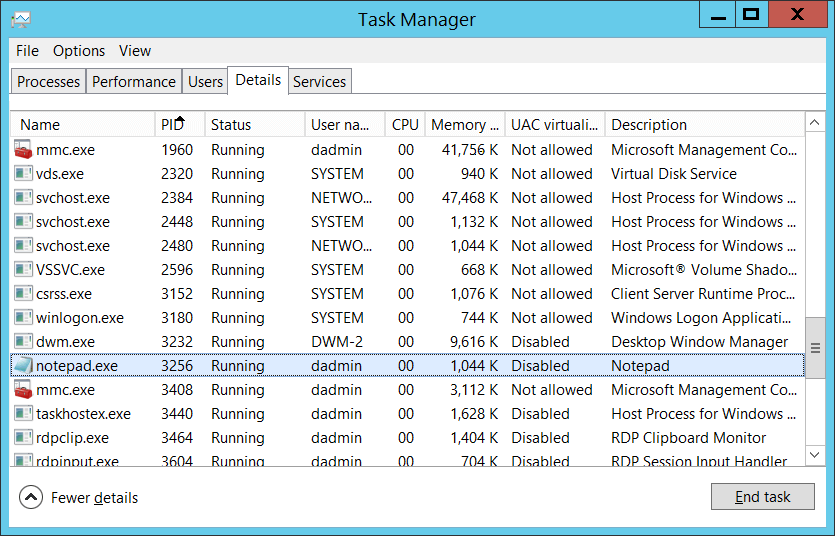
If you convert the hexadecimal value to decimal, you can compare it to the values in Task Manager.
You can also correlate this process ID with a process ID in other events, for example, «4688: A new process has been created» Process Information\New Process ID.
Process Name [Type = UnicodeString]: full path and the name of the executable for the process.
Network Information:
Workstation Name [Type = UnicodeString]: machine name from which a logon attempt was performed.
Source Network Address [Type = UnicodeString]: IP address of machine from which logon attempt was performed.
IPv6 address or ::ffff:IPv4 address of a client.
::1 or 127.0.0.1 means localhost.
Source Port [Type = UnicodeString]: source port which was used for logon attempt from remote machine.
Detailed Authentication Information:
Logon Process [Type = UnicodeString]: the name of the trusted logon process that was used for the logon. See event «4611: A trusted logon process has been registered with the Local Security Authority» description for more information.
Authentication Package [Type = UnicodeString]: The name of the authentication package which was used for the logon authentication process. Default packages loaded on LSA startup are located in «HKLM\SYSTEM\CurrentControlSet\Control\Lsa\OSConfig» registry key. Other packages can be loaded at runtime. When a new package is loaded a «4610: An authentication package has been loaded by the Local Security Authority» (typically for NTLM) or «4622: A security package has been loaded by the Local Security Authority» (typically for Kerberos) event is logged to indicate that a new package has been loaded along with the package name. The most common authentication packages are:
NTLM – NTLM-family Authentication
Kerberos – Kerberos authentication.
Negotiate – the Negotiate security package selects between Kerberos and NTLM protocols. Negotiate selects Kerberos unless it cannot be used by one of the systems involved in the authentication or the calling application did not provide sufficient information to use Kerberos.
Transited Services [Type = UnicodeString] [Kerberos-only]: the list of transmitted services. Transmitted services are populated if the logon was a result of a S4U (Service For User) logon process. S4U is a Microsoft extension to the Kerberos Protocol to allow an application service to obtain a Kerberos service ticket on behalf of a user – most commonly done by a front-end website to access an internal resource on behalf of a user. For more information about S4U, see https://msdn.microsoft.com/library/cc246072.aspx
Package Name (NTLM only) [Type = UnicodeString]: The name of the LAN Manager sub-package (NTLM-family protocol name) that was used during logon. Possible values are:
Only populated if «Authentication Package» = «NTLM».
Key Length [Type = UInt32]: the length of NTLM Session Security key. Typically it has 128 bit or 56 bit length. This parameter is always 0 if «Authentication Package» = «Kerberos», because it is not applicable for Kerberos protocol. This field will also have «0» value if Kerberos was negotiated using Negotiate authentication package.
Security Monitoring Recommendations
For 4624(S): An account was successfully logged on.
| Type of monitoring required | Recommendation |
|---|---|
| High-value accounts: You might have high-value domain or local accounts for which you need to monitor each action. Examples of high-value accounts are database administrators, built-in local administrator account, domain administrators, service accounts, domain controller accounts and so on. | Monitor this event with the «New Logon\Security ID» that corresponds to the high-value account or accounts. |
| Anomalies or malicious actions: You might have specific requirements for detecting anomalies or monitoring potential malicious actions. For example, you might need to monitor for use of an account outside of working hours. | When you monitor for anomalies or malicious actions, use the «New Logon\Security ID» (with other information) to monitor how or when a particular account is being used. |
| Non-active accounts: You might have non-active, disabled, or guest accounts, or other accounts that should never be used. | Monitor this event with the «New Logon\Security ID» that corresponds to the accounts that should never be used. |
| Account allowlist: You might have a specific allowlist of accounts that are the only ones allowed to perform actions corresponding to particular events. | If this event corresponds to an «allowlist-only» action, review the «New Logon\Security ID» for accounts that are outside the allowlist. |
| Accounts of different types: You might want to ensure that certain actions are performed only by certain account types, for example, local or domain account, machine or user account, vendor or employee account, and so on. | If this event corresponds to an action you want to monitor for certain account types, review the «New Logon\Security ID» to see whether the account type is as expected. |
| External accounts: You might be monitoring accounts from another domain, or «external» accounts that are not allowed to perform certain actions (represented by certain specific events). | Monitor this event for the «Subject\Account Domain» corresponding to accounts from another domain or «external» accounts. |
| Restricted-use computers or devices: You might have certain computers, machines, or devices on which certain people (accounts) should not typically perform any actions. | Monitor the target Computer: (or other target device) for actions performed by the «New Logon\Security ID» that you are concerned about. |
| Account naming conventions: Your organization might have specific naming conventions for account names. | Monitor «Subject\Account Name» for names that don’t comply with naming conventions. |
Because this event is typically triggered by the SYSTEM account, we recommend that you report it whenever «Subject\Security ID» is not SYSTEM.
If «Restricted Admin» mode must be used for logons by certain accounts, use this event to monitor logons by «New Logon\Security ID» in relation to «Logon Type«=10 and «Restricted Admin Mode«=»Yes». If «Restricted Admin Mode«=»No» for these accounts, trigger an alert.
If you need to monitor all logon events for accounts with administrator privileges, monitor this event with «Elevated Token«=»Yes».
If you need to monitor all logon events for managed service accounts and group managed service accounts, monitor for events with «Virtual Account«=»Yes».
To monitor for a mismatch between the logon type and the account that uses it (for example, if Logon Type 4-Batch or 5-Service is used by a member of a domain administrative group), monitor Logon Type in this event.
If your organization restricts logons in the following ways, you can use this event to monitor accordingly:
If the user account «New Logon\Security ID» should never be used to log on from the specific Computer:.
If New Logon\Security ID credentials should not be used from Workstation Name or Source Network Address.
If a specific account, such as a service account, should only be used from your internal IP address list (or some other list of IP addresses). In this case, you can monitor for Network Information\Source Network Address and compare the network address with your list of IP addresses.
If a particular version of NTLM is always used in your organization. In this case, you can use this event to monitor Package Name (NTLM only), for example, to find events where Package Name (NTLM only) does not equal NTLM V2.
If NTLM is not used in your organization, or should not be used by a specific account (New Logon\Security ID). In this case, monitor for all events where Authentication Package is NTLM.
If the Authentication Package is NTLM. In this case, monitor for Key Length not equal to 128, because all Windows operating systems starting with Windows 2000 support 128-bit Key Length.
If you monitor for potentially malicious software, or software that is not authorized to request logon actions, monitor this event for Process Name.
If you have a trusted logon processes list, monitor for a Logon Process that is not from the list.