For acquisition of inheritance the successor has to
For acquisition of inheritance the successor has to
For acquisition of inheritance the successor has to
16. George Bernard Shaw said that America and Britain __________________ two nations divided by a common language.
• were
17. Government agencies enforce employment standards codified __________________ labour law.
• by
18. Government agencies enforce employment standards codified by __________________ law.
• labour
19. Governments __________________ many ways of making sure that citizens obey the law.
• have
20. Governments have many ways of making sure that citizens __________________ the law.
• obey
21. Has he __________________ a mistake today?
• made
22. Have they made __________________ tasks today?
• many
23. He asked me what I __________________ by justice.
• understood
24. If I __________________ here, I will come to see you.
• am
25. If I __________________ here, I would come to see you.
• were
26. If I __________________ here, I would have come to see you.
• had been
27. If I __________________ this book, I will tell you about it.
• find
28. If I __________________ this book, I would tell you about it.
• found
29. If I find this book, I __________________ you about it.
• will tell
30. Individual labour law refers to job __________________, health safety or a minimum wage.
• security
Acquisition of inheritance. Concept and signs of acceptance of inheritance
In Russia, inheritance is carried out by law or bywill. The hereditary mass includes things that belonged to the owner on the day of opening the case, and other property. It also includes proprietary rights and duties, with the exception of those that are inextricably linked with the personality of the deceased. Non-property rights and other non-material benefits do not apply to inheritance. 
Features of opening a case
The inheritance is opened in connection with the death of a citizen. When declaring a person in the judicial order the deceased have the same consequences as in the case of the death of the subject.
The day of the opening of the hereditary case is the date of death of the person. If the court declares him dead, the day of entry into force of the decision or the date specified in the resolution is considered to be the court decision.
Right to acquisition of inheritance have physical persons who are alive on the datethe discovery of the case, conceived during the life of the deceased owner and born after his death. Specific successors may be indicated in the will. If there is no such document, inheritance is carried out according to general rules.
How to inherit after the death of a close relative?
Issues related to inheritance are disclosed in Chapters V of the GK section.
For entering into the inheritance it is necessary to collect a package of documents established by regulatory enactments and apply to a notary office within the prescribed period.
Conditions
As one of the main conditions inheritance is its acceptance by successor. An exception is provided for escheat property, transferred to the ownership of the Russian Federation.
Prohibitions
In the 1152 article, a ban on acquisition of inheritance with reservations or terms. The presence of them entails the nullity of a one-sided transaction. Application for inheritance after death The owner must be unconditional and unconditional.
A document filed in violation of the prohibition does not entail the transfer of property to property. Accordingly, a certificate issued on the basis of such an application is considered invalid.
Recognition of inheritance one of the successors entails legal consequencesonly for him. Commitment of actions aimed at the adoption of property does not indicate acceptance of the hereditary mass by other successors. Other persons who are called to inherit, need to be active themselves and turn to notary by heredity or to another person.
Applying
So how to inherit after death a close relative can only be proper heirs, a notary (or other competent citizen) is required to establish all possible successors of the deceased.
The application can be submitted personally, throughrepresentative or sent by mail. If one of the last two options is used, the signature of the applicant must be duly certified. 
Commitment of actions as a method of acceptance of inheritance
This list is considered open.
Meanwhile, conclusive actions can be challenged by interested parties. The burden of refutation, accordingly, rests with these persons.
Term of inheritance acquisition
By common rules, successors must filea statement or carry out conclusive actions within 6 months. from the date of death of the owner of the property. The corresponding provision is fixed in paragraph 1 of Article 1154 of the Civil Code.
Restoration of the inheritance period is allowed by law provided that the following two conditions are met:
For example, ignorance of the fact of discovery by the heiraffairs will be considered an essential circumstance if he should not have known about it. This, in turn, will be determined on the basis of an analysis of regulatory provisions, taking into account the characteristics of the relationship that existed between the successor and the deceased.
If the application for restoration is satisfiedterm and recognition of the subject as an heir, the court must re-determine the shares of all successors in the property. Previously, certificates issued to them are recognized as invalid. The court decision is the basis for registration of new documents.
Transmission
In practice, situations are ofteninheritance subject, dies after the opening of the case, not having time to take the inheritance. His rights in this case go to his heirs by law. If all values have been bequeathed, then his successors will be entitled by will. 
Documentation
For example, before entering into the inheritance after the death of the father, the son / daughter must collect the following package of documents:
The first two documents are presented in the original with copy applications.
If inheritance is by will, thenit is necessarily included in the list of securities. At the same time, the document should contain a note of the notary who compiled it, that the content was not changed and was not canceled, but the new will was not drawn up.
If a trusted person acts on the applicant, documents are attached that testify to the availability of the relevant authorities. For example, before how to get an inheritance on behalf of an adult, to a representativethe power of attorney is issued. If the minor is a successor, the documents certifying the representation under the law (birth certificate, the decision of the guardianship / trusteeship body) are provided.
The norms of Ch. 63 of the Civil Code
Successors of the subsequent group enter intoinheritance, if in the previous groups the successors are absent, do not have the corresponding rights, are suspended from accepting the property, are deprived of the inheritance or have renounced it. 
In one line, inheritance occurs in equal shares, with the exception of succession by right of representation.
The following groups of heirs are established in the norms of the Civil Code:
Right of representation
Part of the successor by law, who died before the opening of the case, passes to his descendants and is divided equally among them. The exception is the descendants of unworthy heirs.
Adopted, his children, grandchildren and so on,the adoptive parent, and also his relatives are considered blood relatives. Adopted, his offspring can not inherit by law the property belonging to his biological parents. As well as the latter are not heirs of their child, adopted by others, after his death.
Mandatory share
It is envisaged for inheritance bywill. The following persons have the right to compulsory share: disabled children (minors) of the deceased owner, his spouse, parents, dependents. They are entitled to at least 0.5 share of the part that would be due to them in case of inheritance by law. This rule applies regardless of the contents of the will.
The right to such a share must be satisfied froman unauthorized part of the property, even if this entails a decrease in the rights of the other successors under the law. If an unaccounted share is not enough, the obligatory part is provided from the bequeathed mass. 
Certificate
Registration of this document is recognized as a notarial act. The certificate of the right to inheritance is given at the place of opening the case.
As the basis for its execution is the statement of the successor. When passing the rights to escheat, the certificate is issued at the request of the relevant state structure.
By common rules, the document is issued to successors inany time after six months from the date of opening the case. An exception is the case when there is reliable information about the absence of other proper heirs. Reliability of information must be evaluated by a notary.
Controversial issues
If for the acceptance of the inheritance the person has committedconcluding acts and provided documents that unequivocally prove them, but he was refused to issue the certificate, he has the right to file a complaint. It is considered in the manner provided for challenging notarial actions or refusing to do so.
Если наследник, совершивший указанные действия, there are no supporting documents, and it is not possible to receive them, he submits an application, the proceedings are conducted according to the rules for resolving cases on the establishment of legally significant facts.
If a dispute arises over disputes about civil law, it is considered within the scope of the lawsuit proceedings, and not special.
Measures for the protection and management of inheritance
They are provided to ensure the protection of the rights of successors, legatees and other stakeholders (for example, creditors of the deceased owner).
Inheritance by will: general provisions
Право на распоряжение имуществом на случай смерти can be realized only through the execution of a will. The subject of law in this case is a person who has legal capacity at the time of writing the last will.
A will is a one-sided transaction made personally by the owner. Document processing through a trustee is not allowed.
The law does not provide for the possibility of drafting one will by several persons.
The rights and obligations under the document arise only after the discovery of the inheritance case.
Liberty of will
The owner has the right to dispose of propertytheir own discretion. He can bequeath the values of any entity, determine any of their shares in the hereditary mass. The testator has the right to deprive anyone or all successors under the law of property rights, without giving reasons for their decision. In the will may be present and other orders of the owner. The only restriction on freedom of last will is the rules that provide for an obligatory share.
The owner can not tell anyone about the contentlast will, change or cancellation. The will can be executed in favor of both one and several subjects who are or are not successors under the law.
Inheritance of inheritance
He, like the acquisition of inheritance, is recognized as a one-sided transaction.
Refusal can be made both with an indicationsubjects in whose favor it is carried out, so without it. The person concerned can use his right during the period envisaged for the acceptance of the inheritance.
The law allows the refusal of the already receivedproperty. In this case, the possibility of restoring a missed period in a judicial procedure is provided. However, this procedure can be applied if the subject has accepted the inheritance by performing conclusive acts.
Refusal is considered irrevocable. It can not be withdrawn or changed subsequently.
Number of subjects for whose benefit it is allowedrefusal, limited. These may include successors to the will or laws. The unworthy heirs who are deprived of the right (not having the right) to inherit, dismissed from the case by a court decision, are not included in this circle of subjects.
In paragraph 1 of Article 1158 of the Civil Code, a ban onrejection of inherited property in favor of other entities, if all values are bequeathed to successors appointed by the owner. This instruction is aimed at ensuring the fulfillment of the will of the testator about the distributed shares of property.
The refusal of an obligatory share inbenefit another subject. The following limitation is made. The establishment of an obligatory share in the law is a way of limiting the freedom of will. It is aimed at protecting persons identified in the 1149 article of the Civil Code. The will of a successor who refuses such a share can not be regarded as sufficient grounds for limiting the scope of freedom of will.
In case of violation of the lawprohibitions refusal in favor of another person is recognized as invalid. In this case, there are consequences similar to those that arise when the inheritance is not accepted.
Additionally
Between the heirs there may be a dispute about what values should be considered household items. Such issues are resolved in court in the light of the circumstances of the case and local customs.
Objects of use are not considered antiquarian things, objects that have artistic or other value. Their purpose in this case does not matter.
For acquisition of inheritance the successor has to
31. Is the right to education __________________ by any documents?
• guaranteed
32. Is there __________________ snow in the street?
• much
33. Labor rights __________________ integral to the social and economic development since the Industrial Revolution.
• have been
34. Many people do not find it easy __________________ the laws.
• to read
35. My friend said that he __________________ just come.
• had
36. My friend was sure that we __________________ the film 2 days before.
• had seen
37. Not having a job when a person __________________ one, makes it difficult for him to meet financial obligations such as buying food for him and his family, and paying his bills.
• needs
38. Not having a job when a person needs one, makes it difficult for him __________________ financial obligations such as buying food for him and his family, and paying his bills.
• to meet
39. Our teacher asked us __________________ late.
• not to be
40. She __________________ this dress herself.
• made
41. She asked us __________________ in time.
• to come
42. She wanted to find out how I __________________ the end of punishment.
• understood
43. Some doctors think the airplane is a dangerous place, especially for __________________ or the unhealthy.
• the old
45. The English also say that they have three variants of weather when it __________________ in the morning, when it rains in the afternoon or when it rains all day long.
• rains
For acquisition of inheritance the successor has to
47. There are __________________ people here.
• a lot of
48. Typically there __________________ three stages of education: primary (or elementary) education, secondary and higher education.
• are
49. Unemployment is the condition of not __________________ a job, being “out of work”, or unemployed.
• having
50. We __________________ our best yesterday.
• did
51. We knew it __________________ raining.
• was
52. We were informed they would __________________ by this time.
• have done
53. We’ll find __________________ interesting things in the bag.
• a lot of
54. What __________________ laws?
• are
55. What __________________ the best way of avoiding employment problems in your future life?
• is
56. Where __________________ you get the weather forecast ([fо:ka:st] — прогноз погоды) from?
• do
57. Where have seen so __________________ theatres?
• many
58. Who has __________________ it in time?
• done
59. Why did he decide __________________ a report at once?
• to make
60. You see __________________ money on the table.
• much
For acquisition of inheritance the successor has to
I now reach the most difficult and obscure part of the subject. It remains to be discovered whether the fiction of identity was extended to others besides the heir and executor. And if we find, as we do, that it went but little farther in express terms, the question will still arise whether the mode of thought and the conceptions made possible by the doctrine of inheritance have not silently modified the law as to dealings between the living. It seems to me demonstrable that their influence has been profound, and that, without understanding the theory of inheritance, it is impossible to understand the theory of transfer inter vivos.
[354] The difficulty in dealing with the subject is to convince the sceptic that there is anything to explain. Nowadays, the notion that a right is valuable is almost identical with the notion that it may be turned into money by selling it. But it was not always so. Before you can sell a right, you must be able to make a sale thinkable in legal terms. I put the case of the transfer of a contract at the beginning of the Lecture. I have just mentioned the case of gaining a right by prescription, when neither party has complied with the requirement of twenty years’ adverse use. In the latter instance, there is not even a right at the time of the transfer, but a mere fact of ten years’ past trespassing. A way, until it becomes a right of way, is just as little susceptible of being held by a possessory title as a contract. If then a contract can be sold, if a buyer can add the time of his seller’s adverse user to his own, what is the machinery by which the law works out the result?
The most superficial acquaintance with any system of law in its earlier stages will show with what difficulty and by what slow degrees such machinery has been provided, and how the want of it has restricted the sphere of alienation. It is a great mistake to assume that it is a mere matter of common sense that the buyer steps into the shoes of the seller, according to our significant metaphor. Suppose that sales and other civil transfers had kept the form of warlike capture which it seems that they had in the infancy of Roman law, /1/ and which was at least [355] partially retained in one instance, the acquisition of wives, after the transaction had, in fact, taken the more civilized shape of purchase. The notion that the buyer came in adversely to the seller would probably have accompanied the fiction of adverse taking, and he would have stood on his own position as founding a new title. Without the aid of conceptions derived from some other source, it would have been hard to work out a legal transfer of objects which did not admit of possession.
A possible source of such other conceptions was to be found in family law. The principles of inheritance furnished a fiction and a mode of thought which at least might have been extended into other spheres. In order to prove that they were in fact so extended, it will be necessary to examine once more the law of Rome, as well as the remains of German and Anglo-Saxon customs.
I will take up first the German and Anglo-Saxon laws which are the ancestors of our own on one side of the house. For although what we get from those sources is not in the direct line of the argument, it lays a foundation for it by showing the course of development in different fields.
The obvious analogy between purchaser and heir seems to have been used in the folk-laws, but mainly for another purpose than those which will have to be considered in the English law. This was to enlarge the sphere of alienability. It will be remembered that there are many traces of family ownership in early German, as well as in early Roman law; and it would seem that the transfer [356] of property which originally could not be given outside the family, was worked out through the form of making the grantee an heir.
The history of language points to this conclusion. Heres, as Beseler /1/ and others have remarked, from meaning a successor to the property of a person deceased, was extended to the donee mortis causa, and even more broadly to grantees in general. Hereditare was used in like manner for the transfer of land. Hevin is quoted by Laferriere /2/ as calling attention to the fact that the ancient usage was to say heriter for purchase, heritier for purchaser, and desheriter for sell.
The texts of the Salic law give us incontrovertible evidence. A man might transfer the whole or any part of his property /3/ by delivering possession of it to a trustee who, within twelve months, handed it over to the beneficiaries. /4/ To those, the text reads, whom the donor has named heredes (quos heredes appellavit). Here then was a voluntary transfer of more or less property at pleasure to persons freely chosen, who were not necessarily universal successors, if they ever were, and who nevertheless took under the name heredes. The word, which must have meant at first persons taking by descent, was extended to persons taking by purchase. /5/ If the word became enlarged in meaning, it is probably because the thought which it conveyed was turned to new uses. The transaction seems [357] to have fallen half-way between the institution of an heir and a sale. The later law of the Ripuarian Franks treats it more distinctly from the former point of view. It permits a man who has no sons to give all his property to whomsoever he chooses, whether relatives or strangers, as inheritance, either by way of adfathamire, as the Salic form was called, or by writing or delivery. /1/
The Lombards had a similar transfer, in which the donee was not only called heres, but was made liable like an heir for the debts of the donor on receiving the property after the donor’s death. /2/2 By the Salic law a man who could not pay the wergeld was allowed to transfer formally his house-lot, and with it the liability. But the transfer was to the next of kin. /3/
The house-lot or family curtilage at first devolved strictly within the limits of the family. Here again, at least in England, freedom of alienation seems to have grown up by gradually increased latitude in the choice of successors. If we may trust the order of development to be noticed in the early charters, which it is hard to believe [358] accidental, although the charters are few, royal grants at first permitted an election of heirs among the kindred, and then extended it beyond them. In a deed of the year 679, the language is, «as it is granted so do you hold it and your posterity.» One a century later reads, «which let him always possess, and after his death leave to which of his heirs he will.» Another, «and after him with free power (of choice) leave to the man of his kin to whom he wishes to» (leave it). A somewhat earlier charter of 736 goes a step further: «So that as long as he lives he shall have the power of holding and possessing (and) of leaving it to whomsoever he choose, either in his lifetime, or certainly after his death.» At the beginning of the ninth century the donee has power to leave the property to whomsoever he will, or, in still broader terms, to exchange or grant in his lifetime, and after his death to leave it to whom he chooses, or to sell, exchange, and leave to whatsoever heir he chooses. /1/ This choice of heirs [359] recalls the quos heredes appellavit of the Salic law just mentioned, and may be compared with the language of a Norman charter of about the year 1190: «To W. and his heirs, to wit those whom he may constitute his heirs.» /1/
A perfect example of a singular succession worked out by the fiction of kinship is to be found in the story of Burnt Njal, an Icelandic saga, which gives us a living picture of a society hardly more advanced than the Salian Franks, as we see them in the Lex Salica. A lawsuit was to be transferred by the proper plaintiff to another more versed in the laws, and better able to carry it on, in fact, to an attorney. But a lawsuit was at that time the alternative of a feud, and both were the peculiar affair of the family concerned. /2/ Accordingly, when a suit for killing a member of the family was to be handed over to a stranger, the innovation had to be reconciled with the theory that such suit belonged only to the next of kin. Mord is to take upon himself Thorgeir’s suit against Flosi for killing Helgi, and the form of transfer is described as follows.
«Then Mord took Thorgeir by the hand and named two witnesses to bear witness, ‘that Thorgeir Thofir’s son hands me over a suit for manslaughter against Flosi Thord’s son, to plead it for the slaying of Helgi Njal’s son, with all those proofs which have to follow the suit. Thou handest over to me this suit to plead and to settle, and to enjoy all rights in it, as though I were the rightful next of kin. Thou handest it over to me by law; and I [360] take it from thee by law.'» Afterwards, these witnesses come before the court, and bear witness to the transfer in like words: «He handed over to him then this suit, with all the proofs and proceedings which belonged to the suit, he handed it over to him to plead and to settle, and to make use of all rights, as though he were the rightful next of kin. Thorgeir handed it over lawfully, and Mord took it lawfully.» The suit went on, notwithstanding the change of hands, as if the next of kin were plaintiff. This is shown by a further step in the proceedings. The defendant challenges two of the court, on the ground of their connection with Mord, the transferee, by blood and by baptism. But Mord replies that this is no good challenge; for «he challenged them not for their kinship to the true plaintiff, the next of kin, but for their kinship to him who pleaded the suit.» And the other side had to admit that Mord was right in his law.
I now turn from the German to the Roman sources. These have the closest connection with the argument, because much of the doctrine to be found there has been transplanted unchanged into modern law.
The early Roman law only recognized as relatives those who would have been members of the same patriarchal family, and under the same patriarchal authority, had the common ancestor survived. As wives passed into the families of their husbands, and lost all connection with that in which they were born, relationship through females was altogether excluded. The heir was one who traced his relationship to the deceased through males alone. With the advance of civilization this rule was changed. The praetor gave the benefits of the inheritance to the blood relations, although they were not heirs, and could [361] not be admitted to the succession according to the ancient law. /1/ But the change was not brought about by repealing the old law, which still subsisted under the name of the jus civile. The new principle was accommodated to the old forms by a fiction. The blood relation could sue on the fiction that he was an heir, although he was not one in fact. /2/
One the early forms of instituting an heir was a sale of the familia or headship of the family to the intended heir, with all its rights and duties. /3/ This sale of the universitas was afterwards extended beyond the case of inheritance to that of bankruptcy, when it was desired to put the bankrupt’s property into the hands of a trustee for distribution. This trustee also could make use of the fiction, and sue as if he had been the bankrupt’s heir. /4/ We are told by one of the great jurisconsults that in general universal successors stand in the place of heirs. /5/
The Roman heir, with one or two exceptions, was always a universal successor; and the fiction of heirship, as such, could hardly be used with propriety except to enlarge the sphere of universal successions. So far as it extended, however, all the consequences attached to the original fiction of identity between heir and ancestor followed as of course.
[362] To recur to the case of rights acquired by prescription, every universal successor could add the time of his predecessor’s adverse use to his own in order to make out the right. There was no addition, legally speaking, but one continuous possession.
The express fiction of inheritance perhaps stopped here. But when a similar joinder of times was allowed between a legatee or devisee (legatarius) and his testator, the same explanation was offered. It was said, that, when a specific thing was left to a person by will, so far as concerned having the benefit of the time during which the testator had been in possession for the purpose of acquiring a title, the legatee was in a certain sense quasi an heir. /1/ Yet a legatarius was not a universal successor, and for most purposes stood in marked contrast with such successors. /2/
Thus the strict law of inheritance had made the notion familiar that one man might have the advantage of a position filled by another, although it was not filled, or was only partially filled, by himself; and the second fiction, by which the privileges of a legal heir in this respect as well as others had been extended to other persons, broke down the walls which might otherwise have confined those privileges to a single case. A new conception was introduced into the law, and there was nothing to hinder its further application. As has been shown, it was applied in terms to a sale of the universitas for business purposes, and to at least one case where the succession was confined to a single specific thing. Why, then, might not every gift or sale be regarded as a succession, so far as to insure the same advantages?
[363] The joinder of times to make out a title was soon allowed between buyer and seller, and I have no doubt, from the language always used by the Roman lawyers, that it was arrived at in the way I have suggested. A passage from Scaevola (B. C. 30) will furnish sufficient proof. Joinder of possessions, he says, that is, the right to add the time of one’s predecessor’s holding to one’s own, clearly belongs to those who succeed to the place of others, whether by contract or by will: for heirs and those who are treated as holding the place of successors are allowed to add their testator’s possession to their own. Accordingly, if you sell me a slave I shall have the benefit of your holding. /1/
The joinder of times is given to those who succeed to the place of another. Ulpian cites a like phrase from a jurisconsult of the time of the Antonines, «to whose place I have succeeded by inheritance, or purchase, or any other right.» /2/ Succedere in locum aliorum, like sustinere personam, is an expression of the Roman lawyers for those continuations of one man’s legal position by another of which the type was the succession of heir to ancestor. Suecedere alone is used in the sense of inherit, /3/ and successio in that of «inheritance.» /4/ The succession par excellence was the inheritance; and it is believed that scarcely any instance will be found in the Roman sources where «succession» does not convey that analogy, and indicate the partial [364] assumption, at least, of a persona formerly sustained by another. It clearly does so in the passage before us.
But the succession which admits a joinder of times is not hereditary succession alone. In the passage which has been cited Scaevola says that it may be by contract or purchase, as well as by inheritance or will. It may be singular, as well as universal. The jurists often mention antithetically universal successions and those confined to a single specific thing. Ulpian says that a man succeeds to another’s place, whether his succession be universal or to the single object. /1/
If further evidence were wanting for the present argument, it would be found in another expression of Ulpian’s. He speaks of the benefit of joinder as derived from the persona of the grantor. «He to whom a thing is granted shall have the benefit of joinder from the persona of his grantor.» /2/ A benefit cannot be derived from a persona except by sustaining it.
It farther appears pretty plainly from Justinian’s Institutes and the Digest, that the benefit was not extended to purchasers in all cases until a pretty late period. /3/
Savigny very nearly expressed the truth when he said, somewhat broadly, that «every accessio, for whatever purpose, presupposes nothing else than a relation of juridical [365] succession between the previous and present possessor. For succession does not apply to possession by itself.» /1/ And I may add, by way of further explanation, that every relation of juridical succession presupposes either an inheritance or a relation to which, so far as it extends, the analogies of the inheritance may be applied.
The way of thinking which led to the accessio or joinder of times is equally visible in other cases. The time during which a former owner did not use an casement was imputed to the person who had succeeded to his place. /2/ The defence that the plaintiff had sold and delivered the thing in controversy was available not only to the purchaser, but to his heirs or to a second purchaser, even before delivery to him, against the successors of the seller, whether universal or only to the thing in question. /3/ If one used a way wrongfully as against the predecessor in title, it was wrongful as against the successor, whether by inheritance, purchase, or any other right. /4/ The formal oath of a party to an action was conclusive in favor of his successors, universal or singular. /5/ Successors by purchase or gift had the [366] benefit of agreements made with the vendor. /1/ A multitude of general expressions show that for most purposes, whether of action or defence, the buyer stood in the shoes of the seller, to use the metaphor of our own law. /2/ And what is more important than the result, which often might have been reached by other ways, the language and analogies are drawn throughout from the succession to the inheritance.
Thus understood, there could not have been a succession between a person dispossessed of a thing against his will and the wrongful possessor. Without the element of consent there is no room for the analogy just explained. Accordingly, it is laid down that there is no joinder of times when the possession is wrongful, /3/ and the only enumerated means of succeeding in rem are by will, sale, gift, or some other right.
In a word, it is equally clear that the continuous possession of privies in title, or, in Roman phrase, successors, has all the effect of the continuous possession of one, and that such an effect is not attributed to the continuous possession of different persons who are not in the same chain of title. One who dispossesses another of land cannot add the time during which his disseisee has used a way to the period of his own use, while one who purchased can. /2/
The authorities which have been quoted make it plain that the English law proceeds on the same theory as the Roman. One who buys land of another gets the very same estate which his seller had. He is in of the same fee, or hereditas, which means, as I have shown, that he sustains the same persona. On the other hand, one who wrongfully dispossesses another, a disseisor, gets a different estate, is in of a new fee, although the land is the same; and much technical reasoning is based upon this doctrine.
In the matter of prescription, therefore, buyer and seller were identified, like heir and ancestor. But the question [369] remains whether this identification bore fruit in other parts of the law also, or whether it was confined to one particular branch, where the Roman law was grafted upon the English stock.
There can be no doubt which answer is most probable, but it cannot be proved without difficulty. As has been said, the heir ceased to be the general representative of his ancestor at an early date. And the extent to which even he was identified came to be a matter of discussion. Common sense kept control over fiction here as elsewhere in the common law. But there can be no doubt that in matters directly concerning the estate the identification of heir and ancestor has continued to the present day; and as an estate in fee simple has been shown to be a distinct persona, we should expect to find a similar identification of buyer and seller in this part of the law, if anywhere.
Where the land was devised by will, the analogy applied with peculiar ease. For although there is no difference in principle between a devise of a piece of land by will and a conveyance of it by deed, the dramatic resemblance of a devisee to an heir is stronger than that of a grantee. It will be remembered that one of the Roman jurists said that a legatarius (legatee or devisee) was in a certain sense quasi heres. The English courts have occasionally used similar expressions. In a case where a testator owned a rent, and divided it by will among his sons, and then one of the sons brought debt for his part, two of the judges, while admitting that the testator could not have divided the tenant’s liability by a grant or deed in his lifetime, thought that it was otherwise with regard to a division by will. Their reasoning was that «the devise is quasi [370] an act of law, which shall inure without attornment, and shall make a sufficient privity, and so it may well be apportioned by this means.» /1/ So it was said by Lord Ellenborough, in a case where a lessor and his heirs were entitled to terminate a lease on notice, that a devisee of the land as heres factus would be understood to have the same right. /2/
But wills of land were only exceptionally allowed by custom until the reign of Henry VIII., and as the main doctrines of conveyancing had been settled long before that time, we must look further back and to other sources for their explanation. We shall find it in the history of warranty. This, and the modern law of covenants running with the land, will be treated in the next Lecture.
For acquisition of inheritance the successor has to
In general, inherits is similar to the son inheriting the property of the father, but this explanation is not accurate, because the father gave the property to his son, his father didn’t, but in the object of JavaScript, inherited more like master and apprentice Relationship, Master teaches the apprentice in his life, and the apprentice learned, but the master did not lose anything, this is the inheritance of JavaScript-oriented object.
Second.
Next, there are several inheritance methods, and their pros and cons:
Protected chain inheritance
principle:Point the prototype object of the Parent to GAOBW, so that Parent’s instantiated object can also inherit the properties of GAOBW
shortcoming:Doing this, there will be inheritance chain disorders, TC is created by constructor farent (). But after inheriting, it will find that TC constructor is not in Farent, but GAOBW.
Workaround: Manual Correct Inheritance Chain
The result final result:
The instantiation of Parent inherits the properties of GAOBW and also proves that it is an instantiated object of Parent. 
2. Inherited directly with prototype
Effect: You can let Parent () skip GAOBW (), directly inherit GAOBW.Prototype
Advantages: high efficiency is relatively high (unforgettable and establishing the instance of Person)
shortcoming:
1. Will still use the inheritance chain disorder, need to modify the inheritance chain
2. Because the Paretn prototype object points to the prototype object of GAOBW, the PARETN modifies the value of the prototype object, and the value of the GAOBW prototype object is also modified, and when the successor modifies the inherited properties, the attribute of the successor will be Tamper, very unreasonable)
3. Use an empty object as an intermediary
Effect: Create an empty constructor to make the prototype object of this empty constructor accept the properties of the GAOBW prototype object
Then, in the instantiation of the prototype object to the Parent, this Parent is not affected when changing the inherited content.
Package method
Will use the method of empty construction function as a medium to package convenient
Three. Construct Function Binds Call && APPLY
Disadvantages: Call can only inherit the attribute of the successor itself, can not inherit the Prototype properties
2.apply
Apply is the same as the inheritance method and mechanism of CALL, and the difference is that Apply needs to write one [], in [] in [], and Call directly, separable value
3. Combination inheritance
1. Combination inherit is also called pseudo-classic inheritance
2. Inherit the original chain inheritance and constructor inheritage in one piece
3. Prototype chain to achieve inheritance of prototyping attributes and methods
4. Borrowing the constructor to achieve inheritance of instance properties
Solving the problem with Call and Apply only inherited the properties of the constructor itself
IV. Prototype chain
1. When the object access attributes and methods, they will find their own, if they don’t go to the prototype. (Level 1 level is formed in the original chain)
2. First, look from itself, it doesn’t look like a parent element, the parent element is not looking like Object, Object has no error
3. The protocol will follow the principle of approach, and will look at the close
Английский язык в сфере юриспруденции Тест Синергия

A person cannot be a partner if
Отметьте правильный вариант ответа:
it is a limited company
he or she is a minor
he or she is an enemy alien
A consent of the principal …
Отметьте правильный вариант ответа:
must be given in written form
is to be given by deed
can be verbal, in writing or by deed
The mortgagor may create
Отметьте правильный вариант ответа:
only one mortgage over the same property
second and subsequent mortgages over the same property
not more than two mortgages over the same property
Employees are entitled to notice which could be a month …
Отметьте правильный вариант ответа:
for senior managers
for other managers
for senior clerical workers
The Monopolies and Mergers Commission consists of.
Отметьте правильный вариант ответа:
three members
not less than 10 members
not more than 30 members
Fiduciary duties of employees are implied into a contract of employment
Отметьте правильный вариант ответа:
by the common law
by statute
are not implied
A shareholder of a public company can sell his shares freely…
Отметьте правильный вариант ответа:
if other shareholders agree
if majority shareholder gives his consent
if the shares are dealt with on the Stock Exchange or the AIM
If a minority shareholder does not agree with the majority…
Отметьте правильный вариант ответа:
the majority must agree with him
he must accept the decision of the majority
the court will support him
Leasehold estate which incudes the renewable yearly lease is …
Отметьте правильный вариант ответа:
the “term of years”
the “estate by sufferance”
the “estate at will”
A holder of bearer shares becomes a member of the company…
Отметьте правильный вариант ответа:
automatically
if Articles of the company allow that
according to the decision of the directors of the company
A mortgage is void against a subsequent purchaser
Отметьте правильный вариант ответа:
if it is legal without title deed
if it is not registered in the Land Charges Registry
if it is not legal
Directors of a public company can be appointed.
Отметьте правильный вариант ответа:
at the age under 70
at the age under 60
at any age
General agents have …
Отметьте правильный вариант ответа:
unlimited authority
authority for a specific purpose
authority to act within certain limits
In case of trespass to land the duty is owed …
Отметьте правильный вариант ответа:
to the possessor if he is the owner
to the owner
to the possessor even if he is not the owner
In a bankruptcy the estate of an insolvent person passes…
Отметьте правильный вариант ответа:
into the control of a trustee
into the control of the creditors
into the control of the bankruptcy court
A shareholder has the right.
Отметьте правильный вариант ответа:
to sell the assets of the company
to give instructions to the directors of the company
to receive a proportion of the profits of the company
A subsidiary company is owned.
Отметьте правильный вариант ответа:
by а partnership
by а sole trader
by а holding company
The East India Company was created.
Отметьте правильный вариант ответа:
by Royal Charter
under Companies Act
by special Act of Parliament
The highest court of appeal in Britain is.
Отметьте правильный вариант ответа:
Civil Court of Appeal
House of Lords
Criminal Court of Appeal
Public limited companies can have…
Отметьте правильный вариант ответа:
two directors
no directors
one director
Agency of necessity can arise on condition that …
Отметьте правильный вариант ответа:
there is some emergency
the person charged with responsibility can get instructions from the owner of the property
there are no pre-existing contracts giving the agent responsibility for the property of another
The bankruptcy order is published in.
Отметьте правильный вариант ответа:
the Business Week
the London Gazette
the Financial Times
The bankruptcy petition can be presented by.
Отметьте правильный вариант ответа:
а creditor
the trustee
а magistrate
A company which develops a new product, protects this invention
Отметьте правильный вариант ответа:
by an insurance policy
by a share certificate
by а patent
The capital clause of the Memorandum states.
Отметьте правильный вариант ответа:
the authorized Capital
the capital assets
the actual capital raised
Ratification of the contract can be possible if
Отметьте правильный вариант ответа:
it takes place after the time fixed for the performance of the contract
it concerns a part of the contract
the contract is not void or a forgery
Things which are capable of physical possession are uncluded into …
Отметьте правильный вариант ответа:
intangible property
incorporeal property
tangible property
The loan agreement provides for repayment of loan plus interest …
Отметьте правильный вариант ответа:
exactly by the legal date of redemption
at any time subject to no restrictions
at any time subject to reasonable restrictions
A mortgage can be set aside
Отметьте правильный вариант ответа:
if the presumption of undue influence has been rebutted in the Court
can never be set aside
if it has been obtained by undue influence
The rights of inheritance are unrestricted in case of
Отметьте правильный вариант ответа:
fee tail estate
life estate
fee simple estate
Dismissal of an employee is considered fair if the reason is …
Отметьте правильный вариант ответа:
redundancy
that the employee is a member of an independent trade union
pregnancy
If a partner secretly carries on a competing business, he…
Отметьте правильный вариант ответа:
must sell that business
must pay to the firm all profits made by him in that business
will be expelled
Fiduciary duties are owed …
Отметьте правильный вариант ответа:
by buyers to sellers
by sales clerks to the customers
by employees to their employers
The major source of the English law which takes precedence over the others is…
Отметьте правильный вариант ответа:
European Community law
case law
legislation
The employer must provide written statement of the following terms
Отметьте правильный вариант ответа:
pension rights
provision of safe tools and equipment
maternity rights
Trading in a name similar to that of another similar business affects
Отметьте правильный вариант ответа:
reputation
economic rights
general rights
According to the contract, the goods must be transferred…
Отметьте правильный вариант ответа:
for securities
for other goods
for money
Legal rights attach to.
Отметьте правильный вариант ответа:
corporations only
natural persons only
natural and artificial persons
If the principal refuses to ratify the transaction…
Отметьте правильный вариант ответа:
no one will be liable for damages
the agent will be liable for damages
the principal will be liable for damages
Choses capable of negotiation are classified as negotiable instruments and include…
Отметьте правильный вариант ответа:
postal orders
bills of lading
bills of exchange
The term ‘goods» includes all «chattels personal» that are…
Отметьте правильный вариант ответа:
immovable
intangible
tangible
To control rogue dealers, the DG may bring proceedings.
Отметьте правильный вариант ответа:
in the Restrictive Practices Court
in the Crown Court
in the High Court
Sole trader.
Отметьте правильный вариант meta:
has limited liability
shares losses with the people he employs
is liable for all his debts
The Register of the Company must be kept.
Отметьте правильный вариант meta:
in the office of the CEO
in the residence of the majority shareholder
at the registered office
Companies limited by shares are usually set up for…
Отметьте правильный вариант ответа:
charitable purposes
trading purposes
educational purposes
Клуб студентов «Технарь». Уникальный сайт с дипломами и курсовыми для технарей.
Все разделы / Иностранные языки /
Ответы Синергия. Иностранный язык в сфере юриспруденции. Тест 2021
Тип работы: Тесты
Сдано в учебном заведении: МФПУ «Синергия»
Описание:
1. Contracts for the sale of goods include …
· agreements to sell
· contracts of bailment
· contracts for hire of goods
2. The power to order that a merger shall not go ahead lies with.
· the Monopolies and Mergers Commission
· the Director General of Fair Trading
· the Secretary of State
3. A shareholder of a public company can sell his shares freely.
· if other shareholders agree
· if majority shareholder gives his consent
· if the shares are dealt with on the Stock Exchange or the AIM
· only one mortgage over the same property
· not more than two mortgages over the same property
· second and subsequent mortgages over the same property
· for senior managers
· for other managers
· for senior clerical workers
7. When the land is owned by a company.
· there must be registration of the equitable mortgage
· there must be registration of both legal and equitable mortgages
· О registration of a mortgage is not necessary
8. Private limited companies cannot raise money…
· by inviting other members
9. The secretary of a private company…
· must be qualified as a chartered secretary, an accountant or a lawyer
· must have work experience as a company secretary
· need not have any personal qualifications
10. The bankruptcy petition can be presented by…
11. To take part in the management of a registered company, a bankrupt must get…
· the trustee’s consent
· the creditors’ consent
12. If the principal refuses to ratify the transaction.
· the agent will be liable for damages
· the principal will be liable for damages
· no one will be liable for damages
14. If a minority shareholder does not agree with the majority.
· the majority must agree with him
· the court will support him
· he must accept the decision of the majority
· the «estate by sufferance»
· the «estate at will»
· has limited liability
· is liable for all his debts
· shares losses with the people he employs
17. A person cannot be a partner if.
· it is a limited company
· he or she is an enemy alien
· he or she is a minor
18. A consent of the principal.
· is to be given by deed
· must be given in written form
· can be verbal, in writing or by deed
19. The Monopolies and Mergers Commission consists of.
· not more than 30 members
· not less than 10 members
20. Fiduciary duties of employees are implied into a contract of employment.
21. A holder of bearer shares becomes a member of the company.
· if Articles of the company allow that
· according to the decision of the directors of the company
22. A mortgage is void against a subsequent purchaser.
· if it is not legal
· if it is legal without title deed
· if it is not registered in the Land Charges Registry
23. Directors of a public company can be appointed.
· at the age under 60
· at the age under 70
24. Choose the right ending of the sentence
· authority for a specific purpose
· authority to act within certain limits
· to the possessor if he is the owner
· to the possessor even if he is not the owner
26. In a bankruptcy the estate of an insolvent person passes.
· into the control of the bankruptcy court
· into the control of a trustee
· into the control of the creditors
27. A shareholder has the right.
· to receive a proportion of the profits of the company
· to sell the assets of the company
· to give instructions to the directors of the company
28. A bankrupt must disclose his status if he wants to obtain.
· a credit of more than 50 pounds sterling
· a credit of 250 pounds or more
31. A subsidiary company is owned.
· by a holding company
32. The East India Company was created.
· by special Act of Parliament
· under Companies Act
33. Agency of necessity can arise on condition that.
· the person charged with responsibility can get instructions to the owner of the property
· there is some emergency
· there are no pre-existing contracts giving the agent responsibility for the property of another
34. The bankruptcy order is published in.
· the Financial Times
· the London Gazette
· by a share certificate
· by an insurance policy
36. The capital clause of the Memorandum states.
· the actual capital raised
· the authorized capital
· the capital assets
37. Ratification of the contract can be possible if.
· it concerns a part of the contract
· it takes place after the time fixed for the performance of the contract
· the contract is not void or a forgery
38. The loan agreement provides for repayment of loan plus interest.
· exactly by the legal date of redemption
· at any time subject to reasonable restrictions
· at any time subject to no restrictions
39. A mortgage can be set aside
· if it has been obtained by undue influence
· if the presumption of undue influence has been rebutted in the Court
· can never be set aside
40. The rights of inheritance are unrestricted in case of.
41. Dismissal of an employee is considered fair if the reason is.
· that the employee is a member of an independent trade union
42. If a partner secretly carries on a competing business, he. in
· must pay to the firm all profits made by him in that business
· must sell that business
· by buyers to sellers
· by employees to their employers
· by sales clerks to the customers
44. The major source of the English law which takes precedence over the others is…
· European Community law
· provision of safe tools and equipment
47. According to the contract, the goods must be transferred…
48. Legal rights attach to…
· natural persons only
· natural and artificial persons
49. The Register of the Company must be kept.
· in the residence of the majority shareholder
· in the office of the CEO
· at the registered office
50. Companies limited by shares are usually set up for…
51. A director of a public company can be disqualified.
· by a majority shareholder
· by the annual meeting of shareholder
52. A separate legal person is created in setting up business as…
· a registered company
53. Partnership can be set up between persons carrying on a business.
· for charitable purpose
· only for receiving profits
· of the contract for service
· of the contract for labor and materials
· of the contract for the sale of goods
56. An employer must make a redundancy payment to an employee who has been employed…
57. A statement of law is binding for future similar disputes if.
· it is based on a hypothesis
· it forms the basis of the decision
· is made by the way
28. Preference shareholders have the right.
· to receive a fixed dividend prior to ordinary shareholders
· to receive an unlimited dividend
· to receive surplus assets
59. The following products are excluded to liability under the Consumer Protection Act:
61. Allowing water to escape to reservoirs is a tort affecting…
62. Supervising trading practices is one of the main duties of.
· the Consumer Protection Advisory Committee
· the Monopolies and Mergers Commission
· the Director General of Fair Trading
63. The Department of Trade and Industry may appoint inspectors.
· on the application of members holding not less than one tenth of the shares.
· on the application of 1 shareholder
· on the application of 100 shareholders
64. To control rogue dealers, the DG may bring proceedings.
· in the Restrictive Practices Court
· in the Crown Court
65. The highest court of appeal in Britain is.
· Civil Court of Appeal
· Criminal Court of Appeal
66. Public limited companies can have…
Комментарии: Сборник ответов на тест Синергия
Ответы выделены в документе
66 вопросов 70+ баллов
Скачано: 52 Коментариев: 0
Некоторые похожие работы:
Спеши, предложение ограничено !
Вход в аккаунт:
Cодержание / Иностранные языки / Ответы Синергия. Иностранный язык в сфере юриспруденции. Тест 2021
Inheritance in Poland

Law of Succession in Poland
Succession rules in Poland
Acceptance or rejection of an inheritance
| Simple acceptance of inheritance | heir is liable for all debts left behind by the deceased, whatever their value or the value of the estate |
| Acceptance of an inheritance with the benefit of inventory | heir’s liability for the deceased person’s debts is limited to the value of the assets received; the estate’s value is determined based on an official estate inventory or an estate inventory compiled individually |
| Rejection of inheritance | heir is treated as if they predeceased the opening of the inheritance and, therefore, loses their rights and obligations under the estate |
| Absence of declaration within 6 months | heir is deemed as accepted with the benefit of inventory. |
Form and content of a declaration of acceptance or rejection of an inheritance
A declaration of acceptance or disclaimer of an inheritance may be made orally or in writing (with an officially authenticated signature) with a civil-law notary or before a court during the proceedings to ascertain the acquisition of an inheritance or to take an oral declaration of acceptance or disclaimer of the inheritance. This declaration may also be filed through an attorney. A declaration of acceptance or disclaimer of an inheritance should contain information provided for by the Polish Code of Civil Procedure.
Acceptance or rejection of an inheritance by a minor
Acceptance or disclaimer of an inheritance through an attorney
An heir, as far as they have full capacity for acts in law, may file a declaration of acceptance or disclaimer of an inheritance either personally or through an attorney. A power of attorney to file such a declaration should be made in writing with authenticated signature. It should clearly indicate the authority to file a declaration of accepting an inheritance in a specific manner or disclaiming thereof.
6 months time limit for acceptance / rejection of inheritance
Temporary inheritance – prior to acceptance / rejection of inheritance
Effects of filing a declaration of acceptance of an inheritance
Inheritance confirmation options
Court inheritance confirmation in Poland
In the court option it is the court who determines a circle of persons entitled to inherit the deceased person’s estate by way of inheritance.
What is interesting, neither the Polish Civil Code nor any other legal acts require such a procedure, but it certainly is in the heir’s interest as the court ascertainment of the acquisition of an inheritance is a document that will have to be presented to third parties in order to confirm the heir’s right to administer the deceased person’s estate. It will allow the heir to recover the amounts due to them, make changes in land and mortgage registers (i.e. property register) or the National Court Register (i.e. company register) and register a car to someone else.
The application for inheritance ascertainment
Such an application must list all potential heirs as participants. In addition, it is necessary to present all the circumstances of the case and indicate whether the inheritance is acquired under the laws of intestacy or a will.
The proceedings of an inheritance ascertainment
Decision on the acquisition of an inheritance
Court jurisdiction
Notarial certificate of inheritance
Notarial certificate of inheritance was introduced in Poland back in 2008 as an alternative to court proceedings to have the acquisition of an inheritance ascertained. A certificate confirming the acquisition of an inheritance and a notarial certificate of inheritance are two documents that produce the same legal effect. However, we will obtain a notarial certificate of inheritance immediately after a civil-law notary has carried out all the actions, which will significantly facilitate and speed up the settlement of inheritance matters after the death of the deceased. It must be noted that a notarial certificate of inheritance covers both intestate and testate succession. It does not, however, cover extraordinary wills and therefore only applies to written wills, wills made in the form of a notarial deed and wills made before a competent state authority.
Proceedings before a civil-law notary
A notarial certificate of inheritance may be drawn up on the basis of a joint application of all the persons who may be considered intestate or testate heirs. If they are in dispute, a civil-law notary will not be able to certify the inheritance and the heirs will need to initiate court proceedings. It should be noted that even if all heirs are in agreement, a civil-law notary will not certify the inheritance in every case. A reason for a civil-law notary’s refusal to draw up a certificate of inheritance is, e.g., the civil-law notary’s doubt as to the potential heir, their share in the estate or jurisdiction of Polish bodies to settle the inheritance.
A written record of inheritance and the certificate of inheritance
A time limit to issue a certificate of inheritance
A certificate of inheritance cannot be issued sooner than six months from the opening of the succession if the known heirs failed to file a declaration of acceptance or disclaimer of an inheritance. Such a declaration can be made both to court and to a civil-law notary. If the deceased person has left a will, a civil-law notary also opens and reads out the document, of which a separate record is made.
Inheritance based on foreign court rulings
It should be noted that if the inherited assets include real estate located in Poland, then regardless of who the deceased person was and what their citizenship was, the courts exclusively competent to hear those cases will be the Polish courts. In practice this means that succession proceedings in this respect must be conducted in Poland.
As a consequence, a foreign court ruling concerning, e.g., the ascertainment of the acquisition of this particular real estate by inheritance cannot be recognized in Poland.
Inheritance of debts
Oftentimes, an indebted person fails to settle all of their debts before they die. In that case, the debts are inherited together with the estate of the deceased. An heir’s liability for estate debts may differ. It depends on whether the heir made a declaration of acceptance or disclaimer of the estate and which it was, whether the period concerned is the one prior to or after the acceptance of the estate, whether more than one heir has been called to succession and whether the estate has already been divided. The liability of an heir means that a creditor of the estate, that is, a person to whom the deceased owed money or a person for whom certain claims arose as a result of the opening of the succession, may enforce the amounts due to them against the assets of the heir in the event the heir fails to voluntarily fulfill their obligation to satisfy a claim.
Inheriting debts and assets is a right and not an obligation of an heir. This means that once the succession is opened upon the deceased person’s death, a person entitled to inherit the estate can:
Each heir has the right to decide individually if they accept or disclaim an inheritance. The decision must be made within 6 months of learning about a title to succession. As of October 18th, 2015, the absence of an heir’s declaration within this period is tantamount to accepting an inheritance with the benefit of inventory. To determine what assets belong to the inheritance and what their value is, an official estate inventory or an estate inventory having a form of a private document is compiled.
Liability for estate debts prior to accepting an inheritance
As per the Polish law, until an inheritance is accepted, the heir’s liability for the estate debts is limited to the value of the estate. Therefore, with respect to the heir’s liability, the estate is treated separately from the heir’s personal property. The liability borne by the heir is limited to the value of the estate and the debts may not be enforced against their personal property.
Liability for estate debts after accepting an inheritance
The acceptance of an inheritance, either by making a specific declaration or, in the absence thereof, by the operation of a legal fiction, makes the acquisition of an inheritance definitive. The heir’s liability also changes. They are now liable for the estate debts with their property.
Division of an inheritance and liability for the estate debts
Until an inheritance is divided, the heirs are jointly and severally liable for the estate debts. In practice, it means that the testator’s creditor may seek the whole or partial payment due to them from all or some of the heirs jointly or from each of them individually. If one of the heirs, as a result of a legal action, satisfies such a creditor, they may demand that the other heirs reimburse the respective portions of the payment made, more specifically, the portions that correspond to their respective shares of the estate.
The moment the inheritance is divided, the heirs become liable for the estate debts proportionately to their shares in the estate. If the division was made by the court, this will be when a ruling on the division of the inheritance becomes final and non-appealable and if the division was made by way of an agreement between the parties – when such an agreement is made. However, the above applies only when the division of the entire estate has been made. When the creditor wants to have their claim satisfied in full, they will be forced to sue all the heirs – each of them individually for the part of the estate debt they have inherited.
Estate inventory taken individually and official estate inventory
The heirs who have decided to accept an inheritance with the benefit of inventory divide the estate based on an official estate inventory or an estate inventory taken individually.
Estate inventory taken individually
An estate inventory taken individually, sometimes referred to as a “private” estate inventory may be submitted by an heir accepting an inheritance with the benefit of inventory, a legatee by vindication and an executor of a will. Submission of an estate inventory is a right and not an obligation of the above persons. In practice, however, an estate inventory taken individually will be compiled and submitted only if the estate contains debts and an heir wants the limits of their liability to be clearly determined. An estate inventory taken individually that is filed with a court must be compiled in accordance with the prescribed form. The competent court is a probate court or a court with jurisdiction over the place of residence of a person filing the inventory.
An estate inventory taken individually may also be submitted to a civil-law notary and then included in the record. At the request of an heir, a legatee by vindication, an executor of a will or an interim representative (tymczasowy przedstawiciel), the record including an estate inventory taken individually shall be drawn up by a civil-law notary. Then, the copy of the record is forwarded to a probate court.
A person compiling an estate inventory individually must exercise due diligence. They should, therefore, undertake actions intended to determine the assets and liabilities forming part of the estate. Moreover, they should establish whether the testator made any legacies by vindication and what the objects thereof are. If any of the testator’s obligations are not included in the inventory – then, once they are revealed, an heir will bear full liability for such obligations, even if they have accepted the inheritance with the benefit of inventory.
An estate inventory may be completed by a person submitting it. It is possible provided that new assets of the estate, objects of a legacy by vindication or estate debts are disclosed.
Drawing up of the inventory and submitting it to a court is free of charge. If the estate inventory is filed with a civil-law notary – the maximum notary fee for drawing up the record is PLN 200 net + VAT.
Official estate inventory
An official estate inventory is an official document compiled by a court enforcement officer following a court’s decision that an official estate inventory be taken, on an application of a person who proves to be an heir, a forced heir or a legatee, an executor of a will or a creditor with written proof of claims against the testator. The application is lodged with a probate court, which issues a decision to take an official estate inventory. The application may also be filed directly with a court enforcement officer competent to follow the court’s decision to take the inventory.
An official estate inventory taken by a court enforcement officer must contain a list of assets of the estate, objects of legacies by vindication and estate debts with the value thereof. A court enforcement officer is also obligated to determine and demonstrate the value of the estate assets, taking account of the things and rights in dispute. The value of the estate assets determined in an official estate inventory sets the limit of an heir’s liability.
If, after the inventory is made, a doubt arises as to whether all the assets of the estate and objects of legacies by vindication have been included in it and whether the debts listed in the inventory actually exist, a court, ex officio or upon an application of an heir, legatee by vindication, executor of the will, interim representative or creditor of the estate who proves that the estate assets disclosed in the inventory are insufficient to cover the estate debts, may order an heir to submit:
An heir’s liability is no longer limited if the heir, acting deceitfully, has failed to recognize the assets of the estate or objects of legacies by vindication in an estate inventory compiled individually or disclose them for the purpose of an official estate inventory or has included the non-existent estate debts in an estate inventory compiled individually or disclosed them for the purpose of an official estate inventory. If, however, the heir failed to disclose certain assets of the estate due to lack of knowledge, their liability remains limited.
Taking an official estate inventory is subject to court and court enforcement officer fees – a court fee for an application is PLN 100 and a fixed fee charged by a court enforcement officer is PLN 400. On top of that, there are cash expenses incurred by a court enforcement officer, if any, when carrying out their actions, and it may also deem necessary to pay for valuation made by property adjusters.
For acquisition of inheritance the successor has to
61. Верна ли грамматическая конструкция в данных предложениях?
A) A city dweller needs shelter from cold and heat and theft.
B) A city dweller needs shelter cold and heat and theft.
• A — да, B — нет
62. Верна ли грамматическая конструкция в данных предложениях?
A) A person whom gives you a job is an employer.
B) A person who gives you a job is an employer.
• A — нет, B — да
63. Верна ли грамматическая конструкция в данных предложениях?
A) A prisoner is a person that is put into prison.
B) A prisoner is a person whom is put into prison.
• A — да, B — нет
64. Верна ли грамматическая конструкция в данных предложениях?
A) A right to education has been created and recognized by some jurisdictions.
B) Typically there are three stages of education: primary (or elementary) education, secondary and higher education.
• A — да, B — да
65. Верна ли грамматическая конструкция в данных предложениях?
A) All over the world people think of land as the most important form of property.
B) A farmer needs a secure right to use a piece of land in order to grow food for his family.
• A — да, B — да
66. Верна ли грамматическая конструкция в данных предложениях?
A) Ann said that she will do it herself.
B) Ann said that she would do it herself.
• A — нет, B — да
67. Верна ли грамматическая конструкция в данных предложениях?
A) Ann say that she will do it herself.
B) Ann said that she will do it self.
• A — нет, B — нет
68. Верна ли грамматическая конструкция в данных предложениях?
A) British and American English have lots of words which looks the same but have different meanings.
B) Most of the differences between British English and American English are minor and are only concern with vocabulary, spelling and pronunciation.
• A — нет, B — нет
69. Верна ли грамматическая конструкция в данных предложениях?
A) By justice we understand nothing more than that bond which is necessary to keep the interest of individuals united, without which men would return to their original state of barbarity.
B) If we look into history we shall find that laws are conventions between men in a state of freedom.
• A — да, B — да
70. Верна ли грамматическая конструкция в данных предложениях?
A) Can boys of this age go to prison?
B) The police carry guns.
• A — да, B — да
71. Верна ли грамматическая конструкция в данных предложениях?
A) Can you even be sure that the seller is the true owner the land and entitled to sell it to you?
B) When was the diplomat kidnapped?
• A — нет, B — да
72. Верна ли грамматическая конструкция в данных предложениях?
A) Crimes can be thought of as acts which the state considers being wrong and which can be punished by the state.
B) There are some acts which are crimes in one country but not in another.
• A — да, B — да
73. Верна ли грамматическая конструкция в данных предложениях?
A) Criminal law is the body of rules that defines conduct that is prohibited by the state because it may threaten, harm or otherwise endanger the safety and welfare of the public.
B) Criminal law is the body of rules that define conduct that is prohibited by the state because it may threaten, harm or otherwise endanger the safety and welfare of the public.
• A — да, B — нет
74. Верна ли грамматическая конструкция в данных предложениях?
A) Criminal law offences viewed as offences against not just individual victims, but the community as well.
B) Criminal law offences are viewed as offences against not just individual victims, but the community as well.
• A — нет, B — да
For acquisition of inheritance the successor has to
106. Верна ли грамматическая конструкция в данных предложениях?
A) The most common problem is jet lag.
B) Is flying the safest way to travel?
• A — да, B — да
107. Верна ли грамматическая конструкция в данных предложениях?
A) The police has many functions in the legal process.
B) The police have many functions in the legal process.
• A — нет, B — да
108. Верна ли грамматическая конструкция в данных предложениях?
A) There are two broad category of labour law.
B) There is two broad categories of labour law.
• A — нет, B — нет
109. Верна ли грамматическая конструкция в данных предложениях?
A) There is capital punishment for some crimes.
B) Do you often walk in areas which are not very safe?
• A — да, B — да
110. Верна ли грамматическая конструкция в данных предложениях?
A) What actions prohibited by Criminal Law?
B) Criminal law sets out punishment for those who breaks the law, doesn’t it?
• A — нет, B — нет
111. Верна ли грамматическая конструкция в данных предложениях?
A) What are laws?
B) No man can judged a criminal until he is found guilty, can he?
• A — да, B — нет
112. Верна ли грамматическая конструкция в данных предложениях?
A) What breakable thing are there on your table?
B) Is his handwriting readable?
• A — нет, B — да
113. Верна ли грамматическая конструкция в данных предложениях?
A) What did the judgment cause?
B) What are the type of the business contracts?
• A — да, B — нет
114. Верна ли грамматическая конструкция в данных предложениях?
A) What doctor treats teeth?
B) Do you like egoists?
• A — да, B — да
115. Верна ли грамматическая конструкция в данных предложениях?
A) What forms of consumer credit agreement you know?
B) How do you understand HP?
• A — нет, B — да
116. Верна ли грамматическая конструкция в данных предложениях?
A) What is the meaning of the English word “education”?
B) What is the main sense of education in general?
• A — да, B — да
117. Верна ли грамматическая конструкция в данных предложениях?
A) What is the role of the court in maintaining (поддержание) law and order?
B) Can ignorance of the law be a defense for breaking it?
• A — да, B — да
118. Верна ли грамматическая конструкция в данных предложениях?
A) What problem face our society now?
B) Violence has become an accepted way of life, has it?
• A — нет, B — нет
119. Верна ли грамматическая конструкция в данных предложениях?
A) What was the verdict for the students?
B) What the prosecution say about him?
• A — да, B — нет
120. Верна ли грамматическая конструкция в данных предложениях?
A) When and where was the murder committed?
B) What were the police looking for?
• A — да, B — да
For acquisition of inheritance the successor has to
76. Верна ли грамматическая конструкция в данных предложениях?
A) Do you wear expensive watch or expensive jewellery?
B) Do you lock doors and windows before you leave the house?
• A — нет, B — да
77. Верна ли грамматическая конструкция в данных предложениях?
A) Does Criminal Law make any moral judgment on an offender?
B) What is the normal punishment for a crime in our country?
• A — да, B — да
78. Верна ли грамматическая конструкция в данных предложениях?
A) Employment standards are social norms for the minimum socially acceptable conditions under which employees or contractors will work.
B) Government agencies enforce employment standards codified by labour law.
• A — да, B — да
79. Верна ли грамматическая конструкция в данных предложениях?
A) Even healthy people find it difficult to concentrate after hours of breathing less oxygen than usual.
B) People with bad colds will probably get earache during take-off and landing.
• A — да, B — да
80. Верна ли грамматическая конструкция в данных предложениях?
A) Even if you feel well when you get the plane, you will possibly feel ill when you get off.
B) Sitting on a plane for many hour gives everyone aches and pains, so you should take some exercise, especially on long flights.
• A — нет, B — да
81. Верна ли грамматическая конструкция в данных предложениях?
A) Have governments some ways of making sure that citizens obey the law?
B) What are police forces use for?
• A — нет, B — нет
82. Верна ли грамматическая конструкция в данных предложениях?
A) How many intruders were there according the police?
B) A big police investigation was under way north London after a wealthy businessman died when intruders broke into his luxury home.
• A — нет, B — нет
83. Верна ли грамматическая конструкция в данных предложениях?
A) I wish you were here.
B) I wish you was here.
• A — да, B — нет
84. Верна ли грамматическая конструкция в данных предложениях?
A) If he called me, I will invite him.
B) If he calls me, I would invite him.
• A — нет, B — нет
85. Верна ли грамматическая конструкция в данных предложениях?
A) If he calls me, I will invite him.
B) If he called me, I will invite him.
• A — да, B — нет
86. Верна ли грамматическая конструкция в данных предложениях?
A) If it had snowed, we will go skiing.
B) If it had snowed, we would have gone skiing yesterday.
• A — нет, B — да
87. Верна ли грамматическая конструкция в данных предложениях?
A) If it snows, we will go skiing.
B) If it snowed, we will go skiing.
• A — да, B — нет
88. Верна ли грамматическая конструкция в данных предложениях?
A) If it snows, we would go skiing.
B) If it snows, we would have gone skiing.
• A — нет, B — нет
89. Верна ли грамматическая конструкция в данных предложениях?
A) If you come to me, I will go for a walk with you.
B) If you came to me, I will go for a walk with you.
• A — да, B — нет
90. Верна ли грамматическая конструкция в данных предложениях?
A) If you come to me, I would go for a walk with you.
B) If you cаme to me, I will go for a walk with you.
• A — нет, B — нет
Тест по дисциплине «Английский язык в профессиональной деятельности» для АНО ПО ОСЭК
Вопрос 1
Вопрос 2
Вопрос 3
Вопрос 4
Вопрос 5
Вопрос 6
Вопрос 7
Вопрос 8
Вопрос 9
Вопрос 10
Вопрос 11
Вопрос 12
Вопрос 13
Вопрос 14
Вопрос 15
Оставить комментарий

Inna Petrova 18 минут назад
Нужно пройти преддипломную практику у нескольких предметов написать введение и отчет по практике так де сдать 4 экзамена после практики

Иван, помощь с обучением 25 минут назад
Inna Petrova, здравствуйте! Мы можем Вам помочь. Прошу Вас прислать всю необходимую информацию на почту и написать что необходимо выполнить. Я посмотрю описание к заданиям и напишу Вам стоимость и срок выполнения. Информацию нужно прислать на почту info@the-distance.ru
Здравствуйте, сколько будет стоить данная работа и как заказать?
Иван, помощь с обучением 2 часа назад
Николай, здравствуйте! Мы можем Вам помочь. Прошу Вас прислать всю необходимую информацию на почту и написать что необходимо выполнить. Я посмотрю описание к заданиям и напишу Вам стоимость и срок выполнения. Информацию нужно прислать на почту info@the-distance.ru
Инкогнито 5 часов назад
Сделать презентацию и защитную речь к дипломной работе по теме: Источники права социального обеспечения. Сам диплом готов, пришлю его Вам по запросу!
Иван, помощь с обучением 6 часов назад
Здравствуйте! Мы можем Вам помочь. Прошу Вас прислать всю необходимую информацию на почту и написать что необходимо выполнить. Я посмотрю описание к заданиям и напишу Вам стоимость и срок выполнения. Информацию нужно прислать на почту info@the-distance.ru
Василий 12 часов назад
Здравствуйте. ищу экзаменационные билеты с ответами для прохождения вступительного теста по теме Общая социальная психология на магистратуру в Московский институт психоанализа.
Иван, помощь с обучением 12 часов назад
Василий, здравствуйте! Мы можем Вам помочь. Прошу Вас прислать всю необходимую информацию на почту и написать что необходимо выполнить. Я посмотрю описание к заданиям и напишу Вам стоимость и срок выполнения. Информацию нужно прислать на почту info@the-distance.ru
Анна Михайловна 1 день назад
Нужно закрыть предмет «Микроэкономика» за сколько времени и за какую цену сделаете?
Иван, помощь с обучением 1 день назад
Анна Михайловна, здравствуйте! Мы можем Вам помочь. Прошу Вас прислать всю необходимую информацию на почту и написать что необходимо выполнить. Я посмотрю описание к заданиям и напишу Вам стоимость и срок выполнения. Информацию нужно прислать на почту info@the-distance.ru
Сергей 1 день назад
Здравствуйте. Нужен отчёт о прохождении практики, специальность Государственное и муниципальное управление. Планирую пройти практику в школе там, где работаю.
Иван, помощь с обучением 1 день назад
Сергей, здравствуйте! Мы можем Вам помочь. Прошу Вас прислать всю необходимую информацию на почту и написать что необходимо выполнить. Я посмотрю описание к заданиям и напишу Вам стоимость и срок выполнения. Информацию нужно прислать на почту info@the-distance.ru
Добрый день! Учусь на 2 курсе по специальности земельно-имущественные отношения. Нужен отчет по учебной практике. Подскажите, пожалуйста, стоимость и сроки выполнения?
Иван, помощь с обучением 1 день назад
Инна, здравствуйте! Мы можем Вам помочь. Прошу Вас прислать всю необходимую информацию на почту и написать что необходимо выполнить. Я посмотрю описание к заданиям и напишу Вам стоимость и срок выполнения. Информацию нужно прислать на почту info@the-distance.ru
Студент 2 дня назад
Здравствуйте, у меня сегодня начинается сессия, нужно будет ответить на вопросы по русскому и математике за определенное время онлайн. Сможете помочь? И сколько это будет стоить? Колледж КЭСИ, первый курс.
Иван, помощь с обучением 2 дня назад
Здравствуйте! Мы можем Вам помочь. Прошу Вас прислать всю необходимую информацию на почту и написать что необходимо выполнить. Я посмотрю описание к заданиям и напишу Вам стоимость и срок выполнения. Информацию нужно прислать на почту info@the-distance.ru
Требуется сделать практические задания по математике 40.02.01 Право и организация социального обеспечения семестр 2
Иван, помощь с обучением 2 дня назад
Ольга, здравствуйте! Мы можем Вам помочь. Прошу Вас прислать всю необходимую информацию на почту и написать что необходимо выполнить. Я посмотрю описание к заданиям и напишу Вам стоимость и срок выполнения. Информацию нужно прислать на почту info@the-distance.ru
Иван, помощь с обучением 3 дня назад
Вика, здравствуйте! Мы можем Вам помочь. Прошу Вас прислать всю необходимую информацию на почту и написать что необходимо выполнить. Я посмотрю описание к заданиям и напишу Вам стоимость и срок выполнения. Информацию нужно прислать на почту info@the-distance.ru
Игорь Валерьевич 3 дня назад
здравствуйте. помогите пройти итоговый тест по теме Обновление содержания образования: изменения организации и осуществления образовательной деятельности в соответствии с ФГОС НОО
Иван, помощь с обучением 3 дня назад
Игорь Валерьевич, здравствуйте! Мы можем Вам помочь. Прошу Вас прислать всю необходимую информацию на почту и написать что необходимо выполнить. Я посмотрю описание к заданиям и напишу Вам стоимость и срок выполнения. Информацию нужно прислать на почту info@the-distance.ru
Пройти 7 тестов в личном кабинете. Сооружения и эксплуатация газонефтипровод и хранилищ
Иван, помощь с обучением 4 дня назад
Вадим, здравствуйте! Мы можем Вам помочь. Прошу Вас прислать всю необходимую информацию на почту и написать что необходимо выполнить. Я посмотрю описание к заданиям и напишу Вам стоимость и срок выполнения. Информацию нужно прислать на почту info@the-distance.ru
Кирилл 4 дня назад
Здравствуйте! Нашел у вас на сайте задачу, какая мне необходима, можно узнать стоимость?
Иван, помощь с обучением 4 дня назад
Кирилл, здравствуйте! Мы можем Вам помочь. Прошу Вас прислать всю необходимую информацию на почту и написать что необходимо выполнить. Я посмотрю описание к заданиям и напишу Вам стоимость и срок выполнения. Информацию нужно прислать на почту info@the-distance.ru
Требуется пройти задания первый семестр Специальность: 10.02.01 Организация и технология защиты информации. Химия сдана, история тоже. Сколько это будет стоить в комплексе и попредметно и сколько на это понадобится времени?
Иван, помощь с обучением 4 дня назад
Oleg, здравствуйте! Мы можем Вам помочь. Прошу Вас прислать всю необходимую информацию на почту и написать что необходимо выполнить. Я посмотрю описание к заданиям и напишу Вам стоимость и срок выполнения. Информацию нужно прислать на почту info@the-distance.ru
Валерия 5 дней назад
Иван, помощь с обучением 5 дней назад
Валерия, здравствуйте! Мы можем Вам помочь. Прошу Вас прислать всю необходимую информацию на почту и написать что необходимо выполнить. Я посмотрю описание к заданиям и напишу Вам стоимость и срок выполнения. Информацию нужно прислать на почту info@the-distance.ru
Инкогнито 5 дней назад
Иван, помощь с обучением 5 дней назад
Здравствуйте! Мы можем Вам помочь. Прошу Вас прислать всю необходимую информацию на почту и написать что необходимо выполнить. Я посмотрю описание к заданиям и напишу Вам стоимость и срок выполнения. Информацию нужно прислать на почту info@the-distance.ru
Защита дипломной дистанционно, «Синергия», Направленность (профиль) Информационные системы и технологии, Бакалавр, тема: «Автоматизация приема и анализа заявок технической поддержки
Иван, помощь с обучением неделю назад
Иван, здравствуйте! Мы можем Вам помочь. Прошу Вас прислать всю необходимую информацию на почту и написать что необходимо выполнить. Я посмотрю описание к заданиям и напишу Вам стоимость и срок выполнения. Информацию нужно прислать на почту info@the-distance.ru
Дарья неделю назад
Необходимо написать дипломную работу на тему: «Разработка проекта внедрения CRM-системы. + презентацию (слайды) для предзащиты ВКР. Презентация должна быть в формате PDF или формате файлов PowerPoint! Институт ТГУ Росдистант. Предыдущий исполнитель написал ВКР, но работа не прошла по антиплагиату. Предыдущий исполнитель пропал и не отвечает. Есть его работа, которую нужно исправить, либо переписать с нуля.

The power to order that a merger shall not go ahead lies with.
the Monopolies and Mergers Commission
the Director General of Fair Trading
the Secretary of State+
3. A shareholder of a public company can sell his shares freely.
if other shareholders agree
if majority shareholder gives his consent
if the shares are dealt with on the Stock Exchange or the AIM+
6. When the land is owned by a company.
there must be registration of the equitable mortgage
there must be registration of both legal and equitable mortgages+
О registration of a mortgage is not necessary
7. Contracts for the sale of goods include …
agreements to sell+
contracts of bailment
contracts for hire of goods
8. Private limited companies cannot raise money…
by selling shares
by making loans
by inviting other members+
9. The secretary of a private company…
must be qualified as a chartered secretary, an accountant or a lawyer+
must have work experience as a company secretary
need not have any personal qualifications
10. The bankruptcy petition can be presented by…
a magistrate
the trustee
a creditor+
11. To take part in the management of a registered company, a bankrupt must get…
the trustee’s consent
the court’ consent+
the creditors’ consent
12. If the principal refuses to ratify the transaction.
the agent will be liable for damages+
the principal will be liable for damages
no one will be liable for damages
14. If a minority shareholder does not agree with the majority.
the majority must agree with him
the court will support him
he must accept the decision of the majority+
16. Sole trader.
has limited liability
is liable for all his debts+
shares losses with the people he employs
17. A person cannot be a partner if.
it is a limited company
he or she is an enemy alien+
he or she is a minor
18. A consent of the principal.
is to be given by deed
must be given in written form
can be verbal, in writing or by deed+
19. The Monopolies and Mergers Commission consists of.
three members
not more than 30 members
not less than 10 members+
20. Fiduciary duties of employees are implied into a contract of employment.
by the common law
are not implied
by statute+
21. A holder of bearer shares becomes a member of the company.
if Articles of the company allow that
according to the decision of the directors of the company
automatically+
22. A mortgage is void against a subsequent purchaser.
if it is not legal+
if it is legal without title deed
if it is not registered in the Land Charges Registry
23. Directors of a public company can be appointed.
at any age
at the age under 60
at the age under 70+
26. In a bankruptcy the estate of an insolvent person passes.
into the control of the bankruptcy court
into the control of a trustee+
into the control of the creditors
27. A shareholder has the right.
to receive a proportion of the profits of the company+
to sell the assets of the company
to give instructions to the directors of the company
28. A bankrupt must disclose his status if he wants to obtain.
a credit
a credit of more than 50 pounds sterling
a credit of 250 pounds or more+
31. A subsidiary company is owned.
by a sole trader
by a partnership
by a holding company+
32. The East India Company was created.
by Royal Charter
by special Act of Parliament+
under Companies Act
33. Agency of necessity can arise on condition that.
the person charged with responsibility can get instructions from the owner of the property+
there is some emergency
there are no pre-existing contracts giving the agent responsibility for the property of another
34. The bankruptcy order is published in.
the Business Week
the Financial Times
the London Gazette+
36. The capital clause of the Memorandum states.
the actual capital raised
the authorized capital+
the capital assets
37. Ratification of the contract can be possible if.
it concerns a part of the contract
it takes place after the time fixed for the performance of the contract+
the contract is not void or a forgery
38. The loan agreement provides for repayment of loan plus interest.
exactly by the legal date of redemption+
at any time subject to reasonable restrictions
at any time subject to no restrictions
39. A mortgage can be set aside
if it has been obtained by undue influence+
if the presumption of undue influence has been rebutted in the Court
can never be set aside
40. The rights of inheritance are unrestricted in case of.
fee simple estate+
fee tail estate
life estate
41. Dismissal of an employee is considered fair if the reason is.
pregnancy
redundancy
that the employee is a member of an independent trade union+
42. If a partner secretly carries on a competing business, he. in
will be expelled
must pay to the firm all profits made by him in that business+
must sell that business
44. The major source of the English law which takes precedence over the others is…
legislation
European Community law
case law+
47. According to the contract, the goods must be transferred…
for money+
for securities
for other goods
48. Legal rights attach to…
natural persons only
corporations only
natural and artificial persons+
49. The Register of the Company must be kept.
in the residence of the majority shareholder
in the office of the CEO
at the registered office+
50. Companies limited by shares are usually set up for…
charitable purposes
trading purposes+
educational purposes
51. A director of a public company can be disqualified.
by a majority shareholder
by the annual meeting of shareholder
by the court+
52. A separate legal person is created in setting up business as…
a sole trader
a partnership
a registered company+
53. Partnership can be set up between persons carrying on a business.
for charitable purpose
only for receiving profits+
for any purpose
56. An employer must make a redundancy payment to an employee who has been employed…
for a month
for a year
for two years+
57. A statement of law is binding for future similar disputes if.
it is based on a hypothesis
it forms the basis of the decision+
is made by the way
28. Preference shareholders have the right.
to receive a fixed dividend prior to ordinary shareholders+
to receive an unlimited dividend
to receive surplus assets
59. The following products are excluded from liability under the Consumer Protection Act:
unprocessed game+
electricity
vapors
61. Allowing water to escape from reservoirs is a tort affecting…
general rights
economic rights+
property
62. Supervising trading practices is one of the main duties of.
the Consumer Protection Advisory Committee
the Monopolies and Mergers Commission
the Director General of Fair Trading+
63. The Department of Trade and Industry may appoint inspectors.
on the application of members holding not less than one tenth of the shares.+
on the application of 1 shareholder
on the application of 100 shareholders
64. To control rogue dealers, the DG may bring proceedings.
in the Restrictive Practices Court+
in the Crown Court
in the High Court
65. The highest court of appeal in Britain is.
Civil Court of Appeal
Criminal Court of Appeal
House of Lords+
66. Public limited companies can have…
one director
two directors+
no directors
Successor Beneficiary RMD Rules After The Death Of The Original Inherited Retirement Account’s Primary Beneficiary
Executive Summary
In December of 2019, Congress passed the Setting Every Community Up For Retirement Enhancement (SECURE) Act, introducing substantial updates to the laws governing retirement accounts. Changes to post-death distribution rules resulted in the death of the ‘stretch’ provision for certain (most) non-spouse Designated Beneficiaries of inherited retirement accounts and introduced a new “10-Year Rule” for account distributions, which have important implications, not just for the Designated Beneficiaries of those retirement accounts, but also for their Successor Beneficiaries as well.
Prior to the passage of the SECURE Act, Designated Beneficiaries of retirement accounts were allowed to ‘stretch’ Required Minimum Distributions (RMDs) from the account over their own life expectancies. However, the SECURE Act eliminated the stretch option for most non-spouse Designated Beneficiaries, and instead, requires the account to be emptied by the end of the 10 th year following the year of the original owner’s death. The SECURE Act, however, also created a new category of beneficiaries – Eligible Designated Beneficiaries – that is still permitted to use the ‘stretch’ provision.
Any of these beneficiaries, of course, could, themselves, die prior to emptying their inherited retirement accounts, leaving the balance to a Successor Beneficiary. Accordingly, there are now three potential scenarios for Successor Beneficiaries of inherited retirement accounts: 1) Successor Beneficiaries of post-SECURE-Act-Eligible Designated Beneficiaries, 2) Successor Beneficiaries of pre-SECURE Act Designated Beneficiaries, and 3) Successor Beneficiaries of post-SECURE Act Non-Eligible Designated Beneficiaries.
In scenarios 1) and 2), Successor Beneficiaries will generally be subject to the full 10-Year Rule. One exception to this is if the post-SECURE Act Eligible Designated Beneficiary (or pre-SECURE Act Designated Beneficiary) is the surviving spouse of the original account owner and dies before the decedent would have been required to begin taking RMDs. In such cases, upon death, they are no longer be considered a “Designated Beneficiary” of the account, but instead, are treated as if they had been the original account owner. Thus, the Successor Beneficiary wouldn’t be treated as a Successor Beneficiary and would not be automatically subject to the 10-Year Rule (i.e., if they were able to qualify as an Eligible Designated Beneficiary, they could qualify to take advantage of the ‘stretch’ provision).
For scenario 3, Successor Beneficiaries who inherit from post-SECURE Act Non-Eligible Designated Beneficiaries are, like other Successor Beneficiaries, subject to the 10-Year Rule; however, unlike other Success Beneficiaries, they will not have their ‘own’ 10-Year timeframe. Instead, their distribution period is a continuation of the 10-Year period that started when the Successor Beneficiary inherited the account.
Although the SECURE Act may negatively impact some Successor Beneficiaries by limiting the time they are allowed to prolong their Required Minimum Distributions, some Successor Beneficiaries may actually be able to benefit from the Act’s changes. In some instances, the number of years a Successor Beneficiary may have to empty their inherited retirement account may be extended, while in other instances, they may simply have a similar amount of time, but more flexibility than was previously allowed prior to the passage of the SECURE Act.
For example, for a Designated Beneficiary who ‘stretched’ RMDs and lives for a long time yet still dies with a substantial account balance, their Successor Beneficiary may have been left with only a few short years to distribute the remaining assets had it been under pre-SECURE Act rules (as they would have been required to use the original beneficiary’s remaining Single Life Expectancy). However, the 10-Year Rule of the SECURE Act now allows these Successor Beneficiaries up to 10 full years to distribute their accounts.
Ultimately, the key point is that while most of the attention on the SECURE Act’s impact on retirement account rules has focused on Primary Beneficiaries, the reality is that Successor Beneficiaries are impacted by the SECURE Act changes as well. While Successor Beneficiaries who inherit accounts from beneficiaries taking RMDs using the ‘stretch’ provision will get the 10-Year Rule (from scratch), some Successor Beneficiaries (i.e., post-SECURE Act beneficiaries of Non-Eligible Designated Beneficiaries) will ‘only’ be able to step into the initial beneficiary’s shoes, and will have to empty the balance of the IRA by the end of the 10-year period established by the original 10-year rule (i.e., the Non-Eligible Designated Beneficiary’s 10-year window). For both the original account beneficiary and their own named Successor Beneficiaries, the SECURE Act has created changes and potential opportunities that impact them both.

Author: Jeffrey Levine, CPA/PFS, CFP®, AIF, CWS®, MSA
Jeffrey Levine, CPA/PFS, CFP, AIF, CWS, MSA is the Lead Financial Planning Nerd for Kitces.com, a leading online resource for financial planning professionals, and also serves as the Chief Planning Officer for Buckingham Strategic Wealth. In 2020, Jeffrey was named to Investment Advisor Magazine’s IA25, as one of the top 25 voices to turn to during uncertain times. Also in 2020, Jeffrey was named by Financial Advisor Magazine as a Young Advisor to Watch. Jeffrey is a recipient of the Standing Ovation award, presented by the AICPA Financial Planning Division for “exemplary professional achievement in personal financial planning services.” He was also named to the 2017 class of 40 Under 40 by InvestmentNews, which recognizes “accomplishment, contribution to the financial advice industry, leadership and promise for the future.” Jeffrey is the Creator and Program Leader for Savvy IRA Planning®, as well as the Co-Creator and Co-Program Leader for Savvy Tax Planning®, both offered through Horsesmouth, LLC. He is a regular contributor to Forbes.com, as well as numerous industry publications, and is commonly sought after by journalists for his insights. You can follow Jeff on Twitter @CPAPlanner.
Read more of Jeff’s articles here.
On December 20, 2019, the Setting Every Community Up for Retirement Enhancement (SECURE) Act was signed into law by President Donald Trump. The law made a number of sweeping changes to the rules for retirement accounts, but the headline news, for many, was the Act’s elimination of the ‘stretch’ option for most non-spouse beneficiaries of inherited retirement accounts.
The SECURE Act’s changes to the post-death distribution rules go deeper than just one beneficiary level, though. Rather, there are significant impacts to both the initial beneficiaries of retirement accounts, as well as Successor Beneficiaries of the same accounts. Advisors must be aware of the rules for both in order to properly guide clients in the coming years.
The SECURE Act’s Changes To The Post-Death Distribution Rules For Designated Beneficiaries Of Retirement Accounts
Prior to the passage of the SECURE Act, the default rule for Designated Beneficiaries (living people, as well as qualifying See-Through Trusts) of a deceased individual’s retirement account was that such beneficiaries would be able to ‘stretch’ distributions over their life expectancy. This ‘Stretch’ provision allowed Designated Beneficiaries – and younger Designated Beneficiaries, in particular – to begin taking relatively small distributions, based on their life expectancy (as calculated using the IRS-provided Single Life Expectancy Table), from inherited retirement accounts beginning in the year after the owner’s death. And while the percentage necessary to withdraw each year under the ‘stretch’ method increases, ‘stretching’ an inherited retirement account often allowed it to continue to grow for many years, and to last for several decades or longer.
For instance, using the ‘stretch’ method, an IRA beneficiary turning 49 years old in the year of the IRA owner’s death needed to begin taking required minimum distributions the following year, in which they turn 50. Furthermore, the Single Life Expectancy Table factor for a 50-year-old is 34.2. Thus, such a beneficiary’s first required minimum distribution would be less than 3% (100 ÷ 34.2 equals 2.92%), and distributions from the account could be ‘stretched’ for as many as 34.2 years!
The SECURE Act, however, eliminated the ‘stretch’ option for most Non-Spouse Designated Beneficiaries. Instead of being able to ‘stretch’ distributions, such beneficiaries now generally fall into a new group of SECURE Act-created beneficiaries, known as Non-Eligible Designated Beneficiaries, who are subject to a new 10-Year Rule that requires them to distribute the entirety of an inherited retirement account by the end of the 10 th year following the year of the original account owner’s death.
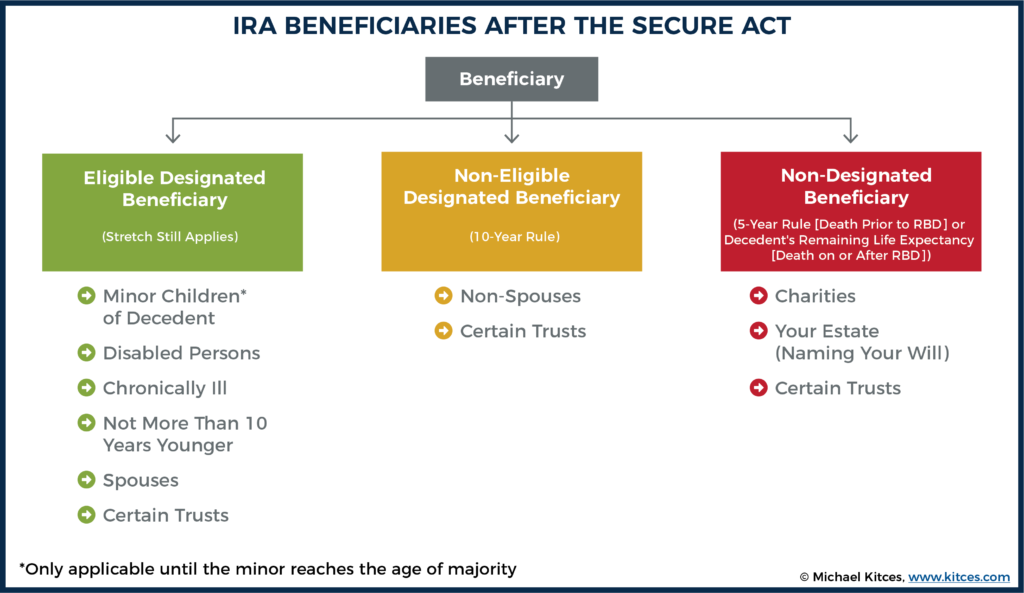
The 10-Year Rule does provide Non-Eligible Designated Beneficiaries some flexibility, though, as there are no requirements other than emptying the account by the end of the 10 th year after the year of the IRA owner’s death (i.e., no distributions of any amount are required in years one through nine after the IRA owner’s death, but voluntarily distributions of any amount are allowed, allowing the owner to make the choice of spreading out the distributions or simply waiting to liquidate the entire account balance in the 10 th year).
Still, other than in the case of a much older Designated Beneficiary (with a Single Life Expectancy Table factor of less than 10), the 10-Year Rule compresses the amount of time over which a Non-Eligible Designated Beneficiary may spread distributions from their inherited retirement account, as compared to the ‘old’ lifetime Stretch rules.
The SECURE Act does, however, provide a limited exception to the changes to the post-death rules for Designated Beneficiaries. More specifically, the SECURE Act creates another new group of beneficiaries, known as Eligible Designated Beneficiaries, which includes spousal beneficiaries, the disabled and chronically ill, beneficiaries who are not more than 10 years younger than the decedent, and certain minor children, who are exempt from the 10-Year Rule as outlined above, and who may still utilize the ‘stretch’.

Nerd Note:
Certain See-Through Trusts drafted to benefit individuals who fall into one or more of the groups described above may qualify to be treated as Eligible Designated Beneficiaries as well. Generally, such trusts would have to be Conduit Trusts. However, Discretionary Trusts which meet the Applicable Multi-Beneficiary Trust requirements (also created by the SECURE Act) may also be treated as an Eligible Designated Beneficiary.
Successor Beneficiaries Are A Beneficiary’s Beneficiary
At its core, a Successor Beneficiary is simply the beneficiary of a previous beneficiary.
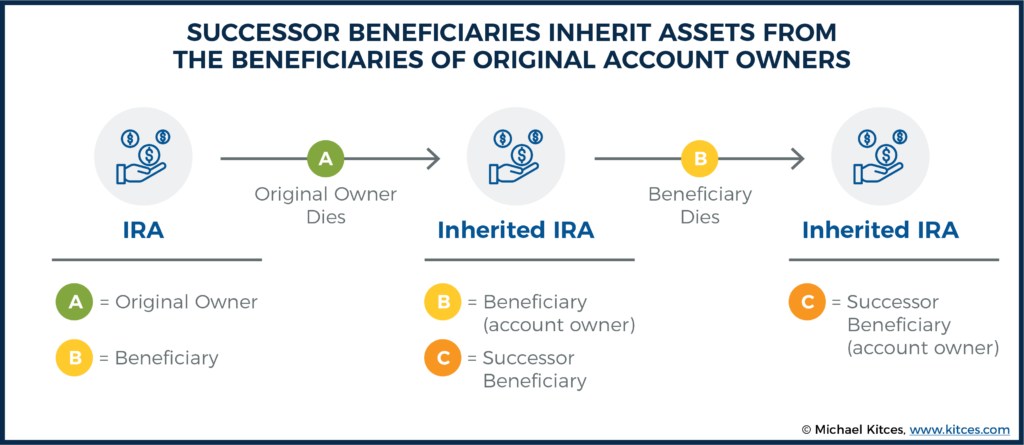
More specifically, when an individual inherits a retirement account from the original owner, they become a beneficiary. In many cases, the assets in the inherited retirement account will be completely distributed to that beneficiary prior to the beneficiary’s own death (in which case, there won’t be a Successor Beneficiary). In other cases, however, there are still funds remaining in the inherited retirement account at the time of the original beneficiary’s death.
Those assets don’t just disappear. They have to go somewhere!
And the person (or entity) to whom those assets pass is known as a Successor Beneficiary. They are, quite simply, the beneficiary’s own beneficiary.
Notably, since the passing of the SECURE Act, much attention has been placed on deciphering the new post-death distribution rules for Designated Beneficiaries (including both Non-Eligible Designated Beneficiaries and Eligible Designated Beneficiaries). Far less focus, however, has been placed on understanding what happens when a beneficiary in the post-SECURE Act world dies, and leaves money to their Successor Beneficiary.
This is certainly understandable, as the SECURE Act’s 10-Year Rule will undoubtedly reduce the number of such beneficiaries as compared to years past, when there was no limit to the length of time in which an account had to be liquidated. Nevertheless, whether it be from a pre-SECURE Act Designated Beneficiary ‘stretching’ distributions, a post-SECURE Act Eligible Designated Beneficiary ‘stretching’ distributions, or a post-SECURE Act Non-Eligible Designated Beneficiary who dies prior to the end of the 10-Year Rule, a nontrivial number of Successor Beneficiaries will continue to inherit the remaining balance of retirement dollars from the original beneficiary… and will need guidance from their advisors as to how to timely distribute those assets.
Example #1: Jamie inherited an IRA from her father in 2003, having been named the original beneficiary by her father.
Upon inheriting the account, she set up an inherited IRA and named her daughter, Maxine, as the subsequent beneficiary of her inherited IRA, should something happen to Jamie before the account was fully distributed.
In March 2020, Jamie passed away, and Maxine inherited Jamie’s inherited IRA. Maxine, therefore, became the Successor Beneficiary of the account.
Nerd Note:
There is no special terminology for a subsequent beneficiary, beyond that of Successor Beneficiary. Thus, if a Successor Beneficiary dies, the individual (or entity) that inherits the Successor Beneficiaries inherited (inherited) IRA is also still simply called a Successor Beneficiary (not a Successor-Successor Beneficiary!).
Critically, though, a Successor Beneficiary is not the same as a Contingent Beneficiary. A Contingent Beneficiary is an individual’s second-choice beneficiary if their first-in-line (primary) beneficiary predeceases them (or disclaims the asset, in which case the first-in-line beneficiary is treated as though they predeceased the owner).
If a retirement account owner’s Primary Beneficiary survives them and inherits their retirement account, the decedent-IRA-owner’s Contingent Beneficiary becomes meaningless. They are not entitled to any of the assets in the inherited retirement account, nor are they automatically in line to receive any remaining funds in the inherited account upon the Primary Beneficiary’s death.
The Primary Beneficiary, of course, may name the original decedent’s contingent beneficiary as their own Primary Beneficiary of the inherited account (which would make them a Successor Beneficiary upon inheritance), but there is actually no requirement for them to do so. Rather, they may choose whoever (or whatever) they’d like as their own Primary Beneficiary of the inherited account.
Or stated more simply, the Contingent beneficiary steps in for the Primary beneficiary (effectively becoming the new Primary beneficiary) if the original Primary dies before the account owner themselves. Whereas the Successor beneficiary steps in after the Primary beneficiary if the original account owner has already died, and the Primary beneficiary has already become ‘the’ beneficiary.
Example #2: Steve is the owner of an IRA and has named Oscar as their Primary Beneficiary, and Austin as their Contingent Beneficiary.
If Oscar were to die before Steve, then Austin as the Contingent Beneficiary would effectively become the new Primary beneficiary, to inherit the account when Steve passes away.
Alternatively, if Steve dies first, then Oscar inherits the account, and Austin no longer is on the list of Steve’s beneficiaries (as his role as Contingent beneficiary is now a moot point).
On the other hand, as Oscar inherits the account, he must subsequently set up an inherited IRA, and name his own Successor beneficiary to receive the account if Oscar now dies. Oscar names Max as the beneficiary of the inherited IRA.
Notably, this means that if Oscar dies prior to exhausting the funds in the inherited IRA, Austin will (still) not receive any of the remaining funds in the account (as the Contingent beneficiary is no longer relevant once Steve, the original account owner, has died), as the funds will pass to Max as the Successor Beneficiary (the newly named Primary Beneficiary of Oscar’s inherited IRA).
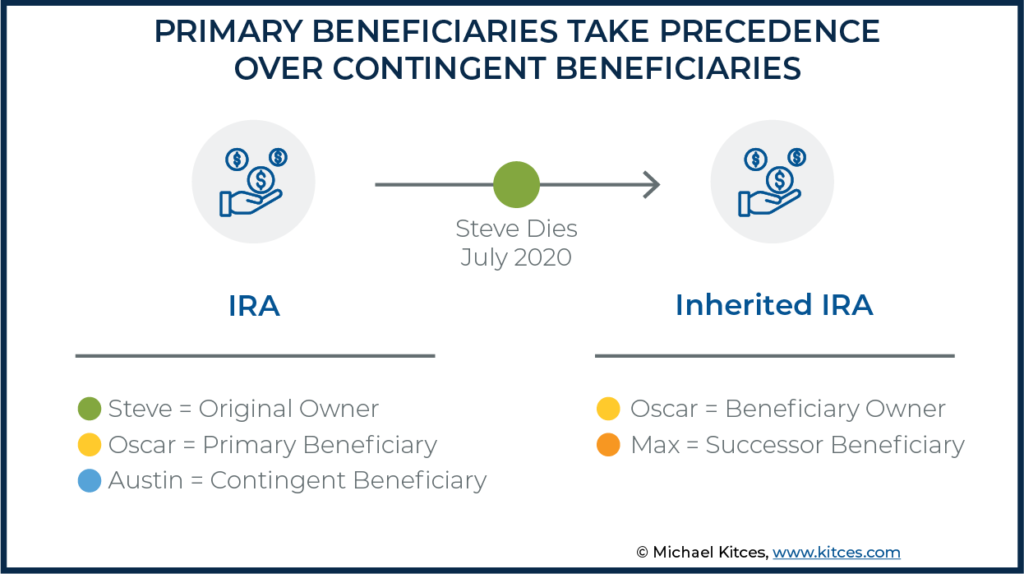
Rules For Successor Beneficiaries After The SECURE Act
The 10-Year Rule of the SECURE Act shortens the time period during which most post-SECURE Act non-spouse beneficiaries have to distribute assets from their inherited retirement account. So too does it shorten the time period during which most post-SECURE Act Successor Beneficiaries have to distribute the funds from their inherited (inherited) retirement accounts. But for a small subset of post-SECURE Act Successor Beneficiaries, the Act will actually extend the amount of time they have to distribute their inherited assets.
In analyzing the rules for Successor Beneficiaries in the post-SECURE Act world, there are three scenarios that must be considered for Successor Beneficiaries. They are as follows:
In scenarios 1 and 2, a Successor Beneficiary will generally (subject to an exception for certain Successor Beneficiaries discussed below) find themselves subject to the (full) 10-Year Rule. By contrast, in scenario 3, Successor Beneficiaries will find they can ‘only’ continue enjoying any time remaining in the original Non-Eligible Designated Beneficiary’s 10-Year Rule.
Scenario #1: Successor Beneficiaries Of A Post-SECURE Act Eligible Designated Beneficiary
When analyzing the SECURE Act’s impact on Successor Beneficiaries, it makes sense to start by evaluating the impact on Successor Beneficiaries who inherit from a post-SECURE Act Eligible Designated Beneficiary (i.e., those beneficiaries who actually can still stretch the inherited retirement account even after the SECURE Act). In fairness, this is unlikely to be the situation for the majority of Successor Beneficiaries who inherit in 2020, and in the immediate years thereafter, as it requires:
1) The death of the original retirement account owner in 2020 or later;
2) The beneficiary of that account owner to be an Eligible Designated Beneficiary (which is a fairly limited group in and of itself); and
3) The death of the Eligible Designated Beneficiary before all the funds in the inherited retirement account have been distributed.
Nevertheless, the Act’s statutory language makes this the logical place to begin one’s analysis (the reason for which will become clearer, momentarily).
Specifically, the SECURE Act created new IRC Section 401(a)(9)(H)(iii), which states:
Rules upon death of eligible designated beneficiary.— If an eligible designated beneficiary dies before the portion of the employee’s interest to which this subparagraph applies is entirely distributed, the exception under clause (ii) shall not apply to any beneficiary of such eligible designated beneficiary and the remainder of such portion shall be distributed within 10 years after the death of such eligible designated beneficiary. [Emphasis added]
The reference to “clause (ii)” in the excerpt from the SECURE Act above refers to the section of the SECURE Act that creates Eligible Designated Beneficiaries. Thus, new IRC Section 401(a)(9)(H)(iii) essentially says that “any” Successor Beneficiary of an Eligible Designated Beneficiary will not, themselves, be treated as a clause (ii) Eligible Designation Beneficiary, and that Successor Beneficiaries should instead be treated as a Non-Eligible Designated Beneficiaries, subject to the SECURE Act’s 10-Year Rule.
Example #3: On February 1, 2020, Abbott, a 70-year-old individual, inherited an IRA from his brother, who is 78. As such, Abbott was an Eligible Designated Beneficiary, able to ‘stretch’ distributions over his life expectancy (as he was less than 10 years younger than his brother).
At some point, of course, Abbott, himself, will pass away. And when that happens, if there is any money still left in the inherited IRA, ‘stretch’ distributions will cease, and the next beneficiary (the Successor Beneficiary named by Abbott) will be subject to the 10-Year Rule. Notably, this is true whether Abbott lives 10 weeks after inheriting the IRA, or 10 years, or even more.
Furthermore, it’s important to emphasize that in the example above, it makes no difference who is named as the successor beneficiary. That person (or entity) will be subject to the SECURE Act’s 10-Year Rule. Put differently, it is not possible to be an Eligible Designated Beneficiary of an Eligible Designated Beneficiary… because “any beneficiary” of an eligible designated beneficiary must distribute the inherited assets “within 10 years after the death.”
Nor, for that matter, can a Successor Beneficiary continue taking distributions over the initial beneficiary’s remaining life expectancy, as was the case before the SECURE Act took effect.
The 10-Year Rule applies to Successor Beneficiaries. Period.
Exception For Eligible Designated Beneficiaries Of Spousal (Eligible Designated) Beneficiaries
Depending upon your reading of the Internal Revenue Code, there may actually be one exception to the no-Eligible-Designated-Beneficiary-of-an-Eligible-Designated-Beneficiary rule. In truth, it’s somewhat a matter of semantics.
More specifically, IRC Section 401(a)(9)(B)(iv)(II) states that “if the surviving spouse dies before the distributions to such spouse begin, this subparagraph shall be applied as if the surviving spouse were the employee.”
Thus, while a surviving spouse who chooses to remain a beneficiary (often because they are under the age of 59 ½ and want to continue to maintain penalty-free access to the inherited funds) is treated as an Eligible Designated Beneficiary under the SECURE Act for as long as they live, if they die before required minimum distributions ‘kick in’ on the inherited account (beginning in the year that the original decedent would have turned 72 for deaths occurring after the SECURE Act), IRC Section 401(a)(9)(B)(iv)(II) will treat them as though they were the owner of the account at the time of their passing.
Thus, at the instant such a ‘surviving’ spouse dies, they are essentially transformed from Eligible Designated Beneficiary to retirement account owner (and as a result, the no-Eligible-Designated-Beneficiary-of-an-Eligible-Designated-Beneficiary rule continues to ring true, as the next beneficiary is actually the first beneficiary… again!).
Accordingly, if a surviving spouse with an inherited IRA, 401(k), or other retirement account dies before the year in which the original post-SECURE-Act decedent would have been 72, they will be treated as though they were the original owner upon their death. This allows the surviving spouse’s beneficiary to be treated as the first beneficiary – and not as a Successor Beneficiary – which may in turn enable them to qualify as an Eligible Designated Beneficiary (assuming that they otherwise meet the qualifications to be treated as such).
Nerd Note:
To date, the IRS has provided little guidance on how to implement some of the rules created by the SECURE Act, and as a result, there remains a substantial amount of ambiguity surrounding various provisions. Case in point?
It is absolutely clear that a surviving spouse who remains the beneficiary of a retirement account will not have to take RMDs from the inherited account until the deceased spouse would have been 72 if that spouse died after the SECURE Act’s effective date. By contrast, if death occurred prior to the SECURE Act’s effective date (and the deceased spouse would not yet have reached age 70 ½ by the end of 2019), it is not clear whether a surviving spouse remaining as the beneficiary of a retirement account would be required to begin RMDs when the deceased spouse would have turned 70 ½, or whether they’d be able to wait until the deceased spouse would have been 72.
Example #4a: On March 1, 2020, Ann, age 45, inherited an IRA from her spouse of the same age. Given her age, Ann chose to remain a beneficiary of the inherited IRA to allow her penalty-free access to its funds.
Suppose now that Ann dies in 2030 at the age of 55, and leaves her IRA to her 53-year-old younger sister, Nancy.
Since Ann died before her deceased spouse would have turned 72, the exception under IRC Section 401(a)(9)(B)(iv)(II) will apply, and Ann will be treated as though she were the original owner upon her death. Thus, Nancy will be treated as an Eligible Designated Beneficiary (because she is less than 10 years younger than Ann) and will be able to ‘stretch’ distributions over her life expectancy.
Nancy will not be considered a Successor Beneficiary, and will not be subject to the SECURE Act’s 10-Year Rule.
By contrast, if the ‘surviving’ spouse dies in the year the original decedent would have been 72 or later, this exception no longer applies, and the Eligible Designated Beneficiary-surviving-spouse will continue to be treated as an Eligible Designated Beneficiary upon their death. Thus, the ‘surviving’ spouse’s beneficiary will be a Successor Beneficiary, and definitively subject to the 10-Year Rule.
Example #4b: On April 20, 2020, Helena, age 48, inherited an IRA from her 65-year-old spouse. Given Helena’s age, she chose to remain a beneficiary of the inherited IRA to allow her penalty-free access to its funds.
Suppose now that Helena dies in 2030, at the age of 58, and leaves her inherited IRA to her 53-year-old sister, Ava.
Since Helena inherited her IRA in 2020, when her spouse was 65, by 2030, at Helena’s death, her deceased spouse would have been 75 years old. Therefore, since Helena’s deceased spouse would have been older than 72, Required Minimum Distributions from the inherited IRA would have already begun, and the exception under IRC Section 401(a)(9)(B)(iv)(II) would no longer apply.
Thus, despite the fact that Ava is less than 10 years younger than Helena, she would not be treated as an Eligible Designated Beneficiary. Rather, she would be considered the Successor Beneficiary of an Eligible Designated Beneficiary and is ‘automatically’ subject to the SECURE Act’s 10-Year Rule.
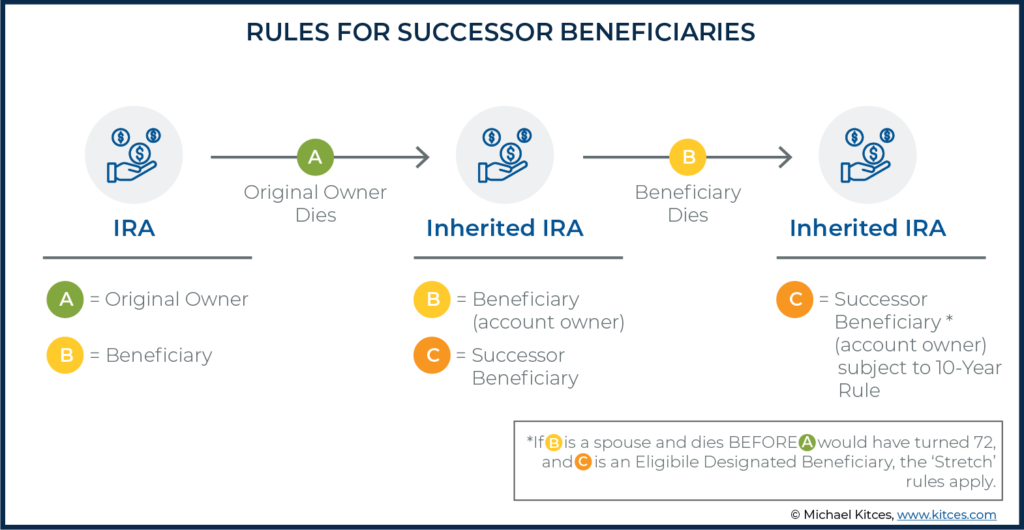
Scenario #2: Successor Beneficiaries Of Pre-SECURE Act Designated Beneficiaries
The most common way an individual is likely to become a Successor Beneficiary – at least for the foreseeable future – is by becoming the Successor Beneficiary of a retirement account that was first inherited by a Designated Beneficiary prior to the SECURE Act’s effective date. As given the recent enactment of the legislation, there are simply more Designated Beneficiaries around today who inherited retirement accounts prior to the SECURE Act than there are of those who inherited after the SECURE Act’s effective date (January 1, 2020 for most retirement accounts).
The rules for Successor Beneficiaries of pre-SECURE Act Designated Beneficiaries will be rather straightforward for advisors who understand the rules for Successor Beneficiaries of post-SECURE Act Eligible Designated Beneficiaries (as discussed above in Scenario #1).] That’s because the rules are essentially the same!
Subject to the same ‘exception’ for surviving spouses as discussed above, any Successor Beneficiary inheriting an IRA, 401(k), or other retirement account from an individual who died before the SECURE Act’s effective date will find themselves subject to the SECURE Act’s 10-Year Rule.
Nerd Note:
Prior to the SECURE Act, when a Designated Beneficiary stretching distributions died, the Successor Beneficiary was able to, in essence, step into the Designated Beneficiary’s shoes, and continue taking distributions calculated using the original ‘stretch’ schedule. That’s no longer the case. In short, the SECURE Act treats a pre-SECURE Act Designated Beneficiary as though they are an Eligible Designated Beneficiary.
5) Exception for certain beneficiaries.—
(A) In general.—If an employee dies before the effective date, then, in applying the amendments made by this section to such employee’s designated beneficiary who dies after such date—
(i) such amendments shall apply to any beneficiary of such designated beneficiary; and
(ii) the designated beneficiary shall be treated as an eligible designated beneficiary for purposes of applying section 401(a)(9)(H)(ii) of the Internal Revenue Code of 1986 (as in effect after such amendments).” [emphasis added]
Simplifying The Successor Beneficiary Rules For Beneficiaries Of ‘Stretch Beneficiaries’
Since the rules for Successor Beneficiaries of pre-SECURE Act Designated Beneficiaries and post-SECURE Act Eligible Designated Beneficiaries are the same, it’s fair to simplify things and discuss the rules and planning for such beneficiaries together.
As described above, these beneficiaries are generally subject to the SECURE Act’s 10-Year Rule, and the only exception, in either case, is when a ‘surviving’ spouse beneficiary dies before the original decedent-spouse would have reached the year in which they turn 72.
Notably, surviving spouses who remain a beneficiary of a deceased spouse’s inherited retirement account do not have to take Required Minimum Distributions from the inherited account until the same time… the year in which the deceased spouse would have turned 72. Thus, the Successor Beneficiary rules can be simplified to say that any beneficiary (including a surviving spouse) of a previous beneficiary who was taking RMDs using the ‘stretch’ is subject to the SECURE Act’s 10-Year Rule.
Put differently, the Successor Beneficiary of a ‘Stretch Beneficiary’ will always be subject to the 10-Year Rule.
Scenario #3: Successor Beneficiaries of post-SECURE Act Non-Eligible Designated Beneficiaries
The third and final scenario for a Successor Beneficiary is one in which they inherit from a post-SECURE Act Non-Eligible Designated Beneficiary. In such situations, the Non-Eligible Designated Beneficiary would have been subject to the SECURE Act’s 10-Year Rule upon inheriting the retirement account.
Not surprisingly, a Non-Eligible Designated Beneficiary’s beneficiary (the Successor Beneficiary) cannot be an Eligible Designated Beneficiary. Does this mean that the Successor Beneficiary gets their own new 10-Year Rule?
Unfortunately, the answer is “no.” Rather, the Successor Beneficiary of a post SECURE Act Non-Eligible Designated Beneficiary simply steps into the original (Non-Eligible Designated) beneficiary’s shoes. Which means the best they can do is to fill the original Primary Beneficiary’s 10-Year Rule (and they don’t even get to reset with their own new 10-Year Rule!).
Example #5: On May 1, 2020, an IRA owner died, leaving his account to his adult, healthy son, Joey. Joey is, therefore, a Non-Eligible Designated Beneficiary, subject to the SECURE Act 10-Year Rule. Accordingly, he must empty the inherited retirement account by the end of 2030.
Suppose, however, that Joey only lives for another four years, and dies in 2024. At that time, Joey’s Successor Beneficiary will step into his shoes. Thus, Joey’s beneficiary does not get a new 10-Year Rule running until 2034. Instead, Joey’s beneficiary would ‘just’ have flexibility over how much or (or how little) to distribute from the inherited retirement account for the six tax years beginning in 2024, and ending in 2029.
Either way, in 2030, any amounts remaining in the account would have to be distributed by year-end, as that would be the end of the 10 th year following the year of the original account owner’s death.
The SECURE Act Extends The Distribution Period And Enhances Flexibility For Some Successor Beneficiaries
While the SECURE Act negatively impacts some Successor Beneficiaries, interestingly, it also will improve things for other Successor Beneficiaries, by either extending the number of years they have to empty their inherited (inherited) retirement accounts and/or by providing them with more flexibility than was available under the pre-SECURE Act rules.
Notably, under the pre-SECURE Act rules, a Successor Beneficiary of a ‘Stretch Beneficiary’ would continue taking ‘stretch’ distributions using the original beneficiary’s remaining Single Life Expectancy. Thus, if the original beneficiary of a retirement account lived long enough, or inherited the account at an advanced (enough) age, the Successor Beneficiary could have been left with fewer than 10 years to distribute the remaining assets. But now, thanks to the SECURE Act, such beneficiaries will benefit from the 10-Year Rule.
Example #6: In 2005, Monica, age 67 at the time, inherited an IRA from her mother. As such, Monica began taking ‘stretch’ RMDs from her inherited IRA in 2006 using the Single Life Expectancy Table factor for a 68-year-old of 18.6.
By contrast, under the SECURE Act rules, Monica’s Successor Beneficiary is now automatically subject to the 10-Year Rule. Thus, the successor beneficiary will have 10 years – or roughly 3 times as many years – over which to spread distributions, if desired, in addition to greater flexibility over the timing of distributions (as there would be no RMD until 2030, the 10 th year after Monica’s death, as opposed to drawing annually for the next 3.6 years under Monica’s original stretch).
Planning For Successor Beneficiaries Of Stretch Beneficiaries
As outlined earlier in this article, the majority of non-spouse Designated Beneficiaries inheriting after the SECURE Act’s effective date will be Non-Eligible Designated Beneficiaries, and subject to the SECURE Act’s 10-Year Rule. This is the exact same rule that will apply to any Successor Beneficiary of a ‘Stretch Beneficiary’. Accordingly, the planning strategies for all such individuals are the same.
For individuals subject to the 10-Year Rule, that planning essentially comes down to one thing: deciding when, during the period of time covered by the 10-Year Rule, it makes sense to distribute the inherited retirement account assets. Thankfully, the 10-Year Rule provides a significant amount of flexibility, enabling beneficiaries to engage in a variety of planning strategies.
For example, beneficiaries of Roth accounts subject to the 10-Year Rule should generally wait until the end of the 10 th year after the year of death to distribute any and all of the inherited assets, as it will allow for the maximum amount of tax-free compounding.
Alternatively, individuals who inherit taxable retirement accounts will often benefit from spreading distributions out over a number of years in order to minimize the chances of being pushed into a (much) higher tax bracket. And in still other instances, it will make sense for individuals to target large distributions over a small number of years, if those years happen to be years in which income is much lower, or deductions much higher, than in other years during the 10-year window during which the inherited retirement account must be emptied.
The SECURE Act made massive changes to the post-death distribution rules governing retirement accounts. The majority of the attention surrounding those changes has been focused on its elimination of the ‘stretch’ provision for most non-spouse Designated Beneficiaries, but the changes also have a substantial impact on the beneficiaries of beneficiaries – the Successor Beneficiaries – as well.
With the Baby Boomer generation continuing to age, it is likely that the number of Successor Beneficiaries will continue to rise in the coming years. Thus, advisors must have a sound understanding of the rules that apply in such situations in order to properly guide clients.
Thankfully, the rules for Successor Beneficiaries in the post-SECURE Act world are pretty simple in most instances. Any Successor Beneficiary of a (pre- or post-SECURE Act) beneficiary taking required minimum distributions using the ‘stretch’ method will be subject to the 10-Year Rule. Which, unfortunately, will usually be shorter than the prior Stretch beneficiary’s remaining distribution period… though for some older beneficiaries, the new 10-Year Rule can still be more favorable.
By contrast, any Successor Beneficiary of a Post-SECURE Act beneficiary subject to the 10-Year Rule will step into the post-SECURE Act beneficiary’s shoes and will have to empty the account by the end of the 10 th year following the original account owner’s death (rather than receiving their own new 10-Year Rule).
Ultimately, the key point is that the SECURE Act changes things for both ‘regular’ original beneficiaries of retirement accounts, and the beneficiaries they name as their Successor Beneficiaries. And both types of beneficiaries need to be aware of the rules in order to avoid penalties and minimize the impact of taxes on any distributions.
Successions Flashcards Preview
Louisiana Bar > Successions > Flashcards
A succession is the “transmission of the estate of a deceased person to his successors. Successors have the right to take possession of the decedent’s estate after complying with relevant laws.” Always governed by the law in place at time of decedent’s death.
Estate = property, rights, and obligations of decedent and charges that accrue after decedent’s death
Types of Successors
Universal Successor – represents deceased and succeeds to all of his rights and charges. (Heirs, universal legatees, and general legatees)
Particular Successor – succeeds only to certain rights relating to a thing bequeathed to him, sold, or ceded to him.
Intestate and Testate Successions
Intestate = occurs when no will, will invalid in whole or in part, or will does not dispose of all of decedent’s property
Testate = will of decedent, in a testament executed as provided by law
Intestate Successors = heirs.
Testate Successors = legatees.
Movables – succession governed by decedent’s domicile at time of death
1. Succession to immovable situated in LA is governed by LA law
2. Succession to immovable outside LA governed by that state’s law
Successor in his own right,
Successor by representation of successor’s heirs, or
Successor by transmission (heir dies after decedent but before exercising right of acceptance or renunciation)
Capacity to Inherit
One must have been in existence at time of decedent’s death. Includes conceived children and children born by artificial insemination post-death.
Classes of Heirs – For separate property, inherit in order of priority:
i. Descendants, then parents and siblings, then surviving spouse, remote ascendants, remote collaterals
1. When decedent leaves siblings and parents, surviving parents receive usufruct subject to siblings’ naked ownership
ii. Relatives in most favored class take to exclusion of other classes. Nearest relation by degrees in a class takes to exclusion of more distant relations.
1. Persons of the same degree share equally.
iii. Counting Degrees:
1. Each degree is one generation.
2. Direct Line (ascendants and descendants) – as many degrees are there are generations.
3. Collateral Line (not direct descent) – count up to nearest common ancestor, then count to decedent. Lowest number of steps is the closest relative.
Inheritance of Separate Property by Intestacy
i. Children or representatives (descendants) take to exclusion of other heirs.
ii. Includes adopted children and illegitimate children who are formally acknowledged or timely establish filiation.
1. Does not include foster children.
To Parents and Siblings, then…
i. If no descendants, then parents and siblings succeed.
ii. Parents have joint and successive usufruct, and siblings have naked ownership. If one parent dies, usufruct accrues to survivor, and siblings still only have naked ownership interest.
iii. Exception – ascendants inherit to exclusion of all others when they donate an immovable to a descendant and descendant dies without posterity.
1. Ascendant will take subject to mortgages.
To Sibling if No Surviving Parents, then…
i. In absence of descendants and surviving parents, entire estate goes to siblings of decedent to exclusion of all others.
1. Half-blood siblings – property divides between paternal and maternal lines. Those with both parents take in both lines, half-bloods take only from that one line.
ii. If no siblings, but parent survives, parent takes entirety in full ownership.
To Surviving Spouse, then…
i. If decedent has no surviving descendants, parents, or siblings, then surviving spouse (if not judicially separated) inherits to exclusion of other ascendants or collaterals
To More Remote Ascendants, then…
i. If no descendants, siblings, parents, or surviving spouse, and grandparent(s) survive, they divide estate.
1. If one ascendant is nearer in degree than others, they take all.
2. If ascendants in same degree survive, they divide estate by roots, with one half going to maternal side and one half going to paternal.
ii. There is no representation in the ascending line!
To More Remote Collaterals, then…
i. If no descendants, parents, siblings, or ascendants, then the nearest collaterals take, by counting to nearest degree. No representation, only equal division by heads.
To The State – if no heirs, estate escheats to the state.
Inheritance of Community Property by Intestacy
Surviving Spouse has Full Ownership of Her Half (not by inheritance)
Decedent’s Half of Community Property:
i. If Children or Other Descendants – decedent’s ½ interest in community property goes to them subject to 890 usufruct in favor of surviving spouse
1. If child renounces, child’s descendants inherit (not surv. spouse)
ii. If No Children/Descendants – decedent’s ½ interest in community property goes to surviving spouse
iii. Community Property of Putative Marriage:
1. Decedent Spouse in Good Faith – the share goes to his successors. Legal and putative spouses share other half pro rata.
2. Decedent Spouse in Bad Faith – entire community divided equally between putative spouse and legal spouse
iv. Article 890 Usufruct of Surviving Spouse
1. Grants legal usufruct to surviving spouse over decedent’s share of community property and naked ownership of decedent’s share to children. Only applies to intestate succession.
a. Even applies if inheriting children not children of marriage.
b. Usufruct lasts until surviving spouse dies or remarries.
Inheritance Rights of Adopted Children
Adopted persons are generally entitled to full inheritance as if they were born of decedent’s marriage.
Adopted persons can adopt from adoptive parents AND natural parents/relatives.
Reverse not true – natural parents/relatives cannot adopt from child legally adopted by another.
Inheritance of Children Born Outside of Marriage (Illegitimate Children)
Children born outside of marriage inherit as if born in the marriage if:
i. Child is formally acknowledged, or
ii. Parents subsequently marry and acknowledge, or
iii. Child timely files a paternity action, or
iv. Father timely files an avowal action
Formal acknowledgement – declaration of father executed before 2 witnesses and notary public or father signs birth certificate. Requires mother to concur.
i. For father to have inheritance rights from child born outside of marriage, he must file an avowal action.
Paternity action – burden is on child to prove by preponderance if father alive, clear and convincing if dead. Child has 1 year, peremptive, from death of alleged father. Age of the child doesn’t matter.
Avowal action – Father can file even if child presumed to be child of another. Must prove by a preponderance of the evidence.
i. If child presumed to be child of another, must file
1 year from birth (if mother deceived in bad faith, 1 year from knew or should have known), but can’t ever be filed any later than 1 year after child’s death.
ii. If child not presumed child of another, can file anytime up to 1 year after the child’s death
Representation impacts degree-counting. Descendants or siblings who would take but predeceased decedent take by representation (those relatives’ descendants step into their shoes)
i. Usually only a dead person can be represented, but quasi-representation allowed if renunciation, unworthiness, or lapse of joint legacy
Representation only occurs in descending and collateral lines, NOT in ascending.
i. Representation in descending line takes place ad finitum
1. But descendants inherit per stirpes – multiple descendants in same degree split pro rata share of their predeceased ancestor
ii. Representation in collateral line is limited – only brothers and sisters of deceased can inherit by representation
One who has renounced to succeed from another person may still represent that other person (son renounces father’s succession, but if grandfather dies after father, can still represent father in grandfather’s succession)
Representation limited to grandchildren whose parent predeceased decedent and did not attain age 24 by time of decedent’s death or permanently disabled grandchildren who parent predeceased decedent.
Presumptions of Survivorship for Persons Who Die in Common Disaster
If no facts to show who died first, each person who perished presumed to survive the other. Burden of proof to establish survivorship is on person claiming through alleged survivor.
Short-Term Survivorship – in testate successions, testator can include short-term survivorship clause in will and require that legatee survive him for time not to exceed six monhs
Seizin (“Le Mort Saisit Le Vif”)
Succession occurs at death of decedent. Successor acquires ownership (“is seized”) of decedent’s property immediately at time of death
i. Universal successor acquires ownership “of the estate”
ii. Particular successor acquires ownership of the thing(s) bequeathed him
iii. Heir transmits succession to his own heirs, can institute all actions decedent could institute, and can prosecute those commenced.
Possession is also transferred to successor. (Particular successor can commence a new possession for purposes of acquisitive prescription)
Succession Representative – if appointed, alienation, lease, or encumbrance by a successor is subordinate to power of the representative
When heir/legatee judicially declared “unworthy”, he is deprived of right to inherit. It is not automatic and requires action filed in the succession proceeding
Unworthiness action may only be brought by person who would succeed in place of or in concurrence with unworthy successor
i. If person who would succeed is a minor/interdict, court can appoint attorney to investigate on motion of any family member or on its own
Grounds for Declaration:
i. Potential heir/legatee convicted of crime involving intentional unjustified killing or attempted killing of decedent
ii. If not convicted, he is judicially determined to have participated in killing or attempted killing of decedent
iii. A pardon does not cure this unworthiness
Prescriptive period of five years. In intestate succession, starts on date of death, and in testate it starts on probate/filing of testament.
Effects of Unworthiness:
i. Devolves right of unworthy successor as if he predeceased the decedent.
ii. If unworthy heir’s minor descendant would take, neither parent has a usufruct over the property the minor inherits
iii. Unworthy heir also loses right to claim as forced heir or right to serve in any fiduciary capacity in succession (executor, trustee, etc.)
iv. Unworthy heir must return or account for any property.
v. Reconciliation or forgiveness will cure unworthiness.
Acceptance and Renunciation Rules
When a decedent dies, successor may (1) accept succession, (2) renounce succession, or (3) accept in part and renounce in part.
Successors are presumed to accept. Minors deemed to accept, but a representative can renounce when authorized by court.
i. No acceptance or renunciation until the succession is opened. Can’t happen before death of decedent, and successor must know of death.
ii. Only valid if person knows of death and knows he has rights as successor.
iii. Can accept inheritance but renounce accretion that arises from someone else (or the reverse)
iv. Subsequent Probated or Annulled Testament:
1. Renunciation or acceptance of right to succeed by intestacy is null if a testament is subsequently probated.
2. Acceptance or renunciation of right to succeed in testate succession is null if testament is annulled or rights altered by subsequent testament or codicil.
v. Legacy subject to a suspensive condition may be accepted or renounced before or after fulfillment of condition.
vi. No formal prescriptive period (used to be 30 years), now only a rule requiring good cause to compel acceptance or renunciation
vii. Creditor of a successor can prohibit renunciation to the extent of the debt, but renunciation remains in effect for the heir himself.
Formal acceptance – express and in writing or in judicial proceeding
Informal acceptance – act that implies intent to accept
1. Act without knowledge that property belongs to estate of decedent is not acceptance.
2. Act of ownership required. Custodial act/conservatory insufficient
3. Acceptance manifested by act of heir, can include alienation, lease, or encumbrance.
Act of renunciation is an acceptance if it is made for a price or made in favor of anyone to whom inheritance would not accrue otherwise
Successor is liable for debts of estate, but only to value of property the heir actually receives, valued at time of receipt
Must be express and in writing, but doesn’t have to be by authentic act.
Intestate succession – accretion flows as if renouncing heir predeceased decedent. (If renouncer is child or sibling and has children, his share will go to his own children instead of to co-heir of same degree.)
Testate succession – accretion flows as if renouncing heir predeceased decedent, but if a ‘governing testamentary disposition’, the testament governs accretion
Can renounce accretion independent of acceptance or renunciation of other inheritance rights.
Renouncing relative can still represent person whose succession they renounced in the succession of another.
Capacity – must have capacity to alienate, for a minor a tutor can renounce with court authoritzation
Seizin – considered seized of inheritance from date of death of decedent until renunciation established, at which point it relates back
Attempted Renunciation – attempt to renounce in favor of someone outside order of succession is not a true renunciation, it’s an acceptance and donation to the intended designee (must be an authentic act)
Payment of Estate Debts
Estate debts = debts of descendant and administration expenses.
i. Debts of decedent are those incurred by decedent (mortgage, credit, etc.) and those arising from death (funeral costs, etc.)
ii. Administration expenses = incurred by management of the estate
Liability of Successors to Creditors
i. Universal successors are jointly liable for estate debts to extent of property received by them.
ii. A successor who is a creditor of the estate is paid in same order of preference as other creditors.
iii. After distribution of estate to successors and payment made to creditors, if a new creditor asserts rights, satisfy claims (1) from assets remaining unde administration of estate, (2) from successors who already received distribution, and (3) from unsecured creditors who received payments
i. If creditor of estate is secured, then creditor paid in accordance with preference and priority of his security right.
ii. Unsecured creditors share pro rata with other unsecured credtiors.
Apportionment of Debts Among Successors:
i. Testator in will can make provisions for allocation of debts, and successors can also agree to allocate payment of debts. However, rights of creditors cannot be impaired either way.
ii. Estate debts attributable to identifiable property are chargeable to that property and its fruits.
iii. Debts of decedent are charged ratably to property that is object of legacies and property that passes by intestacy, valued at death. If property is insufficient, debts are charged:
1. First, ratably to fruits and products of property that is object of general legacies and property devolving by intestacy, then
2. Second, ratably to fruits and products of property that is object of particular legacies, and then ratably to such property itself
iv. Administration expenses charged ratably to fruits and products of property subject to general legacies and property passing by intestacy, then property itself, then fruits of particular legacies, then property itself
v. Receipts and expenditures allocated to all successors in equity & fairness.
1. Succession representative and attorney’s fees allocated between debts of decedent and administration expenses in this way.
2. Successors and succession representative can report and deduct expenditures for tax purposes.
vi. None of this supersedes rights and obligations of usufructuary with respect to payment of estate debts.
Acceptance of an Inheritance as the Basis for Creation of the Rights of a Business Entity Participant
Full Text:
Abstract
Keywords
About the Author
References
1. Попова Л. И. Универсальное правопреемство при наследовании // URL: http://www.dom-i-zakon.ru/ articles/nasl/110940/ (дата обращения: 10 мая 2015 г.)
2. постановление Седьмого арбитражного апелляционного суда от 12 мая 2014 г. по делу № А27-10660/2013 // URL: http://docs.cntd.ru/document/412523861 (дата обращения: 10 мая 2015 г.)
3. постановление Федерального арбитражного суда Центрального округа от 18 марта 2010 г. № Ф10-626/10 по делу № А54-1546/2009-С11 // URL: http://www.resheniya-sudov.ru/2010/52396/ (дата обращения: 10 мая 2015 г.)
4. постановление Федерального арбитражного суда Центрального округа от 18 марта 2010 г. № Ф10-626/10 по делу № А54-1546/2009-С11
5. постановление Семнадцатого арбитражного апелляционного суда от 12 марта 2009 г. № 17АП-1341/2009-ГК по делу № А50-16390/2008 // URL: http://www.lawmix.ru/17ap/17860 (дата обращения: 10 мая 2015 г.)
6. решение Арбитражного суда г. Москвы от 18 марта 2014 г. по делу № А40-91134/2013 // URL: http://docs.cntd.ru/document/411494676 (дата обращения: 10 мая 2015 г.)
7. постановление Президиума ВАС РФ от 27 марта 2012 г. № 12653/11 // URL: http://www.arbitr.ru/bras. net/f.aspx?id_casedoc=1_1_0ae420af-d815-42cd-94a1-f38c3f3d06d4 (дата обращения: 10 мая 2015 г.)
8. постановление Семнадцатого арбитражного апелляционного суда от 12 марта 2009 г. № 17АП-1341/2009-ГК по делу № А50-16390/2008 // URL: http://www.lawmix.ru/17ap/17860 (дата обращения: 10 мая 2015 г.)
9. URL: http://www.arbitr.ru/bras.net/f.aspx?id_casedoc=1_1_7803cdf5-1575-456b-b784-58a4bc30bb15 (дата обращения: 10 мая 2015 г.).
10. URL: http://arbitr.ru/bras.net/f.aspx?id_casedoc=1_1_33e1e7ac-ee41-4502-80ad-cc41761ed6e8 (дата обращения: 10 мая 2015 г.).
11. Постановление Седьмого Арбитражного Апелляционного Суда от 12 мая 2014 г. по делу № А27-10660/2013 // URL: http://docs.cntd.ru/document/412523861 (дата обращения: 10 мая 2015 г.).
12. Решение Арбитражного суда г. Санкт-Петербург и Ленинградской обл. от 11 августа 2014 г. по делу № А56-22818/2014 // URL: https://rospravosudie.com/court-as-sankt-peterburga-i-leningradskoj-oblasti-s/ judge-shhurinova-svetlana-yurevna-s/act-316644289/ (дата обращения: 10 мая 2015 г.).
13. Решение Арбитражного суда Пермского края от 26 марта 2014 г. по делу № А50-24451/2013 // URL: http://docs.pravo.ru/document/view/55374120/62828936/ (дата обращения: 10 мая 2015 г.).
14. URL: http://www.arbitr.ru/bras.net/f.aspx?id_casedoc=1_1_0ae420af-d815-42cd-94a1-f38c3f3d06d4 (дата обращения: 10 мая 2015 г.).
15. Решение Арбитражного суда г. Москвы от 18 марта 2014 г. по делу № А40-91134/2013 // URL: http:// docs.cntd.ru/document/411494676 (дата обращения: 10 мая 2015 г.).
16. Ляпунов С. Г. Наследование прав и обязанностей участников хозяйственных товариществ и обществ: автореф. дис.. канд. юрид. наук. М., 2009.
17. Ремизова А. В. Переход доли в уставном капитале общества с ограниченной ответственностью в порядке наследственного правопреемства: автореф. дис. канд. юрид. наук. М., 2013
18. Колесникова С. Г. Обобщение судебной практики разрешения спорных вопросов наследования прав, связанных с участием в хозяйственных обществах // URL: http://ppt.ru/news/122788 (дата обращения: 10 мая 2015 г.)
19. Летута Т. В. Легитимация органа управления хозяйственного общества в гражданском праве // Вопросы российского и международного права. 2012. № 3-4. С. 65-66
20. URL: http://sudact.ru/arbitral/doc/cPoz15kveLdW/ (дата обращения: 10 мая 2015 г.)
Entry into the inheritance after death without a will. Procedure of acceptance of the inheritance. Terms, documents
Entry into the inheritance after death withoutWills is a process that can bring a lot of problems. In practice, many citizens face it. Not all people manage their property during life and transfer it to one or another person. Such inadvertency in the future can bring some trouble to the heirs. How to get the required property? Who has the right to it? What should every potential heir know? Having understood the established Russian legislation, citizens will be able to resolve all disputes over hereditary cases without wills. 
Methods of inheritance
Russia is a country where relatives and third parties battle for the inheritance every year. That is why the features of inheritance without a will are important. Everyone should know about them.
In general, Russia provides several options for the transfer of property by inheritance. Namely:
But more disputes and problems are brought into the inheritance after death without a will. What features of the process will have to be taken into account?
Heirs by law
For example, who will have to deal with in the future. Especially this applies to citizens who are not too well friends with their family.
The thing is that with inheritance withoutthird persons can not claim the property of the deceased. By law, the distribution of property is conducted between the relatives of the deceased. Therefore, all hereditary disputes and issues will be resolved within the family. 
Also it is necessary to take into account that in Russia there iscalled the succession queue. Citizens will claim the inheritance in the order of their order. Here the role is played by kinship ties. The closer a person is to the deceased, the higher the chances of inheritance.
About queues
As already mentioned, according to the law, the inheritance is distributed in the order of the queue. First on the property can claim:
Other heirs
As a rule, they do not usually get further than the first stage of successors. But there are exceptions. Therefore, in Russia, there are several stages in the order of obtaining inheritance. Which ones? 
Entry into the inheritance after death withoutwills allows you to receive the property of the deceased not only to parents, children and the other halves, but also to other relatives. If the listed people did not have a person (or they abandoned their shares), the property will be offered to other close blood relatives.
The second line of successors includes:
And these relatives do not? In this case, the property is offered to aunts, uncles, great-grandparents with great-grandmothers, cousins, grandfathers and grandmothers, again, aunts and uncles, nephews. Only after them can an inheritance claim:
Was the citizen dependent? In this case, these people can also get their share of the inheritance, but in the last place, after all the relatives listed. In practice, dependents rarely act as heirs by law.
Where to register
Where do they inherit? In Russia, these issues are dealt with by a notary. The inheritance is formalized only in his presence. 
You can apply to both the stateto an authorized person, and to a private person. The main thing is that it is possible to get your share of the inheritance (both by will and without it) only from notaries. About how exactly to act, will be told below.
Timing
It is important to pay attention to the prescription forinheritance. Terms established by the state allow only for a certain time to declare their rights. Otherwise, as an heir to speak will not succeed.
On the decision on inheritancethe property is given 6 months. This term can be restored, but only if the citizen can prove that he did not apply to the notary earlier for good reasons.
Procedure
How exactly is the registration of the inheritance? Do not get confused in the actions will help step-by-step instruction for the heirs. In general, the operation differs little from receiving property as a legacy by will.
In order to receive property by inheritance, it is necessary:
A citizen does not want to be an heir? Then after writing the refusal you will need to inform your close relatives about your decision. And already they will have to apply to the notary by following the instructions.
About documents
A rather important nuance is the preparationdocuments for inheritance. Father, mother or any other relative is not so important. The main thing is that the relationship with the citizen will have to be confirmed. This is the main problem facing people. Especially when it comes to a cousin. 
Among the documents necessary for entering into the inheritance by law, there are:
As a rule, when it comes to designlegacy by law among the heirs of the first stage, then with the preparation of securities there are no problems. Therefore, the only problem that citizens may face is the division of property.
Share of husband and wife
Particular attention should be paid to the spouses’ share in the inheritance of property. The husband / wife of the deceased is the first heirs in turn. Their shares are allocated on special principles.
Registration of rights
Suppose that a citizen decided to inherit by law. He appealed to the notary, presented him with the necessary package of papers and received a certificate indicating the acceptance of the property. What’s next? 
Now, as already said, you needregister your rights. If it is a question of real estate (which in practice occurs more often), you will have to contact the Rosreestr or the registration chamber. With him the heir is obliged to bring:
In exchange for these papers, the applicant will be given an extract,talking about accepting the request. After 5-10 days, you can pick up new documents. It should also be taken into account that inheritance is transferred not only property, but also obligations. For example, debts.
From now on it is clear how the entry intoinheritance without a will. In general, this operation differs little from the inheritance of the will. With certain training, citizens can easily get their share of property without problems.
Critiques of inheritance
The institution of inheritance has been criticized because it renders possible the acquisition of wealth without work and because it is regarded as a principal source of economic inequality. Such attacks have come not only from radicals to whom complete equality of income appeals as a social ideal but also from more moderate thinkers to whom great differences in the distribution of wealth appear to be incompatible with modern views of the dignity of man. In response to their criticisms, inheritance has been defended on economic as well as on moral grounds.
Inheritance has been said to be necessary within the framework of an economy of individual property to guarantee the continuity of enterprise, without which long-range economic activity could not flourish. This argument has lost much of its force as large-scale enterprise has come to be carried on in corporate form and thus to be directed not by owners but by specialists in management who succeed each other in the manner of officeholders. There is, however, still force in the argument that, without the incentive of handing on the fruits of one’s work, competition and consequently the functioning of the total economy would be hampered.
It is possible to conceive of a social system in which property rights would end with the owner’s death. If the assets left behind were not reassigned to some other individual, the eventual result would be complete ownership of all wealth by the community, and the system of individual property would end. A new individual owner could be determined in one of four ways: ownership by the first taker, a practice that would produce strife and disorder; reassignment by a governmental agency, which would constitute an exercise of power regarded as dangerous in a free society; reallotment in accordance with settled rules generally fixed for all; or reallotment in accordance with the wishes of the decedent. The last two are the ways in which the modern systems of inheritance work: the estate is reallotted according to the rules of intestacy law or according to the will of the decedent.
The only debatable issues within a system of private ownership are: who are to be the takers in intestate succession; and whether or not and within what limits freedom of testation shall be permitted. In all societies, inheritance has developed as an incident of kinship. Even in a society in which property is regarded as belonging to individuals rather than kinship groups, the feeling of belonging to one’s group is still so strong, especially between parents and children, that a person’s sense of freedom would not be complete unless he knew that he could pass on his possessions to his children. The question arises, however, whether inheritance shall extend beyond the circle of those persons with whom the decedent was connected by ties of affection or about whose well-being he or she was, or should have been, concerned. In the urbanized, mobile population of highly industrialized nations, the family as a felt unit has tended to shrink to the small circle of husband, wife, and children. Ties of relationship tend to be weak even among first cousins.
In an age of expanding demands on government, there has been an inclination to let the estate of a person dying intestate pass to the public treasury rather than go to enrich distant relatives. In England the circle of intestate takers has been limited by the Administration of Estates Act of 1925 to relatives no more remote than the grandparents, uncles, and aunts of the deceased. Even more restrictive than those of England are the intestacy laws of communist countries. Under the law of the Soviet Union, intestate succession did not extend beyond descendants, the surviving spouse, grandparents, brothers, sisters, and incapacitated persons who had been dependent upon the decedent for at least one year prior to his death.
Another way of limiting the rights of remote relatives for the benefit of the public treasury consists in increasing the rates of inheritance taxes in proportion to the remoteness of the relationship between the takers and the decedent. In the United States, although the federal tax on succession depends solely on the size of the estate, the additional inheritance taxes levied by the states are widely patterned upon the closeness of relationship. This method is also employed in numerous other countries but not, since 1949, in England.
Inheritance law is also used to reduce inequalities in the distribution of wealth. This may be done by compulsory partitions, as under the laws of the French and the German pattern, or by means of progressive inheritance taxation, as in the United Kingdom or the United States, or by a combination of both. The law of inheritance and inheritance taxation thus functions as an instrument of social policy.
An impressive illustration of the way in which the law of inheritance serves social policy is the series of modifications to Soviet inheritance legislation. In the early stage of the Bolshevik Revolution, inheritance was limited to the descent of a modest amount of property to close relatives or to the surviving spouse, provided they were in need. The limit upon the amount of the property was lifted in 1926; and the requirement of need was also abolished for inheritance by the surviving spouse, descendants, parents, grandparents, brothers, and sisters. Under the civil code of 1922, the power of testation was limited to increasing or reducing the share of particular intestate successors. After 1961 property could be left to any person. Private property could not exist in the means of production, and therefore inheritance was limited to goods of use or consumption and to savings accounts. Within the limits stated, inheritance and freedom of testation were regarded as constituting useful incentives to productivity without constituting a danger to the socialist system. Inheritance of private property was thus listed in the constitution of 1936 and reaffirmed in the constitution of 1977 as one of the rights of citizens.
Prime issues in inheritance and succession
In a society in which inheritance exists, two issues are of prime importance for the distribution of wealth and for the social and political structure of the society: (1) the issue of the extent to which owners of property shall have the power by their own decision to determine the course of inheritance and (2) the issue of whether or not estates shall be allowed or even required to pass undivided to one single heir.
The Civil Code of the Russian Federation
Chapter 64. Acquisition of Inheritance
Article 1152. Acceptance of Inheritance
1. To acquire inheritance a heir shall accept it. No acceptance is required for the acquisition of escheat property (Article 1151).
2. The acceptance of a portion of inheritance by an heir means acceptance of the whole inheritance due to him/her, whatever the nature and the whereabouts thereof. When an heir is called upon to inherit simultaneously on several grounds (by will and by operation of law or by hereditary transition and as the result of opening an inheritance etc.) the heir may accept an inheritance he is entitled to on one of these grounds, on several of them or on all of them.
No acceptance of inheritance shall be stipulated by conditions or special clauses.
3. The acceptance of an inheritance by one or several heirs shall not mean an acceptance of inheritance by other heirs.
4. An accepted inheritance shall be recognised as owned by the heir from the date of opening of the inheritance, irrespective of the time of the actual acceptance and also irrespective of the time of state registration of the heir’s rights to assets of estate where such a right is subject to state registration.
Article 1153. The Methods of Accepting an Inheritance
1. An inheritance is accepted by means of the heir’s filing an inheritance acceptance application or an application for a certificate of the right to the inheritance with the notary or personal representative under law at the place of opening of the inheritance. If an heir’s application is passed to the notary by another person or the signature of the heir is mailed on the application shall be attested by a notary, an official empowered to accomplish notarial actions (Item 7 of Article 1125) or a person empowered to attest powers of attorney in compliance with Item 3 of Article 185 of the present Code).
An inheritance can be accepted through a representative if the power of accepting an inheritance is specifically established in powers of attorney. No powers of attorney are required for a personal representative to accept an estate.
2. Until and unless the contrary is proven, an heir shall be deemed to have accepted an inheritance if he has committed actions evidencing an actual acceptance of the inheritance, in particular, if the heir: has commenced possession or administration of assets of the estate;
has taken measures for preserving assets of the estate, protecting it against third persons’ encroachments or claims;
has incurred expenses on his account towards maintenance of assets of the estate;
has paid the testator’s debts or received from third persons amounts of money payable to the testator.
Article 1154. The Term for Acceptance of an Inheritance
1. An inheritance can be accepted within six months after the date of opening of the inheritance. If the inheritance is opened on the date of the alleged death of a citizen (Item 1 of Article 1114) the inheritance can be accepted within six months after the date when the court decision whereby the citizen is announced dead becomes final.
2. If a right of inheritance emerges for other persons as the result of an heir’s disclaimer of an inheritance or an heir’s disqualification on the grounds established by Article 1117 of the present Code such person can accept the inheritance within six months after the date of occurrence of their right of inheritance.
3. Persons whose right of inheritance occurs only due to an heir’s non-acceptance of an inheritance can take the inheritance within three months after the expiry of the term specified in Item 1 of the present article.
Article 1155. Acceptance of an Inheritance upon the Expiry of the Established Term
1. On the application filed late by a heir as concerning the term set for acceptance of an inheritance (Article 1154) the court may reinstate the term and recognise the heir as having accepted the inheritance if the heir did not know and was not supposed to know of the opening of the inheritance or if the heir has missed the term due to other legitimate reasons and on the condition that the heir who missed the term set for acceptance of the inheritance has filed his/her application with the court within six months after the time when the causes/reasons for the lateness ceased to exist. Having recognised an heir as having accepted an inheritance, the court shall determine the shares of all the heirs in the estate and if necessary shall designate measures for safeguarding the rights of the new heir to his/her entitlement (Item 3 of the present Article). The certificates of a right of inheritance issued earlier shall be recognised by the court as void.
2. An heir can accept an inheritance after the expiry of the term set for the acceptance thereof without resorting to the court if all the other heirs who have accepted the inheritance grant their consent thereto in writing. If such a written consent is granted by heirs in the absence of a notary, their signatures on the documents whereby the consent is granted shall be attested in the manner specified in Paragraph 2 of Item 1 of Article 1153 of the present Code. The heirs’ consent shall be deemed a ground for a notary to annul the certificate of right of inheritance issued earlier and to issue a new certificate. If, under a certificate issued earlier, state registration has been accomplished in respect of a right to immovable property, the notary’s decision to annul the certificate issued earlier and the new certificate shall be deemed a ground for amending the state registration records correspondingly.
3. A heir who accepts an inheritance after the expiry of the established term in keeping with the rules set out in the present article shall be entitled to take his/her entitlement in compliance with the rules of Articles 1104, 1105, 1107 and 1108 of the present Code which, in the case specified in Item 2 of the present Article, shall be applicable except as otherwise required by a written agreement concluded by the heirs.
Article 1156. The Transfer of a Right to Accept an Inheritance (Hereditary Transition)
1. If an heir called upon to inherit by will or by operation of law dies after the opening of the inheritance without having accepted it within the established term, the right of accepting his/her entitlement shall pass to his/her legal heirs, or if all assets of the estate have been left by will, to his/her heirs by will (hereditary transition). The right of accepting an inheritance by way of hereditary transition is not incorporated into the estate left after the death of such a heir.
2. The right of accepting an inheritance that belonged to a deceased heir may be exercised by his/her heirs on general terms. If the portion of the term set for the purposes of inheritance acceptance that remains after the death of an heir is less than three months, the term shall be extended to reach three months. Upon the expiry of the term set for inheritance acceptance purposes the heirs of a deceased heir may be recognised by the court as having accepted the inheritance under Article 1155 of the present Code if the court is of the opinion that the reasons for the lateness are legitimate.
3. The right of an heir to accept a portion of inheritance as a compulsory share (Article 1149) shall not be transferable to his/her heirs.
Article 1157. The Right of Disclaimer
1. The heir is entitled to disclaim the gift he is entitled to, for the benefit of other persons (Article 1158) or without an indication of a person for whose benefit he rejects his/her gift. No disclaimer shall be possible in the case of escheat.
2. The heir is entitled to disclaim the gift he is entitled to within a term set for acceptance of inheritance (Article 1154), in particular, in cases when he has already accepted the gift. If the heir has committed actions evidencing the actual acceptance of an inheritance (Item 2 of Article 1153) a court may recognise him/her as having disclaimed the inheritance on the application of such heir, in particular, after the expiry of the set term if the court finds that the reasons for the lateness are legitimate.
3. A disclaimer of an inheritance shall not be subject to alteration or reversed.
4. In the case of a minor heir, an heir lacking dispositive capacity or having a partial dispositive capacity disclaimer of an inheritance shall be admitted on a preliminary consent of the body of tutorship and guardianship.
Article 1158. Disclaimer of an Inheritance for the Benefit of Other Persons and Disclaimer of a Portion of a Gift
1. The heir is entitled to disclaim an inheritance for the benefit of other persons from among the heirs under a will or who belong to any category and who have not been refused inheritance (Item 1 Article 1119), in particular, for the benefit of those who were called upon to inherit by the right of representation or inheritance transition (Article 1156). No disclaimer shall be for the benefit of any of the above persons:
of assets inherited under a will if the whole of the decedent’s estate is left by will for heirs appointed by the decedent;
of a compulsory share of an estate (Article 1149);
if an alternate heir has been appointed for the heir in question (Article 1121);
2. No disclaimer shall be for the benefit of persons who are not specified in Item 1 of the present article. No disclaimer of inheritance shall be stipulated by conditions or special clauses.
3. An heir shall not disclaim a portion of his/her gift. However, if an heir is called upon to inherit simultaneously on several grounds (by will, by law or by inheritance transition or as a result of opening of an inheritance etc.) he shall be entitled to disclaim the gift he is entitled to on one of these grounds, on several of them or on all of them.
Article 1159. Methods of Disclaimer
1. The disclaimer of an inheritance shall be effected by the heir by means of filing a disclaimer application with a notary or official empowered under law to issue certificates of inheritance at the place of opening of the inheritance.
2. If a disclaimer application is filed with a notary by a person other than the heir or if it is mailed the signature of the heir on such application shall be attested in the manner established in Paragraph 2 of Item 1 of Article 1153 of the present Code.
3. An inheritance may be disclaimed through a representative if disclaimer powers are laid down in the powers of attorney. No powers of attorney is required for a legal representative to disclaim inheritance.
Article 1160. Right of Disclaimer of a Testamentary Trust
1. The beneficiary is entitled to refuse accepting a trust (Article 1137). In this case no trust for the benefit of another person, a trust stipulated by a clause or condition is permitted.
2. If the beneficiary is at the same time an heir his/her right specified in the present article shall not depend on his/her right to accept the inheritance or disclaim it.
Article 1161. Increment of Shares of Estate
1. If an heir does not accept his/her gift, disclaims his/her gift without indicating that the disclaimer is for the benefit of another heir (Article 1158), does not have the right to inherit or if his/her right of inheritance is forfeited on the grounds established by Article 1117 of the present Code or as a result of invalidity of the will the portion of the estate to which such heir would have been entitled shall pass to the legal heirs called upon to inherit, pro rata to their shares of the estate. However, if the testator has left all property to the heirs he appointed, the portion of the estate to which an heir who disclaimed his/her gift or who was dropped on the other specified grounds was entitled shall pass to the other heirs by will pro rata to their shares of the estate, except as otherwise required by the will in respect of distribution of that portion of the estate.
2. The rules contained in Item 1 of the present article shall not be applicable if an alternate heir (Item 2 Article 1121) has been appointed for the heir who disclaimed his/her gift or who was dropped on other grounds.
Article 1162. Certificate of Right to Inheritance
1. A certificate of right to inheritance shall be issued at the place of opening of the inheritance by a notary or an official empowered by law to accomplish such a notarial action. The certificate shall be issued on the application of an heir. If heirs so wish one certificate may be issued for all the heirs or a separate certificate may be issued to each of the heirs, for the whole of the estate or for specific parts thereof.
The same procedure shall be applicable when a certificate is issued in the case of escheat in the Russian Federation (Article 1151).
2. If, after the issue of a certificate of right to inheritance, assets of the estate are discovered which are not covered by such a certificate, an additional certificate of right to inheritance shall be issued.
Article 1163. Term for Issue of a Certificate of Right to Inheritance
1. A certificate of right to inheritance shall be issued to heirs at any time upon the expiry of six months after the date of opening of the inheritance, except for the cases specified in the present Code.
2. In the case of succession both by will and by operation of law a certificate of right to inheritance may be issued before the expiry of six months after the opening of the inheritance if there is reliable information evidencing that there are no other heirs entitled to the inheritance or a portion thereof apart from the persons who have applied for the certificate.
3. The issuance of a certificate of right to inheritance shall be suspended by the decision of a court and also in the case of existence of a heir conceived but not yet born.
Article 1164. Heirs’ Common Ownership
Article 1165. Distribution of Decedent’s Estate by Agreement between Heirs
1. The assets of estate in the share ownership of two or several heirs can be divided by agreement between them. The agreement on distribution of estate shall be subject to the rules of the present Code concerning the form of deals and form of agreements.
2. An agreement on distribution of estate incorporating immovable property, in particular, an agreement on devolution of the share of one or several heirs may be concluded by heirs after a certificate of right to inheritance has been issued thereon. The state registration of heirs’ ownership of immovable property being the subject matter of an agreement on distribution of estate shall be accomplished on the basis of the agreement on distribution of estate and the certificate of a right to an inheritance issued earlier and in cases when the state registration of heirs’ rights to immovable property has been accomplished before the heirs entered the agreement on distribution of estate, on the basis of the agreement on distribution of estate.
3. A discrepancy between the way an estate is distributed by heirs in an agreement they concluded and the shares of the estate to which the heirs are entitled as specified in the certificate of right to inheritance shall not cause refusal of state registration of their rights to the immovable property received as the result of distribution of the estate.
Article 1166. Safeguarding the Interests of a Child in the Case of Distribution of Estate
If there is an heir who has been conceived but not yet born, distribution of an estate shall be accomplished only after the birth of such a heir.
Article 1167. Safeguarding the Lawful Interests of Minors, Citizens Lacking Dispositive Capacity or Having a Limited Dispositive Capacity in the Case of Distribution of Estate
If among the heirs there are minor citizens, citizens without dispositive capacity or having a limited dispositive capacity an estate shall be distributed in compliance with the rules of Article 37 of the present Code.
For the purpose of safeguarding the lawful interests of the said heirs the tutorship and guardianship body shall be notified of the drawing up of an agreement on distribution of estate (Article 1165) has been drawn up and of a court’s hearing a case of distribution of estate.
Article 1168. Right in Rem Relating to an Indivisible Item in Cases of Distribution of Estate
1. An heir who had a right of share ownership together with the testator in respect of an indivisible item (Article 133) the share in the right of which is incorporated in the estate shall have a preferential right of obtaining as offsetting his/her share of the estate the thing that was in common ownership, over the heirs who had not been party to the common ownership before, irrespective of their having used the item or not.
2. An heir who had been permanently using an indivisible item (Article 133) incorporated in an estate shall have a preferential right of obtaining as offsetting his/her share in the estate this thing, over the heirs who had not been using the thing and had not been party to the common ownership thereof.
3. If an estate incorporates housing accommodation (residential house, apartment etc.) which cannot be physically divided, the heirs who had been residing in the housing accommodation as of the date of opening of the inheritance and who do not have other housing accommodation shall have the right to enjoy a preferential treatment, in cases of distribution of estate, over the other heirs not being owners of the housing accommodation incorporated in the estate in obtaining this housing accommodation as offsetting their shares of the estate.
Article 1169. Preferential Right to Ordinary Household Articles in Cases of Distribution of Estate
In the case of distribution of estate an heir who had been residing as of the date of opening of an inheritance together with the testator shall have a preferential right of obtaining as offsetting his/her share of the estate household articles.
Article 1170. Compensation of Mismatch between Received Assets of an Estate and the Share in the Estate
1. A mismatch between the assets of estate claimed by an heir by a preferential right under Articles 1168 or 1169 of the present Code and the heir’s share of the estate shall be eliminated by means of his/her transferring other assets of the estate to other heirs or by the provision of another compensation, in particular, disbursement of the relevant amount of money.
2. Except as otherwise required by an agreement between all the heirs, the exercise of a preferential right by any of them shall be possible after the provision of a relevant compensation to other heirs.
Article 1171. Preservation of an Estate and Administration of an Estate
1. For the purpose of safeguarding the rights of heirs, beneficiaries and other persons concerned the executor of a will or the notary at the place where an inheritance is opened shall take the measures specified in Articles 1172 and 1173 of the present Code as well as other necessary measures for preservation and administration of the estate.
2. The notary shall take measures for preservation and administration of the estate on the application of one or several heirs, executor of the will, a local government body, the tutorship and guardianship body or other persons acting in the interests of preservation of the estate. If an executor of the will has been appointed (Article 1134) the notary shall take measures for preservation and administration of the estate in agreement with the executor. The executor of the will shall take measures for the preservation and administration of the estate on his own or at the request of one or several heirs.
3. For the purpose of ascertaining the subject matter of gifts and preserving it banks, other credit institutions and other legal entities shall inform the notary, at the notary’s request, of the information they have concerning assets belonging to the testator. The information so obtained shall be passed by the notary only to the executor of the will and to the heirs.
4. The notary shall take measures for preservation and administration of the estate within a term set by the notary with due regard to the nature and value of the estate and also the time required for the heirs to commence owning their gifts but not exceeding six months, or in the cases specified in Items 2 and 3 of Article 1154 and Item 2 of Article 1156 of the present Code, not exceeding nine months after the opening of the inheritance. The executor of the will shall take measures for the preservation and administration of the estate within the term required for executing the will.
5. In cases when assets of the estate are located in different places, the notary at the place where the inheritance has been opened shall forward instructions on the preservation and administration of the assets of the estate to the notary at the place where the relevant portion of the assets is located, via the bodies of justice. If the notary at the place of opening of the inheritance knows who should take measures for the preservation of the estate, such instructions shall be forwarded to the relevant notary or official.
6. The procedure for preservation and administration of estate, in particular, the procedure for drawing up an inventory of the estate shall be determined by the legislation on notaries. The maximum limits on remuneration payable under an agreement of custody of estate and agreement of trust of estate shall be set by the Government of the Russian Federation.
7. In cases when a right to accomplish notarial actions is granted under law to officials of local government bodies and officials of consular institutions of the Russian Federation the necessary measures for preservation and administration of an estate can be taken by the relevant official.
Article 1172. Measures for Preservation of the Estate
1. For the purpose of preserving an estate the notary shall draw up an inventory of the estate in the presence of two witnesses qualifying under the criteria established in Item 2 of Article 1124 of the present Code. The executor of the will, heirs and in relevant cases representatives of the tutorship and guardianship body can be in attendance when an inventory of estate is being drawn up.
At the request of persons specified in Paragraph 2 of the present item, the estate shall be valuated by agreement of the heirs. If no agreement is made the estate or the portion thereof not covered by a valuation agreement shall be valuated by an independent appraiser on the account of the person who has demanded the valuation of the estate, with these expenses later being distributed among the heirs pro rata to the value of the assets of estate received by each of them.
2. Money in cash incorporated in the estate shall be deposited with the notary and foreign currency valuables, precious metals and stones, articles made from them and securities that do not require management shall be handed over to a bank into the custody thereof under an agreement in compliance with Article 921 of the present Code.
3. If the notary is aware that weapons make up a portion of the estate he shall notify the bodies of interior affairs accordingly.
4. Assets incorporated in the estate but not specified in Items 2 and 3 of the present article, if it does not require management, shall be passed by the notary under an agreement to an heir into the custody thereof, or if it cannot be passed to a heir, to another person at the notary’s discretion. In the case of succession by a will whereby an executor of the will is appointed, the executor of the will shall be responsible for the custody of the said assets of estate on his own or by means of entering into a custody agreement with an heir or another person chosen at the discretion of the notary.
Article 1173. Management on Trust of the Estate
If the estate incorporates assets that require management apart from preservation (an enterprise, an interest in the authorised (aggregate) capital of a partnership or company, securities, exclusive rights etc.) the notary, acting as a trustee under Article 1026 of the present Code, shall conclude a trust agreement in respect of such assets.
In the case of succession by a will whereby an executor of the will is appointed, the rights of the trustee shall belong to the executor of the will.
Article 1174. Reimbursement of Expenses Incurred Due to the Death of the Testator and Expenses Towards Preservation and Administration of the Estate
1. The necessary expenses incurred due to the pre-death illness of the testator, decent funeral expenses, including the necessary expenses incurred as payment for the place of burial of the testator, estate preservation and administration expenses and also testamentary expenses shall be reimbursable out of the decedent’s estate within the value thereof.
2. Claims for reimbursement of the expenses specified in Item 1 of the present article may be presented to heirs which have accepted their gifts and, before the acceptance of a gift, to the executor of the will or satisfied on the account of the estate. Such expenses shall be reimbursed before the repayment of debts to creditors of the testator and within the limits of value of the portion of the estate taken by each of the heirs. In such cases expenses incurred in connection with the testator’s illness and funeral shall rank as first category, estate preservation and administration expenses as second category and testamentary expenses as third category.
3. Any amounts of money owned by the testator, including bank deposits and accounts, may be used to bear the testator’s decent funeral expenses. The banks having in their deposits or accounts the testators’ amounts of money shall provide them on the notary’s decision to the person specified in the decision for the purpose of making payment towards these expenses.
An heir to whom amounts of money in the testator’s deposit or any other bank account have been left by will, in particular in cases when they were left by means of testamentary instructions in a bank (Article 1128), shall be entitled at any time before the expiry of six months after the opening of the inheritance to receive from the testator’s deposit or bank account amounts of money required for the funeral of the testator.
The amount of money handed out by the bank in keeping with the present item for funeral purposes to an heir or a person indicated in the notary’s decision shall not exceed one hundred times the minimum monthly wage as established by the law as of the date of application for the money.
The rules of the present item shall be correspondingly applicable to other credit organisation entitled to raise citizens’ funds in deposit and other accounts.