Food for thought
Food for thought
food for thought
1 food for thought
2 food for thought
3 food for thought
4 food for thought
5 food for thought
6 food for thought
7 food for thought
8 food for thought
9 food for thought
10 give much food for thought about
11 provide food for thought
12 food for reflection
13 food for reflection
Meanwhile Jennie, moving about her duties, also found food for reflection. (Th. Dreiser, ‘Jennie Gerhardt’, ch. XXXII) — Тем временем Дженни, занимаясь домашними делами, тоже предавалась размышлениям.
14 foot for thought
15 food
food for thought пи́ща для размышле́ния
16 food
for fishes утонуть;
to become food for worms умереть to become
for fishes утонуть;
to become food for worms умереть food корм
пища, питание;
еда, корм;
the food there is excellent там хорошо кормят
съестные припасы, провизия, продовольствие
attr. питательный;
food value питательность
for thought (или reflection) пища для ума, духовная пища
attr. продовольственный;
food rationing карточная система (распределения продуктов)
пища, питание;
еда, корм;
the food there is excellent там хорошо кормят
attr. питательный;
food value питательность green
17 food
18 food
19 food
appetizing / delicious / tasty food — вкусная еда
nourishing / wholesome / health food — здоровая пища
plain / simple food — простая пища
to cook / prepare food — готовить еду
to heat / reheat food — разогревать еду
to bolt / gulp (down) / swallow food — глотать пищу
preserved food — консервированные продукты, консервы
food crop — с.-х. продовольственная культура
food for thought / reflection — пища для размышления, для ума
20 food
to make smb go without food — лишать кого-л. пищи
См. также в других словарях:
food for thought —
food for thought —
food for thought — If something is food for thought, it is worth thinking about or considering seriously … The small dictionary of idiomes
food for thought — ► food for thought something that warrants serious consideration. Main Entry: ↑food … English terms dictionary
Food For Thought — est un album musical du guitariste Carlos Santana paru en 2004. Cet album, uniquement disponible sur le site officiel de l artiste, a été produit au profit de l association Milagro Foundition présidée par Deborah Santana sa femme. Plusieurs… … Wikipédia en Français
food for thought — noun anything that provides mental stimulus for thinking (Freq. 2) • Syn: ↑food, ↑intellectual nourishment • Hypernyms: ↑content, ↑cognitive content, ↑mental object • … Useful english dictionary
food for thought — If something is food for thought, it is worth thinking about or considering seriously. (Dorking School Dictionary) *** If something give you food for thought, it makes you think seriously about a particular subject. The documentary … English Idioms & idiomatic expressions
food\ for\ thought — n. phr. Something to think about or worth thinking about; something that makes you think. The teacher told John that she wanted to talk to his father, and that gave John food for thought. There is much food for thought in this book … Словарь американских идиом
food for thought — something worth thinking about seriously. Thanks for your suggestion it gave us lots of food for thought … New idioms dictionary
food for thought — something that makes you think a lot about a particular subject Thanks for your comments – they have given us plenty of food for thought … English dictionary
food for thought — ideas worth considering, interesting suggestions Your comments on Quebec have given me food for thought … English idioms
Перевод «food for thought for» на русский
пища для размышлений для
pishcha dlya razmyshleniy dlya
7 примеров, содержащих перевод
пищи для размышлений на
pishchi dlya razmyshleniy na
2 примеров, содержащих перевод
пища для размышлений о
pishcha dlya razmyshleniy o
2 примеров, содержащих перевод
пищу для размышлений
pishchu dlya razmyshleniy
20 примеров, содержащих перевод
пищу для размышления
pishchu dlya razmyshleniya
4 примеров, содержащих перевод
пищи для размышления
pishchi dlya razmyshleniya
2 примеров, содержащих перевод
пища для размышления для
pishcha dlya razmyshleniya dlya
2 примеров, содержащих перевод
пища к размышлению
pishcha k razmyshleniyu
2 примеров, содержащих перевод
пищей для размышлений
pishchey dlya razmyshleniy
2 примеров, содержащих перевод
пищи для размышлений в отношении
pishchi dlya razmyshleniy v otnoshenii
пища для размышлений, пища для раздумий
(Feifei finds Finn in the company canteen)
(Фейфей заходит в буфет и видит Финна)
Hi Finn. What are you doing here sitting alone in the canteen? Can I sit with you?
Привет, Финн. Что ты тут делаешь один? Можно с тобой сесть?
Sure. Take a seat, Feifei.
Конечно. Садись, Фейфей.
Mind if I take a chip? They look good.
Можно попробовать твою картошку ( chips – картошка фри в британском английском – прим. пер. )? Выглядит аппетитно.
Oh yeah, go ahead! I’m just eating this quickly as I’m going out soon, you know? I’m going to take a look at a car. It’s a sports car! I’ve always wanted one.
На здоровье. Я просто зашёл быстро перекусить перед тем, как мне пора бежать. Я собираюсь купить машину. Это спортивный автомобиль! Я всегда мечтал о нём.
A sports car? Sounds expensive. How can you afford a sports car?
Спортивный автомобиль? Они же такие дорогие. Откуда у тебя деньги на спортивный автомобиль?
Well, it’s a second-hand car. The owner needs to sell it quickly so they’re selling it really cheaply. What a great opportunity, huh?!
Вообще-то, он подержанный. Предыдущий хозяин хочет избавиться от него как можно быстрее, поэтому он стоит очень дёшево.
Well, I hadn’t thought of that…
Об этом я не подумал…
And there’s also insurance. A car like that will attract thieves, so it’ll cost a lot…
К тому же, тебе будет нужна страховка. Такая машина – приманка для воров, так что это обойдется недёшево…
That’s right. You know… you’ve just given me some food for thought…
И правда. Знаешь… ты даёшь мне пищу для размышлений…
Food? You want more food? I thought you wanted to finish eating quickly?
Пищу? Ты хочешь ещё что-нибудь? Я думала, ты хотел поскорее покончить с едой.
I’m not talking about real food. In English, when you say ‘food for thought‘ you mean serious ideas or topics for us to think about.
Я не о еде в прямом смысле. В английском языке под выражением «food for thought (буквально – пища для размышлений)» мы имеем в виду важные идеи или темы, о которых стоит задуматься.
Nothing to do with chips, then?
Значит, никакого отношения к этой картошке?
No food involved. ‘Food for thought‘ is today’s expression in The English We Speak. Let’s hear some examples of how it’s used.
So Finn, are you going to buy this sports car?
Ну что, Финн, ты всё ещё собираешься покупать спортивный автомобиль?
I’m not so sure now. You have indeed given me food for thought.
Уже и не знаю. Ты действительно дала мне пищу для размышлений.
( Chewing )… Mmmm… these are good…
( Жуя )… Мммм… так вкусно…
My chips! Feifei, you’ve taken all my chips?!
Моя картошка! Фейфей, ты съела всю мою картошку?!
Sorry Finn. They looked so good and I thought you were in a rush.
Прости, Финн. Она выглядела так привлекательно, и я думала, что ты спешишь.
I was, until you gave me… food for thought!
Я спешил, пока ты не дала мне… пищу для размышлений!
Ok – let me get another plate. Chips are much better than sports cars anyway. Let’s just focus on the eating today.
OK – я сейчас закажу ещё. Всё равно картошка фри намного лучше, чем спортивные автомобили. Давай сосредоточимся на еде сегодня.
Yeah, and let’s do the thinking another day! Bye.
Food for Thought: “Food for Thought” Meaning with Helpful Conversation
An idiom you will hear a lot in everyday conversation is “food for thought.” Here you will find the meaning of this phrase and how the phrase came to be widely used throughout its history. You will also find examples of how to use this phrase properly in conversations/statements and other ways to say the phrase in more literal terms.
Food for Thought
Food for Thought Meaning
The idiomatic phrase “food for thought” is a means of expression that describes someone pausing to think about, consider and ponder a given situation when presented information to properly understand.
Origin of this idiomatic expression
This idiom first appeared in a poem by author Robert Southey titled A Tale of Paraguay. This poem was published in 1825. The phrase was adopted into use as an idiom for thinking since food is an essential part of the digestion process and keeping the human body healthy. Thus, thoughts are food to keep the brain healthy.
“Food for Thought” Examples
Examples in Statements
A statement in a local newspaper about recent events.
A statement made by an employee after a business meeting.
Examples in Conversations
A conversation between two friends.
A conversation between co-workers.
More useful examples:
Other Ways to Say “Food for Thought”
Like all idiomatic terms, there are other ways that these figurative expressions can be stated in a much more literal way. For instance, saying things like you should really think about it, you should greatly consider this or give it some thought are other ways to literally state “food for thought.”
List of “Food for Thought” synonyms:
Food for thought

What should we eat in order to stay healthy and avoid disease? Nutrition is one of the biggest drivers of chronic diseases, including obesity and diabetes, yet the answer to this seemingly simple question remains a subject of heated debate.
This collection brings together some of the world’s most thoughtful and influential voices in the field of nutrition and health, representing a range of backgrounds and perspectives, to help make sense of the state of current knowledge, the quality of the evidence on key issues, the extent and implications of potential disagreements between experts, and the agenda for further research.

Series articles
Editorials
• Food for thought
Navjoyt Ladher, Paul Simpson, Fiona Godlee
• Food based dietary patterns and chronic disease prevention
Matthias B Schulze, Miguel A Martínez-González, Teresa T Fung, Alice H Lichtenstein, Nita G Forouhi
• Personalised nutrition and health
Jose M Ordovas, Lynnette R Ferguson, E Shyong Tai, John C Mathers
• Hunger and malnutrition in the 21st century
Patrick Webb, Gunhild Anker Stordalen, Sudvir Singh, Ramani Wijesinha-Bettoni, Prakash Shetty, Anna Lartey
• Nutrition disparities and the global burden of malnutrition
Rafael Perez-Escamilla, Odilia Bermudez, Gabriela Santos Buccini, Shiriki Kumanyika, Chessa K Lutter, Pablo Monsivais, Cesar Victora

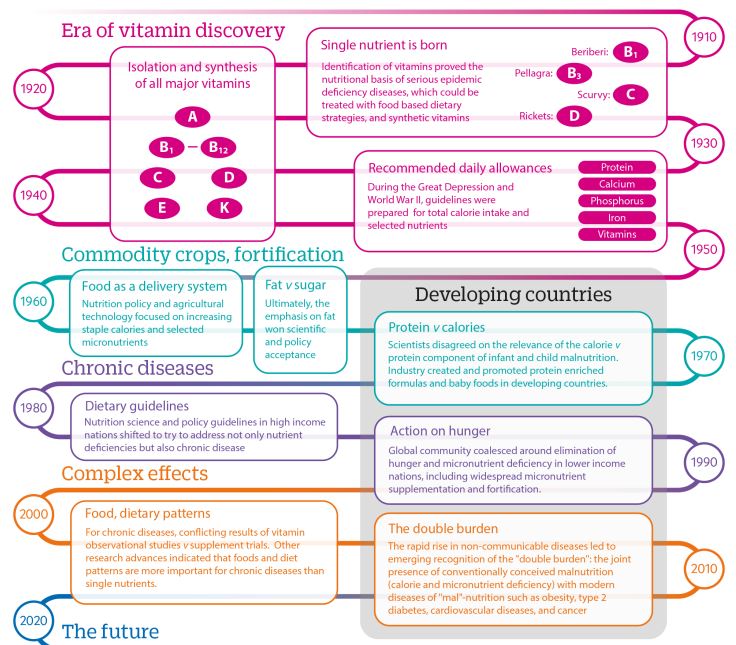
Infographic: A timeline of nutrition research
While food and nutrition have been studied for centuries, modern nutritional science is surprisingly young. This timeline shows how developments in the early 20th century have persistantly shaped our understanding of the field.
The BMJ thanks our series advisers, Dariush Mozaffarian and Nita Forouhi, for valuable advice and guiding selection of topics in the series. These articles are part of a series commissioned by The BMJ. Open access fees for the series were funded by The Swiss Re Institute, which had no input in to the commissioning or peer review of the articles.
The series was launched at a meeting co-hosted by The BMJ and the Swiss Re Institute in Zurich in June 2018, bringing together nutritional researchers, clinicians, and policy makers to discuss the topics covered in the series.

View the Food for Thought 2020 collection:
food for thought
Смотреть что такое «food for thought» в других словарях:
food for thought —
food for thought —
food for thought — If something is food for thought, it is worth thinking about or considering seriously … The small dictionary of idiomes
food for thought — ► food for thought something that warrants serious consideration. Main Entry: ↑food … English terms dictionary
Food For Thought — est un album musical du guitariste Carlos Santana paru en 2004. Cet album, uniquement disponible sur le site officiel de l artiste, a été produit au profit de l association Milagro Foundition présidée par Deborah Santana sa femme. Plusieurs… … Wikipédia en Français
food for thought — noun anything that provides mental stimulus for thinking (Freq. 2) • Syn: ↑food, ↑intellectual nourishment • Hypernyms: ↑content, ↑cognitive content, ↑mental object • … Useful english dictionary
food for thought — If something is food for thought, it is worth thinking about or considering seriously. (Dorking School Dictionary) *** If something give you food for thought, it makes you think seriously about a particular subject. The documentary … English Idioms & idiomatic expressions
food\ for\ thought — n. phr. Something to think about or worth thinking about; something that makes you think. The teacher told John that she wanted to talk to his father, and that gave John food for thought. There is much food for thought in this book … Словарь американских идиом
food for thought — something worth thinking about seriously. Thanks for your suggestion it gave us lots of food for thought … New idioms dictionary
food for thought — something that makes you think a lot about a particular subject Thanks for your comments – they have given us plenty of food for thought … English dictionary
food for thought — ideas worth considering, interesting suggestions Your comments on Quebec have given me food for thought … English idioms
food for thought
Смотреть что такое «food for thought» в других словарях:
food for thought —
food for thought —
food for thought — If something is food for thought, it is worth thinking about or considering seriously … The small dictionary of idiomes
food for thought — ► food for thought something that warrants serious consideration. Main Entry: ↑food … English terms dictionary
Food For Thought — est un album musical du guitariste Carlos Santana paru en 2004. Cet album, uniquement disponible sur le site officiel de l artiste, a été produit au profit de l association Milagro Foundition présidée par Deborah Santana sa femme. Plusieurs… … Wikipédia en Français
food for thought — noun anything that provides mental stimulus for thinking (Freq. 2) • Syn: ↑food, ↑intellectual nourishment • Hypernyms: ↑content, ↑cognitive content, ↑mental object • … Useful english dictionary
food for thought — If something is food for thought, it is worth thinking about or considering seriously. (Dorking School Dictionary) *** If something give you food for thought, it makes you think seriously about a particular subject. The documentary … English Idioms & idiomatic expressions
food\ for\ thought — n. phr. Something to think about or worth thinking about; something that makes you think. The teacher told John that she wanted to talk to his father, and that gave John food for thought. There is much food for thought in this book … Словарь американских идиом
food for thought — something worth thinking about seriously. Thanks for your suggestion it gave us lots of food for thought … New idioms dictionary
food for thought — something that makes you think a lot about a particular subject Thanks for your comments – they have given us plenty of food for thought … English dictionary
food for thought — ideas worth considering, interesting suggestions Your comments on Quebec have given me food for thought … English idioms
food+for+thought
1 food for thought
2 food for thought
3 food for thought
4 food for thought
5 food for thought
6 food for thought
7 food for thought
8 food for thought
9 food for thought
10 food for thought
11 food for thought
12 food for thought
13 food for thought
14 food for thought
15 food for thought
16 food for thought
17 food for thought
18 food for thought
19 food for thought
20 food for thought
См. также в других словарях:
food for thought —
food for thought —
food for thought — If something is food for thought, it is worth thinking about or considering seriously … The small dictionary of idiomes
food for thought — ► food for thought something that warrants serious consideration. Main Entry: ↑food … English terms dictionary
Food For Thought — est un album musical du guitariste Carlos Santana paru en 2004. Cet album, uniquement disponible sur le site officiel de l artiste, a été produit au profit de l association Milagro Foundition présidée par Deborah Santana sa femme. Plusieurs… … Wikipédia en Français
food for thought — noun anything that provides mental stimulus for thinking (Freq. 2) • Syn: ↑food, ↑intellectual nourishment • Hypernyms: ↑content, ↑cognitive content, ↑mental object • … Useful english dictionary
food for thought — If something is food for thought, it is worth thinking about or considering seriously. (Dorking School Dictionary) *** If something give you food for thought, it makes you think seriously about a particular subject. The documentary … English Idioms & idiomatic expressions
food\ for\ thought — n. phr. Something to think about or worth thinking about; something that makes you think. The teacher told John that she wanted to talk to his father, and that gave John food for thought. There is much food for thought in this book … Словарь американских идиом
food for thought — something worth thinking about seriously. Thanks for your suggestion it gave us lots of food for thought … New idioms dictionary
food for thought — something that makes you think a lot about a particular subject Thanks for your comments – they have given us plenty of food for thought … English dictionary
food for thought — ideas worth considering, interesting suggestions Your comments on Quebec have given me food for thought … English idioms
food for thought
1 пища для размышлений
2 пища для ума
3 вопрос для размышления
4 пища для размышлений
5 рынок молочной продукции
6 размышление
подумав; по зрелом размышлении — on reflection
7 духовная пища
8 пища
пища для ума, пища для размышлений — mental pabulum; food for thought
пища богов — celestial food, feast for gods
тяжелая пища — heavy/indigestible food
9 пища для размышлений
10 пища для ума
11 пища
горя́чая пи́ща — hot food; hot meals pl
пи́ща для ума́ — food for thought, mental pabulum
духо́вная пи́ща — spiritual nourishment [‘nʌ-] / food
дава́ть пи́щу слу́хам [подозре́ниям] — feed rumours [suspicion]
12 срок на размышление
подумав; по зрелом размышлении — on reflection
13 пища
пища для ума — food for thought, mental pabulum
духовная пища — spiritual nourishment / food
давать пищу слухам, подозрениям и т. п. — feed* rumours, suspicions, etc .
14 пища
горя́чая пи́ща — hot meal
калори́йная пи́ща — high-calorie/fattening food
пи́ща для ума́ — food for thought
духо́вная пи́ща — soul food
дава́ть пи́щу слу́хам — to feed rumo(u)rs
15 давать пищу
Нюрнбергский процесс оказался таким явлением в истории международных отношений, которое на многие десятилетия вперёд дало пищу уму и государственных деятелей, и историков, и юристов, и дипломатов. (А. Полторак, Нюрнбергский процесс) — The Nuremberg trial proved to be a phenomenon in the history of international relations which for many decades in advance gave food for thought to statesmen, historians, lawyers and diplomatists.
16 информация к размышлению
17 пинок под зад
18 размышление размышлени·е
зрелое размышление — mature deliberation / reflection
по зрелом размышлении — on reflection, on second thought
это наводит на размышления — it makes one think / wonder
19 повод
по́вод для размышле́ний — food for thought
дать по́вод для спле́тен — to set the tongues wagging
без вся́кого по́вода — without cause, without any/the slightest provocation
20 пища для размышлений
We have presented some new ideas as «food for thought» on such topics as.
См. также в других словарях:
food for thought —
food for thought —
food for thought — If something is food for thought, it is worth thinking about or considering seriously … The small dictionary of idiomes
food for thought — ► food for thought something that warrants serious consideration. Main Entry: ↑food … English terms dictionary
Food For Thought — est un album musical du guitariste Carlos Santana paru en 2004. Cet album, uniquement disponible sur le site officiel de l artiste, a été produit au profit de l association Milagro Foundition présidée par Deborah Santana sa femme. Plusieurs… … Wikipédia en Français
food for thought — noun anything that provides mental stimulus for thinking (Freq. 2) • Syn: ↑food, ↑intellectual nourishment • Hypernyms: ↑content, ↑cognitive content, ↑mental object • … Useful english dictionary
food for thought — If something is food for thought, it is worth thinking about or considering seriously. (Dorking School Dictionary) *** If something give you food for thought, it makes you think seriously about a particular subject. The documentary … English Idioms & idiomatic expressions
food\ for\ thought — n. phr. Something to think about or worth thinking about; something that makes you think. The teacher told John that she wanted to talk to his father, and that gave John food for thought. There is much food for thought in this book … Словарь американских идиом
food for thought — something worth thinking about seriously. Thanks for your suggestion it gave us lots of food for thought … New idioms dictionary
food for thought — something that makes you think a lot about a particular subject Thanks for your comments – they have given us plenty of food for thought … English dictionary
food for thought — ideas worth considering, interesting suggestions Your comments on Quebec have given me food for thought … English idioms
«Food for thought» in a word
How can I express «food for thought» in a word? Does such a word exist?
The world will only know peace when our love for power is exceeded by our power to love. That’s __ (something to think about).
9 Answers 9
There is an uncommon word thoughtworthy: (used as thought-worthy also)
Worthy of thought or of being thought; considerable.
Though, considerable is a more common word with a close meaning but does not seem like a good fit for your example.

As a native American English speaker, the first word that came to mind for me was «thought-provoking.» Macmillan dictionary defines thought-provoking as follows:

adjective 1. arousing great interest or curiosity
I don’t know if a single word exists meaning «food for thought» or «worthy of consideration«; perhaps the closest modern English has is:
Or, with a slightly different hue:

While EL&U is an English website, ancient Hebrew has just such a word. That word is selah. If such a word existed in English, you wouldn’t even need to preface it by the word that’s!
Selah is quite commonly used in the Jewish Scripture in the book of Psalms. Despite the obscurity of the word’s origin and meaning, it would seem to mean, at least in part:
meditate/cogitate/ruminate on what has just been said
take the passage’s message to heart
Since the Hebrew psalms, an ancient form of poetry based primarily on parallelism, not rhyme, were meant primarily to be sung, we can imagine that as the choir director in the temple led the singers in a psalm, occasionally he would indicate a pause in the music as a way of letting the words which were being sung to «sink in» to those who were listening. In Handel’s Messiah, there is such a pause in the final measures of the Hallelujah Chorus.
Nowadays, public speakers, for example, will simply repeat a particularly «meaty» sentence or quotation for emphasis, although in some public gatherings, such as at a memorial service, the speaker will sometimes intone,
«Let us observe a minute of silence in memory of [fill in the blank]»
Is there an equivalent, single English word? I doubt it. There should be, in my opinion. Until someone invents one, here are a few alternatives:
Ruminate/cogitate/meditate on that.
That’s worth pondering/considering.
There is in fact a single word which I am blanking on right now. It is a word which describes the power of a quotation, or memorable words, or a theory to stimulate further thought. The word is similar in meaning to prolific, which means having the power to generate many further thoughts and ramifications of the original quotation, words, or theory. When I think of the word, I’ll edit my post accordingly.
Quiz. Food for thought.
Урок 57. Английский язык 8 класс ФГОС

В данный момент вы не можете посмотреть или раздать видеоурок ученикам
Чтобы получить доступ к этому и другим видеоурокам комплекта, вам нужно добавить его в личный кабинет, приобретя в каталоге.
Получите невероятные возможности



Конспект урока «Quiz. Food for thought.»
Some people are fond of reading, while others consider it to be a waste of time.
What kind of reader are you?
If you find reading an amusing and worthy pastime, then join our quiz “Food for Thought”.

1. What do all these people have in common?
Ivan Fyodorov William Caxton Johann Guttenberg
a) they were the first to print books
b) they were all famous poets
c) they were the first to invent the alphabet
Correct answer is a. Ivan Fyodorov was the first to print books in Russia in 1564. The first printing press in England was set up by William Caxton at Westminster in 1476. Johann Gutenberg from Germany invented the printing press in 1450.
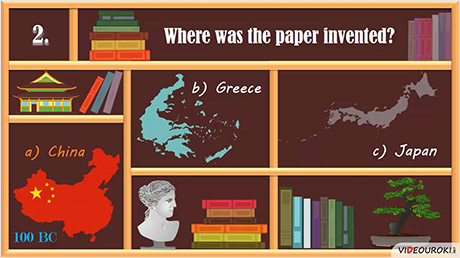
2. Where was the paper invented?
Correct answer is a. Paper was invented around 100 BC in China.

3. When is the World Book Day celebrated?
Correct answer is b. April, 23
4. Put all these genres of books into two columns.
Fiction: novel, fairy-tale, fantasy, thriller, adventure, detective
Non-fiction: dictionary, atlas, encyclopedia, biography, diary
5. In which of the non-fiction books would you:
a. look up the meaning of a word?
b. look up the height of Niagara Falls?
c. find a detailed map of China?
Now check yourselves.
6. Which of the following books would you buy in the situations below:
a cookery book / a travel guide / a children’s book / an autobiography?
1. You don’t like fiction. You prefer to read about the life stories of real people, written by the people themselves.
2. You are 20 years old and are leaving home to share a flat with some friends. You’ve never cooked for yourself before.
3. You don’t know what to buy your seven-year-old nephew for his birthday.
4. You are going to Warsaw for holidays. You’ve never been there before.
Now check yourselves.

7. Use these words to complete the text below: poems / poetry / poet / verses / recite.
When we did poetry at school, we had to learn whole poems by heart and then recite them for the whole class.
Sergey Mayakovski was my favourite poet.
I remember the longest poem I had to learn had over 20 verses!
8. Match the authors and their books.
“The adventures of Sherlock Holmes”
Arthur Conan Doyle
“The Adventures of Tom Sawyer”
“Three men in a boat”
“The Lord of the Rings”
“Gone with the Wind”
9. Do you know where the term Yahoo comes from?
a) Yahoos are the human-like creatures in the novel Gulliver’s Travels by Johann Swift.
b) Yahoo! is an Internet portal. The term was invented by its founders Jerry Yang and David Filo in 1994.
c) Yahoo is the name of the city in South America.
Correct answer is a. Nowadays the term is used to a person, who is very rude, loud or stupid.
10. What is the size of the smallest book in the world?
Correct answer is a. The smallest book in the Welsh National Library is Old King Cole. It measures 1mm x 1mm and the pages can only be turned with a needle.
11. Ernest Vincent is an author of the novel “Gadsby” (1939). It contains 50,000 words. What is his novel famous for?
a) It has no ending.
b) There is no the ‘e’ letter in the whole novel;
c) It was Vincent’s 7 years old son, who wrote the book.
Correct answer is b. There is no the ‘e’ letter in the whole novel.
12. Look at this scrambled picture. What well known English writer is depicted in it?
c) William Shakespeare
Correct answer is c. William Shakespeare

13. Complete the words by R.D. Cumming: A good book has no ____________.
Correct answer is c. A good book has no ending.
14. Complete the saying: Don’t judge a book by its ________.
Find all the words on the topic “Books and Reading” and make up the key word from the rest of the letters.
Now check yourselves: title, content, volume, page, review, essay, epigraph, plot, character, print.
Don’t judge a book by its cover.
Correct answer is a bestseller.
16. Read the following extract and guess its genre:
“Levine walked down another hill and found another river. Something was moving in the grass. An animal the size of mouse came out. Levine looked at it. Greenish skin without hair, large eyes, like a lizard but… Levine knew about this small animal from its bones, but now he was looking at a real, living dinosaur!”
(The Lost World. Jurassic Park. Michael Crichton)
The Lost World belongs to science fiction and fantasy genres.

17. What do you call someone who finds all books worth reading. He feels interested whatever, whenever and wherever he reads.
Correct answer is c) a bookworm.
I hope that most of you answered the questions correctly and the quiz was a good exercise to your mind.
Or even if you gave a couple of wrong answers, you’ve learnt something new.
Reading develops your imagination! TV and computer games have their place, but they are more like amusement.
Amusement comes from two words «a» [non] and «muse» [think]. Amusement is non-thinking activities. But with reading, a person can go anywhere in the world. or even out of it!
Food for thought
1 ♦ food
2 food
3 food
4 food
5 food
food for thought пи́ща для размышле́ния
6 food
7 Food To Go
8 food
9 food
10 food
to go off one’s food — perder* el apetito
food for thought: his father’s words gave him food for thought — las palabras de su padre lo hicieron reflexionar; (before n) <shortage, exports> de alimentos
food group N — grupo m de alimentos, grupo m de comida
food miles NPL — distancia que recorre un alimento desde el lugar en el que es producido hasta el lugar en el que es consumido
• to do food shopping — hacer la compra de la comida
food stamp N — (US) cupón para canjear por comida que reciben las personas de pocos recursos
to go off one’s food — perder* el apetito
food for thought: his father’s words gave him food for thought — las palabras de su padre lo hicieron reflexionar; (before n) <shortage, exports> de alimentos
11 food
for fishes утонуть;
to become food for worms умереть to become
for fishes утонуть;
to become food for worms умереть food корм
пища, питание;
еда, корм;
the food there is excellent там хорошо кормят
съестные припасы, провизия, продовольствие
attr. питательный;
food value питательность
for thought (или reflection) пища для ума, духовная пища
attr. продовольственный;
food rationing карточная система (распределения продуктов)
пища, питание;
еда, корм;
the food there is excellent там хорошо кормят
attr. питательный;
food value питательность green
12 food
he’s very keen on Italian food — er mag die italienische Küche; er isst gern italienisch
food and drink —
they also do food at the pub — in der Kneipe gibt es auch Essen
he’s very keen on Italian food — er mag die italienische Küche; er isst gern italienisch
13 food
14 food
appetizing / delicious / tasty food — вкусная еда
nourishing / wholesome / health food — здоровая пища
plain / simple food — простая пища
to cook / prepare food — готовить еду
to heat / reheat food — разогревать еду
to bolt / gulp (down) / swallow food — глотать пищу
preserved food — консервированные продукты, консервы
food crop — с.-х. продовольственная культура
food for thought / reflection — пища для размышления, для ума
15 food
preserved food — консервированные продукты, консервы
processed food — пищевой продукт, подвергшийся технологической обработке
16 food
17 food
cat food — кошачий корм, корм для кошек
18 food
food cup — годівниця, кормушка
food grains — продовольче збіжжя, продовольчі хліба (хліби)
food value — поживність, поживна цінність
angel food — амер. бісквіт; розм. місіонерська проповідь; побожна промова
preserved food — консервовані продукти, консерви
processed food — бакалійні товари, бакалія
staple foods — масові продукти харчування, продукти широкого вжитку
food for powder, food for the flames — гарматне м’ясо
food value — поживність; пожива
19 food
20 food
См. также в других словарях:
Food — Food, Inc. Saltar a navegación, búsqueda Food, Inc. Título Ficha técnica Dirección Robert Kenner Producción Robert Kenner Richard Pearce Editor … Wikipedia Español
food — 1 Food, feed, victuals, viands, provisions, comestibles, provender, fodder, forage are comparable when meaning things that are edible for human beings or animals. Food is the most general of these terms and is typically applicable to all… … New Dictionary of Synonyms
Food — Food, n. [OE. fode, AS. f[=o]da; akin to Icel. f[ae][eth]a, f[ae][eth]i, Sw. f[ o]da, Dan. & LG. f[ o]de, OHG. fatunga, Gr. patei^sthai to eat, and perh. to Skr. p[=a] to protect, L. pascere to feed, pasture, pabulum food, E. pasture. [root]75.… … The Collaborative International Dictionary of English
food — UK US /fuːd/ noun ► [U] something that people eat to keep them alive: »The country has become a huge importer of raw materials such as cotton, steel, and food products. »The problem is that many small companies don t register their products as… … Financial and business terms
food — [ fud ] noun *** uncount the things that people or animals eat: The prices of food and clothing have risen dramatically in recent years. All the food is cooked and served by volunteers. Doctors stress the importance of eating good fresh food. a.… … Usage of the words and phrases in modern English
food — food; food·less; food·ie; food·lessness; … English syllables
Food — Food, v. t. To supply with food. [Obs.] Baret. [1913 Webster] … The Collaborative International Dictionary of English
food — ► NOUN ▪ any nutritious substance that people or animals eat or drink or that plants absorb to maintain life and growth. ● food for thought Cf. ↑food for thought ORIGIN Old English, related to FODDER(Cf. ↑fodder) … English terms dictionary
food for thought
1 food for thought
2 food for thought
3 food for thought
4 food for thought
5 food for thought
6 food for thought
7 food for thought
8 food for thought
9 food for thought
10 food for thought
11 food for thought
12 food for thought
13 food for thought
14 food for thought
15 food for thought
16 food for thought
17 food for thought
18 food for thought
19 food for thought
20 food for thought
См. также в других словарях:
food for thought —
food for thought —
food for thought — If something is food for thought, it is worth thinking about or considering seriously … The small dictionary of idiomes
food for thought — ► food for thought something that warrants serious consideration. Main Entry: ↑food … English terms dictionary
Food For Thought — est un album musical du guitariste Carlos Santana paru en 2004. Cet album, uniquement disponible sur le site officiel de l artiste, a été produit au profit de l association Milagro Foundition présidée par Deborah Santana sa femme. Plusieurs… … Wikipédia en Français
food for thought — noun anything that provides mental stimulus for thinking (Freq. 2) • Syn: ↑food, ↑intellectual nourishment • Hypernyms: ↑content, ↑cognitive content, ↑mental object • … Useful english dictionary
food for thought — If something is food for thought, it is worth thinking about or considering seriously. (Dorking School Dictionary) *** If something give you food for thought, it makes you think seriously about a particular subject. The documentary … English Idioms & idiomatic expressions
food\ for\ thought — n. phr. Something to think about or worth thinking about; something that makes you think. The teacher told John that she wanted to talk to his father, and that gave John food for thought. There is much food for thought in this book … Словарь американских идиом
food for thought — something worth thinking about seriously. Thanks for your suggestion it gave us lots of food for thought … New idioms dictionary
food for thought — something that makes you think a lot about a particular subject Thanks for your comments – they have given us plenty of food for thought … English dictionary
food for thought — ideas worth considering, interesting suggestions Your comments on Quebec have given me food for thought … English idioms
Food For Thought
As men – even before they became thinkers (primum vivere, deinde philosophari) – philosophers had their favourite dishes and often proved to be great advocates of good food. Their attention to food emerges from their biographies and in their own world, with recurring culinary metaphors and astonishing detail in the wine and food sectors. The word ‘diet’ itself derives from the Greek diaita or ‘way of life’.
Plato definitely preferred the eternal and changeless world of Ideas to this world, and this is why food, cooking and the appetite that directs the process of eating were considered too closely connected to the body to be of any philosophical interest. Plato established this trend in Phaedo, in which he stated that food distracts us from higher things. In the seventh letter he criticizes the Syracusians, accusing them of eating three times a day. He subsequently takes this further still in the Symposium dialogue, which describes a banquet where no one eats anything. Or rather, Socrates intervenes halfway through dinner and the real story begins when the diners’ appetites are already satisfied, leaving nothing to do but drink heavily, sing praises to the gods and discuss philosophy.
An echo of Plato’s influence has remained in popular culture: in John Huston’s 1951 film The African Queen, Rose Sayer (Katherine Hepburn), disgusted by the weaknesses of the flesh displayed by Charlie Allnut (Humphrey Bogart), reproaches him with a philosophically convincing argument: ‘Nature, Mr Allnut, is what we are put in this world to rise above’.
But Plato’s intangible world of ideas (Iperuranio) did not take into consideration the irresistible sweetness of dried figs. Diogenes Laertius, the king of ancient philosophical gossip, tells us that the Greek thinker had a weakness for them and ate them while teaching.
In his fresco The School of Athens, the painter Raphael created a simplified but effective image by placing Plato and Aristotle at the centre of the scene, with Plato on the left pointing to the sky and Aristotle on the right pointing to the ground. This difference in viewpoint is also evident in the importance the two philosophers attribute to food. Aristotle believed it was only possible to think once one’s primary needs had been satisfied: philosophy begins with a full stomach, in other words. It also seems that he had rather sophisticated dietary habits, since he is traditionally reported as owning a well-stocked collection of pots and pans. Aristotle was not so much troubled by the vice of gluttony as by the proximity of greed and loquaciousness and the transformation of one vice into the other, according to which the philosopher’s greed for food became gluttony for words, the unstoppable loquaciousness of the chatterbox.
It is well known that the Pythagoreans theorized about the practice of vegetarianism. These philosophers believed that souls could be reincarnated in animals and that eating meat was tantamount to cannibalism. Their master Pythagoras also severely forbade his disciples to eat fava beans because he believed they contained the souls of the dead waiting to be reincarnated. Legend has it that on one occasion, pursued by enemies, he allowed himself to be captured rather than trample a field of fava beans in order to escape.
Epicurus is renowned for his gluttony, as if throughout his life he had done nothing but stuff himself with food and drink. Today we still refer to those who freely pursue the fulfillment of pleasure as ‘epicureans’ or ‘hedonists’ (the word derives from the Greek edoné, or ‘pleasure’, and indicates the Epicurean doctrine).
This image of Epicurus owes a great deal to misunderstandings and, above all, to the derogatory work of the Fathers of the Church, probably due to his extremely ‘heretical’ theology. Epicurus believed in the mortality of the soul and the total disinterest of the gods towards the fate of humans. To clarify Epicurus’ real thinking, here is a quotation from the famous letter to Meneceus:
When we say, then, that pleasure is the end and aim, we do not mean the pleasures of the prodigal or the pleasures of sensuality, as we are understood to do by some through ignorance, prejudice, or wilful misrepresentation. By pleasure we mean the absence of pain in the body and of trouble in the soul. It is not an unbroken succession of drinking-bouts and of merrymaking, not sexual love, not the enjoyment of the fish and other delicacies of a luxurious table, which produce a pleasant life; it is sober reasoning, searching out the grounds of every choice and avoidance, and banishing those beliefs through which the greatest disturbances take possession of the soul.
In his letters Epicurus himself claims to be content with water and simply baked bread and he writes, ‘Send me a little cheese that I might dine lavishly’. This from the man who established the pursuit of pleasure for its own end as a doctrine. His only weakness was cheese cooked in a pan – a kind of fondue ahead of its time.
The life of Diogenes of Sinope, the most famous and integralist of cynics, is rich in anecdotes. The basic principles of his cynical philosophy were to limit one’s needs as much as possible, live simply and despise wealth, fame and noble birth. ‘It is the privilege of the gods to want nothing, and of godlike men to want little,’ the philosopher used to say. Consequently, Diogenes rejected sumptuous tables and lavish Pantagruelian banquets, and opted for more frugal meals. The cynics were the inventors of ‘fast-food’ or rather, food served in the street, since they preached the necessity of consuming foods in the streets and squares without too much ceremony and preparation.
Diogenes Laertius recounts how the cynic was eating dried figs when he bumped into Plato and invited him to taste them; when Plato took the figs and ate them, Diogenes remarked: ‘I said to take a few, not to eat them all!’. Once again the supreme Plato falls prey to his weakness for dried figs. Diogenes also maintained that it was not unholy to eat human flesh. But it is a little known fact that the philosopher once emulated a boy who, having broken his plate, placed his lentils in the hollow of a piece of bread, throwing away his own bowl and adopting this method of eating. Perhaps Diogenes was the inventor of the modern sandwich?
The stoical Zeno of Citium, according to Appollonius of Tyana, was tall and thin with sturdy legs, flabby and weak, and nearly always refused invitations to banquets. He did, however, love green figs and elected them as the food of philosophers. Carneades, whom Manzoni’s Don Abbondio wondered about in The Betrothed, actually forgot to eat because he devoted too much time to studying. His survival was guaranteed however by a slave who spoon-fed him regularly.
Seneca, the exponent of Roman stoicism, was opposed to luxury (though he did not take this to the same extremes as Diogenes) and liked unfussy, simple but authentic cuisine. As he wrote in De tranquillitate animi: ‘I like food that does not require the preparation and supervision of multitudes of servants, is not ordered days in advance nor is served by many hands; but food that is readily available and simple, with nothing sophisticated or elaborate about it, that can be found wherever one may go, does not weigh heavily on the purse nor the body, so as not to leave the body by the same route along which it entered’.
Porphyry, like the Pythagoreans, sustained the vegetarian cause: in his treatise On Abstinence from Killing Animals he explained that animals cannot be exploited by men and considered as an available means of satisfying their needs. He recommended abstinence also in an ascetic-religious context: a diet based on fruit and vegetables, more sober and frugal than a meat-based diet and healthier too, better suits religious men who seek assimilation with the divine through detachment from the passions and pleasures of the flesh. ‘Meat does not contribute to good health, but is in fact an obstacle to it. Health is preserved through the means by which one obtains strength, and this occurs through a light, meat-free diet. […] Indeed, a philosopher has no need of strength nor of increasing the body’s stamina if he intends to turn his mind to contemplation and not to action and excess’.
Poles apart from the Symposium is the banquet of Tramalchio in Petronius Arbiter’s Satyricon, set in the opulent imperial Rome of the 1st century AD. While in Plato’s dialogue (and in the Greek practice of the symposium in general) the main dish of the banquet was poetry, lyricism or ravenous philosophical disquisition, in the dinner episode of the Satyricon the key moment of the meal is anything but lofty and metaphorical. This is not a casual comparison, since Petronius’ vulgar and materialistic dinner party assumes the tone of a parody of the banquet in Symposium, ideally metaphysical and ferociously refuting the unrestrained luxury and poor taste of Caput mundi. Petronius offers his readers a version of Marco Ferreri’s La grande bouffe set in antiquity.
Real gastronomical monsters are served at Trimalchio’s banquet: a gigantic dish depicting the twelve constellations, with dishes over each sign of the zodiac – chickpeas like small ram’s heads, testicles and kidneys, African figs (again), lobster, cheese pies and honey desserts, even an owl and a sow’s vulva; then a boar surrounded by sucking pigs and dates, a huge pig taking up the entire table, and a sweet with priapean effigies made from pastry. And then a monstrous goose, surrounded by fish and birds of all kinds and a huge cockerel.
This immeasurable quantity of courses, way beyond the requirements of the diners, is deliberately hyperbolic: its aim is to astonish, in a delirium of magnitude which transforms the dinner into a real and spectacular performance. Some dishes are actually paradoxical, like the chicken with peacocks’ eggs inside (a sophisticated feat of gastronomical engineering – or did the Romans already know about GMOs?). The food served is an ecstasy of abundance and luxury, in an unbridled sequence of courses which lead to disgust, nausea and bulimia.
But things are about to change: here we are on the threshold of the Christian era during which we will discover the perverse pleasure of fasting.
Luca Bernardini, a journalist, works at the Slow Food Press Office
to+give+food+for+thought
1 give much food for thought about
2 give
3 будить мысль
4 good
to be in smb.’s good graces см. grace I 3
5 out
6 out
7 program
to administer a program — выполнять / осуществлять программу
to apply a program — использовать / применять программу
to approve a program — утверждать / одобрять программу
to attack smb’s program publicly — публично критиковать чью-л. программу
to carry out a program — выполнять / осуществлять программу
to contribute to a program — способствовать выполнению программы; вносить вклад в программу
to expand / to extend a program — расширять программу
to lay out a program — излагать / намечать программу
to map out a program — намечать / составлять программу
to outline a program — излагать / намечать программу
to profess a program — придерживаться программы; отстаивать программу
to set out a program — излагать / намечать программу
to unfreeze one’s nuclear program — размораживать свою ядерную программу
to unveil one’s program — обнародовать свою программу
to water down one’s program — ослаблять свою программу
8 serious
He can’t be serious in/about what he says. — Не может быть, чтобы он говорил это всерьез.
Are you really serious or only joking? — Ты это всерьез или просто шутишь? /Ты шутишь? /Ты это всерьез?
It is serious for his future (for business, for mankind). — Это важно для его будущего (для дела, для человечества).
См. также в других словарях:
give food for thought — give (someone) food for thought to make someone think seriously about something. What you ve suggested has certainly given me food for thought … New idioms dictionary
give someone food for thought — give (someone) food for thought to make someone think seriously about something. What you ve suggested has certainly given me food for thought … New idioms dictionary
food for thought — If something is food for thought, it is worth thinking about or considering seriously. (Dorking School Dictionary) *** If something give you food for thought, it makes you think seriously about a particular subject. The documentary … English Idioms & idiomatic expressions
food´less|ness — food «food», noun. 1. anything that animals or people eat or drink that makes them live and grow; nourishment: »Milk and green vegetables are valuable foods for young people. 2. what is eaten: »Give him food and drink. 3. anything that plants… … Useful english dictionary
food´less — food «food», noun. 1. anything that animals or people eat or drink that makes them live and grow; nourishment: »Milk and green vegetables are valuable foods for young people. 2. what is eaten: »Give him food and drink. 3. anything that plants… … Useful english dictionary
food — 1 Food, feed, victuals, viands, provisions, comestibles, provender, fodder, forage are comparable when meaning things that are edible for human beings or animals. Food is the most general of these terms and is typically applicable to all… … New Dictionary of Synonyms
thought — thought1 [θo:t US θo:t] the past tense and past participle of ↑think 1 thought 2 thought2 W1S1 n ▬▬▬▬▬▬▬ 1¦(something you think about)¦ 2¦(ideas/opinions)¦ 3¦(careful consideration)¦ 4¦(act of thinking)¦ 5¦(caring about something)¦ 6¦(intention)¦ … Dictionary of contemporary English
thought — thought1 [ θɔt ] noun *** ▸ 1 idea etc. entering mind ▸ 2 mental effort ▸ 3 idea/opinion ▸ 4 plan/wish to do something ▸ 5 care/worry ▸ 6 system of ideas ▸ + PHRASES 1. ) count a word, idea, or image that comes into your mind: a… … Usage of the words and phrases in modern English
thought — I UK [θɔːt] / US [θɔt] noun Word forms thought : singular thought plural thoughts *** 1) [countable] a word, idea, or image that comes into your mind a comforting/sobering/chilling thought thought of: His mind was filled with thoughts of revenge … English dictionary
thought*/*/*/ — [θɔːt] noun I 1) [C] a word, idea, or image that comes into your mind a comforting/sobering/chilling thought[/ex] His mind was filled with thoughts of revenge.[/ex] She couldn t bear the thought of seeing him again.[/ex] The thought had crossed… … Dictionary for writing and speaking English


ABOUT us

Housed in Singapore’s oldest museum, Food For Thought aims to create a space where people can catch a glimpse of our city’s past, present and future, and the stories we tell about them.
Due to our museum locale, you’d find carefully curated selection of locally published children’s books, cookbooks, autobiographies, art and design books and poetry.
Food For Thought serves up hearty, local-inspired bistro fare – honest food in Southeast Asian flavours with a globalised influence.
celebrate with us!
Whether you’re throwing a birthday bash, a kids party, or a wedding dinner, we’re here to listen to your needs and creative ideas. Explore our space and events facilities in our event kit, or fill out the form to make your enquiries!
Housed in heritage architecture, Food For Thought @ National Museum promises a handsome and charming backdrop for your special event.
Our entire restaurant seats up to a total of 170 guests, and customisable layouts and spaces are available for intimate gatherings.
FOOD+for+thought
1 food for thought
2 food for thought
3 food for thought
4 food for thought
5 food for thought
6 food for thought
7 food for thought
8 food for thought
9 food for thought
10 food for thought
11 food for thought
12 food for thought
13 food for thought
14 food for thought
15 food for thought
16 food for thought
17 food for thought
18 food for thought
19 food for thought
20 food for thought
См. также в других словарях:
food for thought —
food for thought —
food for thought — If something is food for thought, it is worth thinking about or considering seriously … The small dictionary of idiomes
food for thought — ► food for thought something that warrants serious consideration. Main Entry: ↑food … English terms dictionary
Food For Thought — est un album musical du guitariste Carlos Santana paru en 2004. Cet album, uniquement disponible sur le site officiel de l artiste, a été produit au profit de l association Milagro Foundition présidée par Deborah Santana sa femme. Plusieurs… … Wikipédia en Français
food for thought — noun anything that provides mental stimulus for thinking (Freq. 2) • Syn: ↑food, ↑intellectual nourishment • Hypernyms: ↑content, ↑cognitive content, ↑mental object • … Useful english dictionary
food for thought — If something is food for thought, it is worth thinking about or considering seriously. (Dorking School Dictionary) *** If something give you food for thought, it makes you think seriously about a particular subject. The documentary … English Idioms & idiomatic expressions
food\ for\ thought — n. phr. Something to think about or worth thinking about; something that makes you think. The teacher told John that she wanted to talk to his father, and that gave John food for thought. There is much food for thought in this book … Словарь американских идиом
food for thought — something worth thinking about seriously. Thanks for your suggestion it gave us lots of food for thought … New idioms dictionary
food for thought — something that makes you think a lot about a particular subject Thanks for your comments – they have given us plenty of food for thought … English dictionary
food for thought — ideas worth considering, interesting suggestions Your comments on Quebec have given me food for thought … English idioms
Food For Thought
Rhiannon Lambert
See acast.com/privacy for privacy and opt-out information.
Эпизоды

Are You Addicted To Food
See acast.com/privacy for privacy and opt-out information.
Processed Vs. Ultra-Processed Food
See acast.com/privacy for privacy and opt-out information.
Finding True Happiness
See acast.com/privacy for privacy and opt-out information.
Should We Count Macros
See acast.com/privacy for privacy and opt-out information.
The Truth About Supplements
The supplements industry is booming, but in a sector that can even be confusing to health professionals, understanding what we should and shouldn’t be taking is becoming more complex than ever before.
This week’s Food For Thought sees registered dietitian Sophie Medlin and I delve into which supplements are worthwhile and breakdown the pseudoscience surrounding so many of the others that you really don’t need to be taking. Plus for more information, rhitritionplus.com and https://www.instagram.com/rhitritionplus/.
See acast.com/privacy for privacy and opt-out information.
How Food Changes Weight
See acast.com/privacy for privacy and opt-out information.
Food Trends Set To Soar
See acast.com/privacy for privacy and opt-out information.
Boosting Brain Power
See acast.com/privacy for privacy and opt-out information.
The Power Of Exercise
See acast.com/privacy for privacy and opt-out information.
Must-Do Wellness Habits
See acast.com/privacy for privacy and opt-out information.
Dangers Of Body Obsession
See acast.com/privacy for privacy and opt-out information.
The Science Of Nutrition
See acast.com/privacy for privacy and opt-out information.
Managing Our Size & Shape
See acast.com/privacy for privacy and opt-out information.
Is It Time To Stop Eating Fish
More of us are going flexitarian, so you won’t be alone if you’ve questioned what you eat. I’m not just referring to individual items but to food groups, this particularly goes to fish and if you’re
thinking is it friend or foe. This week’s Food For Thought sees registered dietitian Tai Ibitoye and I explore the nutritional benefits of fish, it’s role in our diet and what we need to be mindful of. Plus for more information, visit Rhitrition.com and Instagram.com/Rhitrition.
See acast.com/privacy for privacy and opt-out information.
Let’s Talk About Sex
Once a taboo subject, sexual health is something we’re learning to talk about more openly. But despite increased awareness around sexual health it can still be neglected for all sorts of reasons.
Rather than worrying unnecessarily or following unfounded advice let’s open up the conversation even further to support our sexual health as well as our partners. This week’s Food For Thought sees Dr Doireann O’Leary and I discuss what sexual health encompasses, the myths surrounding it and how we can look after ours. Plus for more information, visit Rhitrition.com and Instagram.com/Rhitrition.
See acast.com/privacy for privacy and opt-out information.
Are You Addicted To Caffeine
Caffeine has firmly cemented its place in many of our lives on a daily or even hourly basis. For many this signals the start of a new day and gives us that much needed energy boost.
food for thought
Definition of food for thought
Learn More About food for thought
Share food for thought
Dictionary Entries Near food for thought
Statistics for food for thought
“Food for thought.” Merriam-Webster.com Dictionary, Merriam-Webster, https://www.merriam-webster.com/dictionary/food%20for%20thought. Accessed 26 Aug. 2022.
WORD OF THE DAY
vociferous

Get Word of the Day daily email!
Test Your Vocabulary
The Great British Vocabulary Quiz


Test your vocabulary with our 10-question quiz!
A daily challenge for crossword fanatics.
Subscribe to America’s largest dictionary and get thousands more definitions and advanced search—ad free!
As illustrated by some very smart pups
Bikini, bourbon, and badminton were places first
Do you take pride in Pride?
Look up any year to find out
How to use a word that (literally) drives some pe.
We’re intent on clearing it up
Editor Emily Brewster clarifies the difference.
«The public is a hot mess»
Roll up your sleeves and identify these garments
Can you tell a meerkat from a wombat?
Test your vocabulary with our 10-question quiz!
Can you outdo past winners of the National Spelli.
Learn a new word every day. Delivered to your inbox!
Food For Thought
It’s time to start the new you!


Food/Health Blog
Diet & Nutrition
Thinking about food is almost as fun as eating it – and here at Food For Thought, we do plenty of both!
Putting more consideration behind what goes into your body is important, but it can also be exciting and entertaining.
Healthy food and drink do not have to be boring and bland, or limp and green – it can be flavourful and interesting…and can even include whiskey or wine as part of a balanced diet!


Think Before You Chew Or Sip
Too often the fuel we consume is hastily prepared or not given enough thought, but we aim to change that.
Food For Thought looks at the future of food and diets through a foodie lens – you won’t find boring scientific stats here (unless we’re making a point), just informed observations about food and drink trends and facts.
From the health benefits of premium whiskey to how many glasses of wine a day you should really be having, Food For Thought has even the most inquiring minds covered.


Healthy Meal Plans Perfectly Simple
Why Food For Thought?
Why not just another food and drink blog – that’s popular with the masses, right?
Well, Food For Thought was started because we wanted to look a little closer at what we were munching and sipping away on.
We still have plenty of fun (and lashings of butter and cream in our diet), but with a little more contemplation behind the dishes we create. We wanted to impart our knowledge about food, health, and wellness in a way that was still entertaining and interesting.
We also have some tasty tidbits about the best foodie destinations in London and surrounds, and some recipes that are sure to make your mouth water.


What You’ll Find Here
This is our little piece of the internet where we share all things food and fabulous. We delve into topics that others do not – like healthy alcoholic beverages – and tackle your food conscience with tips and tricks.
We don’t focus on one style or way of eating, but rather explore all avenues and diets, helping readers to think carefully about what they eat and drink.
Our articles make food and drink exciting again, and being based in London, we have access to a melting pot of foodie experiences, from the Whiskey And Wealth Club (for those who want to invest in their favourite premium tipple) to the eccentric “Supper Street” eateries that make up Islington.
Who Are We?
We’re foodies – plain and simple.
We enjoy the finer side of eating, but will give anything a try once! Our team is ready to dive into the nitty-gritty of food and drink so our readers can make informed decisions about their next epicurean adventure.
We’re Londoners at heart, and will take you on a gastronomic experience around The Big Smoke that is sure to surprise and delight even the pickiest of eaters.
Food For Thought is created by people who enjoy eating for people who enjoy eating.
And – we won’t “trick” you into eating healthier, either!
Урок на тему: «FOOD FOR THOUGHT»
Еркужаева Шынар Жұмамұратқызы
Қазалы аграрлы – техникалық колледжінің ағылшын тілі пәні оқытушысы
The procedure of the lesson:
1. Organization moment. Greetings
Good morning! Hello to everybody! How are you? Who is on duty today? Who is absent today? What date is it today? What day of the week is it today? What is the weather like today?


• Apple, carrot, orange, potato, banana, pear, grape, cabbage.
• Write these words in alphabetical order.
• Translate into 3 languages.
3. Home work: Ex: 2.
Discuss the following questions in small groups.
Are you healthy?
Do you eat things that are good for you?
Do you think about your diet?
Do you ever eat too much / too little?
Do you take vitamins?
b) Reading of the text. Ex:6

* Group ‘Seaweed’ * Group ‘ Sea urchins’
e) Ex: 12. Match the sentences in exercise 11 with the meanings below
I forget to I forget to order urchin
I didn’t remember ordering urchins
I probably ordered urchins, but I couldn’t remember
I didn’t remember to order urchins
I didn’t continue eating the urchins
I stopped because I wanted to eat urchins
5. The concluding stage
Work with the picture ( Our national food is beshbarmak )
 c) Association
 d) I.I.I. method
food for thought
Words nearby food for thought
MORE ABOUT FOOD FOR THOUGHT
What does food for thought mean?
The phrase food for thought refers to an idea or piece of information that’s worth pondering or thinking over.
Another way of saying this is “something to think about.”
The phrase food for thought is a metaphor: it suggests that the information that has been presented is like or should be treated like food that needs to be digested. In this way, the potentially helpful or insightful points that can be taken from the information are like nutrients that can be absorbed into the body.
Food for thought can be used to refer to any information that causes a person to think about it, as in The researchers were shocked by the results of their study and it provided them with some real food for thought.
But the phrase is perhaps most commonly used to refer to a suggestion or piece of information that’s presented to someone with the intention of getting them to change their outlook in some way. Sometimes, the speaker will even specifically call something food for thought as a way of telling the listener to really think about it.
Example: You could earn a lot more if you became certified—just some food for thought.
Where does food for thought come from?
The first records of the phrase food for thought come from the 1800s, but the word food had been used in the sense of something to think about since at least the 1600s.
Food for thought always involves something that can or should be mulled over or pondered. A synonym for those verbs is ruminate, which is based on a similar metaphor. Ruminate comes from a word that refers to the digestion process of ruminant animals like cows, in which they chew things over and over. Information that’s considered food for thought should be chewed over in one’s mind. Anything that causes you to think for a while can be called food for thought, regardless of whether it’s a serious philosophical topic or useless trivia.
What are some synonyms for food for thought?
What are some words that share a root or word element with food for thought?
What are some words that often get used in discussing food for thought?
What are some words food for thought may be commonly confused with?
How is food for thought used in real life?
Food for thought is commonly used as a way for someone to suggest that you at least think about what they just said.
While we are on the topic of unemployment/career changes. For those out of work and/or looking for a good career path w/ job security & quality pay, think about IT.
A simple Security+ can go a long way. It did for me & opened plenty of new doors.
Just some food for thought.
Sean Penn received the 2012 Peace Summit Award from a gathering of Nobel winners today & gave them food for thought http://t.co/QReqKv1Q
Try using food for thought!
Is food for thought used correctly in the following sentence?
The lecture gave me a lot of food for thought—I’ve been thinking about it since it ended.
How to use food for thought in a sentence
In other words, the free thinker defending freedom of thought.
Rates are thought to be similar in developed countries around the world.
Sands was involved in a scandalous-for-the-time romance with the carpenter and there were rumors she was pregnant with his child.
Not only had the iconic comedian sexually assaulted many, many women, Maher argued, “I never thought he was funny.”
Because they stopped and I thought, “OK, that makes sense,” and then all of a sudden I saw another issue!
Other things being equal, the volume of voice used measures the value that the mind puts upon the thought.
He was too drowsy to hold the thought more than a moment in his mind, much less to reflect upon it.
To reproduce the impulse born of the thought—this is the aim of a psychological method.
And I have not had the first morsel of food prepared from this grain offered me since I reached the shores of Europe.
There was no doubt thought of his own loss in this question: yet there was, one may hope, a germ of solicitude for the mother too.
Food for thought

Try Our Daily Crossword Puzzle!
WORD OF THE DAY
GAMES & ACTIVITIES
Flex your word muscles and improve your language and writing skills with a bit of fun.

NEW: WORDLE SOLVER
Does today’s Wordle have you STUCK? Wordle Solver can help!

CROSSWORD PUZZLE & SOLVER
Daily puzzles that are always free.

WORD PUZZLE
How many words can you make with 8 letters?
WORD LISTS & FLASHCARDS
All the learning tools you need to level up your knowledge for studying and test preparation.
Words Of The Day
Find the latest Words of the Day here!
What’s Your Sign?
How familiar are you with zodiac signs?
SAT Test Prep
Study these words to help you ace the SAT Writing & …
SIGN UP FOR A VOCABULARY BOOST IN YOUR EMAIL
LEARN ABOUT THE ENGLISH LANGUAGE
Learn more with the stories we’ve written about our words, the origins of our language, and the nuances that make English complicated and so unique.

THE FUNNY NAMES FOR FASHION TRENDS
Have you ever worn «jeggings»? Learn about 13 funny fashion word combos.
Word Facts 101
Words in the News
Word of Mouth
SLANG, EMOJI, & MORE NEW WORDS
In Dictionary.com’s modern language section, we’re constantly documenting the meanings of slang, emoji, and new words as soon as you all start saying them.

SLANG DICTIONARY
The ultimate slang dictionary for words you don’t know, don’t understand, or don’t want to know.

EMOJI DICTIONARY
A guide for how to use popular emoji (beware: the meanings are always changing!).

GENDER & SEXUALITY DICTIONARY
Identity is fluid, and so is the language around it.
BROWSE DICTIONARY.COM
Dictionary.com is the world’s leading online source for definitions, word origins, and a whole lot more. From Word of the Day to the stories behind today’s slang, Dictionary.com unlocks the secrets of the English language for millions of people.
EVERYTHING AFTER Z
SCRABBLE® WORD FINDER
DOWNLOAD OUR APPS
Our apps also have more than 1.5 million definitions and synonyms plus access to our trusted reference articles. Look up the words anywhere anytime-we work offline too!
Translation of «food for thought for» in Russian
пища для размышлений для
pishcha dlya razmyshleniy dlya
Click to view 7 examples
пищи для размышлений на
pishchi dlya razmyshleniy na
Click to view 2 examples
пища для размышлений о
pishcha dlya razmyshleniy o
Click to view 2 examples
пищу для размышлений
pishchu dlya razmyshleniy
Click to view 20 examples
пищу для размышления
pishchu dlya razmyshleniya
Click to view 4 examples
пищи для размышления
pishchi dlya razmyshleniya
Click to view 2 examples
пища для размышления для
pishcha dlya razmyshleniya dlya
Click to view 2 examples
пища к размышлению
pishcha k razmyshleniyu
Click to view 2 examples
пищей для размышлений
pishchey dlya razmyshleniy
Click to view 2 examples
пищи для размышлений в отношении
pishchi dlya razmyshleniy v otnoshenii
Food for thought

A Why not eat insects? So asked British entomologist Vincent M. Holt in the title of his 1885 treatise on the benefits of what he named entomophagy – the consumption of insects (and similar creatures) as a food source. The prospect of eating dishes such as “wireworm sauce” and “slug soup” failed to garner favour amongst those in the stuffy, proper, Victorian social milieu of his time, however, and Holt’s visionary ideas were considered at best eccentric, at worst an offense to every refined palate. Anticipating such a reaction, Holt acknowledged the difficulty in unseating deep-rooted prejudices against insect cuisine, but quietly asserted his confidence that “we shall some day quite gladly cook and eat them”.
B It has taken nearly 150 years but an eclectic Western-driven movement has finally mounted around the entomophagic cause. In Los Angeles and other cosmopolitan Western cities, insects have been caught up in the endless pursuit of novel and authentic delicacies. “Eating grasshoppers is a thing you do here”, bugsupplier Bricia Lopez has explained. “There’s more of a ‘cool’ factor involved.” Meanwhile, the Food and Agricultural Organization has considered a policy paper on the subject, initiated farming projects in Laos, and set down plans for a world congress on insect farming in 2013.
C Eating insects is not a new phenomenon. In fact, insects and other such creatures are already eaten in 80 per cent of the world’s countries, prepared in customary dishes ranging from deep-fried tarantula in Cambodia to bowls of baby bees in China. With the specialist knowledge that Western companies and organisations can bring to the table, however, these hand-prepared delicacies have the potential to be produced on a scale large enough to lower costs and open up mass markets. A new American company, for example, is attempting to develop pressurisation machines that would de-shell insects and make them available in the form of cutlets. According to the entrepreneur behind the company, Matthew Krisiloff, this will be the key to pleasing the uninitiated palate.
D Insects certainly possess some key advantages over traditional Western meat sources. According to research findings from Professor Arnold van Huis, a Dutch entomologist, breeding insects results in far fewer noxious by-products. Insects produce less ammonia than pig and poultry farming, ten times less methane than livestock, and 300 times less nitrous oxide. Huis also notes that insects – being coldblooded creatures – can convert food to protein at a rate far superior to that of cows, since the latter exhaust much of their energy just keeping themselves warm.
E Although insects are sometimes perceived by Westerners as unhygienic or disease-ridden, they are a reliable option in light of recent global epidemics (as Holt pointed out many years ago, insects are “decidedly more particular in their feeding than ourselves”). Because bugs are genetically distant from humans, species-hopping diseases such as swine flu or mad cow disease are much less likely to start or spread amongst grasshoppers or slugs than in poultry and cattle. Furthermore, the squalid, cramped quarters that encourage diseases to propagate among many animal populations are actually the residence of choice for insects, which thrive in such conditions.
F Then, of course, there are the commercial gains. As FAO Forestry Manager Patrick Durst notes, in developing countries many rural people and traditional forest dwellers have remarkable knowledge about managing insect populations to produce food. Until now, they have only used this knowledge to meet their own subsistence needs, but Durst believes that, with the adoption of modern technology and improved promotional methods, opportunities to expand the market to new consumers will flourish. This could provide a crucial step into the global economic arena for those primarily rural, impoverished populations who have been excluded from the rise of manufacturing and large-scale agriculture.
G Nevertheless, much stands in the way of the entomophagic movement. One problem is the damage that has been caused, and continues to be caused, by Western organisations prepared to kill off grasshoppers and locusts – complete food proteins – in favour of preserving the incomplete protein crops of millet, wheat, barley and maize. Entomologist Florence Dunkel has described the consequences of such interventions. While examining children’s diets as a part of her field work in Mali, Dunkel discovered that a protein deficiency syndrome called kwashiorkor was increasing in incidence. Children in the area were once protected against kwashiorkor by a diet high in grasshoppers, but these had become unsafe to eat after pesticide use in the area increased.
H A further issue is the persistent fear many Westerners still have about eating insects. “The problem is the ick factor—the eyes, the wings, the legs,” Krisiloff has said. “It’s not as simple as hiding it in a bug nugget. People won’t accept it beyond the novelty. When you think of a chicken, you think of a chicken breast, not the eyes, wings, and beak.” For Marcel Dicke, the key lies in camouflaging the fact that people are eating insects at all. Insect flour is one of his propositions, as is changing the language of insect cuisine. “If you say it’s mealworms, it makes people think of ringworm”, he notes. “So stop saying ‘worm’. If we use Latin names, say it’s a Tenebrio quiche, it sounds much more fancy”. For Krisiloff, Dicke and others, keeping quiet about the gritty reality of our food is often the best approach. I It is yet to be seen if history will truly redeem Vincent Holt and his suggestion that British families should gather around their dining tables for a breakfast of “moths on toast”. It is clear, however, that entomophagy, far from being a kooky sideshow to the real business of food production, has much to offer in meeting the challenges that global societies in the 21st century will face.
YOU MIGHT ALSO LIKE : SPOKEN ENGLISH TRAINING
Questions 14–21
Reading Passage 2 has nine paragraphs, A–I.
Choose the correct heading for paragraphs A–H from the list of headings below.
Write the correct number, i–xi, in boxes 14–21 on your answer sheet.
List of Headings
i A historical delicacy
ii The poor may benefit
iii Presentation is key to changing attitudes
iv Environmentally friendly production
v Tradition meets technology
vi A cultural pioneer
vii Western practices harm locals
viii Good source of nutrients
ix Growing popularity
x A healthy choice
xi A safety risk
14 Section A
15 Section B
16 Section C
17 Section D
18 Section E
19 Section F
20 Section G
21 Section H
Questions 22–26
Complete the notes below.
Choose NO MORE THAN THREE WORDS from the passage for each answer.
Write your answers in boxes 22–26 on your answer sheet.
Van Huis
• Insects are cleaner & do not release as many harmful gases
• Insects use food intake economically in the production of protein as they waste less 22…………………
Durst
• Traditional knowledge could be combined with modern methods for mass production instead of just covering 23 …………………
• This could help 24 ………………… people gain access to world markets.
Dunkel
• Due to increased 25 …………………, more children in Mali are suffering from 26…………………
ANSWERS:
14. vi
15. ix
16. v
17. iv
18. x
19. ii
20. vii
21. iii
22. energy
23. subsistence needs
24. rural, impoverished /
rural/impoverished
25. pesticide use
26. protein deficiency
(syndrome)/kwashiorkor
FOOD FOR THOUGHT
| Pronunciation (US): |  | (GB): | |
| IPA (US): |  |
Dictionary entry overview: What does food for thought mean?
1. anything that provides mental stimulus for thinking 
Familiarity information: FOOD FOR THOUGHT used as a noun is very rare.
Dictionary entry details
• FOOD FOR THOUGHT (noun)
Anything that provides mental stimulus for thinking
Nouns denoting cognitive processes and contents
Hypernyms («food for thought» is a kind of. ):
cognitive content; content; mental object (the sum or range of what has been perceived, discovered, or learned)
Hyponyms (each of the following is a kind of «food for thought»):
Открытый урок по английскому языку на тему:“Food for thought”
The theme of the lesson: Step 5. “Food for thought” 10 th “A” form
Developing objectives: To develop students’ reading skills
To expand students’ vocabulary
To develop students’ speaking and listening skills
The type of the lesson: mixed
Visual aids: active board, slides about healthy and unhealthy food, videos about
The plan of the lesson:
I. Organization moment
II. Checking the home task.
IV. The benefits of healthy food (Listening to the dialogue on video)
V. Completing the table (Task to the listening text)
VI. Relaxation (Listening to the song about healthy food)
VII. Reading the text “Unusual food”(watching the video)
IX. Conclusion of the lesson. (Drawing the picture)
The procedure of the lesson:
I. Organization moment
T: Good morning. Take your places. Who is on duty today?
Who is absent? What date and day is it today?
Let’s begin our lesson with the checking your home work. What was your home work?
P: To write an essay and make a slide on theme : ”My healthy lifestyle”
Who is ready? Who wants to read or to demonstrate his or her slideshow?
Making an association
T: Now take your seats and make an association. The first group write about healthy food and the second group about unhealthy food.
 |
 |
Well, one pupil of each group should go to the blackboard and present the poster.
Eyesight – көздің көруі
To be rich- бай болу
Now please listen the video attentively then you’ll do the task to the video.
Carrot is full of ………. It is good for your ……….
Apples contain a lot of …………. It is good for ……….
Tomato is rich of …………. It helps to fight with …… and to keep your ……..healthy
Broccoli is full of …………. It helps your …………
Orange is full of ………………….. It gives you …………….
Bananas is rich of ………………… It helps you …… and ………..
What food make you smile? (Bananas, grapes, apples, healthy food)
Sea urchin- теңіз кірпісі
Tarantula’s eggs- тарантула жүмыртқалары (улы өрмекші)
Seaweed- теңіз балдырлары
give much food for thought about
Смотреть что такое «give much food for thought about» в других словарях:
give — 1 verb past tense gavepast participle given PROVIDE/SUPPLY 1 (T) to provide or supply someone with something: give sb sth: Researchers were given a 10,000 grant to continue their work. | Can you give me a ride to the office on Tuesday? | He went… … Longman dictionary of contemporary English
thought — thought1 [θo:t US θo:t] the past tense and past participle of ↑think 1 thought 2 thought2 W1S1 n ▬▬▬▬▬▬▬ 1¦(something you think about)¦ 2¦(ideas/opinions)¦ 3¦(careful consideration)¦ 4¦(act of thinking)¦ 5¦(caring about something)¦ 6¦(intention)¦ … Dictionary of contemporary English
thought — thought1 [ θɔt ] noun *** ▸ 1 idea etc. entering mind ▸ 2 mental effort ▸ 3 idea/opinion ▸ 4 plan/wish to do something ▸ 5 care/worry ▸ 6 system of ideas ▸ + PHRASES 1. ) count a word, idea, or image that comes into your mind: a… … Usage of the words and phrases in modern English
thought — I UK [θɔːt] / US [θɔt] noun Word forms thought : singular thought plural thoughts *** 1) [countable] a word, idea, or image that comes into your mind a comforting/sobering/chilling thought thought of: His mind was filled with thoughts of revenge … English dictionary
For One More Day — is a 2006 novel taken place during the mid 1900 s by the acclaimed sportswriter and author Mitch Albom. It opens with the novel s protagonist planning to commit suicide. His adulthood is shown to have been rife with sadness. His own daughter didn … Wikipedia
thought — thought1 /thawt/, n. 1. the product of mental activity; that which one thinks: a body of thought. 2. a single act or product of thinking; idea or notion: to collect one s thoughts. 3. the act or process of thinking; mental activity: Thought as… … Universalium
Food and Drug Administration — FDA redirects here. For other uses, see FDA (disambiguation). Food and Drug Administration Agency overview Formed 1906 … Wikipedia
Cat food — For the song by King Crimson, see Cat Food (song). Cat with a bowl of dry cat food Cat food is food intended for consumption by cats. As with all species, cats have requirements for specific dietary nutrients, rather than ingredients.[1] Certain… … Wikipedia
food preservation — Any method by which food is protected against spoilage by oxidation, bacteria, molds, and microorganisms. Traditional methods include dehydration, smoking, salting, controlled fermentation (including pickling), and candying; certain spices have… … Universalium
Agriculture and Food Supplies — ▪ 2007 Introduction Bird flu reached Europe and Africa, and concerns over BSE continued to disrupt trade in beef. An international vault for seeds was under construction on an Arctic island. Stocks of important food fish species were reported… … Universalium
Food For Thought
A Collection of Heretical Notions and Wretched Adages
compiled by Jack Tourette
Catholicism baptized polytheism by substituting for the old pagan cults the cults of local and patron saints. Such cults can and have led to abuses, but they are infinitely more healthy than the cult of the fashionable film star or pop singer, which is all that Prostestantism has to offer in their stead.
Though justice be thy plea, consider this,
That, in the course of justice, none of us
Should see salvation: we do pray for mercy;
And that same prayer doth teach us all to render
The deeds of mercy.
Sarcasm I now see to be, in general, the language of the Devil; for which reason I have long since as good as renounced it.
What I claim is to live to the full the contradiction of my time, which may well make sarcasm the condition of truth.
Labeling something as sarcasm utterly undercuts the effect. The whole point about sarcasm is that it’s risky; it depends on your hearer getting the literal meaning and then seeing that you can’t mean that so you must mean something else and working out what that other thing must be. Your hearer has to do some interpretive work, and that work is the effect.
If the devil doesn’t exist, but man has created him, he has created him in his own image and likeness.
An apology for the Devil: It must be remembered that we have only heard one side of the case. God has written all the books.
Sometimes the devil tempts me to believe in God.
We’re fighting against humanism, we’re fighting against liberalism. we are fighting against all the systems of Satan that are destroying our nation today. our battle is with Satan himself.
Satire is a sort of glass, wherein beholders do generally discover everybody’s face but their own, which is the chief reason for that kind of reception it meets in the world, and that so very few are offended with it.
Satire should, like a polished razor keen,
Wound with a touch that’s scarcely felt or seen.
It is said that truth comes from the mouths of fools and children: I wish every good mind which feels an inclination for satire would reflect that the finest satirist always has something of both in him.
I can’t help detesting my relations. I suppose it comes from the fact that none of us can stand other people having the same faults as ourselves. I quite sympathize with the rage of the English democracy against what they call the vices of the upper orders. The masses feel that drunkenness, stupidity, and immorality should be their own special property, and that if anyone of us makes an ass of himself he is poaching on their preserves.
Alas! can we ring the bells backward? Can we unlearn the arts that pretend to civilize, and then burn the world? There is a march of science; but who shall beat the drums for its retreat?
The day would fall, if I should attempt to enumerate the evils which science has inflicted on mankind. I almost think it is the ultimate destiny of science to exterminate the human race.
Science is Christian, not when it condemns itself to the letter of things, but when, in the infinitely little, it discovers as many mysteries and as much depth and power as in the infinitely great.
Science is a first-rate piece of furniture for a man’s upper chamber, if he has common sense on the ground floor.
There is something fascinating about science. One gets such wholesome returns of conjecture out of such a trifling investment of fact.
So it is something of a homiletical commonplace to say that the outcome of any serious research can only be to make two questions grow where one question grew before.
A new scientific truth does not triumph by convincing its opponents and making them see the light, but rather because its opponents eventually die, and a new generation grows up that is familiar with it.
Academic philosophers, ever since the time of Parmenides, have believed that the world is a unity. This view has been taken over from them by clergymen and journalists, and its acceptance has been considered the touchstone of wisdom. The most fundamental of my intellectual beliefs is that this is rubbish. I think the universe is all spots and jumps, without unity, without continuity, without coherence or orderliness or any of the other properties that governesses love. Indeed, there is little but prejudice and habit to be said for the view that there is a world at all. Physicists have recently advanced opinions which should which should have led them to agree with the foregoing remarks; but they have been so pained by the conclusions to which logic would have led them that they have been abandoning logic for theology in shoals.
I think that the external world may be an illusion, but if it exists, it consists of events, short, small and haphazard. Order, unity, and continuity are human inventions, just as truly as are catalogues and encyclopedias.
Religion is something left over from the infancy of our intelligence, it will fade away as we adopt reason and science as our guidelines.
I once said that ‘a science is said to be useful if its development tends to accentuate the existing inequalities in the distribution of wealth, or more directly promotes the destruction of human life’, and this sentence, written in 1915, has been quoted (for or against me) several times. It was of course a conscious rhetorical fluorish, though one perhaps excusable at the time when it was written.
. physics tries to discover the pattern of events which controls the phenomena we observe. But we can never know what this pattern means or how it originates; and even if some superior intelligence were to tell us, we should find the explanation unintelligible. Our studies can never put us into contact with reality, and its true meaning and nature must be for ever hidden from us.
I. It is difficult even to attach a precise meaning to the term «scientific truth.» Thus the meaning of the word «truth» varies according to whether we deal with a fact of experience, a mathematical proposition, or a scientific theory. «Religious truth» conveys nothing clear to me at all.
II. Scientific research can reduce superstition by encouraging people to think and view things in terms of cause and effect. Certain it is that a conviction, akin to religious feeling, of the rationality or intelligibility of the world lies behind all scientific work of a higher order.
III. This firm belief, a belief bound up with deep feeling, in a superior mind that reveals itself in the world of experience, represents my conception of God. In common parlance this may be described as «pantheistic» (Spinoza).
IV. Denominational traditions I can only consider historically and psychologically; they have no other significance for me.
The most beautiful thing we can experience is the mysterious. It is the source of all true art and science.
There is, in fact, no reason to believe that any given natural phenomenon, however marvelous it may seem today, will remain forever inexplicable. Soon or late the laws governing the production of life itself will be discovered in the laboratory, and man may set up business as a creator on his own account. The thing, indeed, is not only conceivable; it is even highly probable.
We are all agreed that your theory is crazy. The question which divides us is whether it is crazy enough to have a chance of being correct. My own feeling is that is not crazy enough.
Anyone who is not shocked by quantum theory has not understood it.
The matter which we suppose to be the main constituent of the universe is built out of small self-contained building-blocks, the chemical atoms. It cannot be repeated too often that the word «atom» is nowadays detached from any of the old philosophical speculations: we know precisely that the atoms with which we are dealing are in no sense the simplest conceivable components of the universe. We have to abandon completely the idea that by going into the realm of the small we shall reach the ultimate foundations of the universe. I believe we can abandon this idea without any regret. The universe is infinite in all directions, not only above us in the large but also below us in the small.
Science has «explained» nothing; the more we know the more fantastic the world becomes and the profounder the surrounding darkness.
In the world of human thought generally, and in physical science particularly, the most important and fruitful concepts are those to which it is impossible to attach a well-established meaning.
We are in an age that assumes the narrowing trends of specialization to be logical, natural, and desirable. Consequently, society expects all earnestly responsible communication to be crisply brief. Advancing science has now discovered that all the known cases of biological extinction have been caused by overspecialization, whose concentration of only selected genes sacrifices general adaptability. Thus the specialist’s brief for pinpointing brevity is dubious. In the meantime, humanity has been deprived of comprehensive understanding. Specialization has bred feelings of isolation, futility, and confusion in individuals. It has also resulted in the individual’s leaving responsibility for thinking and social action to others. Specialization breeds biases that ultimately aggregate as international and ideological discord, which, in turn, leads to war.
May every young scientist remember (these incidents) and not fail to keep his eyes open, for the possibility that an irritating failure of his apparatus to give consistent or unexpected results may. conceal an important discovery.
The conflict between science and religion has a single and simple cause. It is the designation as religiously canonical of any conception of the material world open to scientific investigation. The religious canon. demands absolute acceptance not subject to test or revision. Science necessarily rejects certainty and predicates acceptance on objective testing and the possibility of continual revision. As a matter of fact, most of the dogmatic religions have exhibited a perverse talent for taking the wrong side on the most important concepts in the material universe, from the structure of the solar system to the origin of man. The result has been constant turmoil for many centuries, and the turmoil will continue as long as religious canons prejudice scientific questions.
Truth, in science, can be defined as the working hypothesis best fitted to open the way to the next better one.
Einstein’s space is no closer to reality than Van Gogh’s sky. The glory of science is not in a truth «more absolute» than the truth of Bach or Tolstoy, but in the act of creation itself. The scientist’s discoveries impose his own order on chaos, as the composer or painter imposes his; an order that always refers to limited aspects of reality, and is biassed on the observer’s frame of reference, which differs from period to period, as a Rembrant nude differs from a nude by Manet.
It would be a poor thing to be an atom in a universe without physicists, and physicists are made of atoms. A physicist is an atom’s way of knowing about atoms.
In accepting an honorary degree from the University of Notre Dame a few years ago, General David Sarnoff [head of RCA] made this statement: «We are too prone to make technological instruments the scapegoats for the sins of those who wield them. The products of modern science are not in themselves good or bad; it is the way they are used that determines their value.» That is the voice of the current somnambulism. Suppose we were to say, «Apple pie is in itself neither good nor bad; it is the way it is used that determines its value.» Or, «The smallpox virus is in itself neither good nor bad; it is the way it is used that determines it value.» Again, «Firearms are in themselves neither good nor bad; it is the way they are used that determines their value.» That is, if the slugs reach the right people firearms are good. If the TV tube fires the right ammunition at the right people it is good. I am not being perverse. There is simply nothing in the Sarnoff statement that will bear scrutiny, for it ignores the nature of the medium, of any and all media, in the true Narcissus style of one hypnotized by the amputation and extension of his own being in a new technical form. General Sarnoff went on to explain his attitude to the technology of print, saying that it was true that print caused much trash to circulate, but it had also disseminated the Bible and the thoughts of seers and philosophers. It has never occurred to General Sarnoff that any technology could do anything but add itself on to what we already are.
Among scientists are collectors, classifiers and compulsive tidiers-up; many are detectives by temperament and many are explorers; some are artists and others artisans. There are poet-scientists and philosopher-scientists and even a few mystics.
I. reject the argument put forth by many fundamentalists that science has nothing to do with religion because God is not among the things making up the universe in which we live. Surely if a necessity for a god-concept in the universe ever turns up, that necessity will become evident to the scientist.
I have yet to see any problem, however complicated, which, when you looked at it in the right way, did not become still more complicated.
You can’t study the darkness by flooding it with light.
Science is to computer science as hydrodynamics is to plumbing.
The fathers of the field had been pretty confusing: John von Neumann speculated about computers and the human brain in analogies sufficiently wild to be worthy of a medieval thinker, and Alan Turing thought about criteria to settle the question of whether machines can think, a question of which we now know that it is about as relevant as the question of whether submarines can swim.
It is very hard to realize that this present universe has evolved from an unspeakably early condition, and faces a future extinction of endless cold or intolerable heat. The more the universe seems comprehensible, the more it also seems pointless.
It’s an experience like no other experience I can describe, the best thing that can happen to a scientist, realizing that something that’s happened in his or her mind exactly corresponds to something that happens in nature. It’s startling every time it occurs. One is surprised that a construct of one’s own mind can actually be realized in the honest-to-goodness world out there. A great shock, and a great, great joy.
Science does not need mysticism and mysticism does not need science; but men and women need both.
The progress of science is often affected more by the frailties of humans and their institutions than by the limitations of scientific measuring devices. The scientific method is only as effective as the humans using it. It does not automatically lead to progress.
There is a theory which states that if ever anyone discovers exactly what the Universe is for and why it is here, it will instantly disappear and be replaced by something even more bizarre and inexplicable. There is another which states that this has already happened.
Science is about skepticism.
We live in a Newtonian world of Einsteinian physics ruled by Frankenstein logic.
Nothing is covered up that will not be uncovered, and nothing secret that will not become known. Therefore whatever you have said in the dark will be heard in the light, and what you have whispered behind closed doors will be proclaimed from the housetops.
He wished to gain immortal fame, and he thought of his own personal safety; a tame reflection, always adverse to every great and noble enterprise.
There is no stability in the world; it is like a house on fire. This is not a place where you can stay for a long time. The murderous demon of impermanence is instantaneous, and it does not chose between the upper and lower classes, or between the old and the young.
Our Constitution is in actual operation; everything appears to promise that it will last; but nothing in this world is certain but death and taxes.
Many persons think that by hoarding money they are gaining safety for themselves. If money is your only hope for independence, you will never have it. The only real security that a man can have in this world is a reserve of knowledge, experience, and ability. Without these qualities, money is practically useless.
People talk so much to me about the beauty of confidence. They seem to entirely ignore the much more subtle beauty of doubt. To believe is very dull. To doubt is intensely engrossing. The Apostle Thomas was artistic up to a certain point. He appreciated the value of shadows in a picture. To be on the alert is to live. To be lulled into security is to die.
Too many people are asking the Federal Government to perform the functions of state governments. Too many people want to lean upon the Government, forgetting that the Government must lean upon the people. Too many people are thinking of security instead of opportunity. They seem more afraid of life than death.
Security is mostly a superstition. Security does not exist in nature, nor do the children of men as a whole experience it. Avoiding danger is no safer in the long run than outright exposure. Life is either a daring adventure or nothing.
There is no safety in numbers, or in anything else.
The chilling effect of Watergate is the possibility that agencies created to guarantee the national security could be used to subvert it. That would be nothing new in history. Power always has to be kept in check; power exercised in secret, especially under the magic cloak of national security, is doubly dangerous.
You don’t go out and kick a mad dog. If you have a mad dog with rabies, you take a gun and shoot him.
One preliminary study finds that visible security elements like armed guards, high walls, and barbed wire made people feel less vulnerable to crime. However, when these same devices are instituted in the context of dealing with the threat of terrorism, their effect is to make people feel tense, suspicious, and fearful apparently because they implicitly suggest that the place under visible protection is potentially a terrorist target. In other words, they supplied exactly the effect terrorists hope to induce themselves.
We can also expect continued efforts to reduce the country’s «vulnerability» despite at least three confounding realities: There is an essentially infinite number of potential terrorist targets; the probability that any one of those targets will be hit by a terrorist attack is essentially zero; and inventive terrorists, should they ever actually show up, are free to redirect their attention from a target that might enjoy a degree of protection to one of many that don’t. Nonetheless, hundreds of billions of dollars have been spent on this quixotic quest so far, and the process seems destined to continue or even accelerate, even though, as a senior economist at the Department of Homeland Security put it recently, «We really don’t know a whole lot about the overall costs and benefits of homeland security.»
The commonly held notion that it is correct to surround children with love, security, and affection suffers a serious decline in credibility when it becomes apparent that kids reared thus are entirely unequipped for a world that is cruel, dangerous, and insecure. Enlightened parents begin experimenting with new forms of toys: teddies with sharp teeth, building bricks with abrasive surfaces, mildly toxic crayons, unsafe play areas.
To live in fear of risk and wonder is to exchange life for a secure somnolence in which one dies by degrees.
The point of this blog entry isn’t really to debate the topic, though. It’s to reprint the opening paragraph of Sawyer’s essay, which I’ve never forgotten:
Whenever I visit a tourist attraction that has a guest register, I always sign it. After all, you never know when you’ll need an alibi.
Self-defense is Nature’s oldest law.
I do not wish to kill nor to be killed, but I can foresee circumstances in which both these things would be by me unavoidable.
After a shooting spree, they always want to take the guns away from the people who didn’t do it. I sure as hell wouldn’t want to live in a society where the only people allowed guns are the police and the military.
If you want to know yourself,
Just look how others do it;
If you want to understand others,
Look into your own heart.
The profound thinker always suspects that he is superficial.
There’s no one so transparent as the person who thinks he’s devilish deep.
Like all weak men he laid an exaggerated stress on not changing one’s mind.
Perhaps the only true dignity of man is his capacity to despise himself.
I think it’s one of the scars in our culture that we have too high an opinion of ourselves. We align ourselves with the angels instead of the higher primates.
This trivial and vulgar way of coition; it is the foolishest act a wise man commits in all his life, nor is there any thing that will more deject his cooled imagination, when he shall consider what an odd and unworthy piece of folly he hath committed.
The pleasure is momentary, the position ridiculous and the expense damnable.
«Sex» is as important as eating or drinking and we ought to allow the one appetite to be satisfied with as little restraint or false modesty as the other.
In every animal. a more frequent and continuous use of any organ gradually strengthens, develops and enlarges that organ. while the permanent disuse of any organ imperceptibly weakens and deteriorates it, and progressively diminishes its functional capacity, until it finally disappears.
Prisons are built with stones of Law, Brothels with bricks of Religion.
Prudery is a kind of avarice, the worst of all.
Intercourse with a woman is sometimes a satisfactory substitute for masturbation. But it takes a lot of imagination to make it work.
Everybody’s sexual affairs are his own business. It is idiotic to set oneself up on a pedestal and turn up one’s nose. My own belief is that there is hardly anyone whose sexual life, if it were broadcast, would not fill the world at large with surprise and horror.
The only unnatural sexual act is that which you cannot perform.
I regret to say that we of the F.B.I. are powerless to act in cases of oral-genital intimacy, unless it has in some way obstructed interstate commerce.
. I dwell upon [sex] only because there is a need to deflate the overrated, and nothing in our culture, not even home computers, is more overrated than the epidermal felicity of two featherless bipeds in desperate congress.
It seems not only that the adult male becomes in face-to-face copulation, a surrogate suckling to the adult female by virtue of his position; but also that the adult female becomes a surrogate suckling to the adult male by virtue of her behavior, which is that of soliciting and receiving a life-giving liquid from an adult bodily protuberance.
We got new evidence as to what motivated man to walk upright: to free his hands for masturbation.
At the moment of climax, there is a oneness with you and your husband and God. When you come together, it’s like when the church is brought up to meet Christ in the air.
If homosexuality were the normal way, God would have created Adam and Bruce.
Even them Christians who are born again Go out ‘n’ get pooched every now ‘n’ then.
Crucifixes are sexy because there’s a naked man on them.
. when it comes to exploring the sea of love, I prefer buoys.
One day the President and Mrs. Coolidge were visiting a government farm. Soon after their arrival they were taken off on separate tours. When Mrs. Coolidge passed the chicken pens she paused to ask the man in charge if the rooster copulates more than once each day. «Dozens of times,» was the reply. «Please tell that to the President,» Mrs. Coolidge requested.
When the President passed the pens and was told about the roosters, he asked «Same hen every time?» «Oh no, Mr. President, a different one each time.» The President nodded slowly, then said, «Tell that to Mrs. Coolidge.»
Filling out job applications is so depressing. I was filling one out the other day and I got to the part that says «Sex?» Well, I prefer to ‘F’, but I’m usually alone, so I had to circle ‘M’.
Sex education classes in our public schools are promoting incest.
«You shall have a place outside the camp and you shall go out to it; and you shall have a stick with your weapons; and when you sit down outside, you shall dig a hole with it, and turn back and cover up your excrement.
From the analyses of mixed human excreta made by Wolff in Europe and by Kellner in Japan it appears that, as an average, these carry in every 2000 pounds 12.7 pounds of nitrogen, 4 pounds of potassium, and 1.7 pounds of phosphorus. On this basis and that of Carpenter, who estimates the average amount of excreta per day for the adult at 40 ounces, the average annual production per million of adult population is 5,794,300 pounds of nitrogen; 1,825,000 pounds of potassium, and 775,600 pounds of phosphorus carried in 456,250 tons of excreta.
. civilization is reckoned as the distance man has placed between himself and his excreta.
Shit is a more onerous theological problem than is evil. Since God gave man freedom, we can, if need be, accept the idea that He is not responsible for man’s crimes. The responsibility for shit, however, rests entirely with Him, the Creator of man.
The fact that until recently the word «shit» appeared in print as s— has nothing to do with moral considerations. You can’t claim shit is immoral, after all! The objection to shit is a metaphysical one. The daily defecation session is daily proof of the unacceptability of Creation. Either/or: either shit is acceptable (in which case don’t lock yourself in the bathroom!) or we are created in an unacceptable manner.
No race can prosper till it learns there is as much dignity in tilling a field as in writing a poem.
The gods
Visit the sins of the fathers upon the children.
These six things doth the LORD hate: yea, seven are an abomination unto him: A proud look, a lying tongue, and hands that shed innocent blood, An heart that deviseth wicked imaginations, feet that be swift in running to mischief, A false witness that speaketh lies, and he that soweth discord among brethren.
That which we call sin in others, is experiment for us.
The worst sin towards our fellow creatures is not to hate them, but to be indifferent to them: that’s the essence of inhumanity.
«Hate the sin and not the sinner» is a precept which, though easy enough to understand, is rarely practiced, and that is why the poison of hatred spreads in the world.
1. Politics without Principle.
2. Wealth without Work.
3. Pleasure without Conscience.
4. Knowledge without Character.
5. Commerce without Morality.
6. Science without Humanity.
7. Worship without Sacrifice.
. it is not through sin that he opposes God. The Devil’s strategy for our times is to make trivial human existence and to isolate us from one another while creating the delusion that the reasons are time pressures, work demands, or economic anxieties.
Those of us who were brought up as Christians and have lost our faith have retained the sense of sin without the saving belief in redemption. This poisons our thought and so paralyses us in action.
There is a kind of courtesy in skepticism. It would be an offense against polite conventions to press our doubts too far.
Thus the movers of the tumult, finding that neither words or deeds had force sufficient to stir anyone, saw, when too late, how dangerous a thing it is to attempt to set a people free who are resolved to be slaves.
They demonstrated forcibly how perilous it is to free a people who prefer slavery.
In this enlightened age, there are few I believe, but what will acknowledge, that slavery as an institution is a moral & political evil in any Country. It is useless to expiate on its disadvantages. I think it however a greater evil to the white than to the black race, & while my feelings are strongly enlisted in behalf of the latter, my sympathies are more strong for the former. The blacks are immeasurably better off here than in Africa, morally, socially & physically. The painful discipline they are undergoing, is necessary for their instruction as a race, & I hope will prepare and lead them to better things. How long their subjugation may be necessary is known & ordered by a wise Merciful Providence. Their emancipation will sooner result from the mild & melting influence of Christianity, than the storms & tempests of fiery Controversy.
My paramount object in this struggle is to save the Union, and is not either to save or to destroy slavery. If I could save the Union without freeing any slave, I would do it; and if I could save it by freeing all the slaves, I would do it; and if I could do it by freeing some and leaving others alone, I would also do that. I have here stated my purpose according to my views of official duty and I intend no modification of my oft-expressed wish that all men everywhere could be free.
I have always thought that all men should be free; but if any should be slaves, it should be first those who desire it for themselves, and secondly those who desire it for others. Whenever I hear anyone arguing for slavery, I feel a strong impulse to see it tried on him personally.
No man can put a chain about the ankle of his fellow man without at last finding the other end fastened about his own neck.
The fact is, that civilization requires slaves. The Greeks were quite right there. Unless there are slaves to do the ugly, horrible, uninteresting work, culture and contemplation become almost impossible. Human slavery is wrong, insecure, and demoralizing. On mechanical slavery, on the slavery of the machine, the future of the world depends.
We must accustom ourselves to the thought of arms, to the sight of arms, to the use of arms. We may make mistakes in the beginning and shoot the wrong people; but the bloodshed is a cleansing and a sanctifying thing and a nation which regards it as the final horror has lost its manhood. There are many things more horrible than bloodshed; and slavery is one of them.
A slave cannot be freed, save he do it himself. Nor can you enslave a free man; the very most you can do is kill him.
All men whilst they are awake are in one common world: but each of them, when he is asleep, is in a world of his own.
Death is the veil which those who live call life: They sleep, and it is lifted.
Sleep. oh! how I loathe those little slices of death.
The first moments of sleep are an image of death; a hazy torpor grips our thoughts and it becomes impossible for us to determine the exact instant when the «I,» under another form, continues the task of existence.
I don’t sleep. I hate those little slices of death.
If Socialism can only be realized when the intellectual development of all the people permits it, then we shall not see Socialism for at least five hundred years.
. it is essential that the triumphant proletariat of the advanced countries should render real and essential aid to the toiling masses of the backward nationalities in their cultural and economic development. Unless such aid is forthcoming it is impossible to bring about the peaceful co-existence and fraternal collaboration of the toilers of the various nations and peoples within a single world economic system that are so essential for the final triumph of socialism.
Society is a wave. The wave moves onward, but the water of which it is composed does not. The same particle does not rise from the valley to the ridge. Its unity is only phenomenal. The persons who make up a nation to-day, next year die, and their experience with them.
No society has been able to abolish human sadness, no political system can deliver us from the pain of living, from our fear of death, our thirst for the absolute. It is the human condition that directs the social condition, not vice versa.
This was the guilt of your sister Sodom: she and her daughters had pride, excess of food, and prosperous ease, but did not aid the poor and needy. They were haughty, and did abominable things before me; therefore I removed them when I saw it.
Solitude, though silent as light, is, like light, the mightiest of agencies; for solitude is essential to man. All men come into this world alone; all leave it alone.
Every man alone is sincere. At the entrance of a second person, hypocrisy begins.
Ships that pass in the night, and speak each other in passing,
Only a signal shown, and a distant voice in the darkness;
So on the ocean of life, we pass and speak one another,
Only a look and a voice; then darkness again and a silence.
I never found the companion that was so companionable as solitude. We are for the most part more lonely when we go abroad among men than when we stay in our chambers. A man thinking or working is always alone, let him be where he will.
Alone, even doing nothing, you do not waste your time. You do, almost always, in company. No encounter with yourself can be altogether sterile: Something necessarily emerges, even if only the hope of some day meeting yourself again.
The care of every man’s soul belongs to himself. But what if he neglect the care of it? Well what if he neglect the care of his health or his estate, which would more nearly relate to the state. Will the magistrate make a law that he not be poor or sick? Laws provide against injury from others; but not from ourselves. God himself will not save men against their wills.
Tell me not, in mournful numbers,
Life is but an empty dream!
For the soul is dead that slumbers,
And things are not what they seem.
Life is real! Life is earnest!
And the grave is not the goal;
Dust thou art, to dust returnest,
Was not spoken of the soul.
Man is not by any means of fixed and enduring form (this, in spite of suspicions to the contrary on the part of their wise men, was the ideal of the ancients). He is much more an experiment and a transition. He is nothing else than the narrow and perilous bridge between nature and spirit. His innermost destiny drives him on to the spirit and to God. His innermost longing draws him back to nature, the mother. Between the two forces his life hangs tremulous and irresolute.
I have often regretted my speech, never my silence.
The speaker buries his meaning; it is for the hearer to dig it up again; and all speech, written or spoken, is in a dead language untill it finds a willing and prepared hearer.
. monkeys. very sensibly refrain from speech, lest they should be set to earn their livings.
Speech is conveniently located midway between thought and action, where it often substitutes for both.
Language is civilization itself. The Word, even the most contradictory word, binds us together. Wordlessness isolates.
Be still when you have nothing to say; when genuine passion moves you, say what you’ve got to say, and say it hot.
As water turns into ice, so the chhi crystallise to form the human body. The ice, melting, returns to water, and man, dying, returns to the state of a spirit. It is called spirit just as melted ice resumes the name of water.
The spirit is to the body what the sharpness is to the knife. We have never heard that after the knife has been destroyed the sharpness can persist.
A knife without a blade, for which the handle is missing.
Alas! while the Body stands so broad and brawny, must the Soul lie blinded, dwarfed, stupefied, almost annihilated! Alas! was this too a Breath of God: bestowed in Heaven, but on Earth never to be unfolded!
Great men are they who see that spiritual is stronger than any material force, that thoughts rule the world.
What lies behind us and what lies before us are tiny matters compared to what lies within us.
It is the infinite for which we hunger, and we ride gladly on every little wave that promises to bear us towards it.
On the American desert are horses which eat loco-weed and some are driven mad by it; their vision is affected, they take enormous leaps to cross a tuft of grass or tumble blindly into rivers. The horses which have become thus addicted are shunned by the rest and will never rejoin the herd. So it is with human beings: those who are conscious of another world, the world of the spirit, acquire an outlook which distorts the values of ordinary life; they are consumed by the weed of non-attachment.
I share the belief of many of my contemporaries that the spiritual crisis pervading all spheres of Western industrial society can be remedied only by a change in our world view. We shall have to shift from the materialistic, dualistic belief that people and their environment are separate, toward a new consciousness of an all-encompassing reality, which embraces the experiencing ego, a reality in which people feel their oneness with animate nature and all of creation.
It is becoming ever clearer that the terrors of war, hunger, despoliation are, obviously, neither economic, nor technological problems for which there are economic or technological solutions! They are primarily the spiritual problems of life versus death.
Sport in the sense of a mass-spectacle, with death to add to the underlying excitement, comes into existence when a population has been drilled and regimented and depressed to such an extent that it needs at least a vicarious participation in difficult feats of strength or skill or heroism in order to sustain its waning life-sense.
So long as the state exists there is no freedom. When there is freedom, there will be no State.
Of what importance is all that, if I range men firmly within a discipline they cannot escape? Let them own land or factories as much as they please. The decisive factor is that the State, through the Party, is supreme over them regardless of whether they are owners or workers. All that is unessential; our socialism goes far deeper. It establishes a relationship of the individual to the State, the national community. Why need we trouble to socialize banks and factories? We socialize human beings.
I have three treasures. Guard and keep them:
The first is deep love,
The second is frugality,
And the third is not to dare to be ahead of the world.
Because of deep love, one is courageous.
Because of frugality, one is generous.
Because of not daring to be ahead of the world,
one becomes the leader of the world.
Omnio fieri possent (Everything may happen).
Thus I live in the world rather as a spectator of mankind than as one of the species.
The three most important things a man has are, briefly, his private parts, his money, and his religious opinions.
When I put a seed into the earth, it grows and gets bigger all the time; it forms a stem, leaves and buds; and then a blossom, which in turn holds many seeds. All this is there already in the seed; it is the thought of the flower which transforms itself into substance. And so is every living thing a thought of God, and remains such a thought even when the substance in its individual shapes falls into decay. The essence of thought alone is real in everything, and what it forms is only its changing expression.
. that’s why it is so important to have good and right thoughts. Each person creates his own spiritual surroundings. With many people these don’t look at all pretty, and the dark forces that are related to these images hang onto them. But a good thought not only protects you yourself and helps your being to grow into the light. It is, at the same time, a power which reaches out farther. Through every thought of goodness, a wicked person becomes better, a wild animal less savage, and a poisonous plant less dangerous.
Neither fear or courage saves us. Unnatural vices
Are fathered by our heroism. Virtues
Are forced upon us by our impudent crimes.
These tears are shaken from the wrath-bearing tree.
The various «other worlds» with which human beings erratically make contact are so many elements of totality of the awareness belonging to Mind at Large.
The dying fire of enthusiasm should leave ashes to provide disguising make-up for our faces.
Good sense is of all things in the world the most equally distributed, for everybody thinks he is so well supplied with it, that even those most difficult to please in all other matters never desire more of it than they already possess.
Against stupidity the very gods
Themselves contend in vain.
. in the popular acceptation, common sense in an uncommon degree is what the world calls wisdom.
Ordinarily he is insane, but he has lucid moments when he is only stupid.
Common sense is in spite of, not as the result of education.
There’s a sucker born every minute.
Genius may have its limitations, but stupidity is not thus handicapped.
Common sense isn’t reflective in the least and in the end is nothing more than a collection of prejudices.
Don’t say that the idea of human equality is absurd, because some men are tall and some short, some clever and some stupid. At the height of the French Revolution it was noticed that Danton was tall and Murat short. In the wildest popular excitement of America it is known that Rockefeller is stupid and that Bryan is clever. The doctrine of human equality reposes upon this: That there is no man really clever who has not found that he is stupid. That there is no big man who has not felt small. Some men never feel small; but these are the few men who are.
Common sense is the collection of prejudices acquired by age eighteen.
Sometimes a man wants to be stupid if it lets him do a thing his cleverness forbids.
Strange as it may seem, no amount of learning can cure stupidity, and formal education positively fortifies it.
Anyway, no drug, not even alcohol, causes the fundamental ills of society. If we’re looking for the source of our troubles, we shouldn’t test people for drugs, we should test them for stupidity, ignorance, greed and love of power.
Slums may well be breeding-grounds of crime, but middle-class suburbs are incubators of apathy and delirium.
Success depends on three things: who says it, what he says, how he says it; and of these three things, what he says is the least important.
The sensibility of man to trifles, and his insensibility to great things, indicates a strange inversion.
Depend upon it that if a man talks of his misfortunes there is something in them that is not disagreeable to him; for where there is nothing but pure misery there never is any recourse to the mention of it.
If we could read the secret history of our enemies, we should find in each man’s life sorrow and suffering enough to disarm all hostility.
Pain and suffering are always inevitable for a large intelligence and a deep heart. The really great men must, I think, have great sadness on earth.
Man needs to suffer. When he does not have real griefs he creates them. Griefs purify and prepare him.
We are threatened with suffering from three directions: from our own body, which is doomed to decay and dissolution and which cannot even do without pain and anxiety as warning signals; from the external world, which may rage against us with overwhelming and merciless forces of destruction; and finally from our relations to other men. The suffering which comes from this last source is perhaps more painful than any other.
Neurosis is a substitute for legitimate suffering.
You can hold yourself back from the sufferings of the world, that is something you are free to do and it accords with your nature, but perhaps this very holding back is the one suffering you could avoid.
In default of inexhaustible happiness, eternal suffering would at least give us a destiny. But we do not even have that consolation, and our worst agonies come to an end one day.
Nowadays everybody tells us that what we need is more belief, a stronger and deeper and more encompassing faith. A faith in America and in what we are doing. That may be true in the long run. What we need first and now is to disillusion ourselves. What ails us most is not what we have done with America, but what we have substituted for America. We suffer primarily not from our vices or our weaknesses, but from our illusions. We are haunted, not by reality, but by those images we have put in place of reality.
Jesus said how awful life was, in the Sermon on the Mount: «Blessed are they that mourn,» and «Blessed are the meek,» and «Blessed are they which do hunger and thirst after righteousness.»
Henry David Thoreau said most famously, «The mass of men lead lives of quiet desperation.»
So it is not one whit mysterious that we poison the water and air and topsoil, and construct ever more cunning doomsday devices, both industrial and military. Let us be perfectly frank for a change. For practically everybody, the end of the world can’t come soon enough.
While «suffering» is the conventional translation for the Buddha’s word dukkha, it does not really do the word justice. A more specific translation would be something on the order of «pervasive unsatisfactoriness.»
Nowadays not even a suicide kills himself in desperation. Before taking the step he deliberates so long and so carefully that he literally chokes with thought. It is even questionable whether he ought to be called a suicide, since it is really thought which takes his life. He does not die with deliberation, but from deliberation.
Do not despair of life. You have no doubt force enough to overcome your obstacles. Think of the fox prowling through wood and field in a winter night for something to satisfy his hunger. Notwithstanding cold and hounds and traps, his race survives. I do not believe any of them ever committed suicide.
The thought of suicide is a great consolation: by means of it one gets successfully through many a bad night.
One said of suicide, «As long as one has brains one should not blow them out.» And another answered, «But when one has ceased to have them, too often one cannot.»
Whenever Richard Cory went downtown,
We people on the pavement looked at him:
He was a gentleman from sole to crown,
Clean-favored, and imperially slim.
And he was always quietly arrayed,
And he was always human when he talked;
But still he fluttered pulses when he said,
«Good morning,» and he glittered when he walked.
So on we worked, and waited for the light,
And went without the meat, and cursed the bread;
And Richard Cory, one calm summer night,
Went home and put a bullet through his head.
I pass over the theological objections to self-destruction as too transparently sophistical to be worth a serious answer. From the earliest days Christianity has depicted life on this earth as so sad and vain that its value is indistinguishable from that of a damn. Then why cling to it? Simply because its vanity and unpleasantness are parts of the will of a Creator whose love for His creatures takes the form of torturing them. If they revolt in this world they will be tortured a million times worse in the next.
. between grief and nothing I will take grief.
A suicide kills two people, Maggie, that’s what it’s for!
I stood looking down out of the window. The street seemed miles down. Suddenly I felt as if I’d flung myself out of the window. I could see myself lying on the pavement. Then I seemed to be standing by the body on the pavement. I was two people. Blood and brains were scattered everywhere. I knelt down and began licking up the blood and brains.
Suicide has always been a good friend to me. For me it’s something that’s very comforting: the notion that it’s available. And also the notion that it’s extremely difficult without doing yourself an injury. The options are really not very pleasant. High buildings have been my favourite for quite a time. But recently I was in a building and I was up eight storeys, and I could quite easily have jumped onto the tarmac below, and I decided against it. Because I have discovered at times of great despair it’s usually a preamble to exciting things happening. So I’ve hung on.
Suicide. is about life, being in fact the sincerest form of criticism life gets.
It was easy enough to kill yourself in a fit of despair. It was easy enough to play the martyr. It was harder to do nothing. To endure your life. To wait.
. the mind of man is far from the nature of a clear and equal glass, wherein the beams of things should reflect according to their true incidence; nay, it is rather like an enchanted glass, full of superstition and imposture, if it be not delivered and reduced. For this purpose, let us consider the false appearances that are imposed upon us by the general nature of the mind, beholding them in an example or two; as first, in that instance which is the root of all superstition, namely, That to the nature of the mind of all men it is consonant for the affirmative or active to affect more than the negative or privative: so that a few times hitting or presence, countervails oft-times failing, or absence.
The root of all superstition is that men observe when a thing hits, but not when it misses.
But is superstition the greatest of all possible vices? In its possible excess I think it becomes a very great evil. It is, however, a moral subject and, of course, admits of all degrees and all modifications. Superstition is the religion of feeble minds; and they must be tolerated in an intermixture of it, in some trifling or some enthusiastic shape or other, else you will deprive weak minds of a resource found necessary to the strongest.
Superstition is the poetry of life.
. I would rather dwell in the dim fog of superstition, than in air rarefied to nothing by the air-pump of unbelief, in which the panting breast expires, vainly and convulsively gasping for breath.
Superstition may be defined as constructive religion which has grown incongruous with intelligence.
food for thought
Смотреть что такое «food for thought» в других словарях:
food for thought —
food for thought —
food for thought — If something is food for thought, it is worth thinking about or considering seriously … The small dictionary of idiomes
food for thought — ► food for thought something that warrants serious consideration. Main Entry: ↑food … English terms dictionary
Food For Thought — est un album musical du guitariste Carlos Santana paru en 2004. Cet album, uniquement disponible sur le site officiel de l artiste, a été produit au profit de l association Milagro Foundition présidée par Deborah Santana sa femme. Plusieurs… … Wikipédia en Français
food for thought — noun anything that provides mental stimulus for thinking (Freq. 2) • Syn: ↑food, ↑intellectual nourishment • Hypernyms: ↑content, ↑cognitive content, ↑mental object • … Useful english dictionary
food for thought — If something is food for thought, it is worth thinking about or considering seriously. (Dorking School Dictionary) *** If something give you food for thought, it makes you think seriously about a particular subject. The documentary … English Idioms & idiomatic expressions
food\ for\ thought — n. phr. Something to think about or worth thinking about; something that makes you think. The teacher told John that she wanted to talk to his father, and that gave John food for thought. There is much food for thought in this book … Словарь американских идиом
food for thought — something worth thinking about seriously. Thanks for your suggestion it gave us lots of food for thought … New idioms dictionary
food for thought — something that makes you think a lot about a particular subject Thanks for your comments – they have given us plenty of food for thought … English dictionary
food for thought — ideas worth considering, interesting suggestions Your comments on Quebec have given me food for thought … English idioms
Food For Thought
A Collection of Heretical Notions and Wretched Adages
compiled by Jack Tourette
Be fruitful and multiply, and fill the earth and subdue it; and have dominion over the fish of the sea and over the birds of the air and over every living thing that moves upon the earth.
We do not inherit this land from our ancestors; we borrow it from our children.
Every creature is better alive than dead, men and moose and pine trees, and he who understands it aright will rather preserve its life than destroy it.
Wild animals never kill for sport. Man is the only one to whom the torture and death of his fellow creatures is amusing in itself.
The earth. has a skin, and this skin has diseases. One of these diseases, for example, is called «man.»
Complete adaptation to environment means death. The essential point in all response is the desire to control the environment.
The sun, the moon and the stars would have disappeared long ago. had they happened to be within the reach of predatory human hands.
Man has lost the capacity to foresee and to forestall. He will end by destroying the earth.
You speak of ‘pests’ and the need to kill bugs, termites, flies, mosquitoes, and roaches; otherwise you fear they would very quickly take over the planet and make life impossible for humans. Are you aware that
1. Humans have destroyed countless forests, have overgrazed land and reduced it to uninhabitable deserts?
2. Humans have wiped out entire species of birds, fish and animals?
3. Humans slaughter wild animals for ‘sport’?
4. That in historical times humans have deliberately destroyed the culture of other humans, have exploited them, enslaved them, and killed them by tens of millions?
5. Have you traveled through the U.S.A. and seen the city slums, the hideous approaches to U.S.A. towns, the bill-boarded highways?
By any definition of ‘pest,’ in terms of ‘live and let live,’ human beings would surely take first prize.
One watches them on the sea-shore, all the people: and there is something pathetic, almost wistful in them, as if they wished that their lives did not add up to this scaly nullity of possession, but as if they could not escape. It is a dragon that has devoured us all: these obscene, scaly houses, this insatiable struggle and desire to possess, to possess always and in spite of everything, this need to be an owner, lest one be owned. It is too horrible. One can no longer live with people: it is too hideous and nauseating. Owners and owned, they are like the two sides of a ghastly disease. One feels a sort of madness come over one, as if the world had become hell. But it is only super-imposed: it is only a temporary disease. It can be cleaned away.
But all conservation of wilderness is self-defeating, for to cherish we must see and fondle, and when enough have seen and fondled, there is no wilderness left to cherish.
Scientists have an epigram: ontogeny repeats phylogeny. What they mean is that the development of each individual repeats the evolutionary history of the race. This is true of mental as well as physical things. The trophy-hunter is the caveman reborn. Trophy-hunting is the prerogative of youth, racial or individual, and nothing to apologize for.
The disquieting thing in the modern picture is the trophy-hunter who never grows up.
When a man wantonly destroys one of the works of man, we call him a vandal. When he wantonly destroys one of the works of God, we call him a sportsman.
I would feel more optimistic about a bright future for man if he spent less time proving that he can outwit Nature and more time tasting her sweetness and respecting her seniority.
There are two kinds of satisfactory landscape. One is Nature undisturbed by human intervention. We shall have less and less of this as the world population increases. We must make a strenuous effort to preserve what we can of primeval Nature, lest we lose the opportunity to re-establish contact now and then with our biological origins. A sense of continuity with the past and with the rest of creation is a form of religious experience essential to sanity.
The other kind of satisfactory landscape is one created by human toil, in which, through progressive adjustments based on feeling and thought, as well as on trial and error, man has achieved a kind of harmony between himself and natural forces. What we long for is rarely Nature in the raw; more often it is a landscape suited to human limitations and shaped by the efforts and aspirations that have created civilized life. The charm of New England or of the Pennsylvania Dutch countryside is not a product of chance, nor did it result from man’s «conquest» of nature. Rather it is the expression of a subtle process through which the natural environment was humanized in accordance with its own individual genius. This constitutes the wooing or the taming of nature as defined by Tagore and Saint Exupery.
I differ profoundly from the more alarmist ecologists, like Paul Ehrlich, and where I fight with Barry Commoner, though we are very close friends. I always tell them that in my opinion, the danger is not that we will all be killed by pollution and overpopulation. What is going to happen is that we are going to accept the situation, and make some kind of adjustment to it. We may in the long run suffer physically as well, but the immediate danger is that we are losing our sense of what the environment could and should be.
[What then can be done?]
We have to credit space exploration with the discovery that there is no meaningful life elsewhere in the solar system. This overcomes the earlier romanticism of other inhabitable places in the solar system. That throws more responsibility on us and the way we live on Earth, for there’s nowhere else to go.
Wuthout this realization, this community of Earth, we might have settled down to plans for endless warfare. But there’s a growing feeling that our relationships must change, because there’s nowhere else to go.
Indeed, there is a very eminent scientist associated with Texas A&M who has written about nature laughing at us and, according to his research, if we totally eliminated all the man-made sulfur dioxide in the air today, we would still have two-thirds as much as we have because that’s how much nature is releasing. I know Teddy Kennedy had fun at the Democratic convention when he said that I had said that trees and vegetation cause 80 percent, I said 92 percent, 93 percent, pardon me. And I didn’t say air pollution, I said oxides of nitrogen. And I am right. Growing and decaying vegetation in this land are responsible for 93 percent of the oxides of nitrogen.
Approximately 80% of our air pollution stems from hydrocarbons released by vegetation, so let’s not go overboard in setting and enforcing tough emissions standards from man-made sources.
I have flown over Mount St. Helens out on our west coast. I’m not a scientist and I don’t know the figures, but I have a suspicion that that one little mountain has probably released more sulphur dioxide into the atmosphere of the world than has been released in the last ten years of automobile driving or things of that kind that people are so concerned about.
Attorney General John N. Mitchell said that «the violent incident of dumping on the property of a great American corporation proves that the conservation movement is a breeding ground of Communists and other subversives. We intend to clean them out, even if it means rounding up every bird-watcher in the country.
Mr. Mitchell labeled it «unfortunate» that «many innocent people would have to be investigated just because of the action of a handful of young punks.»
«But», he pointed out, «that’s democracy.»
God put a tree on earth to be used not just to be cut down, but to be used. perhaps for birds to nest in, or simply to be looked at for mere enjoyment to restore the spirit and perspective of man. If a tree grows somewhere unused by man or animal it is somehow wasted. Like a human being, it must be needed by someone.
[Y]ou can’t just let nature run wild.
Man is a blind, witless, low-brow, anthropocentric clod who inflicts lesions upon the earth.
The sort of leaders we need now are not those who promise ultimate victory over Nature through perseverance in living as we do right now, but those with the courage and intelligence to present the world what appears to be Nature’s stern but reasonable surrender terms:
1. Reduce and stabilize your population.
2. Stop poisoning the air, the water, and the topsoil.
3. Stop preparing for war and start dealing with your real problems.
4. Teach your kids, and yourselves, too, while you’re at it, how to inhabit a small planet without helping to kill it.
5. Stop thinking science can fix anything if you give it a trillion dollars.
6. Stop thinking your grandchildren will be OK no matter how wasteful or destructive you may be, since they can go to a nice new planet on a spaceship. That is really mean and stupid.
7. And so on. Or else.
Think of the earth as a living organism that is being attacked by billions of bacteria whose numbers double every forty years. Either the host dies, or the virus dies, or both die.
Do we really hate the world? Are we really contemptuous of it? Have we really ignored its nature and its needs and the problems of its health? The evidence against us is everywhere. It is in our wanton and thoughtless misuse of the land and the other natural resources, in our wholesale pollution of the water and air. It is in our hatred of races and nations. It is in our willingness to honor profit above everything except victory.
Our hatred of the world is most insidiously and dangerously present in the constantly widening discrepancy between our power and our needs, our means and our ends. This is because of machinery and what we call efficiency. In order to build a road we destroy several thousand acres of farmland forever, all in perfect optimism, without regret, believing that we have gained much and lost nothing. In order to build a dam, which like all human things will be temporary, we destroy a virgin stream forever, believing that we have conquered nature and added significantly to our stature. In order to burn cheap coal we destroy a mountain forever, believing, in the way of lovers of progress, that what is of immediate advantage to us must be a permanent benefit to the universe.
In order to protect ourselves against Russia or China, or whoever our enemy will be in ten years, we have prepared weapons the use of which will, we know, involve our own destruction.
Peace and the survival of life on earth as we know it are threatened by human activities that lack a commitment to humanitarian values. Destruction of nature and natural resources results from ignorance, greed and lack of respect for the earth’s living things.
Our ancestors viewed the earth as rich and bountiful, which it is. Many people in the past also saw nature as inexhaustibly sustainable, which we know is the case only if we care for it.
It is not difficult to forgive destruction in the past that resulted from ignorance. Today, however, we have access to more information, and it is essential that we re-examine ethically what we have inherited, what we are responsible for, and what we will pass on to coming generations.
Clearly, this is a pivotal generation. Global communications is possible, yet confrontations take place more often than meaningful dialogue for peace.
Our marvels of science and technology are matched, if not outweighed, by many current tragedies, including human starvation in some parts of the world and extinction of other life forms. Many of earth’s habitats, animals and plants that we know as rare may not be known at all by future generations. We have the capability and the responsibility. We must act before it is too late.
My responsibility is to follow the Scriptures which call upon us to occupy the land until Jesus returns. We don’t have to protect the environment, the Second Coming is at hand.
We who revel in nature’s diversity and feel instructed by every animal tend to brand Homo sapiens as the greatest catastrophe since the Cretaceous extinction.
One might wonder where there was room for so many people, and how there was enough food for them to eat. Indeed. We might call it the Hydrocarbon Culture, or the Oil Culture. Unimaginable quantities of coal and oil and gas were mined and burned. It was as if they were burning all of the forests in the entire country every four or five years, and doing this decade after decade. The hydrocarbon fires fueled giant machines, and these had to be tended by armies of workers. The Oil People created huge farms, covering whole counties and states, and forced food out of the ground by mixing explosives into the soil.
In effect, the whole earth exploded. In just three or four generations they brought the earth’s savings of three hundred million years up out of the ground and into the air where it oxidized. The great conflagration affected every part of the globe, and everything that lived on it.
The rights of a species, any species, must take precedence over the life of an individual of another species. This is a basic ecological law. It is not to be tampered with by primates who have molded themselves into divine legends in their own mind.
In the deepest woods,
lies the heart of our country
A people without forests
is a dying race
that is why
when a tree perishes we grow
another on its grave.
It is the highest impertinence and presumption, therefore, in kings and ministers to pretend to watch over the economy of private people, and to restrain their expense. They are themselves always, and without any exception, the greatest spendthrifts in the society.
. mere parsimony is not economy. Expense, and great expense, may be an essential part in true economy.
If all the economists were laid end to end they would reach no conclusion.
No act of kindness, no matter how small, is ever wasted.
Educated men are as much superior to uneducated men as the living are to the dead.
On one occasion [Aristotle] was asked how much educated men were superior to those uneducated; «As much,» said he, «as the living are to the dead.»
Train a child in the way he should go; and when he is old, he will not depart from it.
I’m sure the reason such young nitwits are produced in our schools is because they have no contact with anything of any use in everyday life.
Scimus te prae litteras fatuum esse.
(We know that you are mad with much learning.)
On one occasion Aristotle was asked how much educated men were superior to those uneducated: «As much,» said he, «as the living are to the dead.»
A little learning is a dangerous thing;
Drink deep, or taste not the Pierian spring:
There shallow draughts intoxicate the brain,
And drinking largely sobers us again.
‘Tis education forms the common mind:
Just as the twig is bent, the tree’s inclined.
Some people will never learn any thing, for this reason, because they understand everything too soon.
Genius without education is like silver in the mine.
The intelligent man finds almost everything ridiculous, the sensible man almost nothing.
Education makes a people easy to lead, but difficult to drive; easy to govern but impossible to enslave.
Anyone who has passed through the regular gradations of a classical education, and is not made a fool by it, may consider himself as having had a very narrow escape.
The priesthood have, in all ancient nations, nearly monopolized learning. Read over again all the accounts we have of Hindoos, Chaldeans, Persians, Greeks, Romans, Celts, Teutons, we shall find the priests had all the knowledge, and really governed all mankind. Examine Mahometanism, trace Christianity from its first promulgation; knowledge has been almost exclusively confined to the clergy. And, even since the Reformation, when or where has existed a Protestant or dissenting sect who would tolerate A FREE INQUIRY? The blackest billingsgate, the most ungentlemanly insolence, the most yahooish brutality is patiently endured, countenanced, propagated, and applauded. But touch a solemn truth in collision with a dogma of a sect, though capable of the clearest proof, and you will find you have disturbed a nest, and the hornets will swarm about your leggs and hands, and fly into your face and eyes.
Le temp est un grand maitre, dit-on. Le malheur est quil tue ses eleves. (Time is a great teacher, but unfortunately it kills all its pupils.)
The education of a man or woman is never completed till they die.
Every now and then a man’s mind is stretched by a new idea or sensation, and never shrinks back to its former dimensions. After looking at the Alps, I felt that my mind had been stretched beyond the limits of its elasticity, and fitted so loosely on my old ideas of space that I had to spread these to fit it.
What does education often do? It makes a straight-cut ditch of a free, meandering brook.
Colleges are places where pebbles are polished and diamonds are dimmed.
What one knows is, in youth, of little moment; they know enough who know how to learn.
Education, n. That which discloses to the wise and disguises from the foolish their lack of understanding.
Whoever ceases to be a student has never been a student.
Education is an admirable thing, but it is well to remember from time to time that nothing that is worth knowing can be taught.
A school should not be a preparation for life: a school should be life.
He who can, does. He who cannot, teaches.
As far as school education is a part of the required practical means, educational theory or philosophy has the task and the opportunity of helping to break down the philosophy of fixation that bolsters external authority in opposition to free cooperation. It must contest the notion that morals are something wholly separate from and above science and scientific method. It must help banish the conception that the daily work and vocation of man are negligible in comparison with literary pursuits, and that human destiny here and now is of slight importance in comparison with some supernatural destiny.
Education. has produced a vast population able to read but unable to distinguish what is worth reading, an easy prey to sensations and cheap appeals.
Real education must ultimately be limited to men who insist on knowing. The rest is mere sheep-herding.
By the time a person has achieved years adequate for chosing a direction, the die is cast and the moment has long since passed which determined the future.
The purpose of education is to keep a culture from being drowned in senseless repetitions, each of which claims to offer a new insight.
The school system, custodian of print culture, has no place for the rugged individual. It is, indeed, the homogenizing hopper into which we toss our integral tots for processing.
The State of California has no business subsidizing intellectual curiosity.
Every act of conscious learning requires the willingness to suffer an injury to one’s self-esteem. That is why young children, before they are aware of their own self-importance, learn so easily; and why older persons, especially if vain or important, cannot learn at all.
I argued that it was a teacher’s duty to speak frankly to students of college age about all sorts of concerns of humankind, not just the subject of a course as stated in the catalogue. «That’s how we gain their trust, and encourage them to speak up as well,» I said, «and to realize that all subjects do not reside in neat little compartments, but are continuous and inseparable from the one big subject we have been put on Earth to study, which is life itself.»
The best education consists in immunizing people against systematic attempts at education.
In education the search for consilience [the interweaving of all the academic disciplines to create a common ground of understanding] is the way to renew the crumbling structure of the liberal arts. During the past thirty years the ideal of the unity of a learning, which the Renaissance and Enlightenment bequeathed us, has been largely abandoned. With rare exceptions American universities and colleges have dissolved their curriculum into a slurry of minor disciplines and specialized courses. While the average number of undergraduate courses per institution doubled, the percentage of mandatory courses in general education dropped by more than half. Science was sequestered in the same period; only a third of universities and colleges require students to take at least one course in the natural sciences. The trend cannot be reversed by force-feeding students with some-of-this and some-of-that across the branches of learning. True reform will aim at the consilience of science with the social sciences and humanities in scholarship and teaching. Every college student should be able to answer the following question: What is the relationship between science and the humanities, and how is it important for human welfare?
A balanced perspective cannot be acquired by studying disciplines in pieces but through pursuit of the consilience among them.
Although I have become, among other things, a teacher, I am skeptical of education. It seems to me a most doubtful process, and I think the good of it is taken too much for granted. It is a matter that is overtheorized and overvalued and always approached with too much confidence. It is, as we skeptics are always discovering to our delight, no substitute for experience or life or virtue or devotion. As it is handed out by the schools, it is only theoretically useful, like a randomly mixed handful of seeds carried in one’s pocket. When one carries them back to one’s own place in the world and plants them, some will prove unfit for the climate or the ground, some are sterile, some are not seeds at all but little clods and bits of gravel. Surprisingly few of them come to anything. There is an incredible waste and clumsiness in most efforts to prepare the young. For me, as a student and as a teacher, there has always been a pressing anxiety between the classroom and the world: how can you get from one to the other except by a blind jump? School is not so pleasant or valuable an experience as it is made out to be in the theorizing and reminiscing of elders. In a sense, it is not an experience at all, but a hiatus in experience.
You know, in your life, you only get about two chances to learn from a 15-year-old bourbon. There’s your first one, and you learn from it all along the time, and you put all that into the second one. By the time the second one’s done, you’re usually about done too.
Sometimes it feels as if the world is divided into two classes: one very large class spurns difficulty, while the other very much smaller delights in it. There are readers who, when encountering an unfamiliar word, instead of reaching for a dictionary, choose to regard it as a sign of the author’s contempt or pretension, a deliberate refusal to speak in a language ordinary people can understand. Others, encountering the same word, happily seize on it as a chance to learn something new, to broaden their horizons. They eagerly seek a literature that upends assumptions, challenges prejudices, turns them inside out and forces them to see the world through new eyes.
One may understand the cosmos, but never the ego; the self is more distant than any star.
And if ever the suspicion of their manifold being dawns upon men of unusual powers and of unusually delicate perceptions, so that, as all genius must, they break through the illusion of the unity of the personality and perceive that the self is made up of a bundle of selves, they have only to say so and at once the majority puts them under lock and key, calls science to aid, establishes schizomania and protects humanity from the necessity of hearing the cry of truth from the lips of these unfortunate persons.
The philosophical I is not the human being, not the human body or the human soul with the psychological properties, but the metaphysical subject, the boundary (not a part) of the world.
I say «me» knowing all the while it’s not me.
The very purpose of existence is to reconcile the glowing opinion we have of ourselves with the appalling things that other people think about us.
Western science is now delineating a new concept of man, not as a solitary ego within a wall of flesh, but as an organism which is what it is by virtue of its inseparability from the rest of the world. But with the rarest exceptions even scientists do not feel themselves to exist in this way. They, and almost all of us, retain a sense of personality which is independent, isolated, insular, and estranged from the cosmos that surrounds it. Somehow this gap must be closed, and among the varied means whereby the closure may be initiated or achieved are medicines which science itself has discovered, and which may prove to be the sacraments of its religion.
Let us suppose, then, that the false reflex of ‘I seeing my sights’ or ‘I feeling my feelings’ is stopped. It is hardly too much to say that such a change of perception would give far better ground for social solidarity than the normal trick of misinformation and hypnosis.
It is when I struggle to be brief that I become obscure.
I have made this [letter] longer, because I have not had the time to make it shorter.
The advantage of the emotions is that they lead us astray.
The young man who has not wept is a savage, and the old man who will not laugh is a fool.
And what would happen to all our life, without negative emotions? What would happen to what we call art, to the theater, to drama, to most novels?
. in the emotional center there is no natural negative part. The greater part of negative emotions are artificial; they do not belong to the emotional center proper and are based on instinctive emotions which are quite unrelated to them but which are transformed by imagination and identification. [. ] Positive emotions are emotions which cannot become negative. But all our pleasant emotions such as joy, sympathy, affection, self-confidence, can, at any moment, turn into boredom, irritation, envy, fear, and so on. Love can turn into jealousy or fear to lose what one loves, or into anger and hatred; hope can turn into daydreaming and the expectation of impossible things, and faith can turn into superstition and a weak acceptance of comforting nonsense.
So we can say without any possibility of mistake that we can have no positive emotions. At the same time, in actual fact, we have no negative emotions which exist without identification and imagination.
We are born into the world of nature; our second birth is into the world of spirit.
Understanding others is wisdom. Understanding yourself is enlightenment.
I gained nothing at all from Supreme Enlightenment, and for that very reason it is called Supreme Enlightenment.
Then the Lord himself spoke and said: «If you can grasp what is meant by this, you will be delivered from the fear of Endings. So do not cease from searching. Yet, remember this; when you find that for which you are looking, you will at first be struck with horror and amazement. But after the horror will come understanding; and in the end you will find yourself to be set apart, and honoured above them all.»
Students, even if you gain enlightenment, do not stop practicing, thinking that you have attained the ultimate. The Buddha Way is endless. Once enlightened you must practice all the more.
We carry within us the wonders we seek without us.
People who know little are usually great talkers, while men who know much say little.
The mystic is too full of God to speak intelligently to the world.
I have learned silence from the talkative, toleration from the intolerant, and kindness from the unkind; yet strange, I am ungrateful to these teachers.
All things in this creation exist within you and all things in you exist in creation; there is no border between you and the closest things, and there is no distance between you and the farthest things, and all things, from the lowest to the loftiest, from the smallest to the greatest, are within you as equal things.
Say not, «I have found the path of the soul.» Say rather, «I have met the soul walking upon my path.»
For the soul walks upon all paths.
Nothing is unthinkable, nothing impossible to the balanced person, provided it arises out of the needs of life and is dedicated to life’s further developments.
Any destiny at all, however long and complicated, in reality consists of a single moment: the moment in which a man once and for all knows who he is.
. he does possess one thing which «enlightened» people seldom or never possess, and that is a sense of responsibility. Enlightened people seldom or never possess a sense of responsibility.
It is not the answer that enlightens, but the question.
As the retina enables us to see countless pulses of energy as a single light, so the mystical experience shows us innumerable individuals as a single Self.
Mystics, prophets, holy men are all laughers because the religious revelation is a rib-tickling amazement-insight that all human purposes including your own are solemn self-deceptions. You see through the game and laugh with God at the cosmic joke.
. Nirvana or lasting enlightenment or true spiritual growth can be achieved only through the persistent exercise of real love.
. People who attain enlightenment. are silent. They are silent because we cannot understand them.
Spiritual development is seen as a threat to the worldly power structures because enlightenment renders individuals less susceptible to their manipulation.
The evil which assails us is not in the localities we inhabit but in ourselves. We lack strength to endure the least task, being incapable of suffering pain, powerless to enjoy pleasure, impatient with everything. How many invoke death when, after having tried every sort of change, they find themselves reverting to the same sensations, unable to discover any new experience.
Bury me not when I am dead
Lay me not down in a dusty bed
I could not bear the life down there
With earth worms creeping through my hair.
We have loved the stars too fondly to be fearful of the night.
Think of the poorest person you have ever seen and ask if your next act will be of any use to him.
I expect nothing. I fear no one. I am free.
It is so soon that I am done for,
I wonder what I was begun for.
A zealous locksmith died of late,
And did arrive at heaven gate,
He stood without and would not knock,
Because he meant to pick the lock.
Remember as you pass me by
as you are now, so was I
as I am now, you all will be
so be prepared to follow me.
Vivi, mortuus sum, non curo.
(I lived, I’m dead, I don’t care.)
Just as modern mass production requires the standardization of commodities, so the social process requires standardization of man, and this standardization is called «equality».
Throughout recorded time, and probably since the end of the Neolithic Age, there have been three kinds of people in the world, the High, the Middle, and the Low. They have been subdivided in many ways, they have borne countless different names, and their relative numbers, as well as their attitude toward one another, have varied from age to age; but the essential structure of society has never altered. Even after enormous upheavals and seemingly irrevocable changes, the same pattern has always reasserted itself, just as a gyroscope will always return to equilibrium, however far it is pushed one way or the other.
Death is not an event in life: we do not live to experience death. If we take eternity to mean not infinite temporal duration but timelessness, then eternal life belongs to those who live in the present.
Those that are good manners at the court are as ridiculous in the country, as the behavior of the country is most mockable at the court.
In refusing benefits caution must be used lest we seem to despise or to refuse them for fear of having to repay them in kind.
Good manners are a mirror in which everyone is reflected.
There is. an unfortunate tendency to confuse manners, which pertain to the outer person, with morals, which belong in such interior realms as the conscience and the soul. Religions generally put regulations about eating, dress, and washing in the same category as opportunities for sinning that promise considerably more fun.
Cordiality is a much-underused tool for conveying a polite, nonspecific and sometimes devastating disinterest in someone.
We have seen more than once that the public welfare may call upon the best citizens for their lives. It would be strange if it could not call upon those who already sap the strength of the State for these lesser sacrifices, often not felt to be such by those concerned, in order to prevent our being swamped with incompetence. It is better for all the world if, instead of waiting to execute degenerate offspring for crime or to let them starve for their imbecility, society can prevent those who are manifestly unfit from continuing their kind. The principle that sustains compulsory vaccination is broad enough to cover cutting the Fallopian tubes. Three generations of imbeciles are enough.
I see a divine hand in this AIDS thing.
When good men die their goodness does not perish,
But lives though they are gone. As for the bad,
All that was theirs dies and is buried with them.
Wrong must not win by technicalities.
Every evil is easily crushed at its birth; when it has become of long standing, it usually gets stronger.
The love of money is the root of all evil; which while some coveted after they have erred from the faith, and pierced themselves through with many sorrows.
All things are poison, and nothing is without poison: the Dosis alone makes a thing not poison. For example, every food and every drink, if taken beyond its Dose, is poison: the result proves it. I admit also that poison is poison: that it should, however, therefore be rejected, is impossible. Now since nothing exists which is not poison, why do you correct?
Poison is in everything, and no thing is without poison. The dosage makes it either a poison or a remedy. He who despises poison does not know what is hidden in it; for the arcanum that is contained in the poison is so blessed that the poison can neither detract from it nor harm it.
Every thing hath in it selfe his vertue and his vice: from one selfe flower the Bee and the Spider sucke honny and poison.
The evil that men do lives after them,
The good is oft interred with their bones.
Venture not to the utmost Bounds of even lawful Pleasures; The Limits of Good and Evil join.
The only thing necessary for the triumph of evil is for good people to do nothing.
When bad men combine, the good must associate; else they will fall, one by one, an unpitied sacrifice in a contemptible struggle.
Since the generality of persons act from impulse, much more than from principle, men are neither so good nor so bad as we are apt to think them.
There are a thousand hacking at the branches of evil to one who is striking at the root, and it may be that he who bestows the largest amount of time and money on the needy is doing the most by his mode of life to produce that misery which he strives in vain to relieve.
You may either win your peace or buy it; win it by resistance to evil; buy it by compromise with evil.
Nothing is easier than to denounce the evildoer; nothing is more difficult than to understand him.
The belief in a supernatural source of evil is not necessary; men alone are quite capable of every wickedness.
Evil comes to us men of imagination wearing as its mask all the virtues. I have certainly known more men destroyed by the desire to have wife and child and to keep them in comfort than I have seen destroyed by drink and harlots.
If an all-good and all-powerful God created the world, why did he create evil? The monks said, so that man by conquering the wickedness in him, by resisting temptation, by accepting pain and sorrow and misfortune as the trials sent by God to purify him, might at long last be made worthy to receive his grace. It seemed to me like sending a fellow with a message to some place and just to make it harder for him you constructed a maze that he had to get through, then dug a moat that he had to swim and finally built a wall that he had to scale. I wasn’t prepared to believe in an all-wise God who hadn’t common sense. I didn’t see why you shouldn’t believe in a God who hadn’t created the world, but had to make the best of the bad job he’d found, a being enormously better, wiser and greater than man, who strove with the evil he hadn’t made and who might be hoped in the end to overcome it. But on the other hand I didn’t see why you should.
As soon as men decide that all means are permitted to fight an evil, then their good becomes indistinguishable from the evil that they set out to destroy.
Success is the sole earthly judge of right and wrong.
The goal of a political reform movement will never be reached by enlightenment work or by influencing ruling circles, but only by the achievement of political power. Every world-moving idea has not only the right, but also the duty, of securing, those means which make possible the execution of its ideas. Success is the one earthly judge concerning the right or wrong of such an effort, and under success we must not understand, as in the year 1918, the achievement of power in itself, but an exercise of that power that will benefit the nation. Thus, a coup d’etat must not be regarded as successful if, as senseless state’s attorneys in Germany think today, the revolutionaries have succeeded in possessing themselves of the state power, but only if by the realization of the purposes and aims underlying such a revolutionary action, more benefit accrues to the nation than under the past regime. Something which cannot very well be claimed for the German revolution, as the gangster job of autumn 1918, calls itself.
If the achievement of political power constitutes the precondition for the practical execution of reform purposes, the movement with reform purposes must from the first day of its existence feel itself a movement of the masses and not a literary tea-club or a shopkeepers’ bowling society.
I believe there are monsters born in the world to human parents. Some you can see, misshapen and horrible, with huge heads or tiny bodies; some are born with no arms, no legs, some with three arms, some with tails or mouths in odd places. They are accidents and no one’s fault, as used to be thought. Once they were considered the visible punishment for concealed sins.
And just as there are physical monsters, can there not be mental or psychic monsters born? The face and body may be perfect, but if a twisted gene or a malformed egg can produce physical monsters, may not the same process produce a malformed soul?
Monsters are variations from the accepted normal to a greater or less degree. As a child may be born without an arm, so one may be born without kindness or the potential of conscience. A man who loses his arms in an accident has a great struggle to adjust himself to the lack, but one born without arms suffers only from people who find him strange. Having never had arms, he cannot miss them. Sometimes when we are little we imagine how it would be to have wings, but there is no reason to suppose it is the same feeling birds have. No, to a monster the norm must seem monstrous, since everyone is normal to himself. To the inner monster it must be even more obscure, since he has no visible thing to compare with others. To a man born without conscience, a soul-stricken man must seem ridiculous. To a criminal, honesty is foolish. You must not forget that a monster is only a variation, and that to a monster the norm is monstrous.
Banish Evil from the world? Nonsense! Encourage it, foster it, sponsor it. The world owes Evil a debt beyond imagination. Think! Without greed ambition falters. Without vanity art becomes idle musing. Without cruelty benevolence lapses to passivity. Superstition has shamed man into self-reliance and, without stupidity, where would be the savor of superior understanding?
If only there were evil people somewhere insidiously committing evil deeds, and it were necessary only to separate them from the rest of us and destroy them. But the line dividing good and evil cuts through the heart of every human being. And who is willing to destroy a piece of his own heart?
Nobody can come to grips with the drama of history unless he recognizes that most of the evil in this world is done by people who do it for good purposes. Evil is not that popular. If one gathered together a lot of people and said, «Let us be evil together,» it would not go over very well. Thanks be to God.
Who speaks to whom? For whom is judgment mercy? That is the question, and unless one understands it, even the most glorious dialectical understanding of theology becomes not only counterproductive but evil.
A wise person accepts the challenge of the darkness and develops a catlike ability to see at night. Not much of significance is clearer in our world than it was in the world of the Wise Men. Good and evil continue their incestuous relationship. As always, nothing is easier than to denounce the evildoer, and nothing is more difficult than to understand him.
We also have to work, though, sort of, the dark side, if you will. We’ve got to spend time in the shadows of the intelligence world. A lot of what needs to be done here will have to be done quietly, without any discussion, using sources and methods that are available to our intelligence agencies, if we’re going to be successful. That’s the world these folks operate in. And so it’s going to be vital for us to use any means at our disposal, basically, to achieve our objective.
Hear no evil, see no evil, speak no evil.
Thus, from the war of nature, from famine and death, the most exalted object which we are capable of conceiving, namely, the production of the higher animals, directly follows. There is grandeur in this view of life, with its several powers, having been originally breathed by the Creator into a few forms or into one; and that, whilst this planet has gone on cycling on according to the fized law of gravity, from so simple a beginning endless forms most beautiful and most wonderful have been, and are being, evolved.
Ontogenesis, or the development of the individual, is a short and quick recapitulation of phylogenesis, or the development of the tribe to which it belongs, determined by the laws of inheritance and adaptation.
Humanity has in the course of time had to endure from the hands of science two great outrages upon its naive self-love. The first was when it realized that our earth was not the center of the universe, but only a yiny speck in a world-system of a magnitude hardly conceivable; this is associated in our minds with the name of Copernicus, although Alexandrian doctrines taught something very similar. The second was when biological research robbed man of his peculiar privilege of having been specially created, and relegated him to a descent from the animal world, implying an ineradicable animal nature in him: this transvaluation has been accomplished in our own time upon the instigation of Charles Darwin, Wallace, and their predecessors, and not without the most violent opposition from their contemporaries. But man’s craving for grandiosity is now suffering the third and most bitter blow from present-day psychological research which is endeavoring to prove to the «ego» of each one of us that he is not even master in his own house, but that he must remain content with the veriest scraps of information about what is going on unconsciously in his own mind.
An extra-terrestrial philosopher, who had watched a single youth up to the age of twenty-one and had never come across any other human being, might conclude that it is the nature of human beings to grow continually taller and wiser in an indefinite progress towards perfection; and this generalisation would be just as well founded as the generalisation which evolutionists base upon the previous history of this planet.
Has joy any survival value in the operations of evolution? I suspect that it does; I suspect that the morose and fearful are doomed to quick extinction. Where there is no joy there can be no courage; and without courage all other virtues are useless.
The basic fact about human existence is not that it is a tragedy, but that it is a bore.
Man is the only animal for whom his own existence is a problem which he has to solve and from which he cannot escape.
I know not anything more pleasant, or more instructive, than to compare experience with expectation, or to register from time to time the difference between idea and reality. It is by this kind of observation that we grow daily less liable to be disappointed.
Experience is the name everyone gives to their mistakes.
To rear a boy under what parents call the «sheltered life system» is, if the boy must go into the world and fend for himself, not wise. Unless he be one in a thousand he has certainly to pass through many unnecessary troubles; and may, possibly, come to extreme grief simply from ignorance of the proper proportions of things.
Experience is not what happens to a man, it is what a man does with what happens to him.
Experience is that marvelous thing that enables you recognize a mistake when you make it again.