биография чайковского на английском языке
Биография Чайковского Петра на английском языке
Здесь вы можете прочитать биографию Чайковского Петра на английском языке.
 Pyotr Ilyich Tchaikovsky was born on 7 May 1840 in Votkinsk. He went down in history as a significant composer who wrote popular concertos, ballets, symphonies, operas and chamber music. Some of his works have made the list of the most famous compositions in the classical repertoire. Pyotr Tchaikovsky is considered the first Russian composer who produced a strong impression internationally.
The education of the young composer was destined for a career as a state employee but Tchaikovsky was musically precocious. In those years it was difficult to make a musical career in Russia and in addition to that there was not a system of public music education. When musical education became available Tchaikovsky snatched at a chance and entered Saint Petersburg Conservatory which was founded in 1862. In 1865 he graduated from conservatory.
The education of Tchaikovsky was Western-oriented and that’s why he was estranged from the Russian composers of The Five, who embodied the contemporary nationalist movement. As a result he reconciled his acquirements with the native musical practices. This approach enabled him to think out an individual, original, but unmistakably Russian style. In those years the principles that determined concord, melody and other bases of Russian music differed from those that determined Western European music; as a consequence of this Russian music was not fully used in large-scale Western composition. The principles of Russian nationalist musicians ran counter to those which supported European conventions and this was a reason for personal antipathies that had a negative influence on self-assurance of Tchaikovsky.
Although Tchaikovsky was successful he was often depressed. The chief reasons contributing to Tchaikovsky’s crises were his leaving his mother for boarding school, her early death and collapse of his relationship with Nadezhda von Meck. Earlier scientists supposed that his same-sex orientation was also a reason for his depression but now musicologists understate importance of this fact.
Tchaikovsky’s music was popular but sometimes it was subjected to criticism. Some people considered that it was not adequately representative of native musical values. Some Europeans on the contrary praised Tchaikovsky because in their opinion he could offer the music that transcended Russian classical music’s stereotypes. There are still negative opinions of Tchaikovsky’s work but by the end of the 20th century most of the critics appreciated him as a great composer.
Pyotr Ilyich Tchaikovsky died of cholera at the age of 53 but some musicologists state that Tchaikovsky could commit a suicide.
Peter Tchaikovsky Biography
The Composer’s Troubled, Fascinating Life
Here is a short Tchaikovsky biography. I’ve tried to include some interesting anecdotes that illustrate the composer as a person, as well as a timeline of the most important events in his life and most popular pieces.
Tchaikovsky Biography Part 1: Early Life
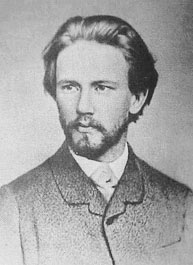
Peter Ilyich Tchaikovsky was born in 1840 in Votkinsk, a tiny town 1000 miles east of St Petersburg. There was no history of musicians in his family, except for a handful of amateur players.
He formed a very close bond with his French governess, Fanny Durbach. Those early years with his family in a small rural town were some of the happiest in his life.
Even at a young age, he was extremely sensitive to criticism. He also suffered from all kinds of illnesses. Once he had to take six months off school because of a sickness.
His illnesses, anxiety, and sensitivity were problems which would sadly affect him on and off for the rest of his life.
His father, noticing his son’s enthusiasm for music, got him good teachers, and an orchestrion (a kind of music box that imitates elaborate orchestral sounds). Tchaikovsky fell in love with Mozart (click for biography)’s music by listening to the orchestrion. The fascinating music box was probably Tchaikovky’s first musical mentor!
His father didn’t want his son having a career as a musician, however, since it wasn’t quite proper. So he sent Peter Ilich to train as a civil servant in the School of Jurisprudence.
On his first day of school, his mother dropped the terrified young Tchaikovsky off. He screamed and ran after her carriage as it drove away, but he couldn’t catch it. He didn’t see her again for two years. The event deeply marked the young boy, and altered his character towards the melancholy man he was in later life.
His mother died of cholera in 1854. Tchaikovsky was wretched and devastated. He was moved to write down one of his pieces for the first time (before, he just improvised) as a touching eulogy for his dead mother.
He graduated school, and entered the Ministry of Justice in 1959. But he resigned from the drudgery four years later, to start a musical career.
It was just as well: he found the work tedious and dull. Later, when someone asked him what he had actually done there, Tchaikovsky said he couldn’t even remember!

Pyotr Ilyich started studying at the St Petersburg conservatory, where he had two main teachers: Nikolai Zaremba, and Anton Rubinstein.
Rubinstein was quite conservative, and got really angry at one of Tchaikovsky’s homework exercises (the symphonic poem The Storm). It had a relatively modern sound and structure, which the grumbling teacher didn’t like the look of.
Tchaikovsky successfully graduated from St Petersburg, and moved to Moscow in January 1866. He began teaching music theory at the brand new Moscow Conservatory, which needed fresh talent.
Over the years he gradually settled into a comfortable life in Moscow, and his fame and popularity grew steadily. This leads me on to the next part of this Tchaikovsky biography.
Tchaikovsky Biography Part 2: Growing Reputation
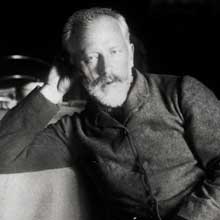
In 1870, Tchaikovsky’s Romeo and Juliet was premiered. This was the beginning of Tchaikovksy’s wider fame. The piece was characteristically «Tchaikovsky», and got the composer’s name known in in places as far away as New York and London.
He stayed at the Moscow Conservatory for 12 years in total, composing a good number of pieces.
He also became a music critic to earn more money. Some of his reviews have quite creatively scathing remarks!
Prince Odoevsky, a generous patron, once gave Tchaikovsky a pair of fine cymbals, since he thought that the composer was «good at introducing them at the right moment» in a piece. What an interesting gift!
He married one of his former students at one point, out of a feeling of obligation. But Tchaikovsky, famously, was actually homosexual. The marriage completely failed after a few months, with Tchaikovsky unable to return his wife’s affection.
He was severely distraught, and tried to drown himself in an icy river.
In 1877, he began a strange relationship with Nadezhda von Meck, the widow of a rich railway magnate. She was a big fan of his, and supported him financially. They communicated entirely through sending letters to each other though, and only met once (where they were too embarrassed to say anything to each other).
Von Meck was a dear friend, and Tchaikovsky was extremely upset when she suddenly stopped sending letters and money in 1891.
So, with his new freedom, Tchaikovsky finally resigned from the Moscow Conservatory in 1878 and traveled around Europe and Russia. He lived alone, in rural areas, and moved frequently. He was almost like a social exile.
His isolated lifestyle suited him very well. He could think and compose in tranquility, and didn’t have to be around irritating distractions like traffic and other people.
Tchaikovsky Biography Part 3
The Tsar eventually gave Tchaikovsky a life pension and the Order of St. Vladimir, and personally requested a performance of the composer’s opera Eugene Onegin. At this point, Tchaikovsky became extremely popular with the public.
He now started to feel more comfortable in society. In 1885 he stopped traveling and went back to live in Russia, in a manor house between Moscow and St Petersburg.
He became a celebrity in Russia, and promoted Russian music. All his life he was enthusiastically proud of being Russian. He hated it when anyone suggested that he might have Polish ancestors.
Once, as a boy, he was looking at a map of Europe. Suddenly, he covered Russia with kisses, and then spat on all the other countries!
He also received some influential musical positions at this late stage of life, such as director of the Moscow branch of the Russian Musical Society.
Once, when he held this position, a percussionist wasn’t playing very well during a rehearsal of Rimsky-Korsakov’s Capriccio Espagnol (conducted by the composer). So Tchaikovsky himself offered to play the castanets!
I would have liked to have seen that performance. It wasn’t to be, however, as the orchestra was suddenly shocked into obedience by Tchaikovsky’s suggestion.
In 1889, he toured around Germany and Switzerland as a conductor. On this trip he met the composers Johannes Brahms and Edvard Grieg. He didn’t like Brahms’s music, but thought that Grieg’s was superb.
Peter Ilich Tchaikovsky died of cholera on November 6, 1893, a few days after drinking unboiled water. His powerful 6th Symphony had its premiere only 10 days earlier.
The Tsar paid for his funeral personally.
Tchaikovsky biography timeline
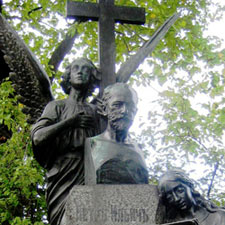
Why not explore Tchaikovsky’s famous music now that you’ve read about the great composer’s life?
Pyotr Ilyich Tchaikovsky Biography
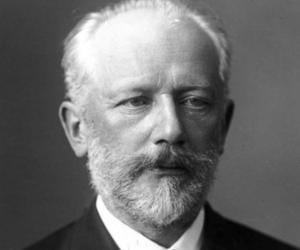
Born in: Votkinsk, Russia
Famous as: Composer
Spouse/Ex-: Antonina Miliukova (m. 1877–1877)
father: Alexandra Andreyevna d’Assier
mother: Ilya Petrovich Tchaikovsky
siblings: Aleksandra Ilinichna Tchaikovskaia, Anatoly Ilyich Tchaikovsky, Ippolit Tchaikovsky, Modest Ilyich Tchaikovsky, Nikolai Ilyich Tchaikovsky, Zinaida Ilinichna Tchaikovskaia
children: Vladimir Davydov
place of death: Saint Petersburg, Russia
education: School of Jurisprudence
Recommended For You
Who was Pyotr Ilyich Tchaikovsky?
Pyotr Ilyich Tchaikovsky was a distinguished Russian composer who scripted many symphonies, concertos, operas, ballets, and chamber music, which became an esteemed part of the classical library. At the educational front, Tchaikovsky was educated for a career as a civil servant due to uncertainly in the field of music in those Russian days. However, when opportunity knocked, he didn’t take time to enter the blossoming Saint Petersburg Conservatory, from where he graduated in 1865. Though audiences welcomed his music wholeheartedly, his critics declined it stating that his music was not in accordance with the existing western style. He went through severe personal catastrophes such as the untimely death of his mother and the crumpling of his marriage within two and a half months and his 13-year link up with a wealthy widow. And not to conceal, his same-sex orientation, which was traditionally considered as a disgrace, influenced him to craft intense and deep emotional music. Despite of all these, Tchaikovsky was honored by Tsar Alexander III in 1884, and also granted a lifetime pension in the late 1880s.
Чайковский краткая биография на английском
Чайковский краткая биография на английском языке изложена в этой статье.
Краткая биография Чайковского на английском языке
Peter Tchaikovsky was born in 1840. He started learning piano when he was 5 years old, and got good quickly.
His parents supported his musical talent at first, but then sent him to be a civil servant (a bit silly, don’t you think?!).
His mother died when he was 14. This tragedy deeply affected the young composer for the rest of his life.
His mother’s death was the inspiration for his composing — he wrote his first piece (a waltz for piano) in her memory.
He went on to study law and had a short career as a civil servant. But he hated it, so switched to studying at the St Petersburg Conservatory instead.
After graduating, he became professor of music theory at the new Moscow Conservatory. He kept on composing during his professorship, and his reputation as a composer grew.
Other Russian musicians and composers shunned Tchaikovsky for a long time at the start of his career. They considered him a bit of an untrustworthy renegade since his music had a very western sound, and was more personally emotional than usual.
The Tsar noticed him eventually, gave him the Imperial stamp of approval and a lifetime pension, and suddenly Tchaikovsky was accepted in Russia.
He became even more famous, and traveled to other countries in Europe and the United States to conduct his own music. But although he was hugely successful, he was still under the black cloud of depression.
His sixth and last symphony (called the Pathétique) was premiered only ten days before the composer died (he died on November 6 1893).
The audience was silent with amazement during the first performance.
Peter Tchaikovsky
Almost everybody knows «The Nutcracker Suite» with its «Dance of the Sugar Plum Fairy» and «Waltz of the Flowers» «The Nutcracker Suite» was written as a ballet, but many more people have heard the music than have seen the ballet. Some of Tchaikovsky’s other compositions are well-known too. Among them are the «Swan Lake» and «Sleeping Beauty» (ballets), the «Romeo and Juliet» (overture), the «Eugene Onegin», «Mazzeppa» «Iolanta» «The Queen of Spades» (operas) and the Symphony N 6; called the «Pathetic».
Many of Tchaikovsky’s writings are very tuneful. Several popular songs have tunes borrowed from them.
Tchaikovsky was born in a small town in the Ural mountains. His father was a mining engineer. As a boy Tchaikovsky loved music, but he did not think of giving his life to it. He planned to be a lawyer. When he was old enough, he began to study law.
But at 21 he decided that music was much more interesting and entered the conservatory at St. Petersburg. After he graduated five years later, he was made a professor in Moscow Conservatory. Along with his teaching, he wrote a great deal of music.
His compositions are so popular now that it is hard to believe that at first they were not at all popular. But for ten years all his operas were failures and no one paid much attention to anything else he wrote.
As a result of his unhappiness and lack of success, he became ill and had to give up his teaching.
At last his music won the praise it deserved. Tchaikovsky was only 53 when he died, but he lived long enough to know that his music was being played far and wide over the world.
Петр Ильич Чайковский
Наверное, нет человека, который не знал бы «Щелкунчика» с «Танцем феи Драже» и «Вальсом цветов». «Щелкунчик» был написан как балет, однако гораздо больше людей слышали музыку, но не видели балет. Известные сочинения Чайковского — это балеты «Лебединое озеро» и «Спящая красавица», увертюра «Ромео и Джульетта», онеры «Евгений Онегин», «Мазепа», «Иоланта», «Пиковая дама», шестая симфония — «Патетическая».
Музыка Чайковского очень мелодична. Мелодии некоторых популярных песен заимствованы из нее.
Чайковский родился в маленьком городке на Урале. Его отец был горным инженером. В детстве Чайковский любил музыку, но не собирался посвящать ей всю свою жизнь. Он хотел стать юристом. Когда он вырос, он стал изучать право.
Но в 21 год он решил, что музыка намного интереснее права и поступил в консерваторию в Санкт-Петербурге. Через пять лет после окончания консерватории он стал профессором Московской консерватории. Чайковский преподавал и писал много музыки.
Его сочинения так популярны сегодня, что трудно поверить в то, что сначала они совсем не пользовались успехом. Но в течение целых десяти лет постановка всех его опер заканчивалась провалом, и никто не обращал внимания на его музыку.
Из-за творческих неудач композитор заболел и был вынужден отказаться от преподавательской деятельности.
Конечно, музыка Чайковского уже оценена по достоинству. Чайковскому было всего 53 года, когда он умер, но он дожил до того времени, когда его музыку стали исполнять во всем мире.